 Nominated for the EMYA2026 award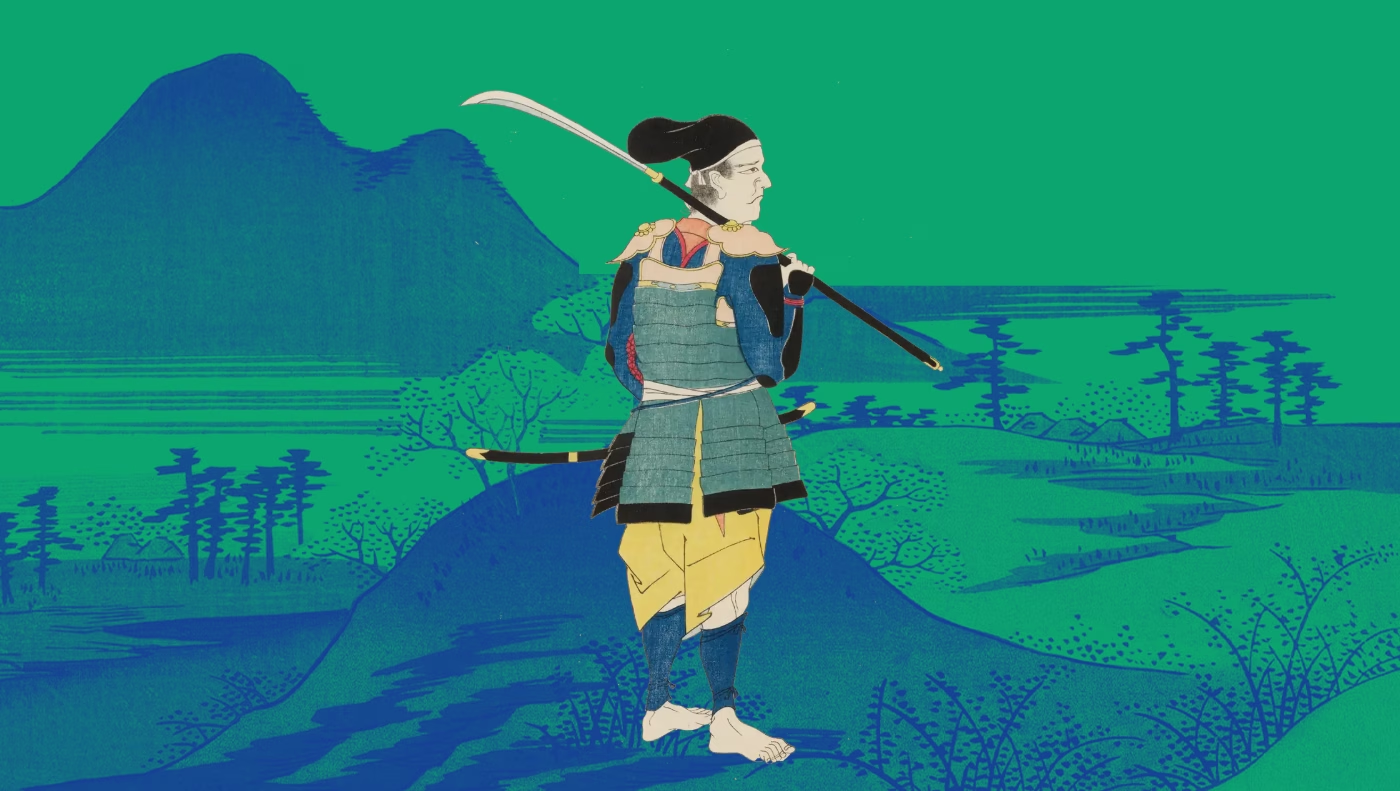
In the spring of 1184, a woman warrior defends the mountain fortress at Tonami-yama. She wears armour and holds a naginata in her hand — the curved blade on a long shaft that killed more warriors on the battlefields of the Heian period than any sword. The scene comes from the Heike Monogatari. Centuries later, the naginata still stands for a warrior culture in which leverage triumphed over muscle power.
The naginata (薙刀) is a Japanese polearm with a curved blade that was used on Japan’s battlefields between the 10th and 16th centuries. Alongside the bow, it was regarded as the preferred weapon in the Kamakura and Muromachi periods — even ahead of the sword. Its name derives from the verb nagu, which means „to mow down”.
At the Samurai Museum Berlin, visitors can study three original Edo-period naginata — testimonies to a weapon that evolved from an anti-cavalry instrument into an artful status symbol.
Construction and Variants of a Battlefield Weapon
A naginata consists of three main components. The blade (ha) is single-edged and curved, with historical blade lengths between 30 and 60 cm. The shaft (ebu) is made of hard wood — often red oak or white oak — with an oval cross-section, 120 to 180 cm long. Metal rings (semegane) reinforce the shaft. At the lower end sits the end piece (ishizuki), a metal cap serving as a counterweight and blunt striking weapon.

The blades can be divided into two basic forms, both named after historical female figures of the 12th century: The tomoe gata widens toward the tip, the curvature increasing — named after the legendary warrior Tomoe Gozen. The shizuka gata shows a narrower, straighter blade profile — named after Shizuka Gozen, the lover of Minamoto no Yoshitsune.
The Ō-Naginata with blades of 50 to 70 cm was the battlefield version for mounted fighters. The Ko-Naginata with a shorter blade was more agile and suited to interior spaces. The Nagamaki — a hybrid weapon — had a grip that was often longer than the blade itself.
Tactical Use: Reach Against Cavalry
Japanese battlefield tactics were based on reach: bow (over 200 m), arquebus (over 100 m), yari spear (4–6 m), naginata (2–3 m), katana (under 1 m). The naginata lay between spear and sword — useless against archers, at a disadvantage against spearmen, but fully effective against mounted opponents.
Thomas Conlan’s statistical analysis of 1,302 wound reports from the 14th century shows: 72 percent of the documented wounds came from arrows, around 20 percent from swords, only a small fraction from polearms. The bow remained the dominant weapon.
The naginata used the movement of the attacking horse against the rider. The fighter waited until the attacker was close enough, then swung the blade horizontally at the height of the horse’s legs. A cut through the tendon of the foreleg — and the animal fell. In the Heian and Kamakura periods, naginata fighters stood in the second rank, behind archers, as a barrier against charging cavalry.
Why the Naginata Was Regarded as a Woman’s Weapon
The answer is pragmatic, not romantic. The naginata used leverage instead of raw muscle power. The long reach of over two metres made it possible to keep opponents at a distance. The curved edge made drawing cuts possible — less effort than a direct blow with the sword. In enclosed spaces — castles, villas, corridors — it was especially effective: the hallways were too narrow for long spears, too low for large sword strokes.
From the Edo period (1615–1868) onward, the naginata was increasingly regarded as the traditional weapon of women. The wives of the samurai trained preferentially with it — a tradition that is directly reflected in today’s martial art Naginata-dō.
The „Warrior Monks”: Myth and Reality
The popular image of bald-headed Buddhist monks with naginata — the Sōhei (僧兵, „warrior monks”) — is painted radically differently by academic research. The historian of religion Mikael Adolphson demonstrated that the term Sōhei does not appear in a single contemporary source of the Heian or Kamakura period. The term was not invented until the Edo period. The armed forces of the great monasteries consisted of secular servants, hired mercenaries, and lower clerics — no homogeneous army of fighting priests.
Three Naginata at the Samurai Museum Berlin
Naginata with blossom lozenges (signed Munenaga saku): A narrow, sword-like blade with a slight curvature. The black-lacquered shaft is decorated with gold-powder technique (maki-e): hexagonal geometric blossom-lozenge patterns over the entire length of the shaft. As an Edo-period piece, this naginata illustrates the transition from a combat weapon to a status symbol.
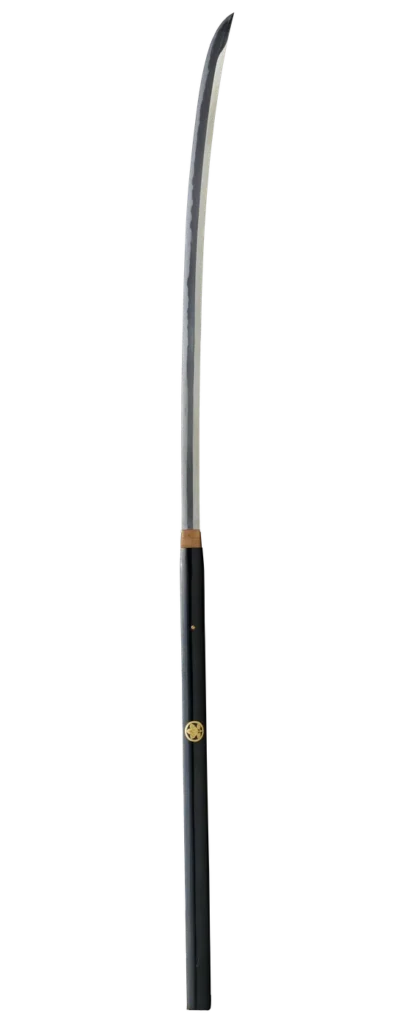
Naginata Fujiwara Korekazu (signed, identified as Unju Korekazu, 1820–1892): The blade, together with the tang, measures about 85 cm and shows the characteristic tomoe gata — widening toward the tip, the curvature increasing. Floral decorations — chrysanthemum and mallow blossom (aoi) — adorn the fittings.
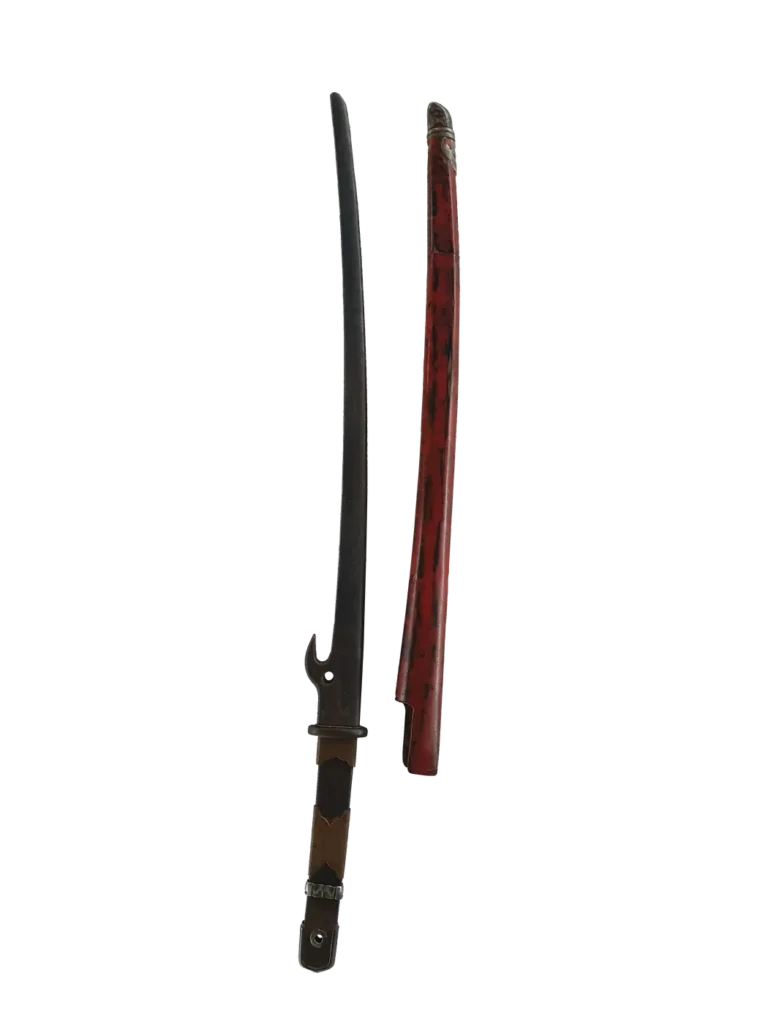
Naginata Kikyō illustrates a revealing practice: since the blade structure of the naginata resembles that of the sword, some blades were removed from the shaft and mounted on a sword grip — naginata naoshi. In Japan a proverb arose for this: Naginata naoshi ni dontō nashi — „No blade reworked from a naginata was ever dull.”
Five Myths About the Naginata
Myth 1: „The naginata was a purely female weapon.” In the Heian and Kamakura periods it was a standard infantry weapon for men. Only in the Edo period was it increasingly regarded as the preferred weapon of samurai women.
Myth 2: „The Sōhei were ordained monks with naginata.” Largely an Edo-period invention. The armed temple forces consisted of secular servants and mercenaries.
Myth 3: „The naginata was militarily superior to the sword.” It was a specialist weapon — effective against cavalry, at equal reach inferior to the yari spear.
Myth 4: „The naginata could cut a horse in two.” No direct severing — but the tendons of the forelegs were the target. Conlan’s analysis confirms the practice.
Myth 5: „Naginata-dō is the unchanged historical martial art.” Modern naginata-dō was standardized in 1955. The historical koryū tradition survives in schools such as Tendō-ryū and Toda-ha Bukō-ryū.
Frequently Asked Questions
What is a naginata?
The naginata (薙刀) is a Japanese polearm with a curved, single-edged blade on a long wooden shaft. Blade length 30–60 cm, total length 180–250 cm. It was used on Japanese battlefields between the 10th and 16th centuries.
What is the difference between naginata and nagamaki?
The nagamaki is a hybrid form with a grip that is often just as long as or longer than the blade. It is wielded like a two-handed sword — more powerful, but less versatile than the classic naginata.
Is there still naginata martial art today?
Yes. Naginatajutsu (historical combat naginata) and Naginata-dō (modern way of the naginata) continue to be practised. The modern form was standardized in 1955. The historical form survives in schools such as Tendō-ryū, Toda-ha Bukō-ryū, and Suiō-ryū.
Visit the Samurai Museum Berlin
The Samurai Museum Berlin shows three historical naginata of the Edo period — among them a piece with artful blossom-lozenge decorations, a signed naginata by the smith Fujiwara Korekazu, and an example of the naginata naoshi reworking. Open daily from 10 a.m. to 7 p.m., Auguststraße 68, Berlin-Mitte.
Related Articles
- Onna-Bugeisha: The Women Warriors of Feudal Japan
- The Katana: History, Forging Technique & 5 Myths Debunked
- Yari: The Spear of the Samurai
Sources
- Samurai Museum Berlin (2025): SMB Catalogue 2025.
- Friday, Karl F. (2004): Samurai, Warfare and the State in Early Medieval Japan. Routledge.
- Conlan, Thomas D. (2003): State of War. University of Michigan Press.
- Adolphson, Mikael S. (2007): The Teeth and Claws of the Buddha. University of Hawai’i Press.
© Samurai Museum Berlin – All rights reserved
You might also like
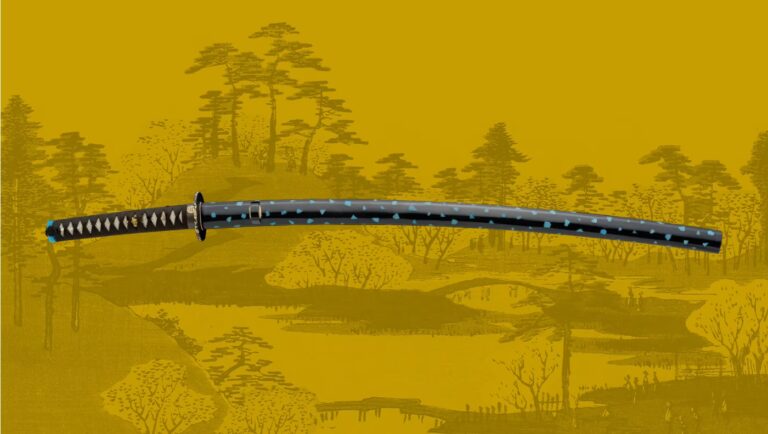
The Katana: History, Forging Technique & 5 Myths Debunked
The Katana: History, Forging Technique & 5 Myths Debunked. What is really true about the most famous sword in the…
Read the article
Ō-Yoroi: The Great Armour of the Heian Samurai
Ō-Yoroi – the great armour of the Heian samurai. Not decoration, but a machine for the mounted archer. History &…
Read the article
Dō — The Cuirass of the Samurai: History & Development
The dō – the heart of every samurai armour. From Heian lamellae to the bulletproof Sengoku cuirass: history, types &…
Read the article