 Nominated for the EMYA2026 award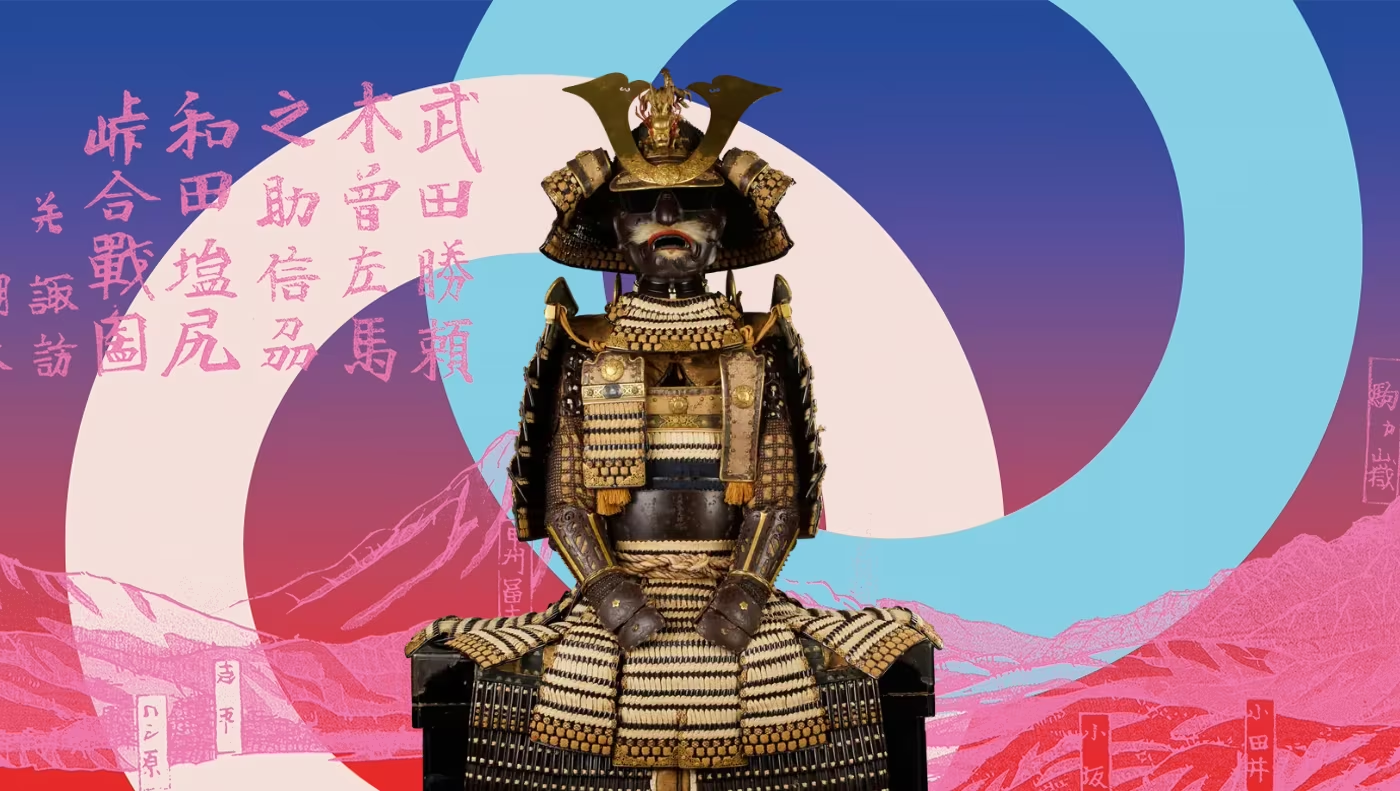
Introduction
13 April 1612, the island of Ganryūjima. Miyamoto Musashi arrives — hours too late. His opponent Sasaki Kojirō is waiting, sword already drawn. Musashi carries no katana. He has carved one from a boat oar. Wood against steel. As Kojirō attacks, Musashi strikes him down with a single blow — and rows away.
The world knows this samurai: cool, calculating, with a sword in hand. Seven centuries of Japanese history have honed this image. Yet it is wrong.
The sword in fact never served as the warriors’ primary weapon. For the early samurai were not swordsmen — they were mounted archers who drew the sword only when the bow failed. The code of honour we call Bushidō did not arise on battlefields, but in Edo-period offices, written by unemployed samurai who had not seen war in two generations. And the man who explained this code to the world — Inazō Nitobe, author of Bushidō: The Soul of Japan (1900) — was born after the samurai class had been abolished.
What remains when you strip away the myth? Seven centuries of one of the most fascinating processes of transformation in world history: frontier warriors become feudal lords, feudal lords become bureaucrats, bureaucrats become icons. Each generation reinvented the samurai — and each believed it knew the original version.
At the Samurai Museum Berlin, around 900 exhibits from the 11th to the 19th century tell of this change — swords from different eras, Tōsei Gusoku armours with bullet holes from the Sengoku era, Edo katanas that were never intended for fighting. Each piece a chapter. Together: the true history behind the myth.
The Birth of the Warrior Class (794–1185)
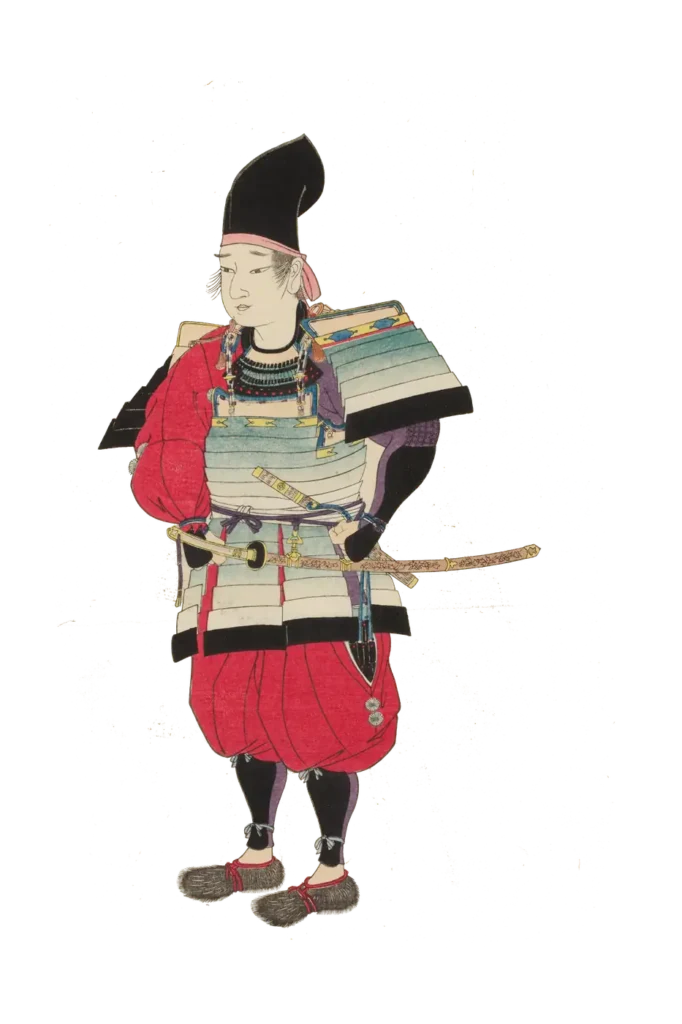
792 AD, north-eastern Japan. Sakanoue no Tamuramaro leads 10,000 warriors against the Emishi — the indigenous population that resisted subjugation by the imperial court in Kyōto. His archers ride, shoot, evade. Tactics they have adopted from their opponents.
They were frontier warriors, tax collectors and enforcers for local power-holders who secured land, enforced levies and put down rebellions. The British Japanologist and non-fiction author Jonathan Clements describes them soberly as “men who learned from their opponents”: culturally Japanese, militarily pragmatic. The image of the noble knight with the sacred sword? It comes only 600 years later.
The weapon of these early warriors was the bow, not the sword. The tachi, the first curved Japanese sword of this era, was worn suspended — blade downwards, optimised for quick access from horseback. Its role: a close-combat last resort when the bow failed. They were also used to carry out a first attack from horseback.
Genpei War (1180–1185)
While the imperial court in Kyōto, Japan’s old cultural and political heart, lingered in ceremonial powerlessness, two warrior families rose to become the true power-holders: the Taira and the Minamoto. Both descended from deposed imperial lines — princes who had been sent to the provinces to remove them from the line of succession. What began as political banishment became a power base.
25 March 1185, the bay of Dan-no-Ura. The Taira fleet encircles the Minamoto ships. Then the current turns. The Minamoto warriors board, ship by ship. Emperor Antoku, five years old, is thrown into the sea by his grandmother, who then plunges into the waves herself — together with the sacred sword Kusanagi, symbol of imperial legitimacy. Taira rule ends in the water.
The Heike Monogatari (平家物語), written down later, describes this moment with epic tragedy. In the eleventh book it reads:
“The widow Nii-no-Ama took the emperor into her arms. ‘At the bottom of the sea is our capital,’ she said to the child. She leapt into the waves, and with her the sun sank.”
The historical reality was more prosaic. The American military historian Karl Friday describes the early samurai not as loyal vassals of an honourable code, but as paid specialists in violence — hired swords — who offered their services to the highest bidder. The Genpei War was not a duel between honour and betrayal. It was a struggle over the distribution of land, taxes and political influence.
Minamoto no Yoritomo (1147–1199), the victor, built his power on networks of vassals, not on swordsmanship. In 1192 the emperor appointed him Shōgun — “general for the subjugation of the barbarians”, as the title was called in the 7th/8th century. The first shogunate arose in Kamakura, far from the imperial court. The samurai were no longer servants. They were the rulers.
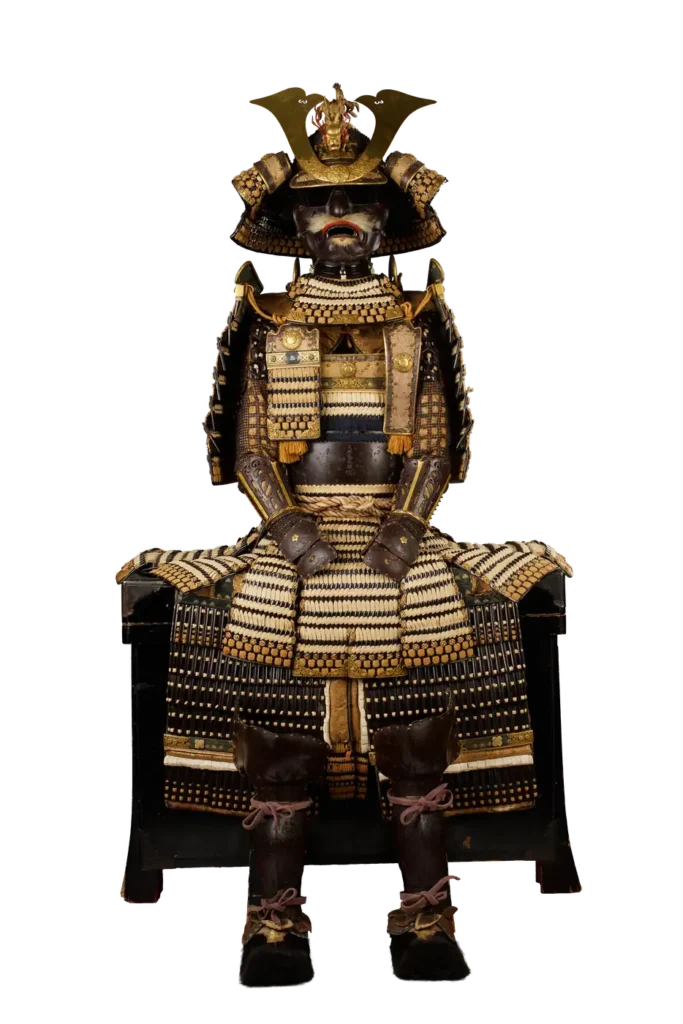
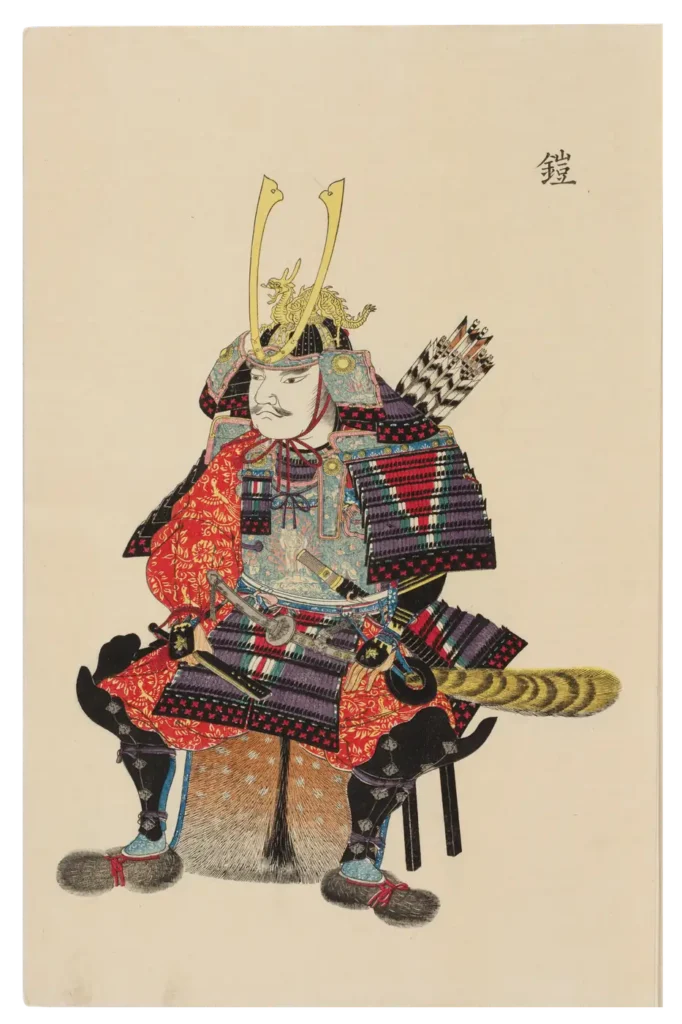
The replica of a 19th-century Ō-Yoroi armour at the Samurai Museum Berlin documents this era. Its asymmetrical construction — the right shoulder more heavily armoured than the left — reveals its function: protection while shooting the bow from horseback. Ian Bottomley, former curator of the Royal Armouries Leeds, describes the development in the museum’s catalogue:
“The tachi developed from the straight swords (chokutō) of the Nara period. The characteristic curvature arose not for aesthetic reasons, but for functional ones: a curved sword cuts more effectively in the slashing blow from horseback. Yet even in the Heian and Kamakura periods, the sword remained a secondary weapon. The bow dominated.”
The Hoshi Kabuto: War Helmet and Vessel of the Gods
The Hoshi Kabuto (星兜, “star helmet”) of the Kamakura period illustrates this functional aesthetic. The museum possesses a rare helmet bowl with 23 iron plates joined by nine rivets per plate. The prominent rivet heads protrude in star shapes — hence the name. This construction lent the helmet considerable strength at minimal weight.
At the apex there is a hole (tehen no ana), surrounded by a decorative rim in chrysanthemum form. Originally the surplus material of the eboshi — the tall black-lacquered cap worn by officials of the imperial court, which served as helmet lining — was drawn through this hole. Later a religious belief developed: the tehen no ana allowed the war god Hachiman to take possession of the warrior’s body and to guide him during battle. Even in combat one needed protection from above.
One detail reveals the Kamakura mentality: on the front plate three gilded, arrow-shaped strips (shinodare) are attached, on the back plate a hat-banner ring (kasa jirushi no kan) — originally for carrying a small identification banner. Even in the densest turmoil of battle: status symbols.
- Clements, Jonathan (2017): A Brief History of Japan, ch. 2
- Friday, Karl F. (2004): Samurai, Warfare and the State in Early Medieval Japan, pp. 45–89
- Heike Monogatari (ca. 1330): Book 11
- Bottomley, Ian (2025): “History of Japanese Arms and Armour”, Main Catalogue pp. 12–15
- Lesniewska, Martyna (2024): Catalogue C03V_9
- Varley, H. Paul (1994): Warriors of Japan as Portrayed in the War Tales, pp. 120–145
- Shively & McCullough (eds.) (1999): Cambridge History of Japan, Volume 2: Heian Japan, ch. 9
Kamakura Shogunate and the Mongol Invasion (1185–1333)
Minamoto no Yoritomo, victor of the Genpei War and first Shōgun of Japan, built his apparatus of power not in Kyōto — the seat of the imperial court, which he never wanted to lose sight of as an adversary — but in remote Kamakura. The emperor remained on his throne, a figurehead without real power. The new shogunate bureaucracy administered the land, levied taxes, dispensed justice. Samurai now received lands (chigyō, 知行) in return for loyalty — no longer a mercenary contract. From this a feudal system emerged.
For eighty years this order held. Then came Kublai Khan.
The Mongol Storm-Surge (1274 & 1281)
In November 1274, 30,000 Mongol-Korean and Chinese warriors landed in Hakata Bay on Kyūshū.
The Mongols attacked in formation, coordinated by drum signals. Explosive incendiary bombs (teppō, 鉄砲) struck among the samurai horses. The animals shied, threw off their riders, fled. What the samurai had expected as individual combatants was a machine.
The samurai Takezaki Suenaga recorded this encounter in an illustrated picture scroll — the Mōko Shūrai Ekotoba (蒙古襲来絵詞, 1293). It shows him himself, desperately pulling a Mongol soldier from his horse: not an honourable duel, but chaotic close combat. Yet the picture scroll was more than a chronicle — it was Suenaga’s personal petition. After the battle he had to travel to Kamakura and testify to his heroic deeds with his own voice, because no one believed that a simple warrior had fought in this way. The Ekotoba was his visual proof.
In 1281 the Mongols returned — this time with 140,000 warriors. Stone walls along the coast, guerrilla tactics, night battles: the samurai had learned. The decision, nonetheless, was brought by no sword — a typhoon ended the war. The kamikaze (神風, “divine wind”) destroyed the Mongol fleet. Japan interpreted this as divine protection — an interpretation that, 660 years later, would send thousands of young pilots to their deaths.
Zen Buddhism and Kamakura Culture
In 1191 the monk Eisai brought the Chan teaching from China to Japan — and with it a practice that immediately attracted samurai: meditation as a method of taming fear. Zen emphasised direct experience over theoretical knowledge, discipline over ritual, the present moment over promises of the hereafter. For men who fought between life and death, this was a craft — not a luxury.
Friday urges caution: most samurai of the Middle Ages were pragmatic landholders, not philosophical warriors. Zen monasteries were patronised by the elite — as an instrument of power, not out of spiritual conviction. The Hōjō clan, which controlled the Kamakura shogunate after Yoritomo’s death, financed Zen temples in order to create a cultural alternative to the imperial court in Kyōto. Philosophy and politics lay close together.
- Bottomley, Ian (2021): “History of Japanese Arms and Armour”. In: Armours of the Samurai
- Samurai Museum Berlin: Catalogue JC-A-018 (Ō-Yoroi, Kamakura period)
- Mōko Shūrai Ekotoba (Takezaki Suenaga, 1293): primary source
- Friday, Karl F. (2004): Samurai, Warfare and the State in Early Medieval Japan, pp. 45–89
- Shively & McCullough (eds.) (1999): Cambridge History of Japan, Volume 2, ch. 9
Sengoku Jidai: The Century of Wars (1467–1603)
In 1467 Kyōto burned. The Ōnin War, a succession dispute among rival clans, turned the capital into ash — and with it the last illusion of central rule. What followed were 130 years in which Japan tore itself apart.
A principle of this era was called gekokujō (下克上, “the low overcome the high”): servants overthrew lords, peasants became generals. Toyotomi Hideyoshi, the later unifier of Japan, began as a foot soldier without a surname — in a society in which the surname decided over life and death. The Sengoku period devoured its own order from within.
The Tanegashima Revolution
Until 1543, Japan had kept the world at a distance — the Mongols from the north, the Chinese imperial court through diplomatic distance, the sea as a natural defensive rampart. Then two Portuguese traders landed on the small island of Tanegashima, and with them something Japan had never seen before: muskets.
The daimyō Tanegashima Tokitaka bought two specimens at once — at a price described in later chronicles as astronomical. He ordered his smiths to take the weapons apart and understand them. What the Portuguese had not reckoned with: Japanese swordsmiths were among the best metalworkers in the world. Within months they produced working copies. Within fifty years, Japanese weaponsmiths made more muskets than any European country.
Why did the Portuguese not simply subjugate Japan with their technical advantage? They came as traders — silver, silk and spices interested them more than territory. Japan, moreover, was no passive target: 130 years of civil war had produced a warrior class that would fight foreigners with firearms just as it fought foreigners without them. And the muskets themselves were anything but invincible — inaccurate beyond thirty metres, slow to reload, useless in the rain. Their true strength lay in the commander who deployed them.
Oda Nobunaga was that commander. In 1575, in the valley of Nagashino: his 3,000 musketeers fired in three rotating ranks — volley after volley, without pause. The mounted warriors of the Takeda clan charged into the fire. They fell, rank by rank, before they reached the enemy line. Nobunaga had eliminated the weakness of the musket — the long reloading time — through sheer rotation.
The changed warfare also forced the armour smithies to respond. The Okegawa dō (桶側胴, “barrel cuirass”) arose as a direct reaction to the new threat from firearms. The museum possesses a typical specimen with a two-part cuirass whose horizontal plates show a wave-like course — tsure yamamichi (“connected mountain path”). On the upper plates, dragons are worked in as silver inlays. One detail reveals the warrior’s everyday life: the armour sleeves have, on both forearms, a flip-open element in the form of a bottle gourd (fukube) — a small container for field medicine. Even in the age of firearms, close combat remained deadly.
While the armours became more compact, the helmets grew into the absurd. The kawari kabuto (変わり兜, “unconventional helmets”) bore monumental crests (maedate, 前立): half-moons, dragon horns, buffalo antlers, stylised rabbits. Martyna Lesniewska, former chief curator of the Samurai Museum Berlin, explains the function of these seeming absurdities:
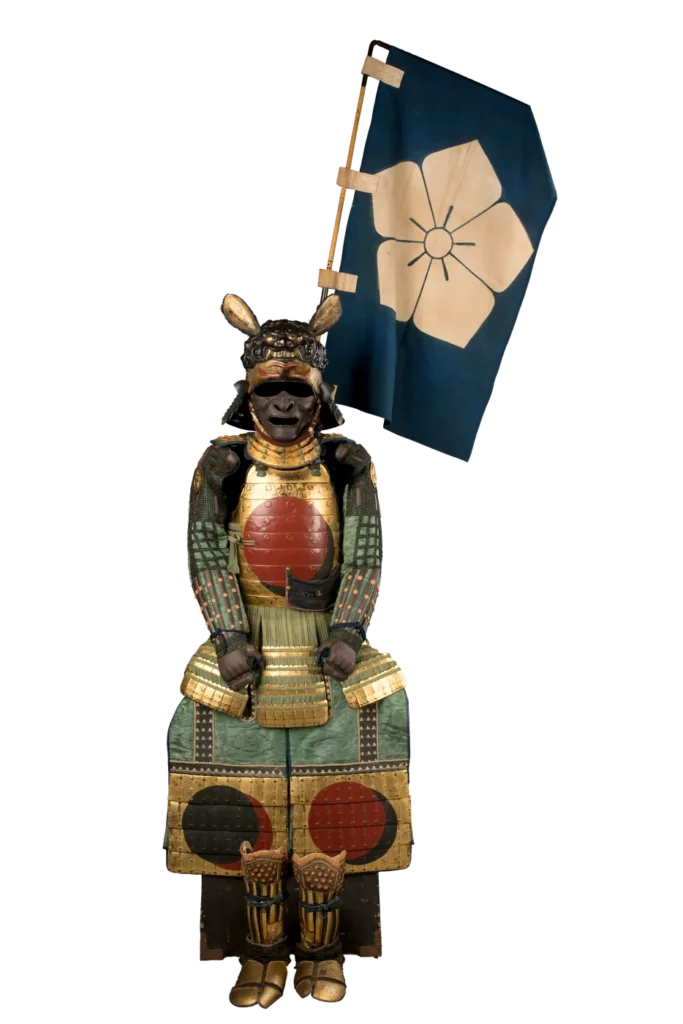
“Kawari kabuto were not vanity, but psychological warfare. On a battlefield with thousands of warriors, generals had to be instantly recognisable — for their own troops as a point of orientation, for enemies as a target or deterrent. Date Masamune, the ‘One-Eyed Dragon’, wore a black helmet with a crescent-shaped moon-horn crest. Even in the densest turmoil of battle: unmistakable.”
The helmets also document hierarchies. Simple foot soldiers (ashigaru, 足軽) wore plain straw hats or iron caps. Middle-ranking samurai: standardised suji kabuto with vertical ribs. Only daimyō and their elite warriors: the spectacular kawari kabuto. The helmet (Momoyama period, late 16th c.) shows this transformation — a golden crescent, 45 cm high, visible at 200 metres. Lesniewska comments drily: “This helmet said: ‘I am rich enough to be impractical.'”
Sekigahara (1600) — The Decisive Battle
21 October 1600, the valley of Sekigahara. Tokugawa Ieyasu stood in the morning mist and watched as 160,000 warriors formed up — the largest battle in Japanese history. His opponent: Ishida Mitsunari, loyalist of the deceased Hideyoshi. They fought for six hours. The decision came not through military brilliance but through betrayal — Kobayakawa Hideaki, nominally on Mitsunari’s side, switched sides in the middle of the battle.
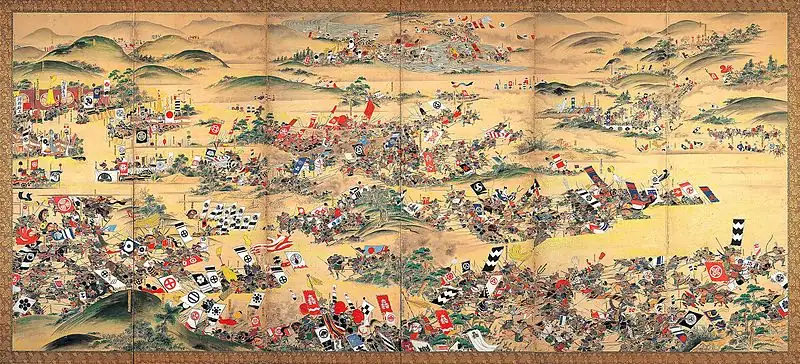
40,000 dead. Tokugawa Ieyasu, the patient strategist among Japan’s three unifiers, had won. In 1603 the emperor appointed him Shōgun — and thereby founded a dynasty that would last 265 years. The longest period of peace in Japan’s history. And the end of the samurai as warriors.
- Lesniewska, Martyna (2024): “Kawari Kabuto: Unconventional Helmets of the Sengoku Period”. In: Helmets of the Samurai
- Lesniewska, Martyna (2024): Catalogue JC-H-042 (Kawari Kabuto, Momoyama period)
- Samurai Museum Berlin: Catalogue E05V_44 (Okegawa Dō, Sengoku period)
- Turnbull, Stephen (1996): The Samurai: A Military History, pp. 145–178
- Yamamura, Kōzō (ed.) (1990): Cambridge History of Japan, Volume 3: Medieval Japan, ch. 6–7
The Edo Period: From Warrior to Official (1603–1868)
Tokugawa Ieyasu had seen 40,000 dead in six hours — and made peace the only option. The sankin-kōtai system (参勤交代, “alternate residence”) forced every daimyō to spend every second year in Edo — his family remaining behind as hostages. Travel cost a fortune, rebellion was unaffordable. Japan sank into 250 years of enforced peace.
For the samurai this was a catastrophe without a battlefield. A warrior class that had nothing left to fight. 400,000 armed men whose only function — war — had simply ceased to exist. They became bureaucrats, teachers, administrative officials. The shogunate continued to pay their stipends (fuchi) — an enormous burden that hollowed out the system over generations.
The Sword as Status Symbol
In this void the sword took on a new meaning. The daishō — katana and wakizashi, long sword and short sword together — had since Hideyoshi’s “sword hunt” (1588) been the legally protected privilege of the samurai class. No peasant, no merchant, no craftsman was permitted to wear two swords. The daishō was no longer a tool of combat — it was a visible badge of social belonging. Turnbull describes it as the “soul in the political, not the military sense”: he who wore the sword belonged. He who did not wear it did not.
The Edo katana at the Samurai Museum Berlin makes this transformation tangible. Its tsuba — the sword guard — is of gilded iron with a cherry-blossom motif in high-relief technique (takabori, 高彫), with a presumed production time of over two hundred hours. The grip wrapping (tsukamaki) is woven so tightly that the grip would be slippery in combat — aesthetically perfect but restricted in its function. The blade itself is polished to a mirror gloss: combat blades were polished more matte to avoid reflections of light. This sword was made for contemplation, not for fighting. It was never drawn to kill anyone. It was drawn to be admired.
The Invention of Bushidō
Why did a systematic “code of honour” of the samurai arise of all times now — in an era without wars? The Oxford historian Oleg Benesch answered this question meticulously in Inventing the Way of the Samurai (2014). His answer is sobering: Bushidō was a response to crisis, not an ancient code.
The samurai were caught in an identity trap. For centuries, combat and warfare had justified their existence. Now the shogunate paid 400,000 warriors to do administrative work. Confucian scholars constructed a new answer: moral superiority, not fighting power, justified the samurai privileges. Texts such as the Bushidō Shoshinshū (武士道初心集) by Daidōji Yūzan codified this reinterpretation — a code of honour as a retrospective legitimation.
Yūzan’s text shows the Edo reality unvarnished:
“The samurai of today wears two swords, yet he has never learned to draw them. He speaks of loyalty, yet he knows no battlefield. When the lord dies, the samurai dies with him — that is the teaching. Yet when this happens, people say: ‘What a waste!’ The modern samurai is a contradiction.”
Yūzan described not what samurai were — but what they were supposed to be. Benesch documented these contradictions meticulously. The samurai scholar Yamamoto Tsunetomo wrote in the Hagakure (1716): “The way of the samurai is death.” His contemporary Yamaga Sokō, Confucian philosopher and one of the most influential thinkers of the Edo period, preached scholarship as the highest virtue. Daidōji Yūzan praised frugality. Three men, one era — three irreconcilable answers to the same question. The notion of a coherent Bushidō arose only when no one had to live by it any more.
Historicism: Old Helmets, New Splendour
The Edo daimyō collected not only art swords — they also restored ancient armours into status symbols. The museum possesses a Hoshi Kabuto whose helmet bowl dates from the 14th century (Nanboku-chō period, 1336–1392), but which was elaborately newly fitted out in the Edo period. The helmet crown shows gilded leaves of the Japanese holly (hiiragi) — a protective symbol against evil spirits.
The helmet bowl itself documents a development in military technology: as the style of combat shifted in the turbulent Kamakura period from cavalry to infantry, weaponsmiths experimented with lighter constructions. This specimen combines classic hoshi rivets with filed-down, countersunk rivets — a hybrid that saved weight without sacrificing robustness.
The magnificent crests — the gilded plates, the arrow-shaped strips, the chrysanthemum rim — were added 400 years later. Feudal lords wore such elaborately restored antique armours in their processions to Edo. The message was clear: “My family already fought in the Middle Ages.” A helmet from the 14th century, gilded in the 18th century.
Note: The Nihon Katchū Bugu Kenkyū Hozon Kai (NKBKHK) classifies this helmet as “Kōshū Tokubetsu Kichō Shiryō” — particularly valuable cultural property.
The 47 Rōnin: Loyalty as Theatre
In 1703, 47 masterless samurai (rōnin) demonstrated what Bushidō meant in practice — or was supposed to mean. Their lord Asano Naganori had insulted the court official Kira Yoshinaka and had been sentenced to seppuku. For two years the 47 waited, gathered money, won public sympathy, found political allies. Then they broke into Kira’s house and beheaded him. Afterwards they turned themselves in to the authorities.
The shogunate faced a dilemma: the rōnin had taken revenge — a samurai ideal. But broken the law. The solution: seppuku instead of execution, an honourable death instead of a criminal’s end. They became folk heroes at once. That same year, Kabuki theatres re-enacted the story.
Was it really loyalty? Two years of preparation, carefully calculated public sympathy, perfect timing — that was calculated political theatre. The story of the 47 Rōnin says less about samurai honour than about the need of an unemployed warrior class to justify its existence. Bushidō as a stage show — in a time when the stage was the only battlefield that still remained. This is at least one interpretation.
- Benesch, Oleg (2014): Inventing the Way of the Samurai, ch. 4–6
- Bushidō Shoshinshū (Daidōji Yūzan, 1716): original text
- Hagakure (Yamamoto Tsunetomo, ca. 1716)
- Bottomley, Ian (2025): Catalogue JC-S-127 (Edo katana)
- Lesniewska, Martyna (2024): Catalogue E04V_63 (Hoshi Kabuto, Edo historicism)
- Ikegami, Eiko (1995): The Taming of the Samurai, pp. 234–289
- Hall & McClain (eds.) (1991): Cambridge History of Japan, Volume 4, ch. 8
Meiji Restoration: The End of the Samurai (1868–1876)
In July 1853, four American steamships anchored in the bay of Edo. The Japanese called them kurofune — “Black Ships” — because they emitted coal smoke, something Japan had never seen before. Commodore Matthew Perry delivered a letter from US President Fillmore with the implicit demand for trade treaties, opened ports and diplomatic relations. Then he departed — and gave the shogunate a year to think it over.
The message was clear without being spoken. Japan had observed what had happened to China in 1842: the Qing Empire had resisted British trade demands — and lost the First Opium War against gunboats. Ports opened, territory ceded, sovereignty damaged. The shogunate knew what refusal meant.
In 1854 Perry returned — this time with seven ships. The Tokugawa shogunate, which had secured peace through isolation for 250 years, signed the Treaty of Kanagawa without resistance. The isolation was broken. Further treaties followed: with Great Britain, France, Russia, the Netherlands — the so-called “Unequal Treaties”, which deprived Japan of control over its own ports and tariffs. Foreigners enjoyed extraterritoriality on Japanese soil. The humiliation was complete.
In the country, things then began to seethe. The sonnō jōi movement — “Revere the Emperor, expel the barbarians” — gained support among radical samurai clans, above all from Satsuma and Chōshū. In their view the shogunate was too weak to defend Japan and had to be removed. In 1868 the overthrow followed. What was construed as a return to tradition was in truth a coup d’état to awaken the country — and the bitterest irony followed at once: in order to make Japan strong enough to resist the West, the new rulers copied precisely the West they had promised to expel.
The dimension of the abolition becomes graspable only through figures. In 1868 about 1.9 million people lived in the samurai class — around 6% of the population, including women and children. Within eight years this entire class was legally eliminated: in 1869 the daimyō had to return their fiefs, in 1871 the feudal domains were dissolved, in 1873 universal conscription deprived the samurai of their monopoly on arms, in 1876 the Haitōrei edict prohibited the public wearing of swords. Lifelong stipends were replaced by one-off government bonds — many samurai invested badly and fell into poverty. Others found new roles as officials, officers, entrepreneurs. The samurai class did not disappear — it transformed itself into the new Meiji elite.
Some resisted. Saigō Takamori, former hero of the Meiji Restoration, led the Satsuma Rebellion in 1877 — the last armed uprising of the samurai class. His 30,000 warriors fought with swords against an army of conscripts with modern rifles. It was not a battle. It was a massacre. Saigō committed seppuku on the battlefield. With him died the samurai era.
Yet the Meiji government, which had fought him, posthumously declared him a national hero. It needed the myth it had just destroyed. Loyalty, willingness to sacrifice, obedience — Bushidō became a state ideology for a modern army that knew no more samurai.
- Jansen, Marius B. (ed.) (1989): Cambridge History of Japan, Volume 5, pp. 567–601
- Benesch, Oleg (2014): Inventing the Way of the Samurai, ch. 6
- Ikegami, Eiko (1995): The Taming of the Samurai, pp. 334–389
- Ravina, Mark (2004): The Last Samurai: The Life and Battles of Saigō Takamori
The Legacy: From Warrior to Global Icon
Militarism and Bushidō (1900–1945)
Inazō Nitobe’s Bushidō: The Soul of Japan (1900), originally written in English for a Western audience, became required reading in Japan itself. Soldiers learned: death in the service of the emperor was the highest honour. The Hagakure quotation “The way of the samurai is death” — written by a man who had never fought, about warriors long since dead — now justified kamikaze attacks. An ideology that had arisen as cultural self-presentation became a death machine.
After 1945, the American occupation banished Bushidō as militaristic propaganda. The myth was too deeply rooted.
Hollywood and the Global Reception
Akira Kurosawa rehabilitated the image in 1954 with Seven Samurai: warriors as protectors of the weak, not as a ruling class. Hollywood copied the narrative — from The Magnificent Seven to Star Wars. In The Last Samurai (2003), an American officer finds “true honour” among Japanese warriors — a projection that Japanese historians criticised as absurd. The modern samurai myth is a Western construct: Zen meditation, katana fetishism, a code of honour without context. It says more about Western longings for discipline and tradition than about historical reality.
The Ambivalence of the Legacy
Japan itself has a divided relationship with the samurai. On the one hand: pride in the aesthetics, the craftsmanship, the discipline. On the other: unease about the violence, the hierarchy, the militaristic appropriation in the 20th century. In popular culture an aestheticised, depoliticised samurai dominates — manga, anime, video games show warriors without context, honour without history. Museums such as the Samurai Museum Berlin make possible a different engagement: beyond glorification and condemnation, close to the objects that have remained.
Conclusion: A Mirror of Japanese History
The samurai as a timeless embodiment of a fixed code of honour never existed. In every era he embodied what the power relations demanded — frontier warrior who learned from enemies; warlord who deployed firearms; bureaucrat who wore swords as works of art; myth that each generation reinterpreted. Each generation reinvented the samurai — and each believed it knew the original version.
What remains is not an answer in a code — only a question: How does violence become legend? How does a society transform its most brutal instruments into its most beautiful symbols? The samurai give no answer. But they show how it is done.
At the Samurai Museum Berlin, around 900 exhibits document this process. Each piece a chapter. Together: seven centuries of one of the most fascinating processes of transformation in world history.
The old samurai have been dead for 150 years. Their history is not.
Related Articles
- Bushidō: The Code of Honour of the Samurai
- The Katana: Technology, Symbolism and Myth
- Sengoku Jidai: The Century of Wars
- Seppuku: Ritual Suicide
Frequently Asked Questions (FAQ)
The samurai emerged in the late Heian period (794–1185). In the 12th century they established their political rule with the Kamakura shogunate (1192).
The word derives from the verb saburau (侍う), meaning “to serve” or “to attend upon someone”. Originally it denoted guards and bodyguards of the imperial court.
No. The notion of a uniform “code of honour” (Bushidō) is a retrospective projection from the Edo and Meiji periods. Historical samurai were pragmatic warriors who employed betrayal, side-switching and violence as strategic means. Friday describes them as hired swords — specialists in violence who offered their services.
The katana became a symbol of samurai identity only in the Edo period (1603–1868) — when samurai were no longer warriors. In the warlike centuries the bow was the main weapon. The “soul of the samurai” romanticism arose when swords became art objects.
At the height of the Edo period, the samurai class comprised about 1.9 million people (ca. 6% of the population), of whom around 400,000 were adult male warriors. From 1868 to 1876 the entire class was legally abolished.
Seppuku (切腹, “belly cut”), often also called harakiri, was ritual suicide. Originally a method of preserving honour after defeat, in the Edo period it became a legal punishment for samurai. The practice had more to do with status than with “honour” — only samurai were permitted to commit seppuku.
Samurai were the official warrior caste with legal status during the Edo period. Ninja (shinobi) were spies, saboteurs and assassins — often recruited from lower social strata. The dramatic distinction “honour vs. cunning” is fiction; many daimyō employed ninja for secret operations.
The Meiji Restoration (1868) modernised Japan on the Western model. Universal conscription (1873) made samurai obsolete as an exclusive warrior caste. The Haitōrei edict (1876) prohibited the public wearing of swords. The last armed rebellion (Satsuma, 1877) was put down.
Ambivalent. On the one hand: pride in aesthetics, craftsmanship, discipline. On the other: unease about militaristic appropriation in the 20th century. In popular culture an aestheticised, depoliticised samurai dominates — more Zen meditation than violence.
Sources and Further Reading
Primary Sources
- Heike Monogatari (平家物語, ca. 1330) — The great war tale about the Genpei War (1180–1185). Cited: Book 11 (Dan-no-Ura).
- Bushidō Shoshinshū (武士道初心集, Daidōji Yūzan, 1716) — “The Foundations of Bushidō”. Edo-period text on samurai ethics, composed in an era without wars.
- Mōko Shūrai Ekotoba (蒙古襲来絵詞, Takezaki Suenaga, 1293) — Illustrated picture scroll about the Mongol wars of 1274 and 1281. A visual eyewitness account.
- Hagakure (葉隠, Yamamoto Tsunetomo, recorded ca. 1716) — “Hidden Leaves”. Collection of sayings about the “way of the samurai”, written down 100 years after the end of the age of wars.
Expert Catalogues (Samurai Museum Berlin)
- Bottomley, Ian (2025): “History of Japanese Arms and Armour”. In: Samurai Museum Berlin: Main Catalogue. → tachi development, armour transformation
- Bottomley, Ian (2021): “History of Japanese Arms and Armour”. In: Armours of the Samurai: The Janssen Collection. → Ō-Yoroi typology, Kamakura armours
- Lesniewska, Martyna (2024): “Kawari Kabuto: Unconventional Helmets of the Sengoku Period”. In: Helmets of the Samurai. → helmet symbolism, psychological warfare
Secondary Literature
- Benesch, Oleg (2014): Inventing the Way of the Samurai. Oxford University Press.
- Clements, Jonathan (2017): A Brief History of Japan. Tuttle Publishing.
- Friday, Karl F. (2004): Samurai, Warfare and the State in Early Medieval Japan. Routledge.
- Hall, John Whitney & McClain, James L. (eds.) (1991): The Cambridge History of Japan, Volume 4: Early Modern Japan. Cambridge University Press.
- Ikegami, Eiko (1995): The Taming of the Samurai. Harvard University Press.
- Jansen, Marius B. (ed.) (1989): The Cambridge History of Japan, Volume 5: The Nineteenth Century. Cambridge University Press.
- Ravina, Mark (2004): The Last Samurai: The Life and Battles of Saigō Takamori. Wiley.
- Shively, Donald H. & McCullough, William H. (eds.) (1999): The Cambridge History of Japan, Volume 2: Heian Japan. Cambridge University Press.
- Turnbull, Stephen (1996): The Samurai: A Military History. Routledge.
- Varley, H. Paul (1994): Warriors of Japan as Portrayed in the War Tales. University of Hawai’i Press.
- Yamamura, Kōzō (ed.) (1990): The Cambridge History of Japan, Volume 3: Medieval Japan. Cambridge University Press.
© Samurai Museum Berlin – All rights reserved
