 Nominated for the EMYA2026 award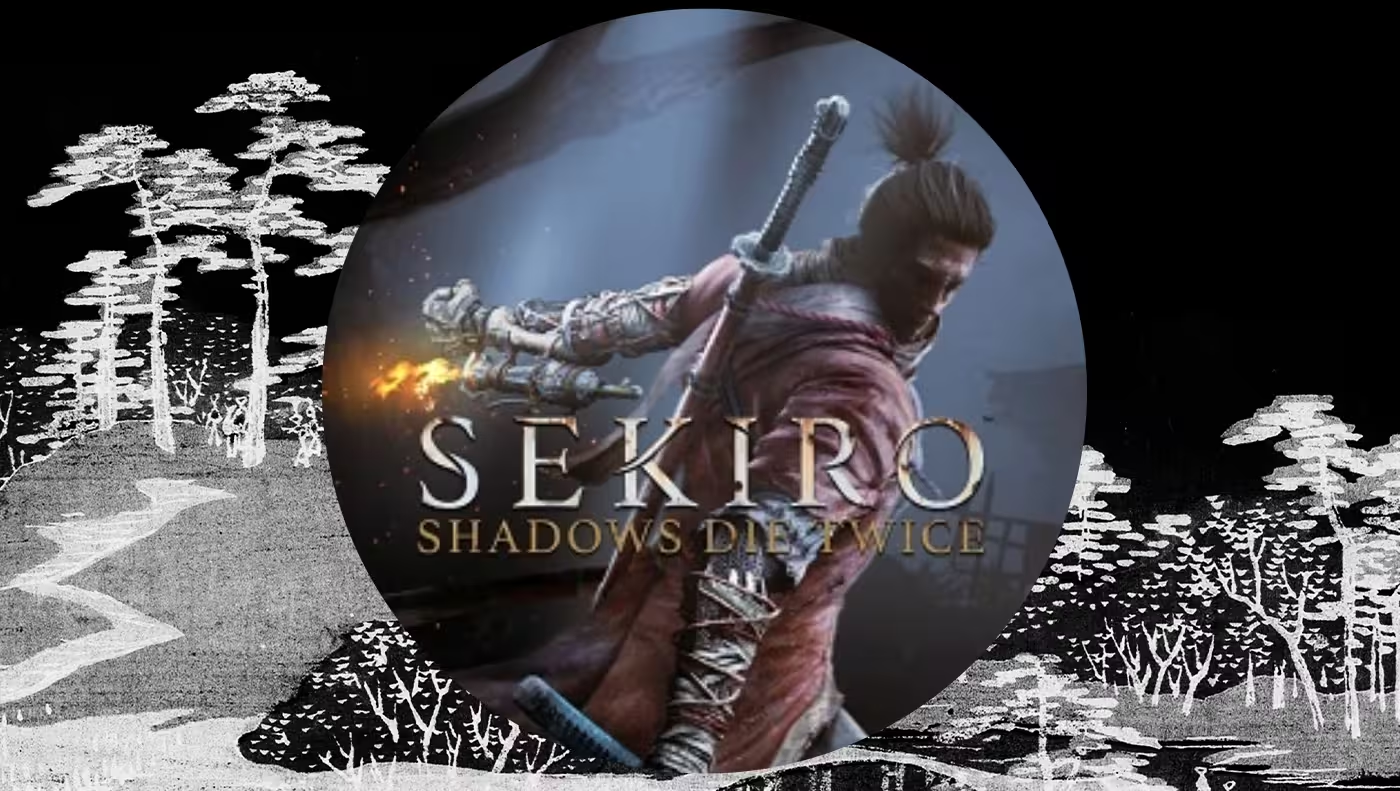
Iga Province, 1581. Fog creeps over the mountain passes as 46,000 soldiers under Oda Nobunaga sweep into the valley. Their opponents are no regular army, but jizamurai – lowly rural samurai who for generations have specialised in the unseen. They know every path, every ravine, every blind corner of the mountain castles.
Anyone who played Sekiro: Shadows Die Twice for the first time in 2019 would have recognised this scene at once. FromSoftware’s Game of the Year tells the story of a shinobi in a fictional version of the Sengoku period – and hits the historical core with astonishing precision. But what exactly did the studio get right? What is creative fiction? And which of it can you actually touch today in a Berlin museum?
This article separates history from gameplay. It shows the real Sengoku period behind the game, explains what a shinobi really was – and links both to original exhibits from the Samurai Museum Berlin.
The World of Sekiro – A Brief Introduction
The Game at a Glance
Sekiro: Shadows Die Twice was released in March 2019, developed by the Japanese studio FromSoftware under the direction of Hidetaka Miyazaki. The action-adventure won the “Game of the Year” award at the Game Awards that same year and sold more than ten million copies worldwide. Unlike FromSoftware’s earlier titles (Dark Souls, Bloodborne), Sekiro shifts the action from a Western fantasy world to feudal Japan – and swaps the nameless undead for a concrete protagonist with a backstory, motivation and cultural identity.
Setting and Plot
The game places the player in the fictional Ashina region of the late Sengoku period – an era in which Japan sank into more than a hundred years of civil war. The protagonist is Wolf, a shinobi in the service of a young nobleman named Kuro, the “Divine Heir”. When his master is abducted, Wolf sets out on a journey through mountain castles, Buddhist temple complexes and battlefields suffused with supernatural forces.
In Sekiro, FromSoftware combines historical elements – castle architecture, armour design, clan conflicts – with Japanese mythology: immortality, a dragon’s heritage and gods lurking in ruined shrines. The result is not a historical simulation, but an artistic interpretation. Yet one that is more deeply rooted in Japanese history than most players suspect.
Miyazaki himself stressed in interviews that his team studied historical sources to capture the atmosphere of the Sengoku period. The following sections examine how close the game stayed to reality in doing so.
The Real Sengoku Period – The Japan Behind the Game
Sengoku Jidai: 150 Years of Civil War
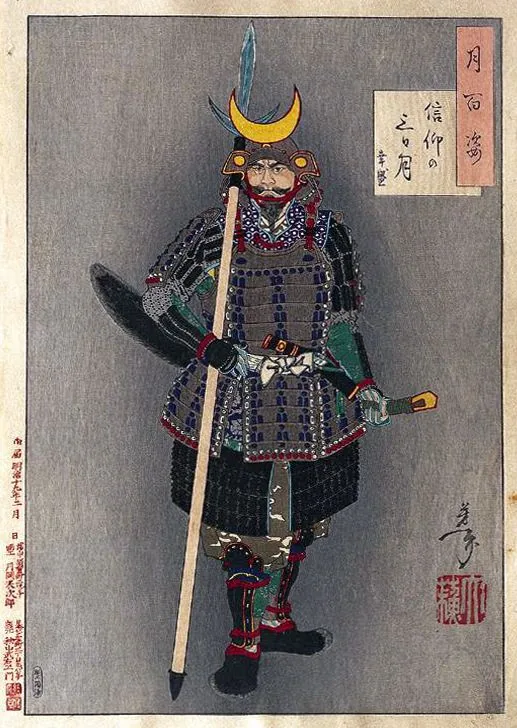
Sekiro’s world is not a fantasy construct with a Japanese veneer. The Sengoku period (1467–1615) was one of the most brutal eras in Japanese samurai history – an age in which the country fragmented into dozens of rival principalities and the principle of gekokujō prevailed: the lower overthrow the higher. The sons of peasants became generals, monks led armies, and clans that were allies yesterday faced one another on the battlefield tomorrow.
The trigger was the Ōnin War (1467–1477), which laid the imperial capital of Kyōto in ruins (Turnbull 2022: 33). The central government of the Ashikaga shogunate lost all control. Into the power vacuum surged the Sengoku daimyō – regional lords who based their rule not on imperial mandates but on military strength (Hall 1991: 40–55).
What followed was not a single war, but a permanent state of armed competition. Alliances shifted with the seasons. Sieges lasted months, battlefields stretched across entire provinces. The social consequences were equally dramatic: the rigid class boundaries of the Kamakura and Muromachi periods eroded. Anyone who could wield a sword and recruit soldiers was a candidate for power – regardless of birth and origin. Toyotomi Hideyoshi, one of the three great unifiers, began his career as a sandal-bearer to a provincial lord. The three great unifiers – Oda Nobunaga, Toyotomi Hideyoshi and Tokugawa Ieyasu – ended the chaos only after more than a century, through a combination of military force, diplomatic calculation and administrative reform.
Ashina – A Real Clan with a Tragic End
Sekiro’s fictional Ashina region bears the name of a real clan. The historical Ashina controlled the Aizu region in Mutsu Province (present-day Fukushima). In the 16th century they were among the more powerful daimyō of the north – strong enough to pressure neighbouring provinces, but too weak to meet the great unifiers as equals. In 1589 they were finally destroyed by the expansionist pressure of Date Masamune – one of the most ambitious and ruthless warlords of his generation.
The fate of the Ashina stands as an example of the principle of gekokujō in its most brutal form: a clan that had ruled a region for decades could be wiped out within a single campaign season if a stronger neighbour sensed his chance. In the case of the Ashina it was Date Masamune, the “one-eyed dragon”, whose expansion to the south redrew the political map of northern Japan.
FromSoftware uses this historical framework as a foundation: a powerful clan in a mountain region, surrounded by enemies, doomed to destruction. The parallels are no coincidence, even if the game’s plot goes its own way with dragons and immortality.
Castles in the Game vs. Reality
Ashina Castle is the central setting in Sekiro – and its visual realisation is clearly modelled on the architecture of historical Sengoku mountain castles (yamashiro). These fortresses exploited the natural topography: steep slopes as defensive lines, interlocking gates (masugata) to slow attackers, and stone walls (ishigaki) that withstood even heavy artillery (Turnbull 2003: 14–28).
At the Samurai Museum Berlin, a set of sashimono – the back banners of the Sengoku armies – illustrates the military organisation of this era (Samurai Museum Berlin, display case C19V). Each unit carried its own field insignia to make its affiliation recognisable in the chaos of battle. Banners of exactly this kind also flutter in the wind in Sekiro’s battlefield sequences – a detail that FromSoftware carefully took over from reality.
The Wolf – What a Shinobi Really Was
Shinobi: A Function, Not a Class
Sekiro’s protagonist bears the name “Wolf” – and his role as a shinobi in the service of a young nobleman corresponds to historical reality more precisely than it first appears. For the British military historian Stephen Turnbull made clear in his academic revision of the ninja myth: a shinobi was not a separate warrior class, not a member of a secret society – but a military function (Turnbull 2018: 10). Any samurai could become a shinobi if his master demanded espionage, sabotage or infiltration.
The image of black-clad ninja fighting as a counterpart to the samurai is a construct of the 19th and 20th centuries. In the Sengoku period, the most famous shinobi were themselves samurai – lowly rural samurai (jizamurai) from the provinces of Iga and Kōga who had specialised in covert warfare. Their strength lay not in supernatural abilities, but in geography: they knew every mountain path, every rocky ravine and every blind corner of their home provinces (Turnbull 2018: 40).
Seven Disguises Instead of a Black Hood
The Shōninki – a shinobi manual from the year 1681 – describes seven standard disguises (shichi hōde) with which a shinobi could move freely through enemy territory: as a wandering monk, merchant, pilgrim, street performer or beggar (Cummins/Minami 2017: 55). The logic behind it was simple: these professions were permitted to cross provincial borders without arousing suspicion. A discovered shinobi had failed – combat was the last resort, not the first.
Sekiro takes up this principle, even if the game naturally simplifies the stealth mechanic for play. Wolf’s ability to hide in bushes and take out enemies from behind corresponds to the core of historical shinobi doctrine: invisibility before confrontation. At the same time, Wolf remains unconditionally loyal to his master – a motif that recalls the idealised concept of loyalty later codified as Bushidō, although the historical reality of the Sengoku period was far less noble.
The Six Tools – and the Shinobi Prosthetic
In the game, Wolf carries a prosthetic hand that can be fitted with various tools: shuriken, firecrackers, an axe attack. The historical parallel is the roku gu – six standard tools that a shinobi was supposed to carry with him at all times: a straw hat (amigasa) for concealing the face, a grappling rope (kaginawa) for climbing, writing implements, medicine, a cloth and a fire-lighting kit (Cummins/Minami 2017: 62). No throwing blades, no smoke bombs – but everyday objects whose inconspicuousness was their greatest strength.
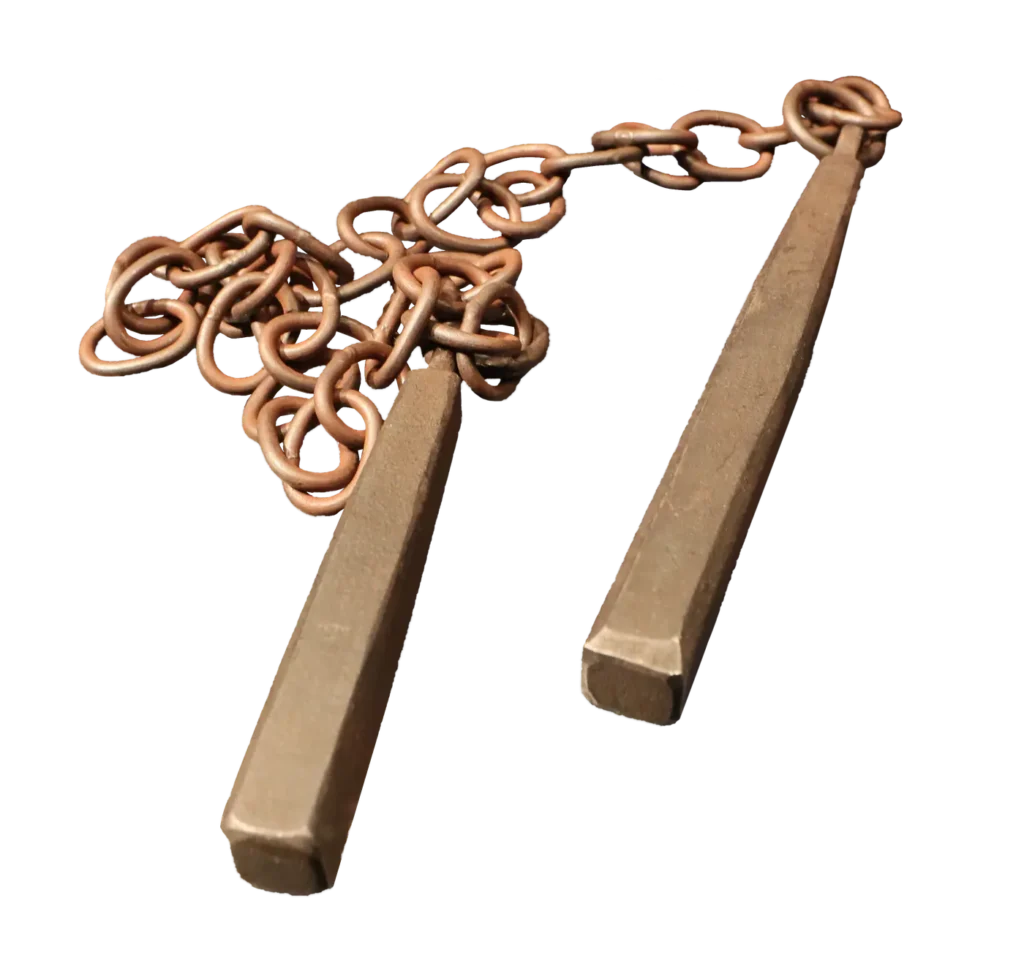
The shinobi display case at the Samurai Museum Berlin (display case D05V) shows exactly this contrast: historical shinobi tools alongside their mythologisation in pop culture. The difference between what a shinobi really used and what Hollywood and video games have made of it is the common thread of this exhibition – and of this article.
Sword Against Sword – Sekiro’s Combat System and Reality
Posture Instead of Hit Points
Sekiro’s combat system differs fundamentally from classic action games. Instead of working through health bars, players must break the opponent’s Posture – their stance. Whoever blocks, parries and attacks rhythmically wears down the enemy’s balance until a single deadly thrust becomes possible.
This mechanic has a surprising historical basis. In the classical sword schools (koryū) of the Sengoku and Edo periods, it was not raw strength that took centre stage, but reading the opponent. The Kashima-Shinryū, one of the oldest still-existing sword schools in Japan, taught its students to understand combat as a psychological contest. Karl Friday, an expert on the history of Japanese martial arts, describes this logic: the decisive moment of a duel is not the strike itself, but the instant in which the opponent loses their balance – physically and psychologically (Friday 1997: 45–67). Whoever attacked too early left themselves open. Whoever reacted too late was already defeated.
Sekiro’s deflect mechanic – the precise parry at the exact moment of impact – reflects the principle of sen: seizing the initiative by turning the opponent’s attack against himself. In the Japanese sword disciplines that live on today as Kendō and Iaidō, the concept of mushin – the “empty mind” – is regarded as the highest stage: a state of complete responsiveness without conscious thought. Sekiro translates both principles into a gameplay mechanic that feels astonishingly authentic.
The Katana in the Game and in the Forge
Wolf’s Kusabimaru – his katana – is in the game an almost indestructible tool that parries hundreds of strikes without taking damage. Reality was more complicated. Historical blades were composite constructions of hard outer steel (kawagane) and soft core steel (shingane), which through the process of yaki-ire – differential hardening – acquired their characteristic curvature and the visible temper line (hamon) (Turnbull 2010: 22–25).
A real katana could indeed be damaged on blade contact – nicks, bends and breaks were everyday occurrences on the battlefield. The romantic notion of endless sword duels, in which blades clash spark-spraying against one another, comes more from chanbara cinema than from the reality of war. Anyone who wants to see the difference between fiction and the art of forging will find original blades from the Sengoku and Edo periods in the sword collection of the Samurai Museum Berlin – with authentic hamon lines that no game rendering can replace.
Firearms – the Forgotten Game-Changer
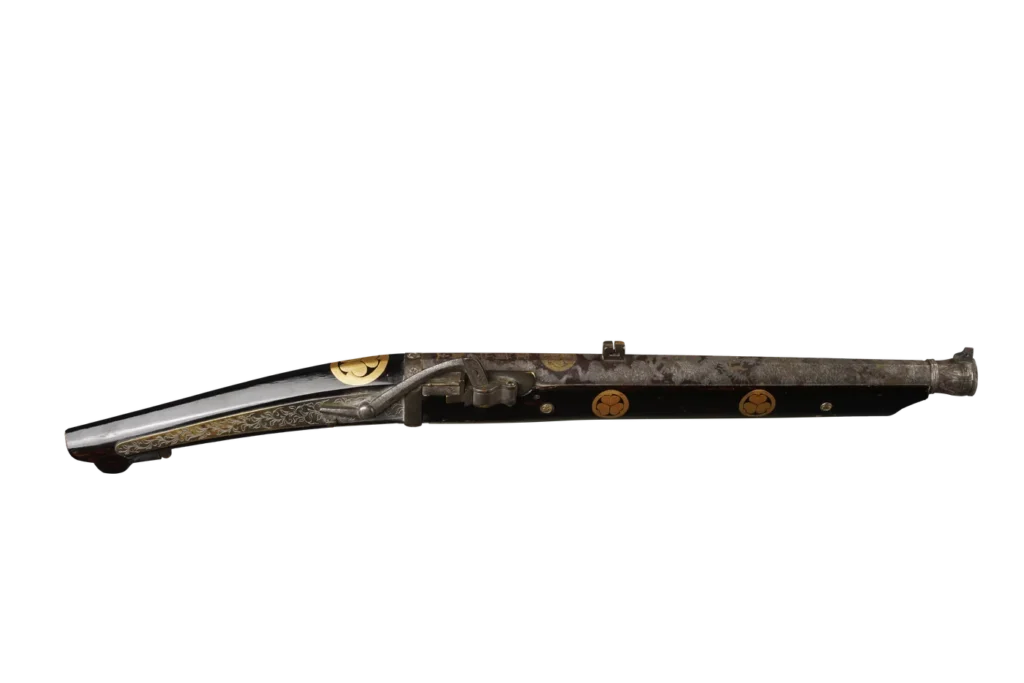
In the game, Wolf occasionally encounters enemies with primitive firearms – and these encounters are particularly historically accurate. The introduction of the teppō (matchlock guns) after the arrival of Portuguese traders on the island of Tanegashima in 1543 radically changed Japanese warfare. At the Battle of Nagashino in 1575, Oda Nobunaga deployed over 3,000 gunners and proved that firearms could annihilate the Takeda cavalry (Turnbull 2022: 89–94).
That Sekiro stages these weapons as a dangerous threat – hard to parry, deadly at a distance – is one of the most historically accurate aspects of the game. The Sengoku period was not the age of the sword alone. It was the age in which the sword lost its supremacy.
What Sekiro Gets Right – and Where the Game Reinvents History
Hits: The Historically Strong Points
FromSoftware evidently did its research. The following elements hold up to historical scrutiny:
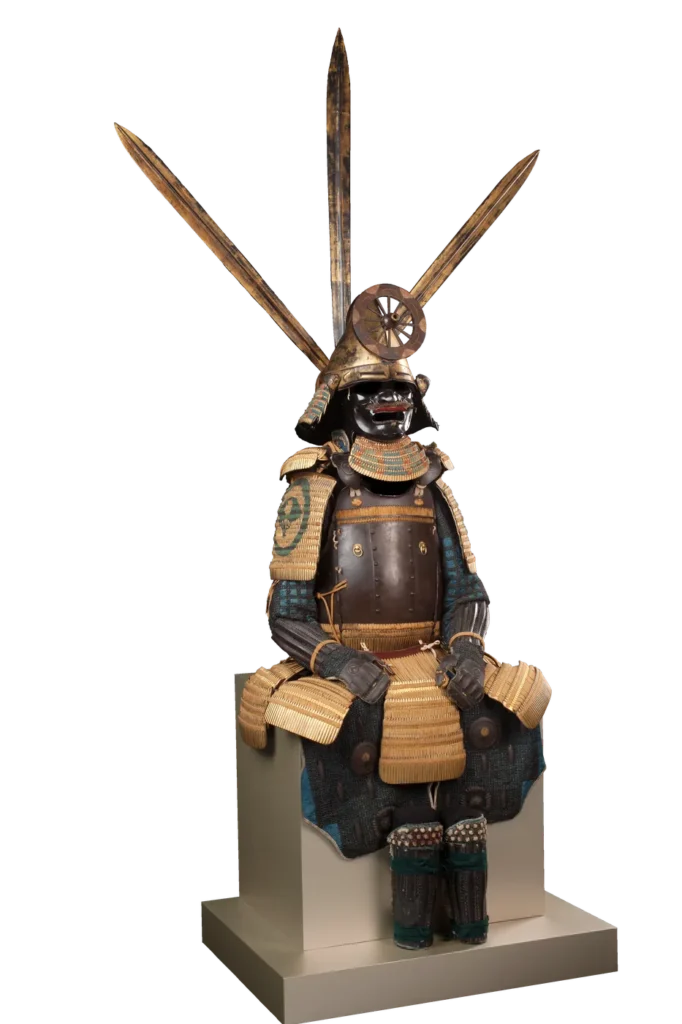
The armour designs of the Sengoku soldiers in Sekiro are recognisably modelled on tōsei-gusoku – the “modern armours” of the 16th century, which, in contrast to the older ōyoroi of the Kamakura period, were lighter, more modular and optimised for foot soldiers. At the Samurai Museum Berlin stands a tōsei-gusoku with bearskin trim (display case C16V), which makes the aesthetic of this era tangible: functional, intimidating and individualised – exactly like the armours in Sekiro’s battlefield sequences.
The game’s clan system – rival lords fighting over a mountain region – accurately depicts the political fragmentation of the Sengoku period. The same goes for the portrayal of the ashigaru (foot soldiers) as mass infantry: these peasants formed the backbone of every Sengoku army and are staged in the game as numerous but individually weak opponents – historically appropriate.
The Buddhist dimension of the game – temples as settings, monks as fighters – also has a real basis. The sōhei (warrior monks) were a powerful military force in Japanese history, even if the historian Mikael Adolphson stresses that the term is problematic: the “warrior monks” were often regular mercenaries in the service of great temple complexes, not spiritual fighters (Adolphson 2007: 4–8).
Misses: Where Fiction Begins
Sekiro’s supernatural elements – the protagonist’s immortality, the dragon’s heritage, giant serpent creatures – are deliberate fantasy additions. Historically there is no basis for them, even if Buddhist cosmology provides the thematic foundation. The concept of the shura – a being trapped in an endless cycle of violence – derives from the Buddhist rokudō (the six realms of existence). In Sekiro the player decides through their actions whether Wolf becomes a shura: a moral mechanic deeply rooted in the Buddhist ethics of the Sengoku period, when temples were not only places of devotion but also stages for political intrigue and military conflict.
The castle architecture in the game is visually impressive, but architecturally simplified. Historical Sengoku castles were not vertical fortresses with a single main tower, but interlocking defensive systems with several concentric rings of walls, moats and deceptive passageways (Turnbull 2003: 14–28). Sekiro’s Ashina Castle is dramatic, but not realistic.
And Wolf’s one-man-army appearances would have been unthinkable in reality. Single combats (ikkiuchi) did exist in the Japanese tradition of war, but the Sengoku battlefields were mass events in which coordination, formation and logistics decided victory and defeat – not individual heroic deeds.
Why Sekiro Fascinates – and What It Reveals About Us
With Sekiro, FromSoftware did not write a history book. But the studio achieved something only few games manage: it condensed a historical era so atmospherically that millions of players worldwide asked for the first time what the Sengoku period actually was.
The answer is more complex than any game can deliver. A 150-year-long period of permanent war, in which social hierarchies broke down, peasants rose to become generals, and the art of covert warfare – what we today call “ninja” – arose out of pragmatic necessity, not out of mysticism.
Sekiro distils this complexity into a play experience: the lone fighter against a world in upheaval. Historically, the reality was more collective, more chaotic and more brutal. But the emotional core – loyalty in an age when loyalty was worth nothing any more – strikes the nerve of the era.
Anyone who, after playing, wants to understand how a real Sengoku armour feels, what a tōsei-gusoku with bearskin trim looks like, or which tools a historical shinobi really carried, will not find the answers on the screen. But at the Samurai Museum Berlin – where over 477 original objects tell the history that lies behind the game.
→ Book tickets for the Samurai Museum Berlin
Frequently Asked Questions about Sekiro and the Sengoku Period
Is Sekiro historically accurate?
Sekiro: Shadows Die Twice is based on the Japanese Sengoku period (1467–1615) and adopts historical elements such as clan conflicts, castle architecture and the role of the shinobi. The armour designs are modelled on historical tōsei-gusoku, and the depiction of firearms corresponds to the introduction of the teppō from 1543 onwards. Supernatural elements such as the protagonist’s immortality, however, are deliberate fantasy additions.
Did the Ashina clan really exist?
Yes. The historical Ashina controlled the Aizu region in Mutsu Province (present-day Fukushima). In the 16th century they were among the more powerful daimyō of the north, before they were destroyed in 1589 by Date Masamune. FromSoftware used the name and the concept of a threatened mountain clan as the basis for the game’s setting.
Was Wolf a real ninja?
The character of Wolf corresponds to the historical concept of a shinobi – a military function in which samurai or lowly warriors took on espionage and sabotage tasks. The military historian Stephen Turnbull has shown that “ninja” was not a separate warrior class, but a job description. Wolf’s loyalty to his master and his specialisation in covert operations fit the historical picture.
What does the name Sekiro mean?
“Sekiro” (隻狼) literally means “One-Armed Wolf” and refers to the protagonist’s prosthetic hand. The name links two central game mechanics: the shinobi prosthetic as a toolkit and Wolf’s status as a lone fighter without clan affiliation – a motif that ties in with the historical rōnin (masterless samurai).
Where can you see real Sengoku armour?
The Samurai Museum Berlin shows original objects from Japan’s feudal era, including tōsei-gusoku armours from the Sengoku period, historical shinobi tools and Sengoku battlefield equipment such as sashimono banners. The collection comprises exhibits from the 8th to the 19th century and offers a unique access to the world behind games like Sekiro.
Bibliography
Primary sources & Tier 1 literature:
- Adolphson, Mikael (2007): The Teeth and Claws of the Buddha: Monastic Warriors and Sōhei in Japanese History. Honolulu: University of Hawai’i Press.
- Cummins, Antony; Minami, Yoshie (2017): True Path of the Ninja: The Definitive Translation of the Shoninki. Tokyo: Tuttle Publishing.
- Friday, Karl F.; Seki, Fumiko (1997): Legacies of the Sword: The Kashima-Shinryū and Samurai Martial Culture. Honolulu: University of Hawai’i Press.
- Hall, John Whitney (ed.) (1991): The Cambridge History of Japan, Volume 4: Early Modern Japan. Cambridge: Cambridge University Press.
- Turnbull, Stephen (2003): Japanese Castles 1540–1640. Oxford: Osprey Publishing.
- Turnbull, Stephen (2010): Katana: The Samurai Sword. Oxford: Osprey Publishing.
- Turnbull, Stephen (2018): Ninja: Unmasking the Myth. London: Frontline Books.
- Turnbull, Stephen (2022): War in Japan 1467–1615. Oxford: Osprey Publishing.
Museum objects:
- Samurai Museum Berlin: Tōsei-gusoku with bearskin (display case C16V), sashimono set (display case C19V), shinobi display case (display case D05V).
© Samurai Museum Berlin – Last updated: 26.03.2026
You might also like
Vagabond Manga: Musashi between Fiction and History
Vagabond: Miyamoto Musashi as a Manga Icon — Art, Philosophy and Historical Truth A double-page spread without dialogue. Ink on…
Read the article
Kill Bill & Hattori Hanzō: Where Myth Meets History
Kill Bill and Hattori Hanzō: Myth and Reality of the Famous Ninja Clan Okinawa, a small sushi restaurant. Behind the…
Read the article
The Last Samurai: Film vs. Reality – The Ultimate Fact Check
Last Samurai: Film vs. Realität – großer Faktencheck. Was stimmt über Saigō Takamori, Meiji & den echten letzten Samurai? Antworten…
Read the article