 Nominated for the EMYA2026 award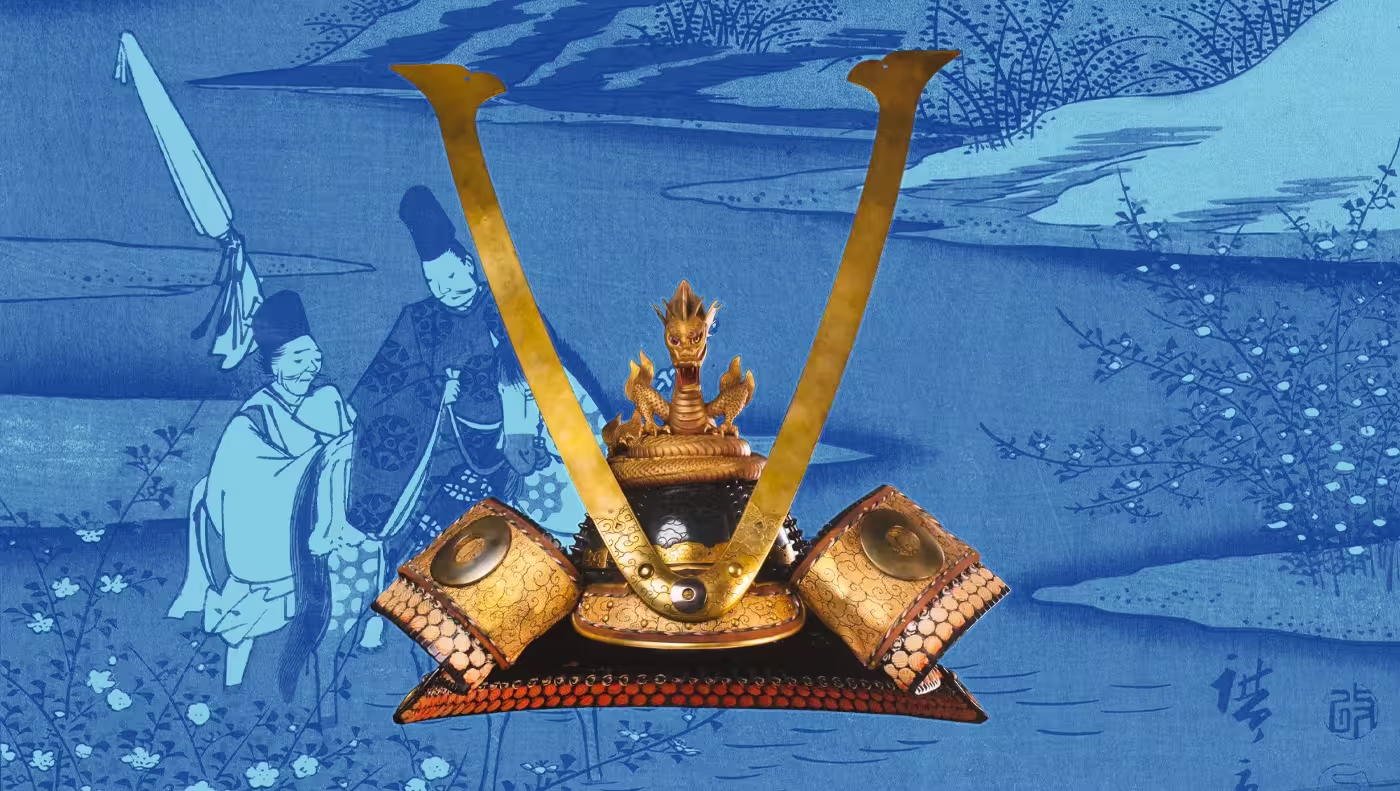
Kabuto – The Helmet of the Samurai
The kabuto (Jap. 兜 or 冑) is the traditional helmet of the Japanese warrior. From the 5th century until the Meiji Restoration in 1868, it protected the samurai’s head – but its function went far beyond mere protection. On the chaotic battlefield, where smoke and dust obscured the view, the helmet was the primary means of identification. A glance at the helmet crest was enough to tell friend from foe.
At the Samurai Museum Berlin, visitors can view more than 200 original kabuto from the eras of samurai history – one of the most important collections outside Japan.
What Is a Kabuto?
The term kabuto refers to the helmet as part of the complete samurai armour. While the early ō-yoroi armour protected the mounted archer, the helmet continued to develop in step with warfare. The goal remained constant: to protect the head from sword blows, arrows and later bullets.
But the kabuto fulfilled a second, equally important task. On a battlefield with thousands of warriors, a commander had to be able to recognise his allies. The helmet crest – often impressively tall and in spectacular shapes – made the wearer unmistakable. A golden crescent moon, stylised antlers or religious symbols towered above the melee.
This dual function – protection and identification – shaped the entire development of the kabuto over more than a thousand years.
The Structure of a Kabuto
A kabuto consists of several precisely defined components. The correct terminology immediately reveals to connoisseurs the era, school and quality of a helmet.
The Helmet Bowl (Hachi)
The heart of every kabuto is the hachi – the actual helmet bowl. Japanese armourers developed various construction methods that differ fundamentally in the number of plates, joining technique and shape.
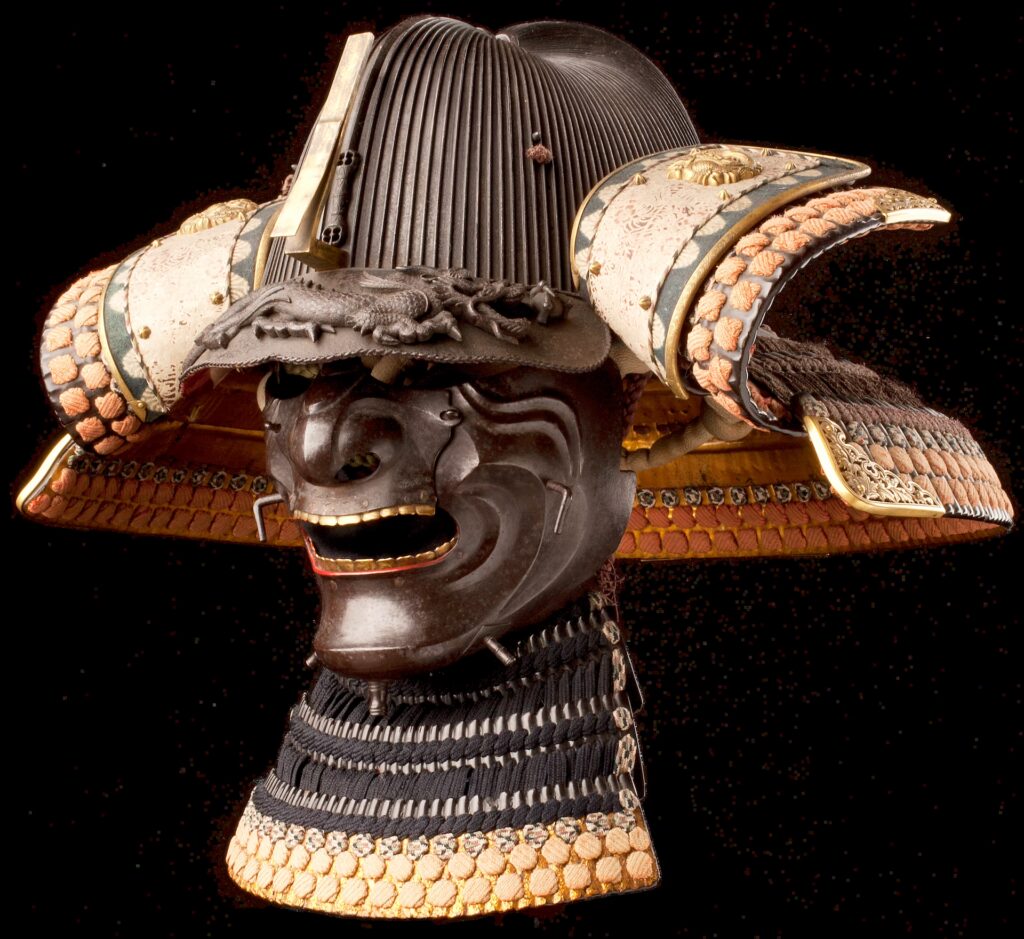
The suji-bachi shows clearly visible ridges (suji) between the individual plates. The Myōchin smiths perfected this technique from the 12th century onwards. The raised seams are not a sign of poor craftsmanship but a deliberate reinforcement of the structure. A suji-bachi in the collection of the Samurai Museum Berlin combines fifty-two black-lacquered iron plates with gold decorative strips – a testament to the highest craftsmanship of the Momoyama period.
The hoshi-bachi comes from the older tradition. Here, prominent rivets (hoshi) hold the plates together. These rivets later became decorative elements – some helmets bear over a hundred of them. One variant, the koboshi-bachi, has smaller, flatter rivets: an example from the Saotome school in the museum has twenty-five rivets per plate, distributed over sixty-two segments – one of the most elaborate constructions of all.
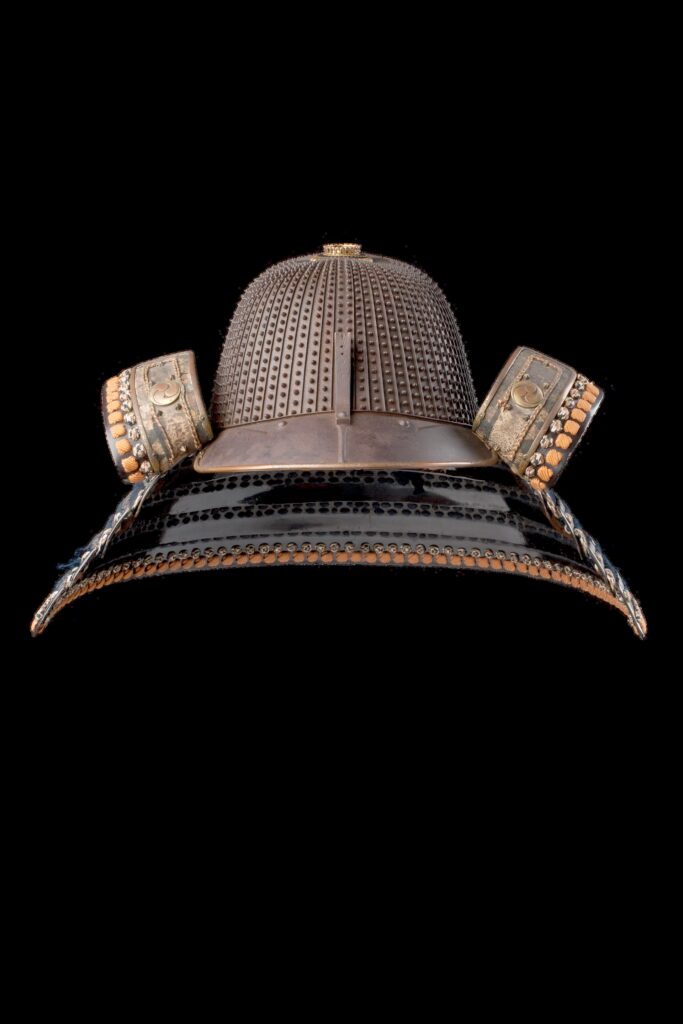
The number of plates varies considerably: simple zunari helmets consist of only three to five plates, while elaborate hoshi-bachi can combine more than sixty segments. The basic shape of the helmet bowl also differs: in addition to the common hemispherical form, there are the akoda-nari (gourd shape) with a markedly curved back, the momonari (peach shape) with a central ridge that tapers to a point, and the rarer shiinari (acorn shape) with a conical profile.
Decorative Techniques
The surface of the helmet bowl was rarely unadorned. Japanese armourers mastered a repertoire of sophisticated decorative techniques. In the nunome-zōgan technique, wafer-thin silver or gold threads were hammered into a previously roughened iron surface – creating delicate scrolling tendril patterns (karakusa), such as those on a zunari helmet in the museum. Kirigane refers to applied metal cut-outs that were riveted onto the helmet surface as crests or floral motifs. The sukashi technique, by contrast, works with openwork in the metal – clearly visible on religious symbols, which thus appear to float in front of the background.
The Neck Guard (Shikoro)
From the lower edge of the helmet bowl hangs the shikoro – a flexible neck guard made of three to seven lames. These lames were made of lacquered metal or hardened leather, joined by lacing (odoshi).
The type of lacing dates a helmet precisely: kebiki-odoshi, with its dense, parallel cords, dominated until the 15th century. The later sugake-odoshi uses sparser, crossed cords – more practical in the field because less water collected in the lacing, but less prestigious. Nevertheless, kebiki-odoshi lacing continued to be used.
It is less well known that the shape of the neck guard also varies by region and period. The kasa-jikoro spreads out like an umbrella and was typical of the classical period – it also protected the shoulders of the mounted archer. The later hineno-jikoro, on the other hand, fits closely and follows the contour of the shoulders with its lower edge, which gave the wearer more freedom of movement. Finally, the ō-manju-jikoro is distinguished by its sweeping, gently rounded form and is found above all on ceremonial helmets of the Edo period.
Helmet Crests (Tatemono)
The most striking component of a kabuto is its helmet crest. Depending on its position, the terminology distinguishes four categories: the maedate attached at the front as the most common element, the wakidate fixed at the sides, the kashiradate mounted on the crown and the ushirodate attached at the back.
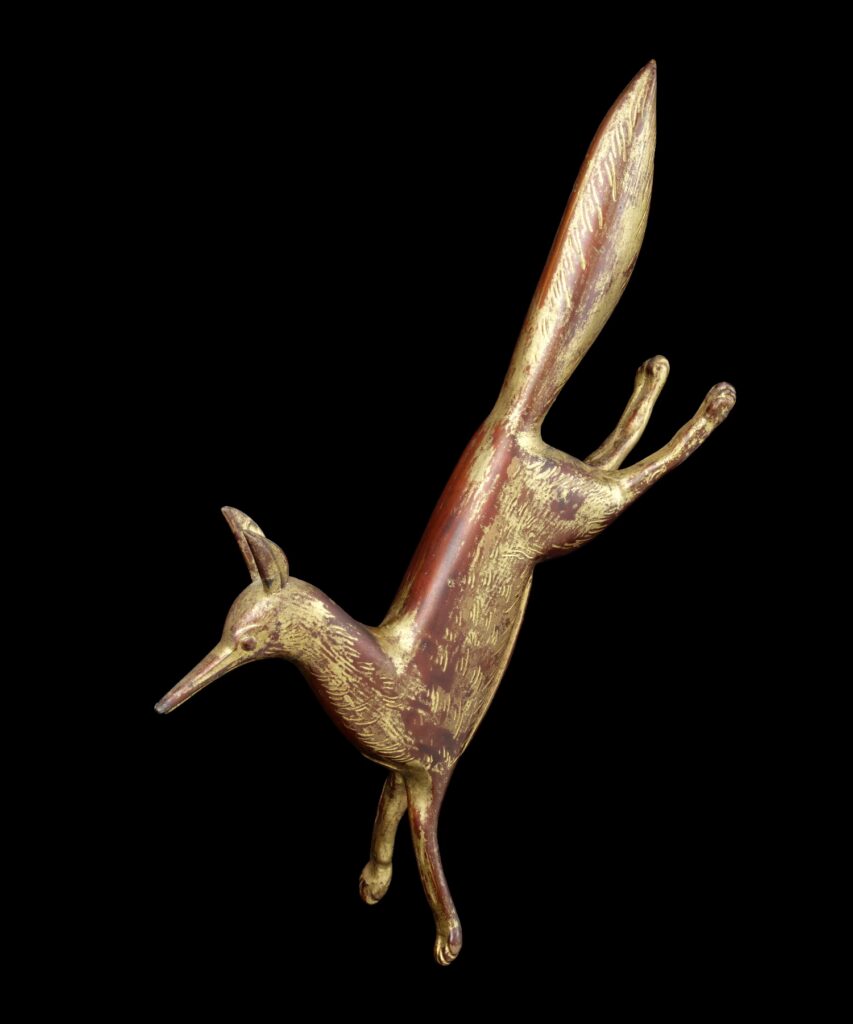
The range of motifs extends from the heraldic to the religious. At the front one finds golden crescent moons, flickering flames and dragon figures as well as the Sanskrit character of the guardian deity Fudō Myōō in openwork. Wakidate at the sides could be covered with exotic materials such as civet fur. Paddle-shaped flaps reminiscent of Chinese court caps occasionally served as ushirodate – a cultural quotation that signalled the wearer’s claim to learning.
The kuwagata – stylised antler shapes – are among the oldest helmet crests. The mon (family crest) identified the wearer unambiguously: the janome (snake’s eye) of the Katō, the wachigai (interlaced rings) of the Wakisaka or the mitsudomoe (three comma shapes) unmistakably marked clan affiliation.
The Crown Opening (Tehen / Hachimanza)
Almost every kabuto has an opening at the highest point of the helmet bowl. Originally, the samurai passed his topknot (chonmage) through this opening. Later it acquired a religious interpretation as the “hachimanza” – the seat of the war god Hachiman.
Even when its practical function disappeared, most helmets retained this opening. It served for ventilation and became a tradition. The hachimanza could itself become a work of art: a helmet in the collection of the Samurai Museum Berlin shows a nine-tiered crown opening made of alternating layers of gold, silver, shakudō and copper.
The Evolution of the Kabuto
The history of the kabuto reflects the development of Japanese warfare. Each era brought new requirements – and new helmet forms.
Early Period (5th–10th Century): The Mabizashi-tsuke Kabuto
The oldest Japanese helmets come from Kofun burial mounds of the 5th century. These early examples show clear influence from the Asian mainland – techniques imported from China and Korea. Characteristic is the round helmet skull, which consists of several lames and has both a fitting at the crown and a visor. Keel-shaped helmets, whose skull tapers to a point at the front, were also used.
These helmets protected warriors who did not yet possess a distinct samurai identity. Japan was in an era of clan conflicts, long before the term “samurai” acquired its later meaning.
Classical Period (10th–14th Century): The Hoshi-bachi
With the rise of the mounted warrior class, the classic samurai helmet emerged. The hoshi-bachi accompanied the ō-yoroi armour – the heavy armour that protected the mounted archer.
Dozens of thin iron plates, joined by prominent rivets, formed a helmet bowl of exceptional strength. The rivets (hoshi) became decorative elements: some helmets bear over a hundred of them, artfully arranged in geometric patterns.
The wide shikoro of this era protected not only the neck but also the shoulders. It was optimised for the archer, who tilted his head to the side when drawing the bow.
Sengoku Period (15th–16th Century): Zunari and Kawari
The year 1543 radically changed Japanese warfare. Portuguese traders brought the arquebus to Japan – and within a generation, mass armies with firearms were waging war against each other.
The zunari kabuto embodies military efficiency. Only three to five plates form a streamlined bowl. Thousands could be produced in a short time – essential for armies that now numbered a hundred thousand men.
The Saotome school from Hitachi Province perfected mass production: its standardised suji-bachi with sixty-two plates and seven rivets per row were made so uniformly that connoisseurs recognise the school at first glance.
At the same time, the kawari kabuto emerged – the “unusual helmets”. While the ordinary soldier wore a zunari, commanders opted for spectacular individuality. Their helmets became three-dimensional sculptures.
Edo Period (17th–19th Century): From Protection to Symbol
The Battle of Sekigahara in 1600 ended a century of civil war. Under Tokugawa rule, a period of peace lasting more than 250 years followed.
Helmets lost their practical function. No samurai of the Edo period ever wore his kabuto in battle. Instead, they became status symbols, displayed on ceremonial occasions.
Paradoxically, the archaic style experienced a renaissance. Wealthy daimyō had ō-yoroi armours made – not for defence, but as an expression of tradition and prestige. A hoshi-bachi in the collection of the Samurai Museum Berlin bears witness to this phenomenon: Myōchin Munesuke made it in 1695 from twenty-eight plates, each individually signed. Thirteen standing rivets per plate display the classic Kamakura aesthetic – yet the helmet was made centuries after the end of the battles that had produced this form.
In 1843 the historian Sakakibara Kōzan catalogued sixty-two different helmet types, many of which were never intended for battle.
Kawari Kabuto – The “Eccentric Helmets”
Water buffalo horns rising a metre into the sky. A life-size hare’s head. The stylised sun, surrounded by flames. The kawari kabuto of the Sengoku period are among the most spectacular objects of samurai culture.
But these helmets were no mere whim. They emerged as a functional answer to a military problem.
Why So Extravagant?
The mass battles of the 16th century confronted commanders with a challenge: how do you coordinate tens of thousands of warriors? Individual banners disappeared in the powder smoke of the arquebuses. The solution: three-dimensional identification marks on the head.
A general had to be able to find his allies – at a glance, from a hundred metres away, through smoke and chaos. The kawari kabuto made that possible.
The Harikake Technique
Spectacular shapes did not necessarily mean unbearable weight. The craftsmen developed the harikake technique: over a simple head-shaped helmet bowl (zunari-kabuto-bachi), a superstructure of wood, papier-mâché and lacquer was modelled until the desired shape emerged.
The result was astonishingly light. A helmet with high horns weighed hardly more than a simple zunari. When struck, the harikake superstructure broke – absorbing the energy and thus protecting the wearer.
Shapes and Motifs
The world of kawari kabuto can be divided into three large groups of motifs.
Animal motifs range from subtle suggestion to fully three-dimensional sculpture. A helmet in the museum’s collection imitates the form of a bear: a harikake superstructure rises above a zunari base, and long black horsehair falls from the rim of the helmet bowl and covers the entire neck guard – a type known as kabuto-mino. Another helmet shows a butterfly in embossed ironwork (uchidashi), whose wings encompass the entire head. Fox masks, dragon heads and antlers are also part of the repertoire.
Cultural references testify to the wearer’s education. The eboshi form adapts the traditional headgear of the court nobility, the tōkanmuri quotes Chinese court caps, and the okitenugui imitates a carelessly draped towel – a gesture of calculated nonchalance that signalled fearlessness on the battlefield.
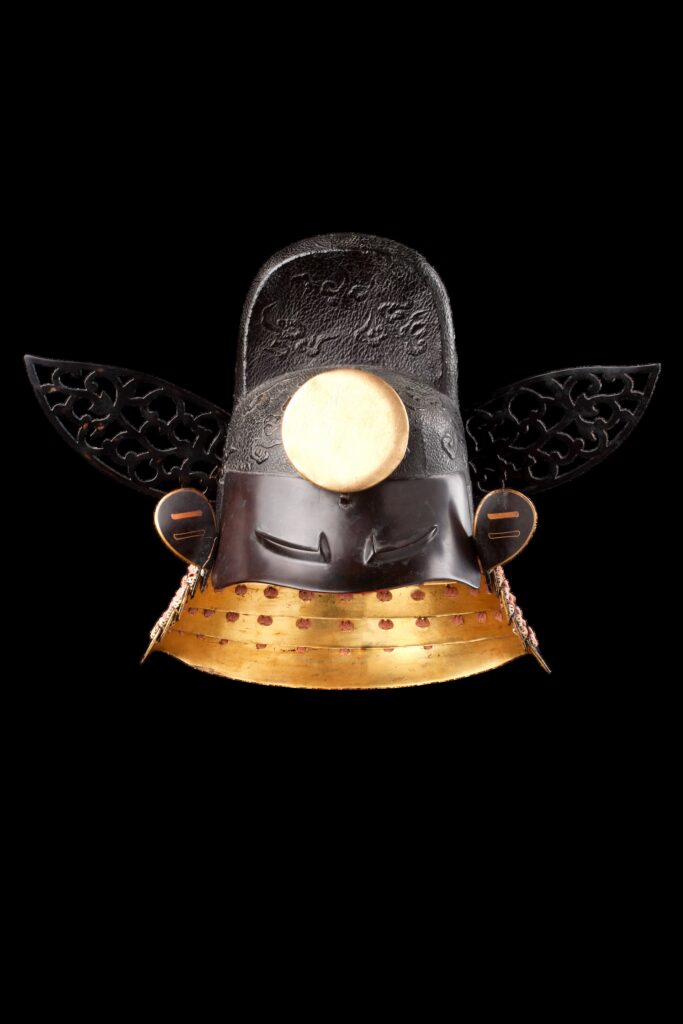
Religious symbolism pervades many kawari kabuto. The Sanskrit character for Fudō Myōō, the Buddhist guardian deity and wisdom king, is found in openwork on front crests. A helmet from the Saotome school bears the engraved names of five deities on its visor: Amaterasu Ōmikami, the sun goddess of Shintō, alongside Hachiman, the god of war, and three other guardian deities – a simultaneous invocation of different religious traditions, as was typical of samurai religious thought.
Famous Examples
Some helmet decorations became icons of Japanese history:
Honda Tadakatsu, one of the “Four Heavenly Kings” of Tokugawa Ieyasu, wore a helmet with mighty antlers. He fought in more than fifty battles – supposedly without ever being wounded.
Kuroda Nagamasa chose water buffalo horns. His helmet symbolised strength and endurance.
Date Masamune, the “One-Eyed Dragon”, wore a golden crescent moon. The symbol became the emblem of his entire clan.
The Master Smiths – Myōchin, Saotome and Other Schools
A signed kabuto was a prestige object. The great families of smiths enjoyed a reputation equal to that of the most famous swordsmiths. Each school developed characteristic techniques that connoisseurs can identify at first glance.
The Myōchin Dynasty
No family shaped the Japanese art of helmet-making more than the Myōchin. For seven centuries – from the 12th to the 19th century – they dominated the craft.
The Myōchin perfected the suji-bachi, the helmet construction with the characteristic ridges between the plates. Their signature on a helmet guaranteed the highest quality. A hoshi-bachi by Myōchin Munesuke from 1695, now in the collection of the Samurai Museum Berlin, illustrates the family’s aspirations: each of the twenty-eight iron plates bears an individual signature and a dedication in which Munesuke describes himself as “Japan’s foremost armour expert” and a descendant in the fifty-fourth generation of the legendary Takenouchi Sukune.
These genealogical claims deserve critical scrutiny. The official Myōchin family history, probably written by Munesuke’s brother Kunimichi, demonstrably contains fictitious elements. One helmet in the collection bears on its inside a lacquer attribution to the tenth-generation Myōchin, a certain Muneyasu, who is said to have been active around 1380 – but this smith very probably never existed. Such attributions increased the value and prestige of an armour, but in the Edo period they were a widespread practice, not a peculiarity of the Myōchin.
Myōchin Muneakira, adopted by the family master Munesuke, is regarded as probably the finest armourer of the 18th century. His work on an armour ensemble of the Ōseki clan in the museum shows the late flowering of the school.
The Saotome School
One of the most productive helmet-making schools in Japan came from Hitachi Province (today’s Ibaraki Prefecture). The Saotome specialised in the suji-bachi and developed such a uniform, delicate style that their work is instantly recognisable.
Their trademark was the sixty-two-plate helmet, usually with seven rivets per row. Another distinguishing feature, the so-called Saotome-byō, is hidden inside the helmet: a small round or octagonal washer with a special rivet, placed just below the crown opening. No other smith used this detail.
Unlike the Myōchin, the Saotome preserved their local character. They did not disperse across Japan, did not compile an elaborate genealogy and claimed no mythical descent. According to current research, the frequently claimed connection to the Myōchin school is purely fictitious. The Samurai Museum Berlin holds helmets by Saotome Ienari, Saotome Ietada and Saotome Iehisa, a smith of the ninth generation.
The Bamen School
In Echizen Province (today’s Fukui Prefecture), a school emerged that owes its name to a special commission: for the siege of Osaka in 1614/15, the smiths made horse masks (bamen) – and the name stuck.
The Bamen developed their own helmet type, the tenkokuzan, in which the crown opening dips towards the centre and the back sits higher than the front. Their hoshi kabuto feature short, pointed rivets arranged in a butterfly shape around the crown opening. Their horizontal signature technique is striking: each character of the name stands on a different plate and is read from right to left.
As craftsmen officially employed in the Fukui domain on a fixed salary, they supplied the local warrior elite. For Honda Shigemasa (1683–1733), for example, they made three helmets to individual specifications.
The Haruta School and the Unkai Branch
The Haruta smiths, originally based in Nara, branched out into Kii Province (Wakayama) and to Edo (Tokyo). A peach-shaped helmet (momonari kabuto) at the Samurai Museum Berlin bears the signature of Haruta Tatsumune, a smith of the mid-Edo period. Sixteen iron plates with a russet patina and chrysanthemum-shaped washers (zaboshi) – a detail that points to the armourers of Kaga Province.
An important branch of the Haruta developed in this very province: the Unkai school, founded by Unkai Mitsunao in the second half of the 17th century, became the preferred supplier of the Maeda clan in Kanazawa – the lords of the richest province in Japan. Their work is characterised by a distinctive combination: russet iron patina (tetsu-sabiji), fine engraved lines (yasurime) and refined metal cut-outs (sukashi-kirigane). A mask in the museum, signed by Mitsushige with the pseudonym “Juryō”, shows these features to perfection.
Signatures and Quality
The finest helmet bowls bore the signature of their maker – struck or engraved on the inside. These signatures are no guarantee of authenticity; forgeries and fictitious attributions already existed in the Edo period, when wealthy families enhanced their armour with prestigious stories of origin.
But an authentically signed Myōchin helmet today fetches auction prices in the six-figure range. The signature of a Saotome or Haruta bears witness to a quality that has endured for centuries.
The Helmet Collection of the Samurai Museum Berlin
With more than 200 original kabuto from all eras, the Samurai Museum Berlin holds one of the most important collections outside Japan.
The Janssen Collection
The helmet collection is part of the comprehensive Janssen Collection, which brings together more than 4,000 objects relating to Japanese warrior culture. The collector Peter Janssen assembled these holdings over four decades – with the aim of making samurai culture accessible to a European audience.
Highlights of the Collection
Some objects deserve special attention:
The bear kawari kabuto of the Momoyama period combines several craft traditions in a single helmet. A harikake superstructure rises above a head-shaped base, and long black horsehair covers the neck guard. The half-mask with gilded canine teeth and bearskin at the lower edge completes the animal impression. At the front, the helmet bears the Sanskrit character for Fudō Myōō in openwork – fighting form and religious protection in one.
The butterfly helmet from the early Edo period shows uchidashi embossing in its most spectacular application. Russet iron was hammered into the shape of a butterfly whose wings enclose the entire head. The six-row neck guard of corrugated sheet iron, covered with leather on the outside and finished on the inside with byakudan-nuri lacquer, testifies to an effort that goes far beyond the purely protective function.
The Myōchin Munesuke hoshi-bachi of 1695 documents the Edo-period longing for the warlike past. Twenty-eight plates, each with thirteen standing rivets, imitate the classic Kamakura aesthetic – made centuries after the end of the battles for which this form had been developed.
The Saotome helmet with five deities bears on its visor the engraved names of Amaterasu, Hachiman, Kasuga, Sumiyoshi and Fuji Asama – a religious protective formula that invokes Shintō and Buddhist traditions at the same time. The backs of the turned-back protective elements (fukigaeshi) bear the wachigai crest of the Wakisaka clan, whose lords ruled the Tatsuno domain in Harima Province.
What Visitors Can Expect
The exhibition allows direct comparison of different eras and styles. Hoshi-bachi beside suji-bachi, simple zunari beside extravagant kawari – the evolution of the kabuto becomes tangible.
Many helmets are presented as part of complete armours. In this way, the interplay of helmet, mask, cuirass and greaves becomes clear.
→ Experience these helmets at the museum: Book tickets
Frequently Asked Questions about Kabuto
How much does a kabuto weigh?
Depending on its construction, between 1.5 and 5 kilograms. A suji-bachi with more than sixty plates is naturally heavier than a simple zunari with only five plates. Kawari kabuto with harikake superstructures are often astonishingly light despite their spectacular size – the papier-mâché and lacquer mixture weighs only a fraction of metal.
What materials was a kabuto made of?
The helmet bowl (hachi) was almost always made of iron, less often of steel or hardened leather. The neck guard (shikoro) combined lacquered metal lames with silk or leather lacing. The helmet crest could be made of metal, wood, leather or – in the case of kawari kabuto – harikake (papier-mâché and lacquer). More exotic materials such as shakudō (a gold-copper alloy), civet fur, bearskin, horsehair, crystal glass and decorated brocade were used as ornamental elements. The insides were typically coated with red lacquer (shu-urushi-nuri) to prevent friction against the head.
What does the crown opening mean?
Originally, the samurai passed his topknot (chonmage) through this opening. Later it acquired a religious interpretation as the “hachimanza” – the seat of the war god Hachiman. Even when its practical function disappeared, most helmets retained this opening for ventilation and out of tradition.
Were kawari kabuto practical in combat?
The answer requires nuance. Sengoku-period kawari kabuto with harikake superstructures were entirely fit for combat: light enough for hours of use, and the paper-and-lacquer structure broke when struck without endangering the wearer. Edo-period examples, on the other hand, were often purely parade pieces – never intended for use in the field.
Where can you see real samurai helmets?
The Samurai Museum Berlin owns more than 200 original kabuto from all eras of Japanese history – one of the largest collections outside Japan. The spectrum extends from early hoshi-bachi to spectacular kawari kabuto. → Tickets for the Samurai Museum Berlin
Conclusion
The kabuto was more than a helmet. It was protective equipment and a means of identification, a status symbol and a work of art. Its development – from the simple import of the 5th century through the riveted hoshi-bachi of the Kamakura period to the extravagant kawari kabuto of the Sengoku era – reflects the history of Japan itself.
In the Edo period, when peace reigned and no samurai fought any longer, helmets became symbols of a bygone warrior culture. The schools of smiths – Myōchin, Saotome, Haruta, Bamen – no longer competed for the best protection, but for the most beautiful work. Their masterpieces have survived the centuries.
Today they allow us a glimpse into this world.
More than 200 original kabuto await you at the Samurai Museum Berlin. Experience a thousand years of Japanese helmet-making – from the earliest masterpieces to the most spectacular creations of the samurai era.
→ Book tickets and discover the collection
Sources
Primary Sources
- Sakakibara Kōzan: Chūkō Katchū Seisakuben (1800/1843), pp. 51-66, 138-143
- Metropolitan Museum of Art: Art of the Samurai: Japanese Arms and Armor, 1156-1868 (2009), Ikeda essay pp. 37-45, Ogawa essay pp. 21-25
Secondary Sources
- Bottomley, Ian / Thatcher, David: The Samurai – A Military History, Glossary, pp. 21-27
- Samurai Museum Berlin: Helmets (2024), Weber essay pp. 9-20
- Samurai Museum Berlin: Catalogue (2025), objects: C02V, C07V, C08V, C09V, C16V, C24V, C35V, C36V, E04V, E06V, E07V, E08V, F02V, F07V
© Samurai Museum Berlin – All rights reserved
You might also like
The Katana: History, Forging Technique & 5 Myths Debunked
The Katana: History, Forging Technique & 5 Myths Debunked. What is really true about the most famous sword in the…
Read the article
Tōsei Gusoku: The Bulletproof Armour of the Sengoku Era
The Tōsei Gusoku replaced the Ō-Yoroi after 1543. How iron plates and hinges answered the arquebus. With original exhibits at…
Read the article
Gokaden: Japan’s Five Great Swordsmithing Traditions
Gokaden – the five great swordsmithing traditions of Japan. Yamashiro, Yamato, Bizen, Sōshū & Mino: history, characteristics & original blades…
Read the article