 Nominated for the EMYA2026 award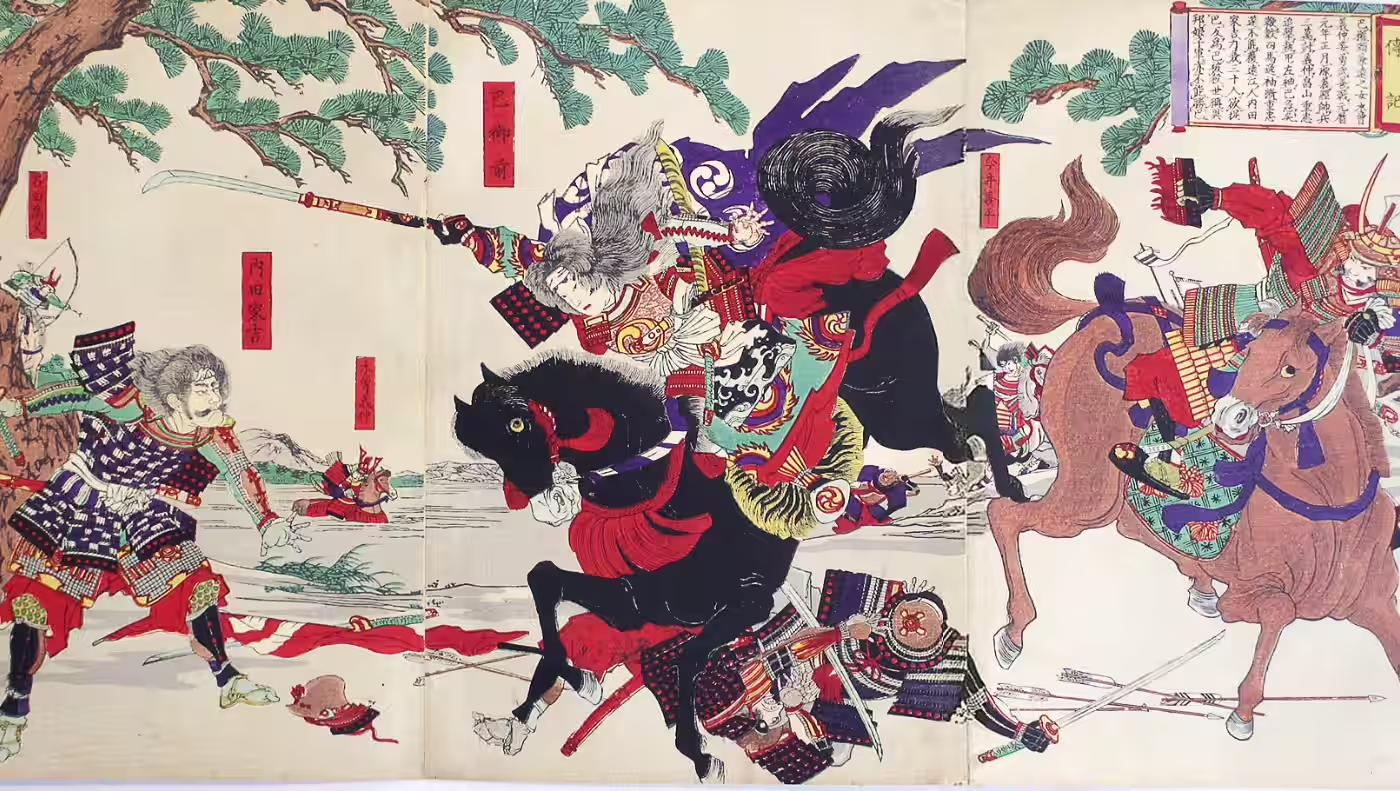
The Heike monogatari describes her thus: strong, brave, and unusually beautiful. A rider who outmatched any man. An archer who never missed. A swordswoman who feared no foe.
Tomoe Gozen (Gozen is an honorific, not a personal name) fought in the Genpei War (1180–1185) on the side of Minamoto no Yoshinaka — the general who took Kyoto and thereby sealed his own downfall. She was his strongest companion in the field, perhaps his most important military support. She outlived him.
What became of her afterward is unclear. The sources fall silent or contradict one another. She is said to have become a nun. She is said to have lived to 90. She is said to have married another warrior.
We do not know. And that is perhaps telling: the most famous female warrior in Japanese history is at the same time one of the most poorly documented historical figures.
The Samurai Museum Berlin devotes a dedicated section in display case C35V to the onna-musha — the female samurai: proof that Tomoe Gozen was not an exception but a tradition.
Who Was Tomoe Gozen? The Problem of the Sources
Tomoe Gozen appears mainly in the Heike monogatari — a literary work describing the Genpei Wars. This work was composed roughly 30 to 50 years after the events and served not historical documentation but literary remembrance and moral reflection on war and transient power.
In her analysis of the Heike monogatari, Oyler shows that the work systematically constructs historical figures in literary terms: Yoshinaka as a coarse, uncultivated barbarian who plundered Kyoto (an exaggeration that legitimized Kamakura rule); Yoshitsune as a tragic hero; Yoritomo as a shrewd statesman.[4]
Tomoe in this context: she appears as a radiant exception within Yoshinaka’s otherwise crude retinue — cultivated, brave, loyal. Her function in the text is partly literary. This does not make her fictional, but it means we must not simply read the text as historical biography.
What Cambridge Vol. 2 (Shively/McCullough) says about women in the Heian period is illuminating: some women in this era were indeed trained for combat and defense — especially with the naginata as a weapon for defending the household and the court.[2]
This makes Tomoe historically plausible, even if the details of the Heike monogatari bear literary features.
The Onna-musha: Tomoe Gozen in Context
Onna-musha (female warriors) existed as a category in the Japanese warrior class from the Heian era until the dissolution of the samurai class. They fought, they defended castles, they wore armor. They are not overrepresented in war chronicles — but they are present, once one looks.
The SMB catalog describes what distinguished female warriors: they usually carried a shorter, lighter form of the naginata (polearm), the bow (yumi), and the dagger (tantō). Their primary function in armed conflict was often the defense of household and castle while the male warriors were in the field. There were women who honed their martial skills to avenge the murder of relatives. For others, combat training was simply a survival strategy.[5]
In his sourcebook, Conlan documents that women of the warrior class in the Kamakura period held property rights and rights of inheritance — and defended them in court as well. The Jōei Formulary (1232), the first legal document of the Kamakura shogunate, explicitly regulates women’s rights to land.[3]
This legal reality is important: onna-musha did not fight in spite of the system, but within a system that assigned them — limited but real — rights and roles.
The Genpei War: Tomoe’s Context
The Genpei War (1180–1185) was the decisive civil war of Japanese history — the conflict that founded the Kamakura shogunate and made the warrior class the dominant political power in Japan.
On one side: the Taira clan, which dominated the court politics of Kyoto. On the other: the Minamoto clan, which gathered support in the provinces.
Yoshinaka — Tomoe’s lord — was a Minamoto cousin who grew up in the north, assembled a swift and independent army, and in 1183 was the first to reach Kyoto. His success was his problem: he was too early, too strong, too independent. His cousin Yoritomo, who later won the war and founded the shogunate, saw a rival in Yoshinaka.
Varley shows how the Heike monogatari constructs Yoshinaka: as a crude northerner who did not know how to govern the capital, who plundered temples and terrified court society. This characterization is literarily exaggerated — it retrospectively legitimizes Yoritomo’s decision to destroy Yoshinaka.[1]
Tomoe fought for Yoshinaka to the end. One of the best-known scenes in the Heike monogatari: when the final defeat comes, Yoshinaka is said to have sent her away — she should save herself, because it would not befit him to die alongside a woman. She obeyed. Or not. The sources diverge.
What happened afterward is unclear.
The Death of Yoshinaka and Tomoe’s Departure
In 1184, Yoshinaka was overtaken and killed by Yoritomo’s troops — the imperial capital cleansed by the troops he himself had once liberated.
Tomoe survived.
How? Why? What came afterward — that is the great silence of history. The Heike monogatari lets her vanish with the final scene. Later sources offer various continuations: she became a nun. She married a warlord and lived to 90. She wandered through Japan.
All these variants are later additions — no contemporary evidence. Tomoe disappears from history just as abruptly as she appears.
For Oyler, this gap is telling: the Heike monogatari had no further function for her after Yoshinaka’s death. She was Yoshinaka’s companion — not an independent heroine with her own story. Her disappearance is literary, not historical.[4]
This finding does nothing to diminish the fascination. It only shifts it: from biography to meaning. What did it mean in the early 13th century — for the narrators of the Heike monogatari, for warrior society, for court culture — that a woman was described in such terms?
Tomoe Gozen in Posterity: From Text to Icon
Kabuki plays portrayed her as a radiant warrior. Woodblock prints by Utagawa Kuniyoshi, a master of ukiyo-e, made her one of the best-known pictorial motifs in Japan. In the 19th century, when Meiji nationalism sought heroic female figures who united modernization and tradition, Tomoe was ideal.
Today she lives on in a different medium: manga and anime have reinterpreted her dozens of times.
This popularity is not trivial. It shows what Tomoe means as a symbol: the possibility of female strength within a patriarchal society — not against the system, but through extraordinary individual ability. That is an image with manifold points of connection.
Varley warns — implicitly, through his focus on literary construction — against adopting these images unquestioningly.[1] Tomoe Gozen has grown large through centuries of overwriting. The historical substrate is thin.
This does not make her less fascinating. It makes her a different type of historical object: not a window into the past, but a mirror for what various eras wanted to seek in history.
The Weapons of the Onna-musha: What Tomoe Really Carried
When Tomoe Gozen is depicted today, one often sees a warrior with the katana — the standard image of the samurai.
This is historically wrong on two counts.
First: the katana in its familiar form (worn in the belt, edge up) did not yet exist in the Heian period. Tomoe would have carried a tachi — the older, hanging long sword designed for mounted archers.
Second: women of the warrior class did not fight primarily with the sword. The SMB catalog describes the typical armament of the onna-musha precisely: a shorter, lighter form of the naginata (polearm), the bow (yumi), and the dagger (tantō).[5]
The naginata had a clear logic here: it allowed combat at a distance without the physical closeness of swordfighting. For women, whose body weight and muscle mass were on average lower than those of male opponents, this offered a tactical means of compensation. The naginata later became the prototypical women’s weapon of the samurai class — into the 19th century, noblewomen trained with it systematically.
The Heian-era female warrior thus looked different from how we imagine her. Not a swordswoman — but an archer and naginata bearer.
Tomoe and the Heike monogatari: Why Her Description Is Surprising
The description of Tomoe in the Heike monogatari is literarily unusual.
The Heike monogatari describes warriors in conventional formulas: enumeration of ancestry, trial of arms, battle description. Tomoe is described differently — with a striking focus on her physical appearance (unusually beautiful, with long hair) and her combat ability (superior in archery and swordfighting, riding unbroken horses).
Oyler interprets this dual portrayal: the Heike monogatari presents Tomoe as an exception that proves the rule.[4] Her beauty marks her as a woman; her combat ability makes her unusual. Together this yields a literary figure that generates astonishment — not an ordinary warrior, but an extraordinary woman in a male domain.
This is a different image from the one that modern feminist readings often make of Tomoe. In the text, she is not a matter of course — she is an exception that is marked as such.
The interesting thing: this literary image makes her neither smaller nor larger. It shows that Heian warrior society knew combat-capable women — and at the same time framed them as extraordinary.
Yoshinaka and Tomoe: The Question of the Relationship
The Heike monogatari deliberately leaves the exact relationship between Yoshinaka and Tomoe open.
Was she his warrior? His lover? His wife? Later sources sometimes call her mekakenagori — a kind of mistress or concubine. The Heike monogatari itself is precise in its vagueness: she is loyal to him, she fights for him, he does not want her present when he dies. Nothing more.
Oyler interprets this openness as a literary strategy.[4] An unambiguous definition of the relationship would place Tomoe in a social category and thereby constrain her extraordinary function as a warrior. The ambiguity lets her be greater than any category.
For modern Japan — and the modern West — this openness is a free pass for projection. Tomoe becomes a warrior without private constraints, a wholly autonomous fighter.
Shively/McCullough show how complex the social roles of women in the Heian period were: there was latitude, but it was embedded in structures of class, clan, and gender.[2] Tomoe lived within this system, not outside it.
The Afterlife: From the Edo Period to Manga
Tomoe’s transformation into a figure of national culture took place in two phases.
In the Edo period: Kabuki plays and woodblock prints made her famous. Utagawa Kuniyoshi created some of the best-known images of Japanese female warriors — Tomoe among them, depicted in full armor, with spear or sword, often on horseback. These images shape how we imagine her to this day.
In the 20th century: Yoshikawa Eiji’s novel Shin Heike monogatari (1950s) brought the Genpei era back to life for a mass audience. Tomoe appears there as a heroine in a modern narrative style. Then manga, anime, games — every generation rediscovers her.
The interesting thing about this tradition: Tomoe is almost always portrayed as an exception — the extraordinary warrior in a male world. Rarely is what the SMB catalog shows ever addressed: that she was part of an entire tradition of female warriors, not alone.[5]
That would be the more honest picture. Not Tomoe as the only one — but Tomoe as the best-known of a group.
Frequently Asked Questions About Tomoe Gozen
Who was Tomoe Gozen?
Tomoe Gozen (ca. 1157–ca. 1247) was a Japanese female warrior (onna-musha) who fought for Minamoto no Yoshinaka in the Genpei War (1180–1185). She appears mainly in the Heike monogatari and is regarded as Japan’s best-known female samurai. Most historical details are uncertain.
Is Tomoe Gozen a historical figure?
With reservation: yes. A female warrior of this name in Yoshinaka’s circle is plausible. Whether the descriptions in the Heike monogatari are historically accurate is uncertain — the work was composed decades after the events and has literary functions. Oyler shows that the Heike monogatari portrayals are systematically constructed.
What does “Gozen” mean?
An honorific for women of high rank — comparable to “Lady” or “Dame.” Tomoe is her name; Gozen her title. The combination is the designation used to this day.
Did female samurai really exist?
Not directly. Onna-musha (female warriors) are documented in Japanese history. They fought mainly with the naginata, bow, and tantō, predominantly in the defense of houses and castles. The SMB catalog describes them as professionally trained warriors who existed over nearly eight centuries.
How did Tomoe Gozen die?
Unknown. The sources end with Yoshinaka’s death in 1184. Later additions report her entry into a convent or a long life as a nun — all without contemporary evidence.
Visit the Samurai Museum Berlin
Tomoe Gozen is the best-known, but not the only female warrior of Japan. Open daily from 10 a.m. to 7 p.m., Auguststraße 68, Berlin-Mitte.
Related Articles
- The Heian Period: The Rise of the Warrior Class
- Kamakura & Muromachi: The First Shogunate
- Naginata: The Weapon of the Onna-musha
- Ashikaga Takauji
- Seppuku: The Ritual Suicide of the Samurai
Show Sources
[1] Varley, H. Paul (1994). Warriors of Japan as Portrayed in the War Tales. University of Hawaii Press. Used: Tomoe in the Heike monogatari (p. 118); literary construction; the hōganbiiki concept.
[2] Shively, Donald H. & McCullough, William H. (eds.) (1999). The Cambridge History of Japan, Vol. 2: Heian Japan. Cambridge University Press. Used: women of the warrior class; combat training; the onna-musha tradition.
[3] Conlan, Thomas D. (2022). Samurai Sourcebook. Hackett Publishing. Used: the Jōei Formulary and women’s rights; primary sources of the Kamakura period.
[4] Oyler, Elizabeth (2006). Swords, Oaths, and Prophetic Visions: Authoring Warrior Rule in Medieval Japan. University of Hawaii Press. Used: literary construction of the Heike monogatari; portrayal of Yoshinaka; Tomoe’s function in the text.
[5] Samurai Museum Berlin (2025). SMB Catalog 2025. Display case C35V: onna-musha, naginata, yumi, tantō; description of the female samurai tradition.
You might also like
Sanada Yukimura: Japan’s Bravest Warrior (1567–1615)
Sanada Yukimura defended Ōsaka against Tokugawa Ieyasu's army – and became an icon of the honourable last stand. History, myth…
Artikel lesen
Nanboku-chō: The War of the Two Imperial Courts (1336–1392)
For 56 years, Japan was ruled by two emperors at once. The Nanboku-chō period: civil war, the collapse of loyalty,…
Artikel lesen
The 47 Rōnin: Japan’s Legendary Tale of Revenge
The true story of the 47 Rōnin: how 47 masterless samurai avenged their lord in 1703 – and why not…
Artikel lesen