 Nominated for the EMYA2026 award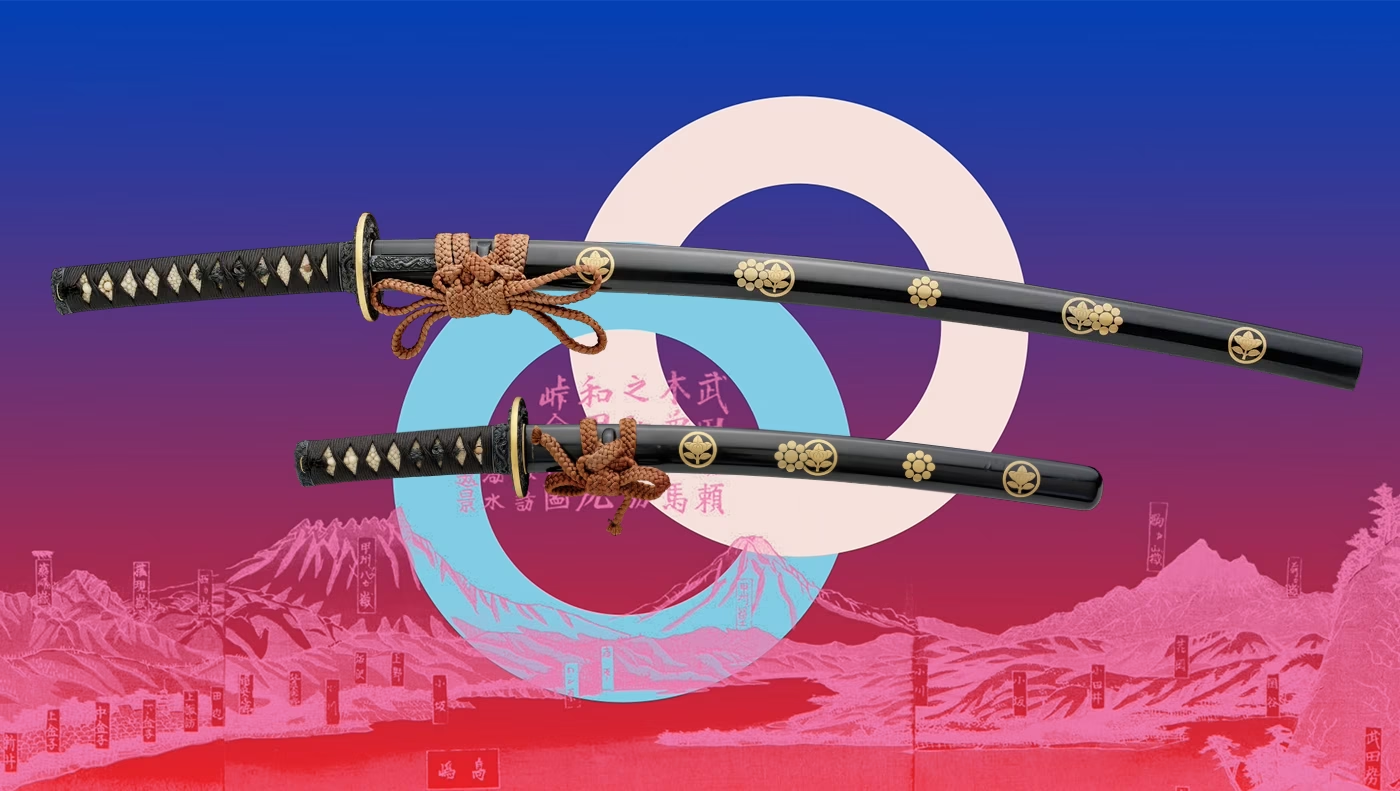
In the Western imagination, a samurai without a katana is barely conceivable. And yet: when a warrior met his feudal lord in the Edo period, he took off his katana at the entrance. He placed it in the sword racks of the anteroom, bowed and stepped into the reception hall. The weapon he carried with him was the wakizashi — the shorter of the two swords of a daishō pair. It stayed on his belt day and night. It accompanied him to meals, to the bath, to sleep. Anyone who saw a samurai without a wakizashi was not looking at a samurai.
In popular memory, the wakizashi is overshadowed by the katana. Films, novels and video games almost always show the samurai with his long sword drawn. The short sword seems like an accessory — an emergency instrument, a secondary object. This perspective fundamentally distorts historical reality. In a samurai’s everyday life, the wakizashi was the ever-present weapon, the long sword the occasional one. In defining the samurai class, it was the decisive feature — not the length of the katana, but the right to two swords distinguished the warrior caste from the rest of society.
This article reconstructs the wakizashi in its concrete dimensions, materials and functions. It shows how the practical second sword of the Muromachi period became the symbolic centrepiece of samurai identity in the Edo period. It examines its legal significance in the Tokugawa regulations and the craft tradition preserved in the surviving examples in museum collections.
What Is a Wakizashi? Definition, Dimensions, Distinction
The wakizashi is a Japanese short sword with a blade length of between about 30 and 60 centimetres. The name is made up of the characters waki (“side”) and sashi (“to insert”) — literally “that which is inserted at the side”. Unlike the tachi of the earlier period, which was worn hanging at the hip, the wakizashi was inserted, cutting edge upwards, in the obi, the belt of the samurai’s garment.[1]
Outwardly, a wakizashi does not differ fundamentally in construction from a katana. It has the same blade curvature, the same structure of hamon (hardening line), hada (surface pattern of the folding) and nakago (tang with the smith’s signature), the same mounting (koshirae) with tsuba, tsuka, saya and menuki. What makes a wakizashi a wakizashi is not its construction but its function within the system: it is the partner sword to the katana, the second blade of the daishō.
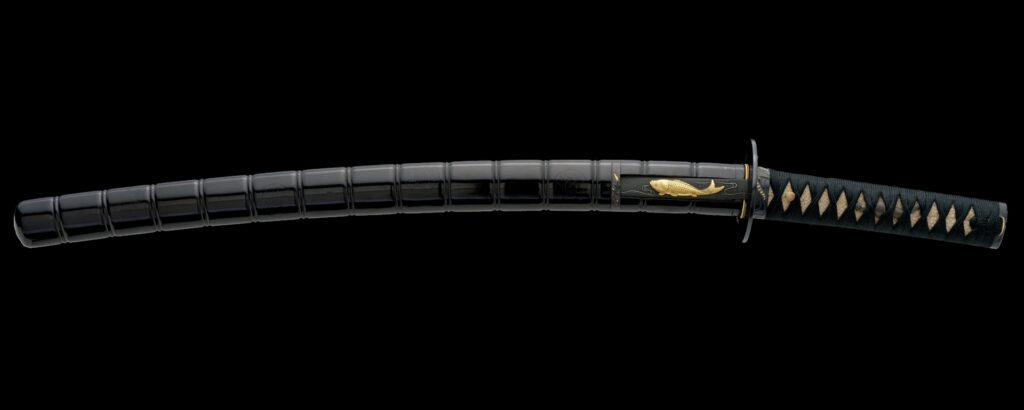
This membership of the system was legally codified in the Edo period. The scabbard of the katana had to have a flat end; the scabbard of the wakizashi, by contrast, a round one. This one detail — the shape of the scabbard end — is still the most reliable external identifying feature of an official Edo-period wakizashi today.[3]
From the Sengoku Period to the Pax Tokugawa — How the Wakizashi Came About
The emergence of the wakizashi is closely linked to a deeper change in Japanese sword culture: the transition from the tachi to the uchigatana. The tachi, the dominant long sword of the Heian and Kamakura periods, was hung at the hip with the cutting edge facing down. It was the weapon of mounted warriors and was suited to sword strikes from the saddle. The uchigatana, the forerunner of the later katana, was thrust through the obi with the cutting edge facing up — a way of wearing it that favoured faster drawing and infantry combat.[4]
This change took place between the late Kamakura and the early Muromachi periods, i.e. between about 1300 and 1400. With it came the practice of carrying a shorter second sword alongside the long sword. There were several reasons for this. On the battlefield, the short sword served as a reserve in case the long sword broke or was lost. Indoors, where a long katana was unwieldy, the wakizashi could be used for defence and attack. And in the event of capture or a hopeless situation, the short sword was available as an instrument of ritual suicide.
During the Sengoku period (1467–1615), the concept of the wakizashi was still flexible. Warriors often simply carried a second, shorter sword, without the combination of long sword and short sword having been formalised. The two blades frequently did not come from the same smith and were not intended as a pair. Only with the end of the civil wars and the establishment of Tokugawa rule after Sekigahara (1600) did a systematic codification begin, which turned the pragmatic second sword into the symbolic partner piece of a daishō pair.
The legal basis was created by Toyotomi Hideyoshi’s sword hunt (Katanagari) of 1588. With this edict, Hideyoshi forbade peasants from owning swords; from then on, only the samurai class was allowed to carry long weapons. The Tokugawa further expanded this privilege. In the Edo period (1615–1868), the right to two swords — katana and wakizashi together — was the central legal characteristic of the samurai class. Members of other classes were allowed to carry a wakizashi under certain circumstances (for example, wealthy merchants when travelling), but never a second, long sword. The daishō was the exclusive symbol of the samurai caste.[5]
Daishō — The Pair of Swords as a System
The daishō (大小, literally “large-small”) refers to the pair of long sword and short sword as a unit that belongs together. In its strict form, as it developed in the Edo period, the daishō was more than just two swords worn at the same time: it was a system in which blades, mounting and fittings were made as a coordinated ensemble. The tsuba, the menuki, the fuchi-kashira fittings — everything was supposed to harmonise visually and be recognisable as a pair.
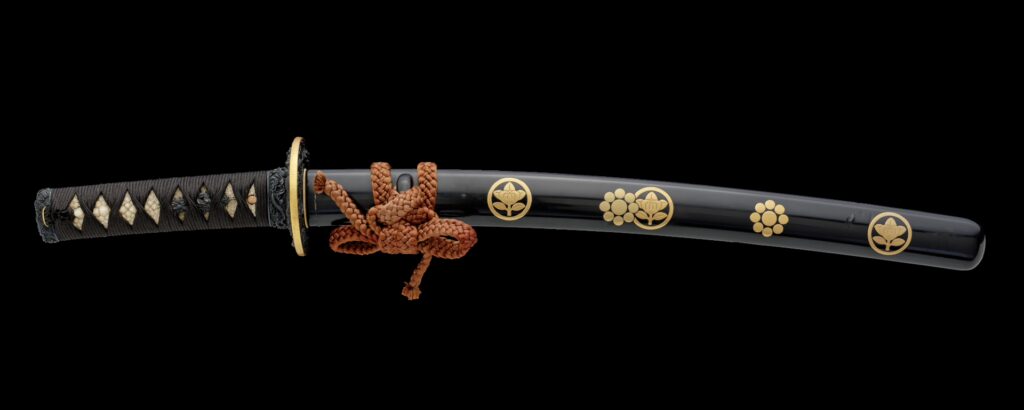
The strictest daishō regime was the banzashi daishō, which samurai had to wear on obligatory visits to the capital, Edo. The so-called Sankin-kōtai — the system of alternate residence — required every daimyō to move between his province and Edo at regular intervals and to leave his family permanently in Edo. Accompanying samurai had to appear at court in the banzashi daishō format. The regulations were detailed: the scabbards of both swords had to be lacquered black; the hilt covered with white same (ray skin); the pommel cap (kashira) made of horn; the hilt wrapping knotted over it. The tsuba was kept simple — usually with a fine nanako pattern and the family crest. The katana had a flat scabbard end, the wakizashi a round one.[8]
This uniformity had political reasons. The Tokugawa shōgunate regulated not only the political hierarchy of the daimyō, but also their visual representation. A uniform sword protocol prevented the display of excessive wealth or political independence in the capital. At home in their own provinces, the samurai were allowed to wear considerably more elaborate daishō — with golden shishi lions, dragon motifs, elaborately crafted menuki and gilded tsuba rims. But at the shōgun’s court, reduction was the rule: strict forms, few colours, no pretension.
The Wakizashi in the Seppuku Ritual
The widespread notion that seppuku was always performed with a wakizashi is historically inaccurate — but it contains a kernel of truth. Andrew Rankin’s primary research (2011) shows that the classic, highly ritualised seppuku of the Edo period was a late codification that only acquired its definitive form in the 17th and 18th centuries. Before that, practices varied widely. In the Kamakura period, the forms ranged from a simple stab to the abdomen with any available blade to elaborate ceremonies with special instruments.[10]
In the standardised Edo ritual, the actual ritual weapon was often a tantō — the short dagger without a tsuba, often wrapped in white paper and placed on a small wooden stand in front of the seppuku candidate. But in contexts in which a tantō was not available or was not considered culturally appropriate, the wakizashi served as an alternative. Samurai of the middle and higher ranks wore their wakizashi on their belt continuously, even in moments of capture or military failure. When honour demanded ritual self-destruction, the blade was immediately at hand.
Rankin also documents that the standardisation of the ritual in the late 17th century was also a consequence of Tokugawa attempts to monopolise violence. In 1663 the shōgunate banned junshi — retainers’ seppuku on the death of their lord — and generally tried to establish seppuku not as a free decision of the samurai but as a controlled punitive measure. In the formalised seppuku sentences of the Edo period, the condemned man was assigned a blade; often this was a wakizashi or a specially prepared kogatana (a very short knife). The question “Which blade?” thus increasingly became less a question of custom and more one of state protocol.[11]
A special form is documented in the late Edo period: the so-called “fan seppuku” (ōgi-bara). Urban samurai who were hardly familiar with practical swordsmanship any longer merely performed the gesture of stabbing the abdomen symbolically with a paper fan. As soon as the gesture was completed, the kaishakunin — the second — beheaded the condemned man. The wakizashi often lay clearly visible to one side, as a symbol but not as a tool. This practice clearly shows how far seppuku had moved away from the combat experience of the Sengoku period at this point — and how much the wakizashi had become a ceremonial object.[12]
Well-known historical cases illustrate the significance of the wakizashi in the context of ritual suicide. Sen no Rikyū, the tea master who committed seppuku on Hideyoshi’s orders in 1591, used a short sword according to tradition. Toyotomi Hidetsugu, Hideyoshi’s nephew who was forced to commit suicide (1595), also used a short sword. In the case of the 47 Rōnin (1703) — the most famous seppuku event in Japanese history — the blade handed to the samurai of Akō was a tantō in most accounts, but some of the rōnin are said to have used their own wakizashi, which they had carried during their revenge on Kira Yoshinaka.
Anyone who systematically works through the Samurai Museum Berlin’s literature on the wakizashi will recognise an important distinction. Not every wakizashi was an instrument of seppuku — the wakizashi was first and foremost an everyday sword. But in those moments when samurai honour demanded a ritual end and no tantō was available, the wakizashi took on the function of the final instrument. This dual role — ever-present everyday weapon and potential instrument of death — gave it the special symbolic weight that it still has for us today.
The Wakizashi in Everyday Life — Indoor Weapon and Constant Companion
While the katana had to be taken off in many everyday situations, the wakizashi accompanied the samurai practically all the time. This practice resulted from several overlapping regulations and customs. In reception rooms and at official audiences with higher-ranking persons, carrying the long sword was forbidden or at least undesirable — after all, the host was not to be left defenceless against possible attacks. The wakizashi, on the other hand, could be worn. It was the weapon for defending one’s immediate personal space, but at the same time short enough not to pose an open threat.
The architecture of traditional Japanese houses supported this distinction. The narrow corridors, low door frames and low ceilings made drawing and swinging a katana inside buildings almost impossible. The wakizashi, on the other hand, could be used effectively indoors. Historical fighting schools developed specific techniques for using the short sword indoors — techniques that worked in confined spaces and took the limited range of swinging movements into account.
In the baths, in the bedrooms, in the private living quarters — wherever even the wakizashi could not be worn directly — it lay within reach. Many samurai residences had special holders, so-called katana-kake (sword stands), which were set up in several rooms and held the long sword. The wakizashi often remained on the body even in these situations — placed next to the pillow, within its owner’s reach.
This omnipresence had social consequences. The wakizashi became part of posture, of the repertoire of movement, of self-image. A samurai who took off his wakizashi did so consciously and temporarily — for example at a tea school, where chadō etiquette required all weapons to be placed on a special shelf in front of the tea house. But even in such exceptional cases, taking off the wakizashi was a brief interruption; it was put back on immediately after the tea ceremony.
Legally, the carrying of a wakizashi outside the samurai class was restricted, but not completely prohibited. Wealthy merchants and craftsmen were allowed to carry a wakizashi when travelling under certain circumstances — for self-defence against highwaymen. Doctors, accountants of certain domains and some other professional groups had similar privileges. But the daishō — the combination of katana and wakizashi — remained reserved exclusively for samurai. The legal difference between a commoner with a wakizashi and a samurai with a wakizashi lay in what else he was allowed to carry: only samurai were allowed to add a second, longer sword.[13]
The social system of the Edo period that secured this distinction is called shinōkōshō — the four-part class hierarchy of samurai (shi), peasants (nō), craftsmen (kō) and merchants (shō). Only samurai stood at the top of this system and possessed the corresponding privileges, including the right to two swords.
Craft and Aesthetics — How a Wakizashi Was Made
A wakizashi was more than just a short blade. It was a highly complex crafted ensemble that came about through the collaboration of several specialists: the smith (tōshō), the blade polisher (togishi), the scabbard maker (sayashi), the metal fittings artisan (kinkō-shi) and the hilt wrapper (tsukamaki-shi). Each of these craftsmen brought decades of training to the work, and a high-quality wakizashi could take months to years to produce.
The making of the blade followed the same principles as that of the katana. The basic material was tamahagane — iron-rich sand steel obtained from iron sand in traditional tatara smelting furnaces. The smith folded the steel repeatedly, sometimes twenty to thirty times, so that the blade consisted of thousands of thin layers of steel. These layers were visible as hada — a fine surface pattern revealed by polishing. The characteristic hardening line (hamon) was created by differential hardening: the cutting edge was covered with a thin layer of clay, the back with a thicker one; when quenched in water, the cutting edge hardened into martensite, while the back remained softer and more flexible.[15]
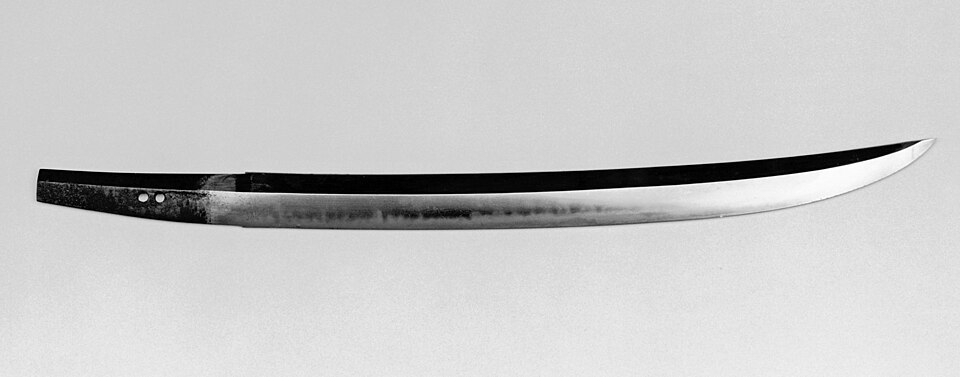
The length of the blade determined differences in construction. Since a wakizashi was shorter than a katana, it had a proportionally somewhat wider blade and often a shorter nakago (tang). The balance had to be suited to one-handed or two-handed use in confined spaces. The curvature (sori) was usually flatter than on a katana in order to be more manoeuvrable indoors. Some ō-wakizashi, which lay at the upper length limit, resembled small katana and were sometimes used as such — a grey area that appeared under various names in historical documents.
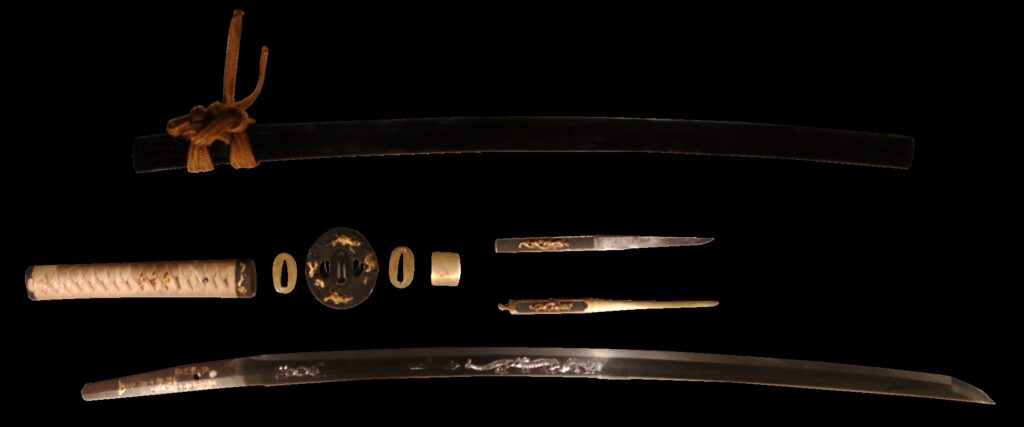
The mounting — the koshirae — consisted of several detachable and interchangeable parts. The saya (scabbard) was usually carved from hōnoki wood (magnolia) and covered with several layers of lacquer. The lacquering could take months and comprised dozens of layers of urushi lacquer, with sanding in between each one. The tsuka (hilt) was covered over the same wooden core with ray skin (same) and then wrapped with a cord (tsukamaki). The tsuba (sword guard) was the central decorative element — often made of iron, with elaborate engravings, inlays of gold, silver or copper, family crests or symbolic motifs.
The fittings were not only decoration but also identification. The menuki (small ornaments on the side of the hilt) often depicted mythological figures, dragons, lions or plants. The fuchi (hilt collar) and the kashira (pommel cap) formed a stylistic unit and often bore the family crest. In a daishō, the tsuba, menuki, fuchi and kashira of both swords had to harmonise stylistically — they were designed and made as an ensemble.
The schools of smiths from which wakizashi blades came were the same as for katana. The five classical traditions (Gokaden) — Yamashiro, Yamato, Bizen, Sōshū and Mino — all produced swords of every length category. Some schools, however, specialised in short swords for certain periods. The Hizen school under Hizen Tadayoshi (first generation, early 17th century), for example, was famous for wakizashi blades of the highest quality, the construction following the shinogi zukuri form — the same form that was also used for most katana of the Edo period.[16]
The End — Haitōrei 1876 and the Transformation into an Art Object
With the Meiji Restoration in 1868, the end of the samurai class began. The new government wanted to rebuild Japan into a modern nation state on the Western model, and this included dissolving the feudal class order. In 1871 the daimyō were stripped of their domains. In 1872 the hereditary privileges of samurai families ended. And in 1876 came the symbolic capstone: the Haitōrei, the sword ban, which prohibited the former samurai class from carrying swords in public. Only the military and police were still allowed to carry state-approved uniform swords.[17]
The Haitōrei edict had dramatic consequences for the swordsmithing industry. Within a few years, the domestic market for Japanese swords collapsed. Many forges closed. Others switched to producing kitchen knives, agricultural tools or cutlery. The lines of the great traditional schools of smiths — many of them documented over centuries — were broken off during this time. Only a few masters continued the tradition within a small circle, often in rural regions, often without being able to exhibit their work publicly.
At the same time, another development began: Japanese swords became collector’s items. Western diplomats, traders and adventurers who travelled to Japan after the Meiji opening bought wakizashi, katana and tantō as exotic souvenirs. European and American museums began to build systematic collections. The pieces found today in London, Paris, Vienna, New York or Berlin reached Western institutions in this way in most cases between the 1870s and the 1920s.
This development had a paradoxical effect. The mass export threatened Japanese cultural heritage — and at the same time led to its international visibility and appreciation. From the 1930s, and increasingly after the Second World War, there was a renewed appreciation of swordsmithing as Japanese cultural heritage. The institution of the Ningen Kokuhō — the “Living National Treasures”, state-recognised masters of intangible cultural techniques — was established in 1950 and also included the art of swordsmithing.
In this phase, the wakizashi itself underwent a twofold transformation. On the one hand, it became a pure art object in museum display cases. On the other hand, it reappeared in the new popular iconography of the “samurai” — in kabuki theatre, in jidaigeki films, in the emerging manga and anime tradition of the 20th century. This popular return often projected the image of a samurai world that had never existed in that form: with an overemphasis on the katana, a marginalisation of the wakizashi and a romantic stylisation of seppuku.
Five Myths about the Wakizashi — and What Is Really True
The wakizashi is less well known than the katana, but all the more burdened with misunderstandings. Five widespread misconceptions are worth correcting.
Myth 1: “The wakizashi was only a reserve weapon.” This view underestimates the importance of the short sword in everyday life. In many situations — indoors, at audiences, during longer stays in other people’s residences — the wakizashi was the only weapon that could be worn. It was therefore not the reserve, but often the primary weapon of everyday social life. The katana was the weapon of the military campaign and of formal ceremony; the wakizashi was the weapon of the everyday world.
Myth 2: “Every wakizashi was used for seppuku.” The classic, highly ritualised seppuku of the Edo period mostly used tantō — short daggers. The wakizashi served as an alternative in contexts in which a tantō was not available, and as a substitute tool in spontaneous or emergency situations. But most Edo-period wakizashi were never used for seppuku; they were everyday swords, not ritual instruments.
Myth 3: “The length of 30 to 60 centimetres was a strict regulation.” The length categories were conventions, not laws. There were wakizashi of 28 centimetres and some of 62 centimetres, and classification also depended on context and manner of wearing. The Tokugawa regulations on official dress governed certain details, but not every blade of this length was classified uniformly everywhere.
Myth 4: “Only samurai were allowed to carry a wakizashi.” That is almost, but not entirely, correct. The right to the daishō — the combination of katana and wakizashi — was reserved for samurai. But carrying a single wakizashi was permitted, subject to conditions, for certain non-samurai groups (merchants when travelling, doctors, certain professional associations). The exclusive hallmark of the samurai class was the second sword.
Myth 5: “Wakizashi and katana were always made as a pair.” In the strict Edo form of the banzashi daishō, yes, but historically most pairs were pragmatic combinations of blades already in existence. Only the Edo regulations on the official daishō enforced a jointly made, stylistically coordinated mounting. In the Sengoku period that was not yet the case — many samurai there simply carried the two best blades they happened to have available.
Conclusion: The Second Sword as the Centrepiece of Samurai Identity
This article began with a samurai who hands over his katana in the anteroom and enters the audience hall with his wakizashi. This scene is not a rare exception but the everyday life of the Edo period. The wakizashi, not the katana, was the weapon that accompanied the samurai without interruption — in sleep, in the bath, at tea, at audiences, on journeys, in his own residence.
Popular memory has reversed this proportion. It sees the katana as “the” samurai sword and the wakizashi as an appendage. But historical reality was different. The right to the pair, not the long sword alone, defined the samurai class. The concrete materiality of everyday life — the constant presence of the short sword at the belt, within reach, as an extension of the body — made the wakizashi the real everyday weapon. And in borderline cases — capture, defeat, political disgrace — the short sword was the instrument of ritual suicide.
The wakizashi therefore stands for a dimension of samurai culture that goes beyond the glorification of the battlefield: for the quiet, permanent presence of the warrior class in a largely peaceful society. The Pax Tokugawa — 265 years of domestic peace after Sekigahara — was an era in which the samurai had to redefine himself. His military function had become obsolete, his economic base precarious, his political role increasingly bureaucratic. What remained was the symbolism: the right to two swords, the prescribed form of the koshirae, the ritualisation of suicide. The wakizashi carried all of these functions at once and was thus, paradoxically, the central symbolic instrument of a warrior class that no longer waged war.
Today, 150 years after the Haitōrei, the wakizashi lives on in museums. The surviving examples — the elaborately crafted daishō koshirae of the Samurai Museum Berlin, such as the examples with blue glass inlays and the Miura crest — document a craft tradition of extraordinary refinement. They allow the modern observer to look behind the popular images and study the true depth of this culture. A wakizashi is not a simple blade. It is the condensed document of a way of life that no longer exists — and whose material testimonies must therefore be all the more precious to us today.
Frequently Asked Questions
What is a wakizashi?
The wakizashi is a Japanese short sword with a blade length of between about 30 and 60 centimetres. It was worn together with the longer katana as a pair of swords (daishō) and was a central status symbol of the samurai class in the Edo period (1615–1868). It was worn in the obi (belt) with the cutting edge facing upwards, which made a quick draw possible.
What is the difference between a wakizashi and a katana?
The main difference lies in the length. The katana has a blade length of over 60 centimetres, the wakizashi between 30 and 60 centimetres. Functionally, the katana served as a combat weapon on the battlefield and in formal ceremonies, the wakizashi as an everyday weapon for indoors, audiences and emergencies. In the Edo period, the katana was not allowed to be worn in many interiors, whereas the wakizashi almost always was.
Was the wakizashi the weapon used for seppuku?
Classic Edo seppuku mostly used a tantō (short dagger). The wakizashi served as an alternative when no tantō was available, or in spontaneous contexts. Not every wakizashi was used for seppuku — most were everyday swords. But as a constant companion at the belt, the wakizashi was immediately available in borderline situations.
Was everyone allowed to carry a wakizashi?
No. In the Edo period, the carrying of swords was strictly regulated. The right to the pair of swords (daishō of katana and wakizashi) was reserved for samurai. Single wakizashi could, under certain conditions, also be carried by non-samurai groups — for example, wealthy merchants when travelling, doctors or certain craftsmen. The second, longer sword, however, remained reserved exclusively for the samurai class.
What does “daishō” mean?
Daishō (大小) literally means “large-small” and refers to the pair of long sword and short sword as a unit that belongs together. In its strict Edo-period form, the blades, mountings and fittings were made as a coordinated ensemble. For certain official purposes (banzashi daishō), the Tokugawa regulations also governed the external form: black-lacquered scabbards, white ray-skin wrapping, a flat katana scabbard end and a round wakizashi scabbard end.
How was a wakizashi made?
The making of the blade followed the same principles as for the katana: folding of tamahagane steel, differential hardening to create the hamon line, polishing by specialised craftsmen. The mounting comprised the scabbard (saya) of hōnoki wood, the hilt (tsuka) with ray skin and tsukamaki wrapping, the sword guard (tsuba), the ornaments (menuki) and the hilt collar and pommel cap (fuchi/kashira). In daishō pairs, the fittings of both swords were stylistically coordinated with each other.
Visit the Samurai Museum Berlin
In its permanent exhibition, the Samurai Museum Berlin shows several wakizashi in different contexts: as part of regulated official daishō of the Edo period with strictly prescribed forms, as elaborately decorated princely pairs with intricate tsuba work, and as individual blades by great smiths such as Hizen Tadayoshi. The collection allows visitors to study the full range of the wakizashi tradition — from the strict official form to decorative virtuosity.
Related Articles
- Katana: The Legendary Sword of the Samurai
- Tachi: Japan’s Classic Long Sword
- Tantō: The Short Dagger of the Samurai
- Daishō: The Pair of Swords as a Symbol of the Samurai Class
- Seppuku: The Ritual Suicide of the Samurai
- Japanese Swordsmithing: From Tamahagane to the Finished Sword
- Yasuke: The African Samurai in the Service of Oda Nobunaga
Sources and Further Reading
This article is based on academic research, primary sources and the expert catalogues of the Samurai Museum Berlin. All cited works are documented in the complete bibliography of the knowledge hub.
Primary Sources
- [1] Samurai Museum Berlin (2025). SMB Catalogue 2025 — Swords and Sword Mountings. [Used: C35V_33 daishō koshirae with blue glass, C41V_66 daishō dove tsuba, C39V_37 tosei gusoku context, H04V_59 blade by Hizen Tadayoshi]
Secondary Literature
- [2] Turnbull, Stephen (2010). Katana: The Samurai Sword. Osprey Publishing. [Used: typology and classification, daishō system, wakizashi/tantō in the context of seppuku, Haitōrei edict]
- [3] Yumoto, John (1958/2013). The Samurai Sword: A Handbook. Tuttle Publishing. [Used: length classification, blade anatomy, forging process, basics of kantei]
- [4] Sesko, Markus (2014). Encyclopedia of Japanese Swords. Self-published. [Used: Gokaden smithing traditions, Hizen school, wakizashi terminology]
- [5] Rankin, Andrew (2011). Seppuku: A History of Samurai Suicide. Kodansha. [Used: standardisation of the seppuku ritual, choice of blade, 1663 ban on junshi, fan seppuku in the 18th century]
- [6] Lockley, Thomas; Girard, Geoffrey (2019). African Samurai: The True Story of Yasuke. Hanover Square Press. [Used: wakizashi as a marker of samurai status, Nobunaga’s bestowal on Yasuke]
- [7] Hall, John Whitney (ed.) (1991). The Cambridge History of Japan, Vol. 4: Early Modern Japan. Cambridge University Press. [Used: Katanagari edict, shinōkōshō class order, Tokugawa sword policy]
- [8] Totman, Conrad (2005). A History of Japan. Blackwell. [Used: Haitōrei edict, Meiji transformation of the samurai class]
- [9] Friday, Karl F. (1997). Legacies of the Sword: The Kashima-Shinryū and Samurai Martial Culture. University of Hawaii Press. [Used: adoption of the uchigatana, sword-fighting schools of the Edo period]
Museum Catalogues and Expert Reports
- [10] Samurai Museum Berlin (2025). Exhibit Documentation — Sword Pairs and Koshirae of the Edo Period. [Used: banzashi daishō rules, Miura family crest, Hizen Tadayoshi blade]
© Samurai Museum Berlin – All rights reserved
You might also like
Ō-Yoroi: The Great Armour of the Heian Samurai
Ō-Yoroi – the great armour of the Heian samurai. Not decoration, but a machine for the mounted archer. History &…
Read the article
Tachi: The Magnificent Long Sword of the Heian Samurai
The tachi – the long sword of the Heian samurai. History, manner of wear, gokaden & the path to the…
Read the article
Gokaden: Japan’s Five Great Swordsmithing Traditions
Gokaden – the five great swordsmithing traditions of Japan. Yamashiro, Yamato, Bizen, Sōshū & Mino: history, characteristics & original blades…
Read the article