 Nominated for the EMYA2026 award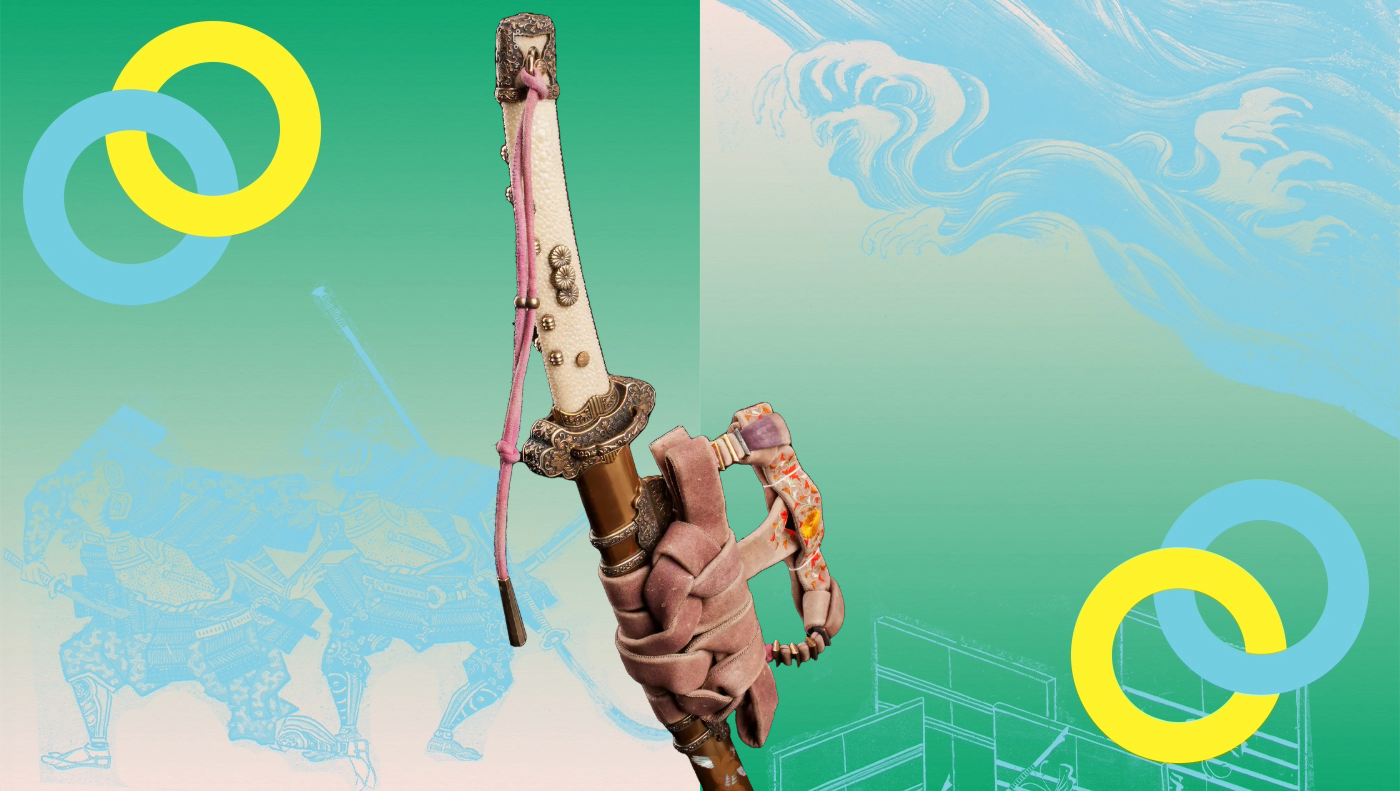
In Japanese war literature, warriors fight in a ritual as formalised as an exchange of courtesies: naming, recitation of ancestors, challenge. Then one gallops towards the other and draws his sword.
The sword drawn in this was the tachi.
It was no quick draw. The tachi hung edge-down from two leather loops at the belt — the manner of wear alone distinguishes it from the later katana. To draw it, the warrior had to shake it from the scabbard, almost weightlessly from the saddle. A skill that took years. For one who mastered it, the tachi was the ideal weapon of the mounted fighter.
In the sword collection of the Samurai Museum Berlin — over forty signed blades — tachi, uchigatana and their transitions tell the entire history of Japanese sword development.
What Is a Tachi? Definition and Distinction
The tachi is the long, curved single-edged sword of the Japanese Heian and Kamakura periods. Its formal distinction from the katana is precise and multidimensional:
Manner of wear: The tachi is worn suspended — edge down, fastened to two hanging metal fittings. The katana is thrust into the belt — edge up. This difference is functional: drawing the tachi from horseback requires a different movement kinematics than the standing katana draw.
Length and geometry: Tachi tend to be longer than katana (over 60 cm blade length, often 70–80 cm), with stronger curvature (Koshi-zori — curvature near the tang) and a narrower point (Ko-kissaki). These parameters varied considerably depending on era and forging school.[1]
Tang and signature: The signature (mei) on the tang (Nakago) is, on tachi, on the side that faces outward when worn suspended — that is, on the opposite side compared to the katana. On a signed piece, the side of the signature thus reveals the original manner of wear.[1]
As Sesko systematically demonstrates in his Encyclopedia of Japanese Swords, there is no clear boundary between tachi and uchigatana (the precursor designation of the katana): many blades were reworked over the centuries (Suriage), remounted and redesignated. A tachi can become a katana by being shortened.[1]
The Development: From Chōkutō to Tachi
The tachi did not fall from the sky. It is the result of a centuries-long development process that began in Korea and China.
The earliest Japanese swords were straight — Chōkutō, direct adoptions of Chinese models from the Kofun period (3rd–7th century). As a weapon for foot soldiers and for display, the straight chōkutō was sufficient. When Japan fought at its frontiers against the Emishi in the 8th and 9th centuries and mounted archers became the dominant form of combat, this changed.
The curvature arose — initially probably unintentionally — through the differential hardening process: since the edge cools faster than the spine, the metal contracts unevenly during quenching and produces the characteristic curve. Master smiths recognised that this curve had advantages: it strengthens the cutting force in the swing from horseback and makes the withdrawal in an arc movement more efficient.[2]
The classic tachi of the Kamakura period (1185–1333) was the result of this optimisation: blade length 70–80 cm, curvature near the tang, narrow elegant point, with a hilt elaborately decorated with silk cords. These swords were works of art and weapons at the same time.
The patronage structure of the Kamakura period favoured this quality. Successful smiths had wealthy clients — shōgun, daimyō, high-ranking warriors — who paid for excellent work. The Ōsaka smiths of the 13th century, the Kyoto smiths, the Bizen forges: all profited from a system in which status was demonstrated through the quality of the sword.
And yet the sword was never merely a weapon. The tachi was a gift between lord and vassal, a present at ceremonies, an heirloom passed down through generations. As Turnbull quotes from contemporary reports: “Hideyoshi guesses the owner of a sword from its style.” — The blade carried the signature of its tradition, and a connoisseur read this signature like a name.[2]
The Gokaden: Five Regional Traditions of Tachi Smithing
The Kamakura period (1185–1333) was the golden era of the tachi — and of Japanese smithing in general. In this epoch, five great regional smithing traditions emerged, which Sesko classifies in his Encyclopedia as Gokaden (五ヶ伝 — “Five Traditions”).[1]
Yamashiro (Kyoto): The most courtly tradition. Blades with an elegant, even curvature (Torii-sori), compact Ko-kissaki point, fine Ko-nie hardening effect. Masters: Awataguchi Tōshirō, Rai Kunimitsu. Target audience: court nobility and the highest warrior elite.
Yamato (Nara): The most religious tradition. Strong contact with the Buddhist monasteries of Nara, which as a political military power ran their own weapons production. Blades with a strict, straight hardening line (Suguha), of military character. Masters: Tegai, Senjūin.
Bizen (Okayama): The most productive tradition. Bizen — today’s Okayama Prefecture — had the best conditions: iron sand (Satetsu) in abundance, fast-flowing rivers for quenching, a centuries-old smithing culture. The Bizen school under the Osafune masters produced more high-quality blades than all other regions combined. Characteristic: gentle curvature, broad blade, the rare Utsuri shimmer effect.
Sōshū (Kamakura): The wildest tradition. The school arose at the seat of the shogunate — with rich patronage. Goro Nyūdō Masamune, its most famous master, created blades with irregular, spectacular hamon patterns and broad, massive blade geometries. Sōshū is regarded as the technically most demanding tradition, because the wild hamon work is harder to control.
Mino (Seki/Gifu): The most pragmatic tradition. Faster to produce, more robust, suited for mass purchase in times of war. The Sengoku period made Mino the most important source for warriors who had to be armed quickly.[1]
The Tachi in Practice: What Karl Friday and the Wound Analyses Say
The image of the tachi in combat is shaped by two sources — and they contradict each other.
The war epics (Gunki Monogatari) depict magnificent single combats: warriors flashingly draw the tachi, engage in elegant duels, die with poems on their lips. That is the literary reality.
Historical research shows something different. Friday demonstrates that in the Heian and Kamakura periods the sword was primarily the weapon of second choice: the mounted warrior first shot arrows until his quiver was empty, and then — in close combat, when riders collided — drew the tachi. “The sword was the weapon of last resort… For the Heian and Kamakura warrior, battle was primarily an exchange of arrows.” (Friday 2004, p. 69)[3]
The O-yoroi armour, designed for Heian warriors, supports this thesis: its sweeping shoulder plates (O-sode) are optimal for shooting the bow from horseback, but hinder any sword swing that comes from the shoulder. The tachi was a complement to the bow, not its replacement.
Conlan’s wound analysis from the 14th century confirms this: 72% arrow wounds, ~20% sword wounds. The sword wounded — but the bow killed.[4]
This does not diminish the quality of the blades. The smiths of the Kamakura period created works of an unsurpassed level — not because the sword was the main weapon, but because status, patronage and craftsmanly pride demanded excellence independently of tactical function.
The Transformation: From Tachi to Katana
Before the tachi disappeared, it experienced a bizarre extreme phase in the Nanboku-chō period (1336–1392): the Enbun-Jōji-sugata — named after the eras Enbun (1356–1361) and Jōji (1362–1368) — describes blades of excessive length: 90 to 150 centimetres, with overlong points (Ō-kissaki) and broad blade geometry. These colossi were developed when combat shifted from mounted single combatants to mass-infantry battles — the tachi was, in a sense, overstretched into a polearm before it was superseded by shorter forms. Sesko categorises these transitional forms precisely: they show how quickly smiths reacted to tactical requirements, even if the result appears in retrospect like a dead end.[1]
With the change in warfare in the Nanboku-chō period (1336–1392) — mass infantry instead of a mounted elite — the specific tachi manner of wear lost its tactical basis. Foot soldiers could not use a suspended sword efficiently; they needed something that could be drawn while standing.
The Uchigatana (literally: “striking sword”) established itself as the new form: shorter, worn edge up in the belt. From the uchigatana came what we today call the katana. The transition was gradual, not abrupt — and with many blades not clearly categorisable.
Sesko shows that the practice of Suriage (blade shortening) was widespread: when a tachi became too long or too heavy — or when the owner switched to the foot infantry — he had the tang shortened and the blade remounted. In doing so, the signature was often cut off or relocated.[1]
This explains why many historical “katana” are actually shortened tachi — objects that have lost their original form but retained their original quality.
Gassan Sadakazu: The Last Great Tachi
Display case H04V of the Samurai Museum Berlin preserves a sword by Gassan Sadakazu (1836–1918) — one of the last and most significant smiths of the Shinshintō renaissance.
Gassan Sadakazu was born in the province of Ōmi, was adopted by the master Gassan Sadayoshi and completed training in several smithing traditions. In 1907 he received the title Teishitsu Gigei-in — imperially authorised craftsman, precursor of today’s “Living National Treasure”. He made one of his blades at the age of fourteen; it is in the Berlin collection.
Gassan Sadakazu mastered all five Gokaden traditions, but was especially known for the Gassan school, which works with the characteristic Ayasugi-hada — a wave-shaped forging pattern. This technique, named after the ayasugi cypress wood whose grain it imitates, makes Gassan blades visually recognisable at once.[1]
Tamahagane: The Material Behind the Perfection
Behind every tachi stands a material that is hardly produced any more today: Tamahagane — literally “jewel steel”.
The process begins with Satetsu, the black iron sand found in the rivers of Japan, especially in the San’in region (Shimane, Tottori), in deposits. In the Tatara furnace — an earth-bound charcoal smelter operated continuously for three days and three nights — this sand melts into a heterogeneous lump of steel containing various carbon contents: from soft wrought iron to hard, brittle steel.
The smith breaks up this lump, selects the pieces with the right carbon content — a judgement from experience, not from measurement — and begins the actual forging work.
Sesko emphasises in his Encyclopedia that “tamahagane” does not simply mean “good steel”, but a specific production method: “Tamahagane is the traditional Japanese steel product from the Tatara process and the criterion for a Nihontō (Japanese sword) in the legal sense.” (p. 81)[1]
The folding — often wrongly described as “hundreds of thousands of layers” — is in reality a homogenisation process: the heterogeneous tamahagane block is made more uniform through repeated heating, hammering and folding. An average tachi contains, after ten to fifteen foldings, about 32,768 layers — considerably fewer than popular depictions claim, but enough for the required uniformity.
The actual innovation is the composite construction: a hard Kawagane jacket (outer steel) encloses a softer Shingane core (inner steel). The jacket takes on the sharp hardening line (Hamon) and stays keen; the core absorbs blows and prevents breaking. This is not a Japanese invention — comparable composite techniques existed in Europe and the Near East — but the Japanese differential hardening (Yaki-ire) is unique in its execution.
The Hamon: Where Aesthetics and Function Coincide
The hardening line (Hamon) is the most beautiful and technically most demanding element of every tachi.
It arises through the Yaki-ire — the quenching. Before heating, the smith applies a clay mixture to the blade: thick on the spine (Mune), thin on the edge (Ha). During rapid quenching in cold water, the thin clay layer near the edge cools faster than the thick spine area. This different cooling speed produces different crystal structures in the steel: the edge becomes martensitic (hard, brittle), the spine remains pearlitic (soft, tough).
The boundary line between these crystal structures is the Hamon.
Sesko describes the subtleties: Nie — visible martensite crystals that appear like sparkling stars on the hardening line — and Nioi — a milky mist of the same crystals in finer form. Bizen blades tend towards Nie, Yamashiro blades towards Nioi. By this alone an expert can identify the school of a blade.[1]
Among the hamon forms there are Suguha (straight line, typical of Yamato), Notare (gentle waves, Bizen), Gunome (wave crests) and the spectacular wild variations of the Sōshū school under Masamune. Each form is an aesthetic decision and a technical statement at once.
Tachi at the Samurai Museum Berlin: The Collection at a Glance
The Samurai Museum Berlin owns over forty signed blades — one of the most significant private collections outside Japan.
Display case H04V focuses on the smithing tradition: two pieces by Gassan Sadakazu document the Shinshintō renaissance of the late 19th century. Another highlight is a tantō with the hardening test stamp (Tameshi) of 1672 — the inscription on the tang reads: “25th day of the eleventh month of Kanbun twelve — Futatsu-dō kiri-otoshi (two bodies severed) — Yamano Kanjūrō Hisahide.” A document of real use engraved in iron.
These blades are no museum of nostalgia. They are documents of a craft tradition that runs in a direct line from the Kamakura smiths to Gassan Sadakazu — over seven centuries in which the weapon changed but the principle remained: beauty and function as an inseparable unity.
Conclusion: Why the Tachi Is More Than a Predecessor
The tachi is not simply the older model before the katana. It is an independent art form — optimised for a specific form of combat, brought to perfection by a group of master smiths, and become a symbol of an entire epoch.
The blades in the collection of the Samurai Museum Berlin — above all the Gassan Sadakazu pieces in display case H04V — show that this tradition did not end with the Haitōrei of 1876. The great masters of the Meiji era worked in the same techniques, with the same materials, according to the same principles as their forebears of the Kamakura period. Not because they knew nothing new, but because they considered the old worth preserving.
Frequently Asked Questions About the Tachi
What is the difference between tachi and katana?
The most important differences: manner of wear (tachi suspended/edge down, katana thrust in/edge up), signature side (faces outward on the tachi when suspended), and tendentially length and curvature position. Many historical blades were reworked and reclassified over time, so the boundary is fluid.
Was the tachi really the most important weapon of the Heian samurai?
No. The bow (Yumi) was the primary weapon. The tachi was the emergency weapon, when arrows were used up. Karl Friday demonstrates: “The sword was the weapon of last resort… battle was primarily an exchange of arrows.” The O-yoroi armour was designed for the archer, not for the swordsman.
What are the Gokaden?
The five great regional smithing traditions of Japan: Yamashiro, Yamato, Bizen, Sōshū and Mino. They differ in blade geometry, steel properties, hardening styles and aesthetics. Classified and systematised by Markus Sesko in the Encyclopedia of Japanese Swords.
What is Suriage?
Suriage denotes the shortening of a tachi by cutting down the tang. This was done frequently when a tachi was considered too long or was to be repurposed into a katana. In doing so, the smith’s original signature was often cut off — which considerably complicates the expertise for collector’s pieces.
Who was Gassan Sadakazu?
Gassan Sadakazu (1836–1918) was one of the most significant Japanese swordsmiths of the Meiji era. He mastered all Gokaden traditions and received in 1907 the imperial title Teishitsu Gigei-in. Two of his blades are in the collection of the Samurai Museum Berlin (display case H04V), among them a sword dated to Emperor Taishō’s coronation in 1915.
Visit the Samurai Museum Berlin
The sword collection of the Samurai Museum Berlin comprises over forty signed historical blades — including pieces by Gassan Sadakazu and documentations of all the important smithing traditions. Display case H04V preserves two Gassan Sadakazu pieces that document the tradition of Shinshintō smithing. Open daily from 10 a.m. to 7 p.m., Auguststraße 68, Berlin-Mitte.
Related Articles
- Katana: The Sword of the Samurai
- Daishō: The Pair of Swords of the Samurai
- Japanese Smithing
- Gokaden: The Five Smithing Traditions
- The Heian Period
Show Sources
Primary Sources
[1] Sesko, Markus (2014). Encyclopedia of Japanese Swords. Lulu Enterprises. Used: blade anatomy (pp. 5–8), Gokaden definition (p. 95), Enbun-Jōji-sugata (p. 55), tachi-uchigatana distinction (pp. 7–8), Suriage (p. 480).
[2] Turnbull, Stephen (2010). Katana: The Samurai Sword. Osprey Publishing. Used: tachi development (pp. 8–15), forging process (pp. 16–27), Heian warrior (p. 23).
Secondary Literature
[3] Friday, Karl F. (2004). Samurai, Warfare and the State in Early Medieval Japan. Routledge. Used: bow as primary weapon (p. 69); sword as emergency weapon.
[4] Conlan, Thomas D. (2003). State of War: The Violent Order of Fourteenth-Century Japan. University of Michigan. Used: wound analysis (p. 58); weapon statistics.
[5] Ogawa, Morihiro (ed.) (2009). Art of the Samurai. Metropolitan Museum of Art. Used: tachi exhibits, Heian/Kamakura blade development (p. 88).
Museum Catalogues
[6] Samurai Museum Berlin (2025). SMB Katalog 2025. Display case H04V (Gassan Sadakazu, two blades — tantō and sword).
You might also like
Jinbaori: The Surcoat of the Samurai
Jinbaori — the samurai's field-camp coat made of European wool. History, material, symbolism. Exhibits at the Samurai Museum Berlin.
Read the article
Ō-Yoroi: The Great Armour of the Heian Samurai
Ō-Yoroi – the great armour of the Heian samurai. Not decoration, but a machine for the mounted archer. History &…
Read the article
Daishō: The Pair of Swords of the Samurai — Symbol and Meaning
The daishō – two swords, one status badge. History, symbolism & craftsmanship of the samurai pair of swords, with originals…
Read the article