 Nominated for the EMYA2026 award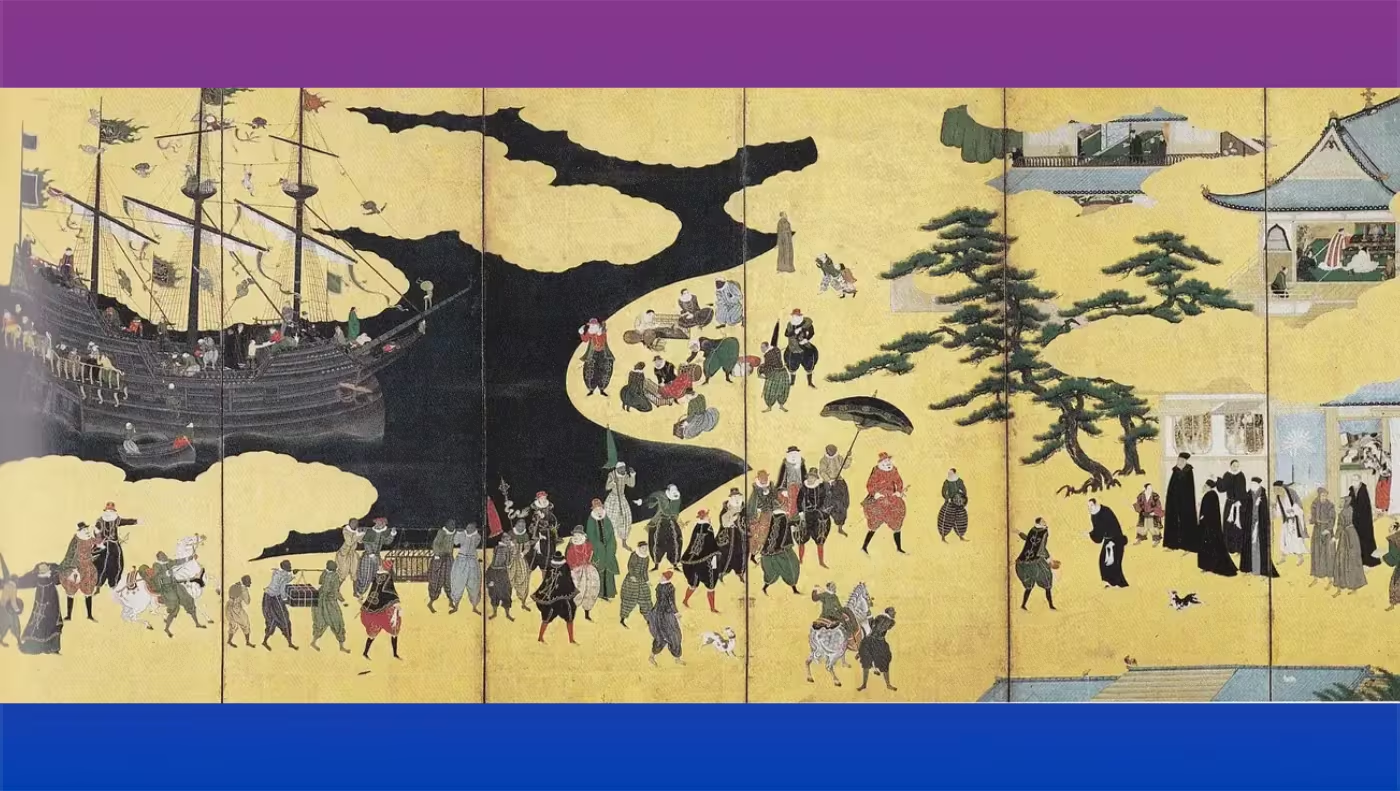
In March 1581, a man entered the streets of Kyoto and threw the city into uproar. His stature towered over most Japanese by a head. Hundreds gathered to see the stranger — so many that several people were reportedly trampled to death in the crush. This man’s name was Yasuke, and he would enter Japanese history as the first documented African.
Between 1581 and 1582, Yasuke served the most powerful warlord in Japan at the time: Oda Nobunaga. During this brief period he apparently received a house, a stipend, and a sword — privileges that seemingly made him the first African samurai. Yet despite the fascination his story continues to exert to this day, the historical sources are alarmingly thin.
Arrival in Japan (March 1581)
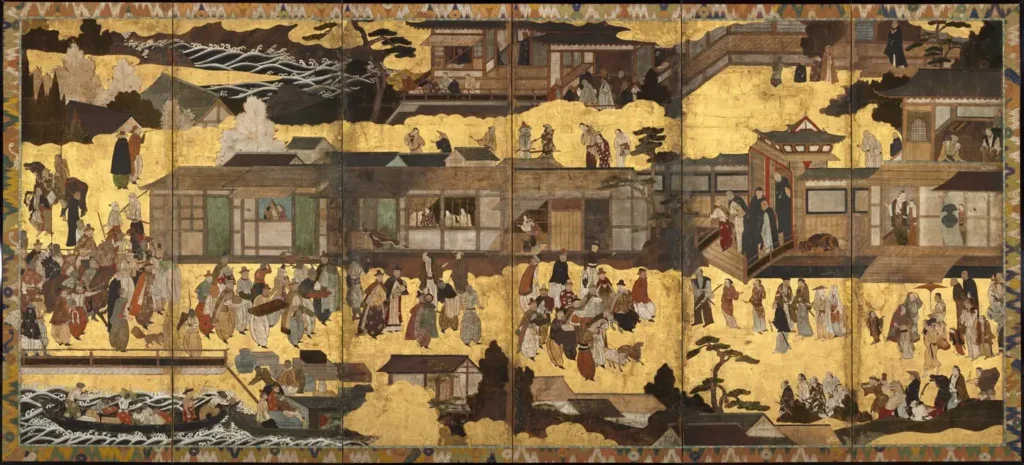
The African warrior did not come to Japan as a free man. He accompanied Alessandro Valignano, the Italian Visitor of the Jesuit mission in Asia, as his bodyguard or servant. Valignano reached Japan in 1579 via Goa and Macau. The exact date of arrival in Kyoto is recorded in the diary of the samurai Matsudaira Ietada: 23 March 1581.
The sources are largely silent about Yasuke’s origins. The historian Thomas Lockley considers a Sudanese or Ethiopian origin more likely than Mozambique — possibly from the Dinka people, who are known for their exceptional height. On his arrival, Yasuke probably spoke Portuguese and had spent years in the service of the Jesuits.
News of Yasuke’s presence also reached Oda Nobunaga. When Nobunaga heard of Yasuke, he ordered that he be brought to him. At first Nobunaga did not believe the skin color was real — he had him scrubbed. When the skin remained black, his fascination was kindled. At a time when almost no one in Japan had ever seen an African, this was less racism than an expression of scientific curiosity.
In the Service of Oda Nobunaga (1581–1582)

Exactly how Yasuke moved from Valignano’s service into Nobunaga’s household is unclear. What is certain is that he entered Nobunaga’s service in the spring or summer of 1581. The privileges he received were extraordinary: a house, a stipend, and a sword. The sword was no trifle — it was the central symbol of the warrior class, the boundary between warrior and non-warrior.
He was referred to as a kosho — a term meaning “sword-bearer” or “weapon-bearer,” belonging to the personal household of a daimyō. His imposing stature — contemporary sources speak of over six feet (about 188 cm) — made him an unmistakable presence. In a culture that highly valued presentation and status, he was probably also a prestige object.
Kosho vs. Samurai — What Was Yasuke Really?
Whether Yasuke can be called a samurai depends on how one defines the term. In the 16th century, the meaning was more fluid than in the later Edo period. The principle of heinō bunri — the “separation of warriors and peasants” — was only systematically enforced from 1585 onward by Toyotomi Hideyoshi. In 1581, theoretically any wealthy peasant could own weapons.
Functionally, Yasuke was a samurai: he lived like a samurai, fought like a samurai, was treated like a samurai. Yet the contemporary sources never explicitly call him so — they use terms such as “servant” (kerai) or kosho. Possibly because his African origin placed him outside the usual categories in Japanese eyes.
The Battle of Honnō-ji (21 June 1582)
In the early morning of 21 June 1582, Akechi Mitsuhide’s troops surrounded the Honnō-ji temple in Kyoto, where Nobunaga was spending the night with about 30 to 50 men — Yasuke among them. Nobunaga immediately recognized that the situation was hopeless and committed seppuku. The temple was set ablaze to conceal his head from his enemies.
Yasuke fought during the attack and afterward fled with survivors to Nobunaga’s son Oda Nobutada at nearby Nijō Castle. There too, resistance was futile. Nobutada committed seppuku. Yasuke was taken prisoner.
Akechi Mitsuhide decided not to kill the prisoner. According to surviving Jesuit reports, Akechi did not regard him as a full Japanese samurai and had him handed over to the Jesuits — and Yasuke vanished from the history books.
After Nobunaga’s Death: The Disappearance
What became of him after June 1582 is a mystery. The contemporary sources — Jesuit letters, Japanese chronicles, war diaries — never mention Yasuke again. Thomas Lockley’s main theory: he probably returned to India, possibly to Goa. Whether he left Japan or found a place there remains unresolved.
The silence of the sources perhaps says more than any speculation. To the Japanese chroniclers, Yasuke was only ever relevant in the context of Nobunaga. After Nobunaga’s death, he no longer had any independent historical significance.
Five Myths About Yasuke — and What Is Really True
Myth 1: “Yasuke commanded troops and led armies.” Not a single contemporary source describes him as a general or mentions that he ever commanded troops. His role was that of a kosho — personal bodyguard and sword-bearer.
Myth 2: “He came from Mozambique.” The sources are silent on his exact origin. Lockley suspects Sudan or Ethiopia.
Myth 3: “Yasuke saved Nobunaga’s head at Honnō-ji.” No source confirms this. It was Mori Ranmaru, Nobunaga’s page, who set the temple on fire.
Myth 4: “He became a rōnin afterward.” The sources are entirely silent about his fate after 1582.
Myth 5: “He spoke fluent Japanese.” Possible, but not documented. The sources never mention his language skills.
Yasuke’s Legacy
Yasuke’s story is proof that the world of the 16th century was more global and interconnected than we often think: African servants in Portugal, Portuguese Jesuits in India, Italian missionaries in Japan, Japanese warlords with an interest in European technology — all of this was part of a network that spanned continents.
The Netflix anime series “Yasuke” (2021) and video games such as Assassin’s Creed: Shadows have established his name in popular culture — but have also blurred the line between historical person and fictional figure. Yasuke does not need to be made into a general to make his story significant. His actual story is extraordinary enough.
Conclusion: What We Know — and What We Don’t
Documented facts: He came to Japan in March 1581 as a companion of Valignano. He entered the service of Oda Nobunaga and received a house, a stipend, and a sword. He served as a kosho (bodyguard/sword-bearer), not as a troop commander. He fought on 21 June 1582 during the attack on Honnō-ji, was taken prisoner, and survived. After his handover to the Jesuits, he vanished from all historical sources.
Not verifiable: his exact origin, his language skills, his fate after 1582, whether he was formally recognized as a “samurai.”
Frequently Asked Questions About Yasuke
Who was Yasuke?
Yasuke was an African man who served the Japanese warlord Oda Nobunaga in 1581–1582. He is the first African known by name to be documented in Japan as a servant of a daimyō. He served as a kosho (sword-bearer/bodyguard) and received a house, a stipend, and a sword — signs of high status.
Was Yasuke really a samurai?
Functionally, yes — he carried weapons, served a daimyō, received a stipend and a house. Formally, it is unclear: the contemporary sources never call him “samurai,” but rather kosho or kerai (servant). In the transitional period of 1581, before the systematic separation of social classes by Hideyoshi, the boundaries were fluid in any case.
Where did Yasuke come from?
The sources are silent on this. The historian Thomas Lockley suspects an East African origin — possibly Sudan or Ethiopia, perhaps from the Dinka people. The widespread assumption of “Mozambique” is not documented.
What happened after Nobunaga’s death?
Akechi Mitsuhide handed Yasuke over to the Jesuits after the defeat at Honnō-ji. After that he vanished entirely from the historical sources. His further fate is unknown.
Visit the Samurai Museum Berlin
The Samurai Museum Berlin displays armor, helmets, and weapons from the Azuchi-Momoyama period (1573–1615) — the era in which Yasuke lived and served. Open daily from 10 a.m. to 7 p.m., Auguststraße 68, Berlin-Mitte.
Related Articles
- Oda Nobunaga: The First Unifier of Japan
- Sengoku Jidai: The Age of the Warring Provinces
- Tōsei Gusoku: The Armor of the Sengoku Era
Bibliography
- Lockley, Thomas & Girard, Geoffrey (2019): African Samurai. Hanover Square Press.
- Hall, John Whitney (ed.) (1991): The Cambridge History of Japan, Vol. 4. Cambridge University Press.
- Turnbull, Stephen (2022): War in Japan 1467–1615. Osprey Publishing.
- Oyler, Elizabeth (2006): Swords, Oaths, and Prophetic Visions. University of Hawai’i Press.
© Samurai Museum Berlin – All rights reserved
You might also like
Kusunoki Masashige: Japan’s Most Loyal Warrior
Kusunoki Masashige – guerrilla tactician, imperial loyalist, myth. Who was the most loyal samurai really? History, facts & exhibits at…
Read the article
Toyotomi Hideyoshi: From Peasant’s Son to Ruler of Japan
Toyotomi Hideyoshi (1537–1598): how a nameless foot soldier became the unifier of Japan. History, reforms & exhibits at the Samurai…
Read the article
Battle of Sekigahara 1600: Japan’s Decision — Won through Betrayal
Sekigahara 1600 — Japan's largest samurai battle, decided by betrayal. Course, strategy, consequences. Exhibits at the Samurai Museum Berlin.
Read the article