 Nominated for the EMYA2026 award
A sword cuts through bamboo as if it were paper. The blade glitters in the sun, the edge so sharp that it slices silk in mid-fall. In films, the katana effortlessly splits other swords. Video games show samurai cutting down armoured opponents with a single stroke. The katana is regarded as the sharpest, strongest, most perfect sword in history.
But is that true?
The truth is more complicated – and more interesting. The katana is neither the „best sword in the world“ nor mere Hollywood exaggeration. It is the result of a thousand years of technological adaptation to Japan’s specific conditions: iron scarcity, cavalry tactics, urban duels, social hierarchy. The blade that lies in museums today or is mythologised in action films was for centuries a precise tool for a brutal profession.
The Samurai Museum Berlin houses one of the most extensive samurai collections in Europe – including 48 authentic katana from the Kamakura period (1185–1333) to the Meiji Restoration (1868–1912).
The 3 Biggest Myths About the Katana – What Is Really True?
Pop culture loves the katana. Films, anime and video games have turned the Japanese sword into a super-weapon that ignores physics and metallurgy. Some of these myths are so old that they were already being spread by Western collectors in the 19th century. Others are modern inventions. Here are the three most persistent legends – and what scholarship has to say about them.
Myth 1: „The katana can cut through anything – even other swords“
The myth: In Highlander, katana cut through European longswords like butter. The message: the katana is so superior that even steel is no obstacle.
The reality: The edge of a katana reaches a hardness of 60–62 on the Rockwell scale (HRC). This makes it extremely sharp – but also brittle. A direct impact on hardened steel results in chips (ha-gire) or fractures. No sword can „cut through“ another, because both are made of similarly hard material. The laws of physics apply in Japan too.
The blade carries this brittleness in its very construction: fine lines of martensite, called Ashi, run through the hardened zone (yakiba). Markus Sesko, the leading Western expert on Japanese sword terminology, describes their function:
„Ashi were first introduced to straight hamon patterns to limit the maximum size of a lateral crack of the yakiba to the distance between two ashi. In other words, ashi act as ‚crack stopper’.“
Sesko, Encyclopedia of Japanese Swords, p. 19
In other words: the forging technique anticipates cracks. The ashi limit the damage so that the blade does not break entirely. A sword that could „cut through anything“ would not need these safety mechanisms.
Karl Friday, professor at the University of Georgia and an expert on samurai combat techniques, confirms: sword-against-sword fights were rare. The Kashima-Shinryū tradition, one of the oldest sword schools in Japan, primarily teaches evasive manoeuvres and disarming techniques – not blocking strikes with one’s own blade. „The edge-to-edge clash so beloved of Hollywood would have been seen as a failure of technique“ (Friday, Legacies of the Sword, p. 45).
Conclusion: The katana cuts bamboo, straw mats (tatami) and unprotected flesh superbly. Against metal it fails – like any other sword.
Myth 2: „The katana was the main weapon of the samurai“
The myth: The samurai is the man with the sword. Whether in The Last Samurai – the katana is omnipresent, the bow a footnote.
The reality: Until the 16th century, the bow (yumi) was the most important weapon on the battlefield. The sword was a backup weapon and status symbol, not the primary means of combat.
Friday documents: in the Kamakura period (1185–1333), samurai wore the sword at the belt, but their identity was defined by the bow. A warrior without skill in archery was not a fully fledged samurai, regardless of his swordsmanship (Friday, Legacies of the Sword, p. 67).
The Metropolitan Museum in New York confirms this hierarchy in its arsenal analysis: of 127 documented Kamakura weapons in Japanese collections, 89 are bows, 23 are spears (yari) and only 15 are swords. „The sword’s prominence in modern imagination reflects Edo-period (1603–1868) peacetime culture, not battlefield reality“ (Ogawa, Art of the Samurai, p. 88).
Only when firearms (tanegashima) rendered cavalry tactics obsolete in the mid-to-late 16th century did the sword gain military significance. In the urban duels of the Edo period it became the dominant tool – but by then there were no more battles.
Conclusion: The samurai was a warrior with many weapons. The katana only became a symbol once peace broke out.
Myth 3: „Japanese steel (tamahagane) is the best in the world“
The myth: The traditional smelting in the tatara furnace produces a mystical „super-steel“ that is superior to all other metals.
The reality: Tamahagane is the result of iron scarcity, not of superiority. Japan did have mineable iron ore deposits, but iron was also obtained from magnetite sand (satetsu) washed out of riverbeds.
The tatara process takes three days and three nights at temperatures between 1,200 and 1,500 degrees Celsius. The yield: about one tonne of raw steel per smelt, of which only a fraction has the necessary quality for blades. The carbon content is 1–1.5 % – similar to 19th-century European Krupp steel.
Markus Sesko explains the metallurgical reality:
„Gunsui steel is close to tamahagane except for the high manganese content. The name gunsui-tō goes back to the company which produced the steel, the Gunma Suiden Co., Ltd.“
Sesko, Encyclopedia, p. 81
In other words: modern industrial steel (such as Gunsui, produced for military swords in the Second World War) achieves properties similar to or better than traditional tamahagane. The elaborate smelting was a makeshift solution, not a sign of superiority.
Stephen Turnbull, the leading English-language expert on samurai weapons, writes: „Japanese swordsmiths were not working with superior raw materials. They were making the best of what their geography provided“ (Turnbull, Katana, p. 24).
Conclusion: Tamahagane demonstrates the mastery of technique, not the superiority of the material.
Sources for this section
- Sesko, Markus (2014): Encyclopedia of Japanese Swords, p. 19
- Friday, Karl F. (1997): Legacies of the Sword: The Kashima-Shinryū and Samurai Martial Culture, pp. 45, 67
- Ogawa, Morihiro (2009): Art of the Samurai: Japanese Arms and Armor, 1156–1868, p. 88
- Sesko, Markus (2014): Encyclopedia of Japanese Swords, p. 81
- Turnbull, Stephen (2010): Katana: The Samurai Sword, p. 24
What Is a Katana? Definition and Distinction
The precise definition
A katana is a single-edged, curved long sword with a blade length (nagasa) of more than 60.6 centimetres – which corresponds to 2 shaku in the traditional Japanese system of measurement. The blade is differentially hardened: the edge consists of hard martensite (60–62 HRC), the spine of softer pearlite (30–40 HRC). This construction makes the blade simultaneously sharp and fracture-resistant.
The decisive feature: the katana is worn in the belt (obi) with the edge facing up. This manner of wearing (uchigatana-style) allows an immediate draw and attack in a single motion (nukitsuke) – an advantage in urban duels and confined spaces.
The curvature (sori) varies by era, but is typically 1.5 to 2 centimetres on a 70-centimetre blade. It is not produced by mechanical bending, but by the differential hardening: the edge contracts more strongly than the spine as it cools.
Distinction from other Japanese swords
The katana belongs to a family of weapons that are often confused with one another. The distinction is based on length, manner of wearing and era:
Tachi (太刀) – The predecessor
- Era: Heian period (794–1185) to Muromachi period (1392–1573)
- Length: 70–90 cm
- Manner of wearing: edge facing down, hanging from the belt
- Signature: on the outer side of the tang (nakago)
- Purpose: weapon for mounted archers
The tachi was the dominant sword form until warfare shifted from cavalry to infantry combat in the 15th century. The Cambridge History documents: „The transition from tachi to katana marks the shift from mounted archery to infantry tactics during the Sengoku period“ (Yamamura, Medieval Japan, p. 20).
Wakizashi (脇差) – The short companion
- Length: 30–60 cm (1–2 shaku)
- Manner of wearing: together with the katana in the daishō pair
- Purpose: backup weapon, indoor fighting, seppuku
From the Edo period (1603–1868), only the samurai class was permitted to carry two swords. The daishō system (大小, „large-small“) became the visible marker of rank.
Tantō (短刀) – The dagger
- Length: under 30 cm
- Purpose: close combat, coup de grâce, ritual suicide
The anatomy: Parts of the katana
Japanese terminology for sword parts is precise down to the smallest detail. In his Encyclopedia of Japanese Swords, Markus Sesko has catalogued over 1,000 terms – the language itself is proof of the cultural significance of the blade.
The blade body
Kissaki (切先) – The point
The shape of the point reveals the era: a ko-kissaki (small point) is typical of Kamakura swords (1185–1333), an ō-kissaki (large point) of the Nanboku-chō period (1336–1392). The point is set off from the rest of the blade body by a slight ridge line (yokote).
Shinogi (鎬) – The ridge line
This raised line runs parallel to the edge and defines the geometry (shinogi-zukuri). It divides the blade into two planes: shinogi-ji (the flat side) and ji (the main surface). The position of the shinogi determines the balance and the cutting power.
Mune (棟) – The blade spine
The spine is usually forged in iori-mune form: two flat surfaces meeting at a blunt ridge. This „roof shape“ is structurally stable and lighter than a rounded spine.
Ha (刃) – The edge
The edge is not ground evenly, but follows a complex geometry (hira-niku) that tapers towards the point. The edge angle is 15–20 degrees.
Hamon (刃文) – The hardening line
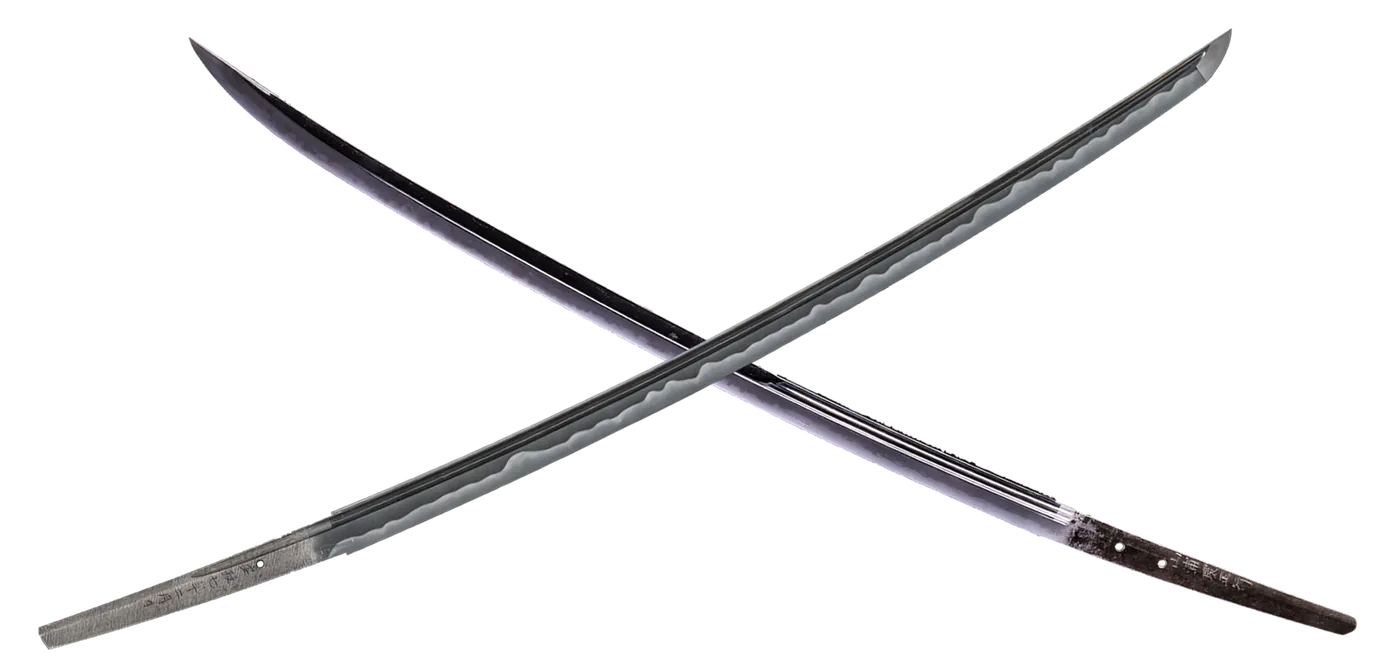
The visible boundary between hardened and unhardened steel. The pattern can be straight (suguha), wave-shaped (notare), clove-shaped (chōji) or wild (gunome). The hamon arises from the crystal structure of the martensite and is not painted or etched. In our sword gallery (display case H03) you can study a particularly characteristic gunome midare hamon on the blade of Hizen Munetsugu – the wave-shaped pattern is a hallmark of the Hizen school.
Nakago (茎) – The tang
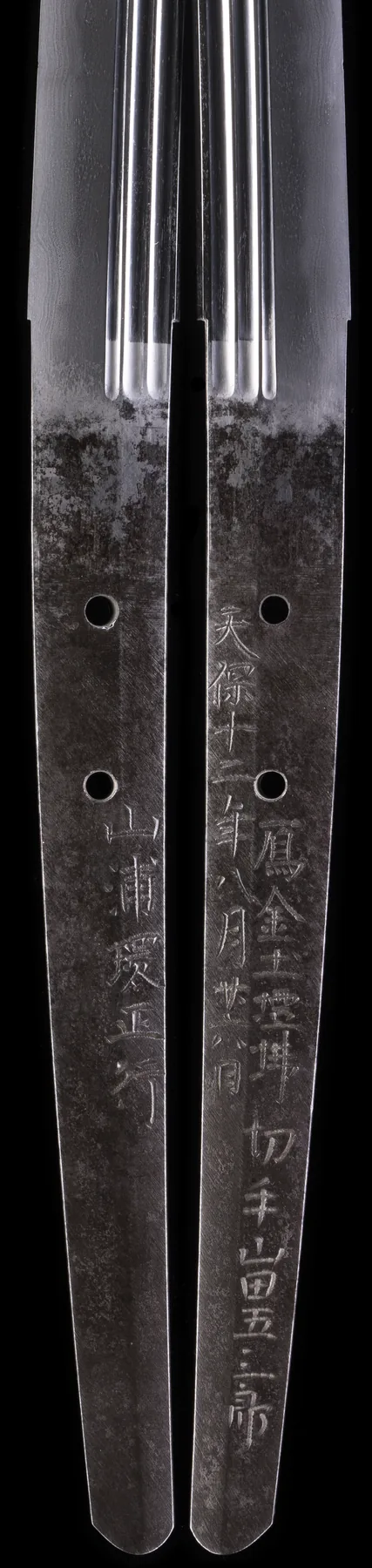
The tang bears the signature (mei) of the smith, the date (nengō) and often additional information (kinzōgan: gold inlays). The rust patina (sabi) must never be removed – it is the blade’s certificate of authenticity. Sesko warns: „The patina of the tang is an important criterion for judging the age of a blade. A polished nakago destroys its historical value“ (Sesko, Encyclopedia, p. 285).
The file marks (yasurime) on the tang are as individual as a fingerprint: katte-sagari (descending diagonally), sujikai (straight), kiri (crossing). Re-cutting them is considered an indication of forgery.
The mounting (Koshirae, 拵)
Tsuba (鍔) – The sword guard
The hand guard protects the hand and serves as a counterweight. They are also works of art: inlaid motifs of gold (kinzōgan), silver (ginzōgan) and a copper-gold alloy (shakudō) depict dragons, cranes, historical scenes. In display case I01 of our exhibition you can see masterpieces of the Higo-Hirata school – one of the four most important tsuba workshops of the 17th to 19th centuries, whose style was shaped by the aesthetics of the tea ceremony.
Tsuka (柄) – The grip
The grip is made of wood, covered with ray skin (samegawa) and wrapped with silk braid or leather strips (tsuka-ito). Two grip ornaments (menuki) lie beneath the wrapping – originally for fastening, later purely decorative.
Fuchi (縁) and Kashira (頭) – Grip fittings
Metal rings at the beginning and end of the grip. They stabilise the construction and often complement the design of the tsuba.
Saya (鞘) – The scabbard
The scabbard is made of wood, lacquered (urushi) and often reinforced with metal fittings. A cotton cord (sageo) allows it to be fastened to the belt. In the Edo period, samurai often wore two-coloured saya: black for service, red for ceremonies.
Sources for this section
- Yamamura, Kōzō (1990): The Cambridge History of Japan, Volume 3: Medieval Japan, p. 20
- Sesko, Markus (2014): Encyclopedia of Japanese Swords, p. 285
How Is a Katana Forged? The 5 Steps
The making of a traditional katana sword takes three to six months. Each step requires decades of experience – one mistake can destroy weeks of work. In our exhibition (display case H02) we explain the process using original tools and intermediate products.
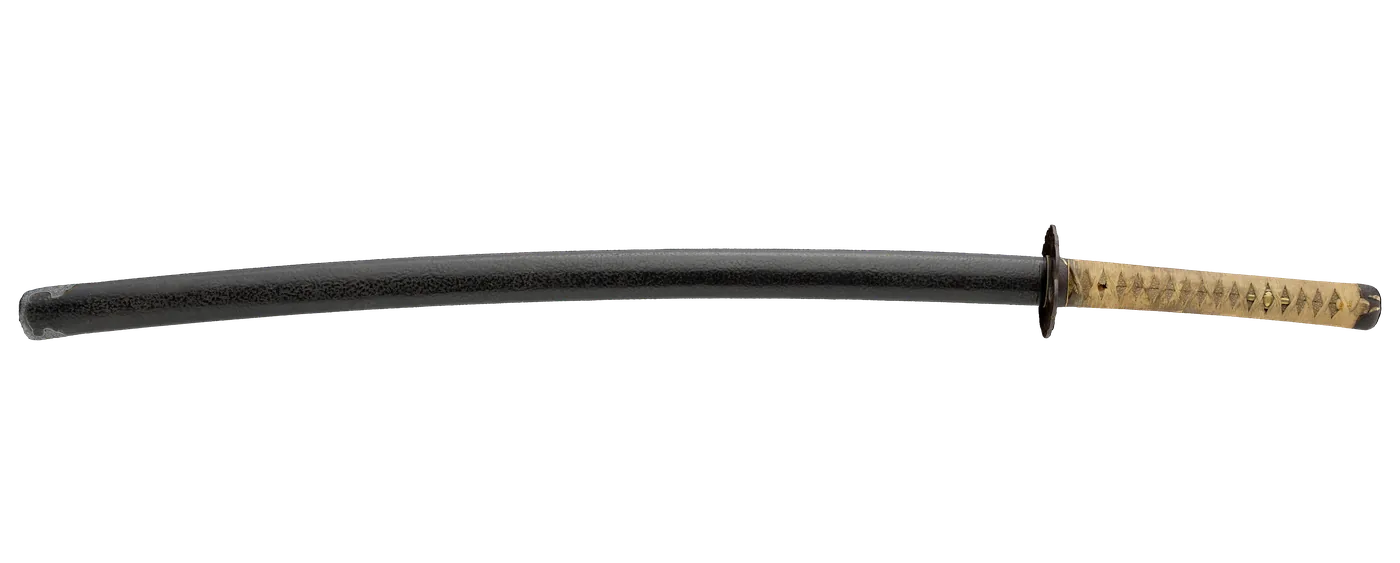
Step 1: Tamahagane – Obtaining the steel
The tatara furnace is a clay structure about 1.2 metres high. For three days and nights, workers burn 13 tonnes of charcoal while feeding in iron sand (satetsu) layer by layer. The temperature reaches 1,500 degrees Celsius – without modern thermometers, controlled only by observing the colour of the flames.
The result: a 2.5-tonne steel block (kera), which is broken up with hammers. Only about 1 tonne is usable steel. The smith sorts the pieces by carbon content:
- Tamahagane (玉鋼, 1.0–1.5 % C): high-carbon steel for the edge
- Hagane (鋼, 1.0–1.5 % C): hard steel for the edge
- Hocho-tetsu (包丁鉄, 0.5–0.8 % C): soft steel for the core
Why no better steel? Stephen Turnbull explains: „Japanese swordsmiths were not working with superior raw materials. They were extracting iron from sand because they had no alternative. The tatara process was a necessity, not a choice“ (Turnbull, Katana, p. 24).
Step 2: Oroshi-gane – Folding the steel
The myth: Folding makes the blade stronger. 10,000 folds create an indestructible weapon.
The reality: Folding homogenises the steel, but does not make it stronger. Each fold doubles the layers:
- 4 folds: 16 layers
- 8 folds: 256 layers
- 12 folds: 4,096 layers
- 16 folds: 65,536 layers
Most traditional blades were folded 12 to 15 times. More folds are pointless: from about 20,000 layers onwards, the carbon diffuses so evenly that further folds have no effect. The steel only becomes thinner.
The process:
- The smith heats a steel block to 1,100 degrees (cherry red).
- He breaks it apart with a hammer and stacks the pieces on top of one another.
- He forges the stacks together (welding by pressure).
- He repeats the procedure.
Why fold at all? Tamahagane from the tatara furnace is heterogeneous – some areas have 0.8 % carbon, others 1.5 %. Folding distributes the carbon evenly, so that the blade does not break at weak points.
The characteristic patterns on the polished blade (hada, 肌) are by-products of folding: masame (straight lines), mokume (wood grain), ayasugi (cedar bark). They demonstrate the skill of the forging, but have no functional significance.
Step 3: Tsukurikomi – The composite construction
A blade of pure steel (60 HRC) would be extremely sharp – but brittle. An impact would break it. A blade of soft iron (30 HRC) would be flexible – but too soft to cut. The solution: composite steel.
The smith combines hard and soft material in layers:
Kobuse (甲伏せ) – The standard construction
- Outside: hard steel (edge + sides)
- Inside: soft iron core
- Result: the edge cuts, the core absorbs impacts
Honsanmai (本三枚) – The three-layer variant
- Edge: hard steel
- Sides: medium-hard steel
- Spine: soft iron core
- Advantage: the sides strengthen the blade against lateral bending
Shihozume (四方包) – The four-layer luxury construction
- Four different steel qualities, layered like a sandwich
- Rare: only master smiths use this technique, as it is extremely difficult
The smith welds the layers at 1,200 degrees and shapes the blade by hammering. The silhouette (sugata) is refined by grinding: the curvature (sori), the thickness (kasane), the balance (motokasane).
Step 4: Yaki-ire – The differential hardening
This is the most critical moment. A mistake here destroys the blade irretrievably.
The smith mixes a paste of clay, charcoal powder and rice-straw ash. He applies it to the blade:
- Edge: thin layer (1–2 mm)
- Spine: thick layer (5–7 mm)
- Transitions: the smith paints the pattern of the hamon with varying thickness of application
The blade goes into the furnace. At 800 degrees Celsius (cherry red) the steel takes up carbon. The colour is the temperature sensor – no traditional smithy uses a pyrometer. Knowledge of the exact colour is the secret of every school.
Then: quenching. The smith plunges the blade into a water bath. The edge cools within seconds and forms martensite – an extremely hard crystal structure. The spine cools slowly and forms pearlite – soft, tough crystals.
The result:
- Edge: 60–62 HRC (hard, sharp, brittle)
- Spine: 30–40 HRC (soft, flexible, tough)
- Curvature: the edge contracts more strongly than the spine – the blade bends
The hamon becomes visible: the boundary between martensite (white, cloudy) and pearlite (dark, smooth). The pattern is not decorative, but the direct result of physics. Markus Sesko stresses: „The hamon is the visible manifestation of the steel’s crystal structure. It cannot be faked by etching or painting“ (Sesko, Encyclopedia, p. 19).
Step 5: Shiage-togi – The final polish
The blade is finished forging – but invisible. The surface is rough, the hamon concealed, the beauty of the steel locked away.
Now the work of the polisher (togishi) begins. This is a profession in its own right, with 10 to 15 years of training. A master polisher earns more in Japan than some smiths.
The process uses 7 to 12 different grinding stones (toishi), from coarse to ultra-fine:
- Binsui (備水倉) – coarse stone (grit 220): removes hammer marks, shapes the geometry
- Kaisei (改正) – medium stone (400): refines the form
- Chu-Nagura (中名倉) – fine stone (800): first polish
- Uchigumori (内曇) – misty-fine (2000): the hamon becomes visible
- Narutaki (鳴滝) – waterfall stone (5000): gloss polish of the edge
- Hazuya (刃艶) – powder stone (8000–10000): final gloss
The last step: nuguigami – a special paper made of rice straw, soaked in uchiko (polishing powder). The polisher dabs the blade until it gleams like a mirror.
Polishing takes 40 to 80 hours for a single blade. One mistake – too much pressure, the wrong angle – destroys weeks of work.
Markus Sesko distinguishes two philosophies:
„It is essential to distinguish between kaji-togi (the smith’s rough polish, focusing on geometry) and shiage-togi (the professional togishi’s final polish, revealing the aesthetic features).“
Sesko, Encyclopedia, p. 185
Why is polishing so important? Without it, the hamon is invisible. The hada (steel pattern) remains concealed. The blade looks like a dull piece of metal. The polish is not optional – it is the difference between weapon and work of art.
Sources for this section
- Turnbull, Stephen (2010): Katana: The Samurai Sword, p. 24
- Sesko, Markus (2014): Encyclopedia of Japanese Swords, pp. 19, 185
The Evolution: From the Tachi to the Katana
The katana did not appear as a finished form. It developed over a thousand years – a slow adaptation to changing warfare, social structures and technological revolutions. The blade that lies in museums today carries the history of Japan in its very shape.
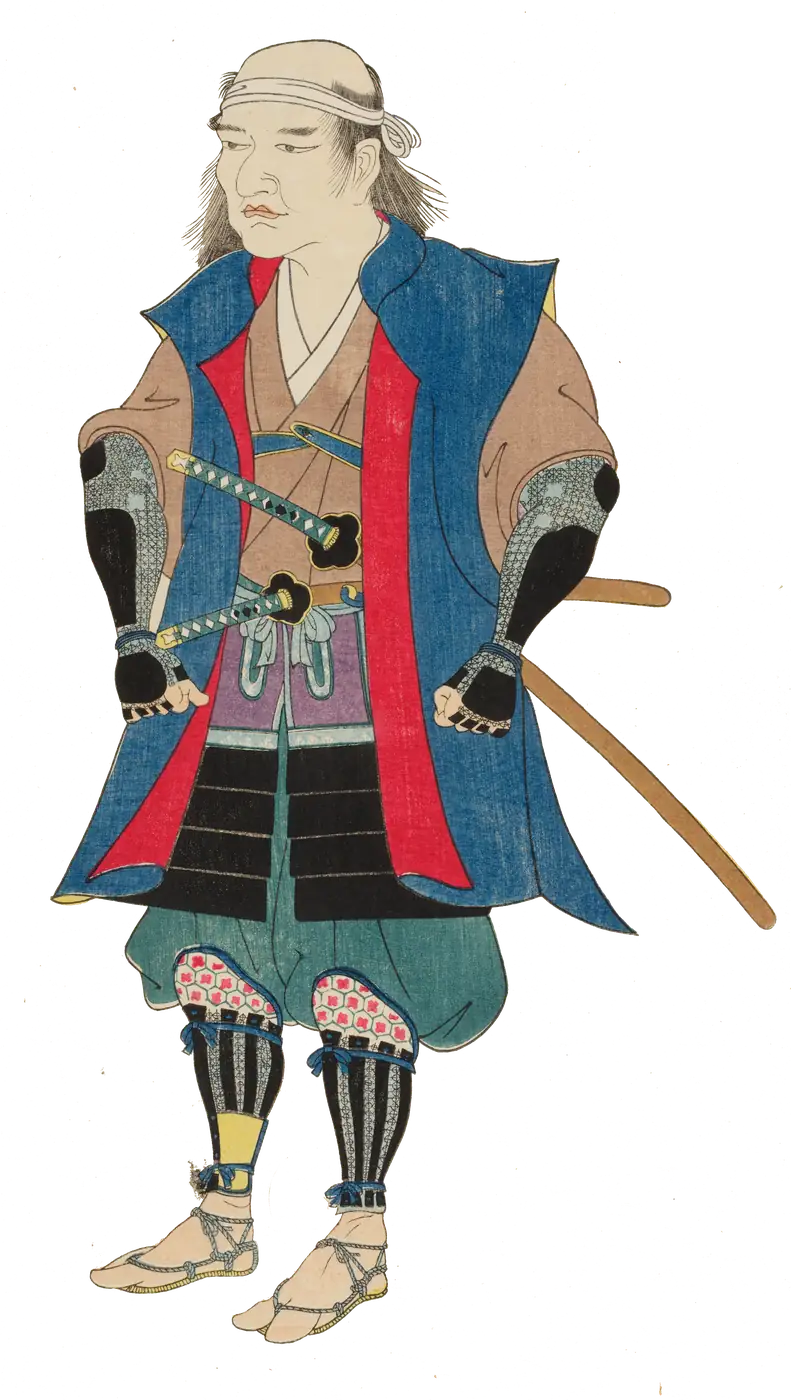
Period designations of Japanese sword craftsmanship
Sword experts divide Japanese blades into four main periods – a system that was standardised in the 20th century:
These categories are not rigid boundaries, but fluid transitions. In our sword gallery (display cases H02–H04) you can compare examples from all four periods.
Heian period (794–1185): The tachi – sword of the horsemen
The warrior of the Heian period fought from horseback. His primary tool was the bow (yumi). The sword hung as a backup at the saddle – edge facing down, hanging from the belt. This weapon was called tachi (太刀, „long sword“).
The tachi was optimised for mounted archers:
- Strong curvature (koshi-zori): the bend lies close to the grip, ideal for strikes from horseback
- Narrow point (ko-kissaki): reduction of weight, focus on cutting rather than thrusting
- Long blade (70–90 cm): reach from the saddle
Why curved? The curvature arose as a by-product of differential hardening. But the smiths retained it, because it increased the cutting power: a curved blade „draws“ through the target rather than merely chopping.
The Cambridge History documents: „The tachi was the weapon of the mounted aristocratic warrior (bushi), who dominated warfare until the Mongol invasions forced tactical changes“ (Yamamura, Medieval Japan, p. 18).
Kamakura period (1185–1333): The perfection – Gokaden
The Kamakura period is regarded as the golden age of Japanese sword-forging. The military elite (buke) financed forging schools in five main regions – the Gokaden, as they came to be described in modern times (五箇伝, „Five Traditions“). In display case H02 of our exhibition we explain the characteristic features of each school:
1. Yamashiro (山城) – Kyoto
- Style: elegant, compact point, narrow hamon
- Famous smiths: Rai Kunitoshi, Awataguchi Yoshimitsu
- Distinctive feature: courtly aesthetics, often for ceremonies
2. Yamato (大和) – Nara
- Style: plain, military, straight blades
- Famous schools: Tegai, Senjūin
- Distinctive feature: forged for temple warriors (sōhei)
3. Bizen (備前) – Okayama
- Style: long gentle curvature, utsuri (shadow hamon)
- Famous school: Osafune
- Distinctive feature: mass production from the Muromachi period onwards, but high quality
4. Sōshū (相州) – Kamakura
- Style: broad blade, wild hamon (rich in nie)
- Famous smiths: Masamune, Sadamune
- Distinctive feature: innovation, hybrid styles
5. Mino (美濃) – Seki
- Style: practical, robust, sharp hamon
- Famous smith: Kanemoto
- Distinctive feature: emerged only late (15th c.), then dominated the mass market
The Gokaden are not rigid categories. Markus Sesko warns: „Many smiths practiced hybrid styles (e.g., Sōden-Bizen, combining Sōshū and Bizen techniques). The Gokaden system was retrospectively imposed by later scholars“ (Sesko, Genealogies, p. 27).
Nanboku-chō period (1336–1392): The giants – Ō-dachi
The Mongol invasions of 1274 and 1281 failed because of typhoons (kamikaze, „divine wind“) – but they exposed a weakness: Japan’s cavalry tactics failed against infantry formations with long spears.
One response: longer swords.
In the Nanboku-chō period, smiths forged blades of absurd length:
- 90–120 cm: large tachi for foot soldiers
- 120–150 cm: ō-dachi („great sword“) – almost as long as a man
- 150+ cm: ōdachi or nodachi – ceremonial weapons, too large for combat
These swords had broad points (ō-kissaki) and disproportionate length. Markus Sesko documents:
„Enbun-Jōji-sugata (延文・貞治姿) refers to the characteristic, oversized sword shapes of the Nanbokuchō period, which peaked during the Enbun (1356–1361) and Jōji (1362–1368) eras.“
Sesko, Encyclopedia, p. 55
Why so large? Foot combat against polearms required reach. A sword had to reach the spears before its bearer came within thrusting range. The ō-dachi were not elegant duelling weapons, but battlefield tools.
Most of these giants were later „shortened“ (o-suriage) – too long for the subsequent age of peace. This shortening process explains why almost all surviving works by Masamune are today preserved as katana, even though he originally forged tachi: the tangs were cut off, the signature lost. Today, original Nanboku-chō blades in full length are extremely rare.
Muromachi period (1392–1573): The birth of the uchigatana
The Muromachi period brought the decisive innovation: the uchigatana (打刀, „striking sword“) – the katana proper.
What changed?
- Manner of wearing: no longer hanging (tachi), but thrust into the belt – edge facing up
- Advantage: drawing and striking in a single motion (nukitsuke)
- Tactics: duel-focused rather than battlefield-focused
Why the change? Three factors:
- Urbanisation: the development of castle towns (jōkamachi) led to narrow alleys and indoor fighting. A hanging sword caught on everything.
- Sengoku Jidai (1467–1603): the century of wars led to mass battles. Foot soldiers (ashigaru) needed cheaper, shorter weapons that were quick to draw.
- Firearms: the arrival of the Portuguese tanegashima (muskets) in 1543 made armour heavier and cavalry riskier.
The Cambridge History documents: „The shift from tachi to uchigatana coincided with the decline of mounted warfare and the rise of infantry tactics during the Sengoku period“ (Yamamura, Medieval Japan, p. 20).
Edo period (1603–1868): The katana as a status symbol
1600: the Battle of Sekigahara. Tokugawa Ieyasu unifies Japan. The Edo period begins – 250 years of peace (Pax Tokugawa).
The katana loses its military function. It becomes a status symbol.
The daishō system (大小)
From 1638, only samurai are permitted to carry two swords:
- Katana (大, „large“): over 60 cm
- Wakizashi (小, „small“): 30–60 cm
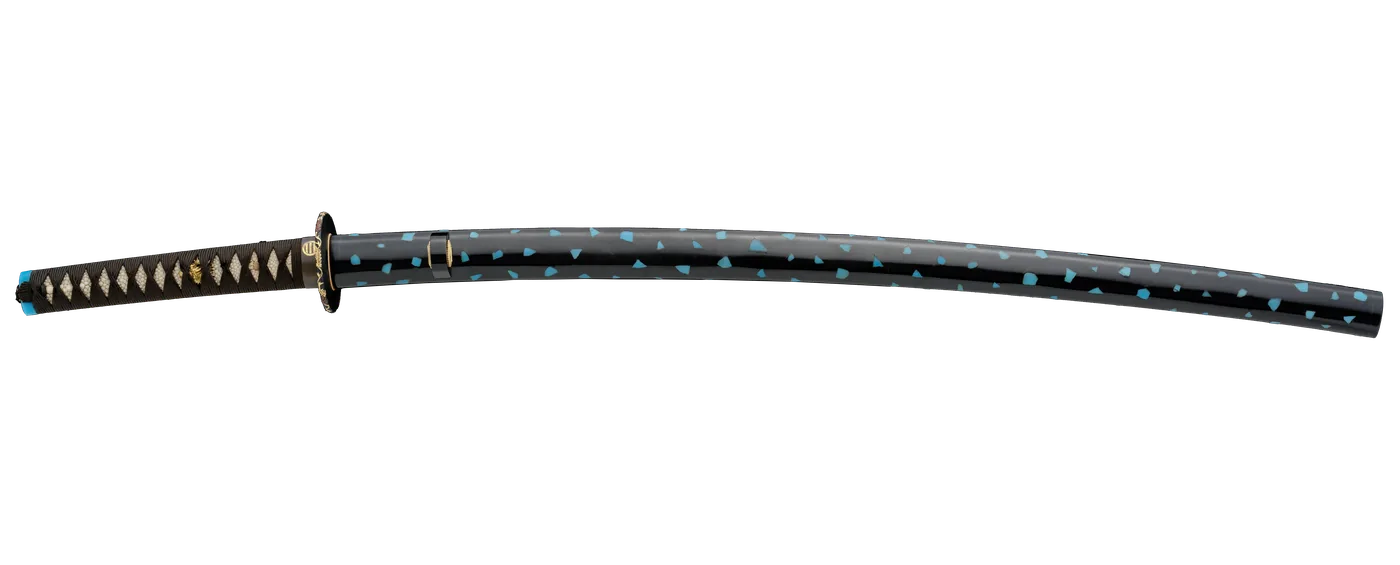
This pair marks the samurai class visually. A peasant with two swords risked execution. In display case C35 of our exhibition you can see an exquisite daishō pair with mountings of blue glass – a testament to the decorative excellence of this peaceful era.
1588: Katanagari (刀狩り) – The sword hunt
Toyotomi Hideyoshi forbids peasants to own weapons. The sword becomes the exclusive privilege of the samurai. The Cambridge History explains: „The katanagari of 1588 enforced class separation (mibun seido), making the sword a legal marker of warrior status“ (Hall, Early Modern Japan, p. 93).
Craft rather than instrument of war
- Tsuba: inlaid motifs (gold, silver, shakudō)
- Saya: lacquered scabbards with family crests
- Menuki: miniature sculptures (dragons, deities)
In display case C37 you can examine a tachi mounting with the Tokugawa family crest (mitsuba aoi, the triple hollyhock). The elaborate gold inlay work shows how the sword was transformed from an instrument of war into a dynastic status symbol.
Meiji period (1868–1912): The end – the Haitorei edict
1868: the Meiji Restoration. The Emperor takes power. Japan opens itself to the West. The samurai class becomes obsolete.
1876: Haitorei (廃刀令) – The sword ban
The government bans the public wearing of swords. The justification: modernisation, the dismantling of feudal privileges. In practice: the disempowerment of the samurai class.
The consequences:
- Hundreds of smithies close or switch to making kitchen knives
- The Gokaden traditions die out (only individual smiths remain)
- Sword ownership becomes stigmatised
1877: The Satsuma Rebellion
The last samurai, under Saigō Takamori, rebel against the sword ban. They fight with katana against rifles. They lose. The age of the samurai ends in blood.
The rebirth
Only in 1933, under the military regime, did sword-forging experience a renaissance. The guntō system (軍刀, military sword) distinguished between shin-guntō (army) and kai-guntō (navy) and financed traditional smiths for officers’ weapons. After 1945, the craft was preserved as intangible cultural heritage (UNESCO 2014). Today there are about 200 licensed smiths in Japan.
The Cambridge History summarises: „The Haitorei edict of 1876 marked the end of the samurai as a social class, but the sword remained – transformed from weapon to symbol of cultural identity“ (Hall, Early Modern Japan, p. 42).
Tachi vs. katana: the key differences
Visual distinction: if the signature on the tang faces up when the sword is worn hanging (edge facing down), it is a tachi. If the signature faces up when the sword is worn thrust into the belt (edge facing up), it is a katana.
Many tachi were later reworked (o-suriage) and worn as katana – the signature reveals the original form.
Sources for this section
- Yamamura, Kōzō (1990): The Cambridge History of Japan, Volume 3: Medieval Japan, pp. 18, 20
- Sesko, Markus (2010): Genealogies and Schools of Japanese Swordsmiths, p. 27
- Sesko, Markus (2014): Encyclopedia of Japanese Swords, p. 55
- Hall, John Whitney (1991): The Cambridge History of Japan, Volume 4: Early Modern Japan, pp. 42, 93
Katana at the Samurai Museum Berlin
Our collection: 48 katana from six centuries
The Samurai Museum Berlin houses one of the most extensive samurai collections in Europe – including 48 authentic katana from the Kamakura period (1185–1333) to the Meiji Restoration (1868–1912). Each blade tells a story: of battles, smiths, families.
Highlights of our collection:
Display case H02 – The Gokaden explained
Here we convey the five great forging traditions of the Kotō period using original examples. About 80 % of all blades forged before 1530 come from schools of these five traditions. The term Gokaden was systematised only in the Meiji period by Hon’ami Kōson (1879–1955) – before that, swords were classified by their province of origin.
Display case H03 – Blade by Hizen Munetsugu (1606)
A signed first-generation Shintō blade, 74 cm long with 1.5 cm curvature. The characteristic gunome midare hamon (wave-shaped with irregularities) is a hallmark of the Munetsugu style. Both sides of the blade bear Buddhist engravings (horimono): a ritual sword with dragons on the outer side, chopsticks for Shintō altars on the inner side.
Display case H04 – Blade by Hizen Tadayoshi with tameshigiri signature
This blade bears a gold inscription (kinzōgan mei) by Yamano Kanjūrō Hisahide (1635–unknown), the official government sword tester from 1685. The signature confirms cutting tests (tameshigiri) on two bodies – a quality certificate of the Edo period.
Display case H04 – Nagamaki with the Tachibana crest
A hybrid weapon between sword and naginata, popular with warlords such as Oda Nobunaga (1534–1582). The extended grip (70–100 cm) made possible powerful swings both on horseback and on foot. This black-lacquered nagamaki bears the mon (family crest) of the Tachibana clan.
Interactive learning: Our exhibition explains not only history, but technique. At interactive stations, visitors can recognise the differences between the Gokaden schools, understand the function of the hamon and trace the evolution of sword forms.
➡️ Book tickets | To the collection
Frequently Asked Questions (FAQ)
How much does a genuine katana cost?
An authentic, historical katana from the Edo period (1603–1868) costs between 5,000 and 50,000 euros, depending on the smith, state of preservation and provenance. Swords by famous smiths (Masamune, Muramasa, Gassan Sadakazu) can cost millions – a Masamune was auctioned in 2019 for 1.2 million dollars. Modern, hand-forged katana (gendaitō) by licensed smiths start at 3,000 euros and can cost up to 30,000 euros. A word of caution: katana under 500 euros are almost always decorative swords from China – not traditionally forged, often made of stainless steel and suitable only for wall decoration.
What distinguishes a katana from a tachi?
The decisive difference lies in the manner of wearing: the tachi is worn hanging from the belt, edge facing down. The katana is thrust into the belt, edge facing up. The signature (mei) on the tang faces outwards in each case – on the tachi facing up, on the katana likewise facing up, but in the reverse manner of wearing. Many tachi were shortened (o-suriage) in the Edo period and worn as katana.
How can I recognise a genuine katana?
Three characteristics: first, the hamon – the cloudy hardening line is visible only on differentially hardened blades, not on modern steel imitations. Second, the nakago with its rust patina – this must never be removed and is the certificate of authenticity. Third, the weight and balance: a genuine katana weighs about 1.1 to 1.4 kilograms and is balanced in the front third. When in doubt, it is worth having it assessed by an NBTHK-certified expert.
Why is the blade curved?
The curvature (sori) arises automatically during the yaki-ire hardening process: the edge cools faster than the spine and contracts more strongly. The smiths retained this effect because the curvature increases the cutting power – a curved blade draws through the target rather than merely chopping. The ideal curvature is 1.5 to 2 centimetres on a 70-centimetre blade.
How long does it take to forge a katana?
A traditional katana requires three to six months of handwork. The five main steps – obtaining the steel, folding, composite construction, differential hardening and polishing – each take weeks. The final polish by a togishi alone takes 40 to 80 hours. A licensed Japanese smith (tōshō) produces a maximum of 24 blades per year.
Are katana legal in Germany?
Yes. Genuine Japanese swords are regarded in Germany as collectors’ items or works of art. Carrying them in public is prohibited under §42a of the Weapons Act. Ownership, acquisition and transport at home or to events is permitted. For blades over 12 cm outside of sporting purposes, it is advisable to carry a copy of the proof of purchase.
Conclusion: The katana between legend and reality
The katana is neither the „best sword in the world“ nor mere pop-culture exaggeration. It is the result of a thousand years of technological adaptation to Japan’s specific conditions: iron scarcity, cavalry tactics, urban duels, social hierarchy.
The truth lies in the middle:
✅ What is true
- Highly developed forging technique (composite steel, differential hardening)
- Aesthetic and functional at the same time
- Cultural significance as the „soul of the samurai“
❌ What is not true
- Not superior to European or Arab swords (different solutions to the same problems)
- Was not the main weapon of the samurai (the bow dominated until the 16th century)
- Cannot „cut through anything“ (physics applies in Japan too)
Modern relevance
Today the katana is an intangible UNESCO cultural heritage (2014). The traditional forging craft is preserved by about 200 licensed smiths in Japan. Each blade requires three to six months of handwork – the technique has barely changed since the Edo period.
In museums such as ours, you can experience this history at first hand: 48 historical katana from six centuries, documented by international experts, explained with scholarly precision.
Visit us at the Samurai Museum Berlin. Stand before a 700-year-old blade from the Kamakura period. See the hamon shimmer – the visible proof of a technique that has endured for many centuries. Recognise the differences between the five Gokaden schools. Understand why Japanese smiths possessed no superiority, but proved their mastery.
➡️ Visit us at the Samurai Museum Berlin and see 48 historical katana from 6 centuries.
Bibliography
Primary sources
- Samurai Museum Berlin (2025). SMB Katalog 2025 ONLINE. Berlin: Samurai Museum Berlin GmbH.
- Sakakibara Kōzan (1800/1962). The Manufacture of Armour and Helmets in Sixteenth Century Japan. Trans. H. Russell Robinson. The Holland Press.
Academic secondary literature
- Friday, Karl F. & Seki, Fumiko (1997). Legacies of the Sword: The Kashima-Shinryū and Samurai Martial Culture. University of Hawaii Press.
- Hall, John Whitney (ed.) (1991). The Cambridge History of Japan, Volume 4: Early Modern Japan. Cambridge University Press.
- Yamamura, Kōzō (ed.) (1990). The Cambridge History of Japan, Volume 3: Medieval Japan. Cambridge University Press.
- Ogawa, Morihiro (ed.) (2009). Art of the Samurai: Japanese Arms and Armor, 1156–1868. The Metropolitan Museum of Art.
Specialist databases
- Sesko, Markus (2014). Encyclopedia of Japanese Swords. Lulu Enterprises.
- Sesko, Markus (2010). Genealogies and Schools of Japanese Swordsmiths. Books on Demand.
Expert literature
- Turnbull, Stephen (2010). Katana: The Samurai Sword. Osprey Publishing.
You might also like
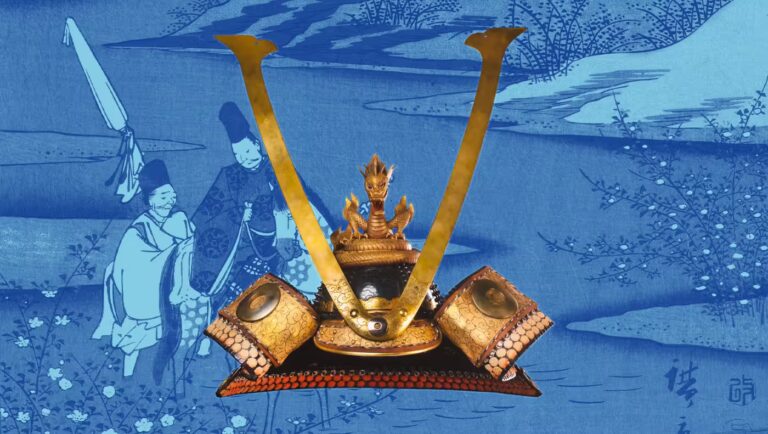
Kabuto: The Helmet of the Samurai — History & Anatomy
The kabuto – protection, identity, and work of art in one. History, anatomy & smithing traditions of the samurai helmet.…
Artikel lesen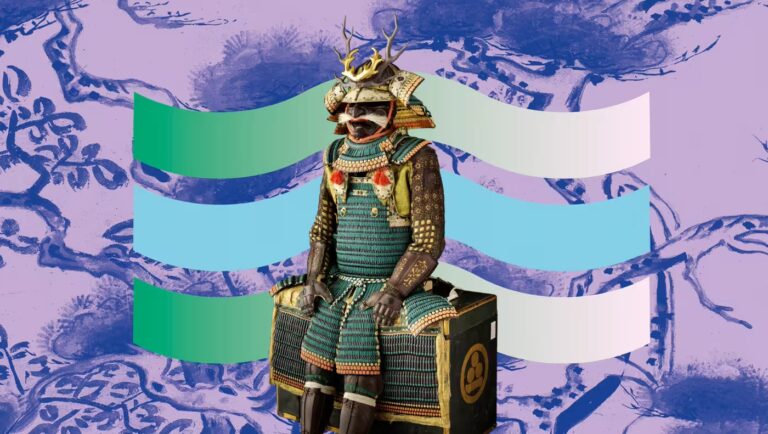
Tōsei Gusoku: The Bulletproof Armour of the Sengoku Era
The Tōsei Gusoku replaced the Ō-Yoroi after 1543. How iron plates and hinges answered the arquebus. With original exhibits at…
Artikel lesen
Naginata: The Polearm of the Samurai
The naginata: polearm of the samurai, anti-cavalry instrument and woman's weapon. History, types, and three originals at the Samurai Museum…
Artikel lesen