 Nominated for the EMYA2026 award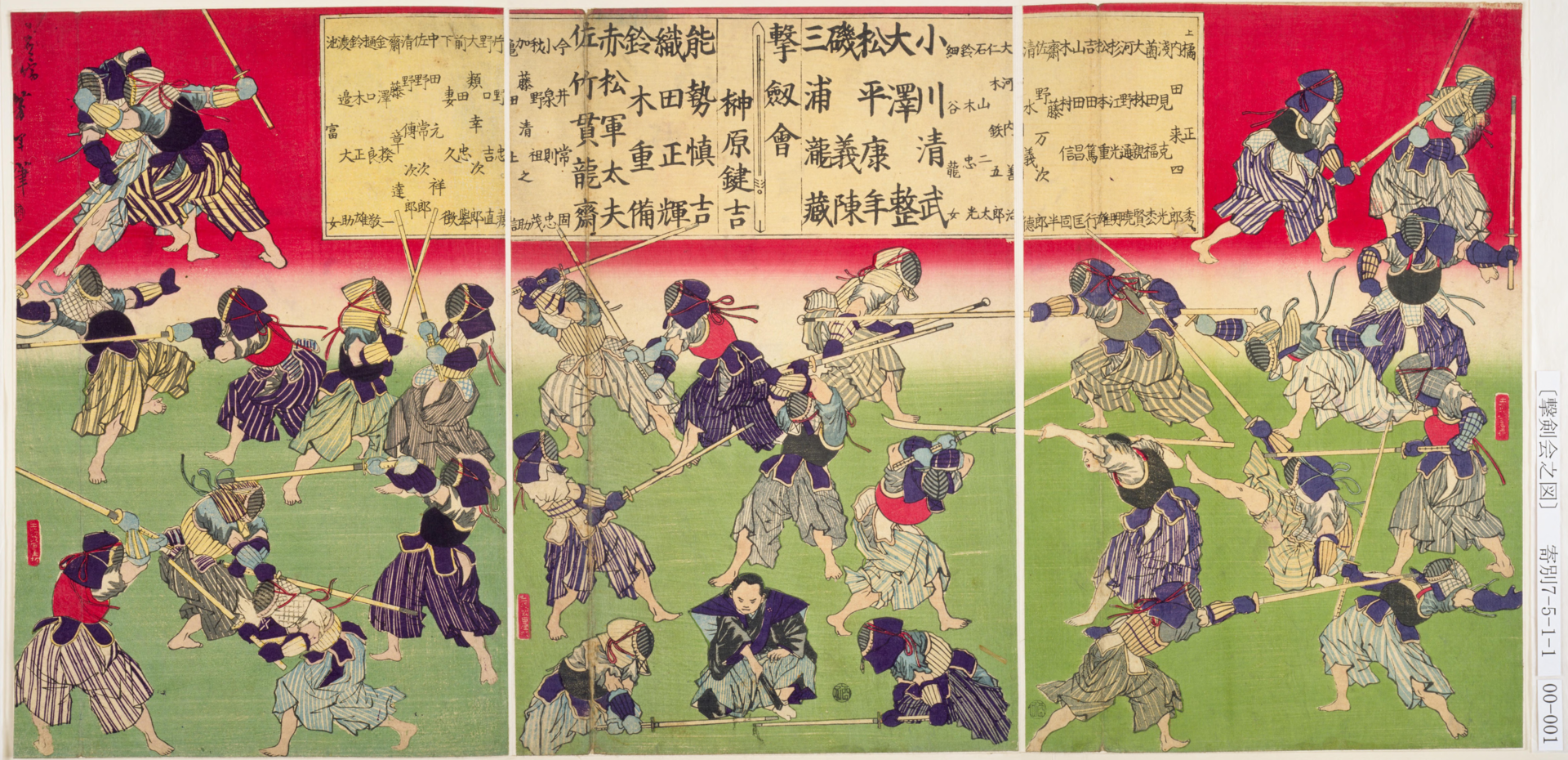
The separation of -jutsu (technique) and -dō (way) is itself a modern construction. Historical sword schools saw no contradiction between combat effectiveness and mental training – the two belonged together (Friday, 1997, ch. 4).
History: From the Battlefield to the Dōjō
Kenjutsu – The Root in War
The prehistory of Kendō does not begin with the sword. On the battlefields of the Kamakura (1185–1333) and Muromachi periods (1336–1573), the katana was a secondary weapon. Combat priorities lay with the bow (yumi), the spear (yari) and, from the middle of the 16th century, the arquebus (teppō). The sword came into use when the spear broke, when the distance became too small, or when the decisive head-cut (kubi-tori) was needed to take a trophy (Turnbull, 2010, pp. 52–54).
Systematic swordsmanship developed, paradoxically, only as war subsided. From the late 15th century onwards, the first formalised schools (ryū) emerged, which codified their techniques and kept them secret – not primarily as a military innovation, but as social distinction. Hundreds of schools competed for students and patronage, each with its own secret techniques (hiden):
The Kashima-Shinryū (founded around 1450) focused on swift counterattacks and is regarded as one of the oldest documented sword schools. The Ittō-ryū (founded 1580) propagated the minimalist “one-sword” style. And the Yagyū Shinkage-ryū (founded 1565) rose to become the official sword school of the Tokugawa shogunate.
At the Samurai Museum Berlin, the openwork tsuba of the Yagyū school (display case I03V) make this process tangible: the Yagyū served the Tokugawa shogunate as official sword masters, and the beginning of tsuba production is attributed to Yagyū Ren’ya (1625–1694). The Yagyū philosophy of Katsujin-ken (“the life-giving sword”) – the idea that true swordsmanship lies not in killing but in the ability to resolve conflicts without bloodshed – shapes Kendō philosophy to this day.
The Edo Revolution: Bamboo instead of Steel
The decisive transformation took place in the Edo period (1615–1868). More than 250 years of peace under the Tokugawa confronted the samurai with an existential problem: how do you preserve an art of war without war?
At first Kata (型, “forms”) dominated – choreographed practice sequences with wooden swords (bokutō). But Kata alone had a problem: they trained principles, not responsiveness. “Kata training is predictable and symmetrical,” Turnbull analyses. “Real combat is unpredictable, asymmetrical and brutal.” (Turnbull, 2010, pp. 36–38).
The second wave was the invention of protected free sparring. In the early 18th century, sword masters such as Naganuma Shirōzaemon developed the first protective armour (bōgu) for use with bamboo swords (shinai). The decisive breakthrough came from Chiba Shūsaku (1793–1855), who systematised shinai free sparring and introduced Kirikaeshi training – fast, repetitive striking sequences against a partner, which to this day form the basic exercise of every Kendō practice.
Meiji: Death and Rebirth
The Meiji Restoration (1868) overthrew not only the shogunate but the entire samurai class. In 1876, the Haitōrei edict prohibited the public wearing of swords. Dōjō closed. Salvation came from an unexpected direction: the police. Kawaji Toshiyoshi, first chief of the modern Japanese police, integrated Kenjutsu into police training in 1879.
One man embodies the transition like no other: Yamaoka Tesshū (1836–1888), whose original calligraphy is on display at the Samurai Museum Berlin (display case C39V). Tesshū was at once an outstanding swordsman, a Zen Buddhist and a master of calligraphy. He founded the Mutō-ryū (“school without a sword”), whose name was its programme: the overcoming of dependence on the physical sword through spiritual maturity.
Institutional salvation came in 1895 with the founding of the Dai Nippon Butoku Kai. The organisation standardised the rules and transferred Kenjutsu into Kendō. The change of name was programmatic: from -jutsu (technique) to -dō (way).
A Dark Chapter: Kendō as a Weapon of the State
The darkest phase began in 1931, when the Japanese government declared budō a compulsory subject in schools. What was marketed as a “revival” was in truth a reinvention as an instrument of indoctrination. After Japan’s defeat in 1945, the US occupation banned all budō as militaristic. The enforced re-legitimisation as “peaceful education” compelled the Kendō community to a fundamental self-reflection: what actually was Kendō, once the militaristic superstructure was stripped away?
A New Beginning: The All Japan Kendo Federation
In 1952 – the same year in which Japan’s sovereignty returned – the All Japan Kendo Federation (AJKF) was founded. In 1975 it formulated its philosophical foundation: Kendo no Rinen – “The purpose of Kendō is to mould the human character through the application of the principles of the sword.”
In 1970 the founding of the International Kendo Federation (FIK) followed. Since then, the World Kendo Championships (WKC) have been held every three years – most recently in 2024 in Milan, with participants from over 60 nations. The FIK deliberately rejects inclusion in the Olympic Games: Kendō is budō, not an Olympic sport.
Philosophy: More than Sport
Bunbu – The Unity of Learning and the Sword
Bunbu (文武) denotes the unity of civil learning (bun) and military skill (bu). At the Samurai Museum Berlin, this concept becomes tangible in several places. The information panel Bunbu (display case C38V) explains: “A fundamental ideal of the samurai is summarised under the term bunbu. Bun denotes civil, that is, intellectual and cultural education, while bu stands for military training.” The magnificent armour of Katō Yasuzumi (1785–1826) in the same case embodies this ideal.
Mushin, Fudōshin, Zanshin – The Mental States
Three mental states are central: Mushin (無心, “mind without mind”) denotes acting without conscious reflection – analogous to the “flow” state of modern sport psychology. Fudōshin (不動心, “immovable mind”) is inner calm under pressure. Zanshin (残心, “remaining mind”) describes the continued alertness after an action. In Kendō, Zanshin is so important that a technically perfect strike without Zanshin is not scored.
Shu-Ha-Ri: The Path of Learning
Friday documents the traditional learning progression in three phases: Shu (守, preserving) – exact imitation of the master. Ha (破, breaking) – critical variation of the learned forms. Ri (離, separating) – transcendence of form, free application. The goal is “freedom from form through form” (Friday, 1997, pp. 107–108).
Technique and Equipment
The Shinai: Bamboo instead of Steel
The shinai consists of four bamboo strips, bound with leather and cords, is about 120 cm long and weighs 500–600 grams. It simulates a katana – without killing. The protective armour (Bōgu) comprises four parts: Men (face mask), Dō (breastplate), Tare (hip guard) and Kote (armoured gloves). A fully equipped kendoka carries 5–7 kg.
The Four Target Zones: Form over Force
Kendō recognises only four valid strikes (Yuko-datotsu): Men (head), Kote (wrist), Dō (torso) and Tsuki (thrust to the throat, for advanced practitioners only). A strike counts only when the movement is executed correctly (body, sword and spirit as a unity), the blow is made with the Datotsu-bu, the battle cry accompanies the strike, and the fighter afterwards shows Zanshin. One can strike an opponent ten times and receive zero points because the posture was wrong.
Kendo no Kata: The Invisible Heritage
Alongside duels (Shiai), kendoka practise Kendo no Kata – ten choreographed forms (seven with the long sword, three with the short sword), which are performed in pairs with wooden swords (bokken). They preserve techniques that do not exist in modern competition: lateral cuts (yoko-men), evasion techniques (nuki-waza), counterattacks (kaeshi-waza).
Myths and Corrections
“Kendō is genuine samurai swordfighting” — No. Kendō is a deliberate abstraction. Historical Kenjutsu encompassed dozens of techniques – leg cuts, disarms, throws, ground fighting –, which were eliminated from modern Kendō for safety reasons.
“Kendō is an ancient tradition” — The roots reach back to the 15th century, but Kendō as a standardised discipline has existed only since 1912. Turnbull pinpoints the paradox: “The most formalised sword schools arose in times of peace, when actual combat experience was rare” (Turnbull, 2010, p. 33).
“Zen is the religion of Kendō” — Zen is influential, but historically overemphasised. Friday shows that meditation in the martial arts draws on techniques from esoteric Buddhism (Mikkyō) and Taoism, not only Zen (Friday, 1997, p. 153).
The Tengu Legend: Swordsmanship and Mythology
At the Samurai Museum Berlin, several masks (display cases E01V and E03V) depict the Tengu – supernatural beings of Japanese folklore with striking long noses or birds’ beaks. The accompanying exhibition panel explains: “These supernatural beings were associated with ascetic practices in the mountains, and it was believed that they possessed outstanding abilities in the martial arts, especially in fencing.”
The most famous Tengu legend concerns Minamoto no Yoshitsune (1159–1189). According to tradition, as a boy he learned swordsmanship from a Tengu named Sōjōbō on Mount Kurama near Kyōto.
Kendō Today: Figures, Facts, Practice
Kendō is practised today in over 60 countries. Japan remains the undisputed centre, with an estimated 1.5 million active kendoka. The German Kendo Federation (DKenB), founded in 1975, represents over 100 dōjō with around 3,000 members across Germany. Beginners initially need only a Keikogi and Hakama for about €100–150. The protective armour (Bōgu) comes later and costs, depending on quality, €500–2,000.
Kendō is one of the few martial arts that can be practised lifelong. Many kendoka begin at 40+, some at 60+. The focus on technique, timing and mental clarity rather than raw strength makes this possible.
Frequently Asked Questions
What is Kendō?
Kendō (剣道, “way of the sword”) is a modern Japanese martial art in which two opponents fence with bamboo swords (Shinai) and protective armour (Bōgu). It is based on historical samurai swordsmanship (Kenjutsu), but is oriented towards character building and mental training, not combat effectiveness.
How long does it take to learn Kendō?
Kendō has no “completion”. The basic techniques can be learned in 6–12 months, but refinement takes a lifetime. The 8th-dan examination – the highest regularly awarded grade – has a pass rate of under 1%.
What does Kendō equipment cost?
Entry: Keikogi + Hakama about €100–150. Protective armour (Bōgu): €500–2,000. Shinai: €15–30 (subject to regular wear). Club fees: €20–50 monthly. Total costs in the first year: about €300–600 (without Bōgu).
Is Kendō dangerous?
Kendō is regarded as one of the safest full-contact martial arts. The protective armour absorbs blows effectively. Injuries are mostly limited to bruises on the wrist or the Achilles tendon.
What is the difference between Kendō and Iaidō?
Kendō is loud – two kendoka fence with bamboo swords and protective armour. Iaidō is silent – an individual performs forms (Kata) against imaginary opponents with a real or blunt sword. Kendō focuses on responsiveness and timing, Iaidō on precision and meditation.
Where can you learn Kendō in Berlin?
Berlin has several active Kendō dōjō that offer beginners’ courses. For a complete overview, the website of the German Kendo Federation (DKenB) is recommended: www.dkenb.de.
From what age can you begin Kendō?
Children can begin Kendō from about 6–8 years of age. Likewise, there is no upper limit – Kendō can be practised into old age.
The Way Without End
At the Samurai Museum Berlin, in the Bakumatsu display case hangs the calligraphy of a man who mastered both sword and brush. Yamaoka Tesshū would have understood modern Kendō – not as a nostalgic repetition of a past that never existed in that form, but as a living practice of self-improvement.
In Tōkyō, businesspeople train after work. In Berlin, students practise on weekends. In São Paulo, pensioners fight with bamboo swords. What unites them is the search for the moment in which body, mind and sword become one. The Japanese call it ki-ken-tai no ichi – the unity of energy, sword and body.
Visit the Samurai Museum Berlin
You can experience the exhibits and themes of this article up close in the permanent exhibition of the Samurai Museum Berlin. Over 500 original objects from feudal Japan await you at Auguststraße 68, Berlin-Mitte. Open daily from 10 a.m. to 7 p.m.
Related Articles
- Samurai: History, Culture and Legacy
- Bushidō: The Code of Honour of the Samurai
- The Katana: Myth and Reality
List of Sources
- Sánchez García, Raúl (2019): The Historical Sociology of Japanese Martial Arts. Routledge.
- Friday, Karl F. / Seki, Fumitake (1997): Legacies of the Sword: The Kashima-Shinryū and Samurai Martial Culture. University of Hawai’i Press.
- Ikegami, Eiko (1995): The Taming of the Samurai. Harvard University Press.
- Turnbull, Stephen (2010): Katana: The Samurai Sword. Osprey Publishing.
- Benesch, Oleg (2014): Inventing the Way of the Samurai. Oxford University Press.
- All Japan Kendo Federation (1975): Kendo no Rinen.
- Samurai Museum Berlin (2024): Display-case texts C38V, C39V, I03V, E01V/E03V, H02V–H04V.
© Samurai Museum Berlin – All rights reserved
You might also like
Bushidō: The Code of Honor – The 7 Virtues of the Samurai
Bushidō – the samurai code of honor. Nitobe's 7 virtues, historical reality, Hagakure, modern adaptations. Facts instead of myths, with…
Artikel lesen
Seppuku: History, Ritual and Meaning of the Stomach-Cutting
Seppuku – history, ritual and meaning of the stomach-cutting. From battle tactic to Edo ceremony: what really drove the samurai…
Artikel lesen
Shogun: The Military Rulers of Japan — History & Significance
Shogun – the military rulers of Japan: who they were, how they ruled & why they never abolished the emperor.…
Artikel lesen