 Nominated for the EMYA2026 award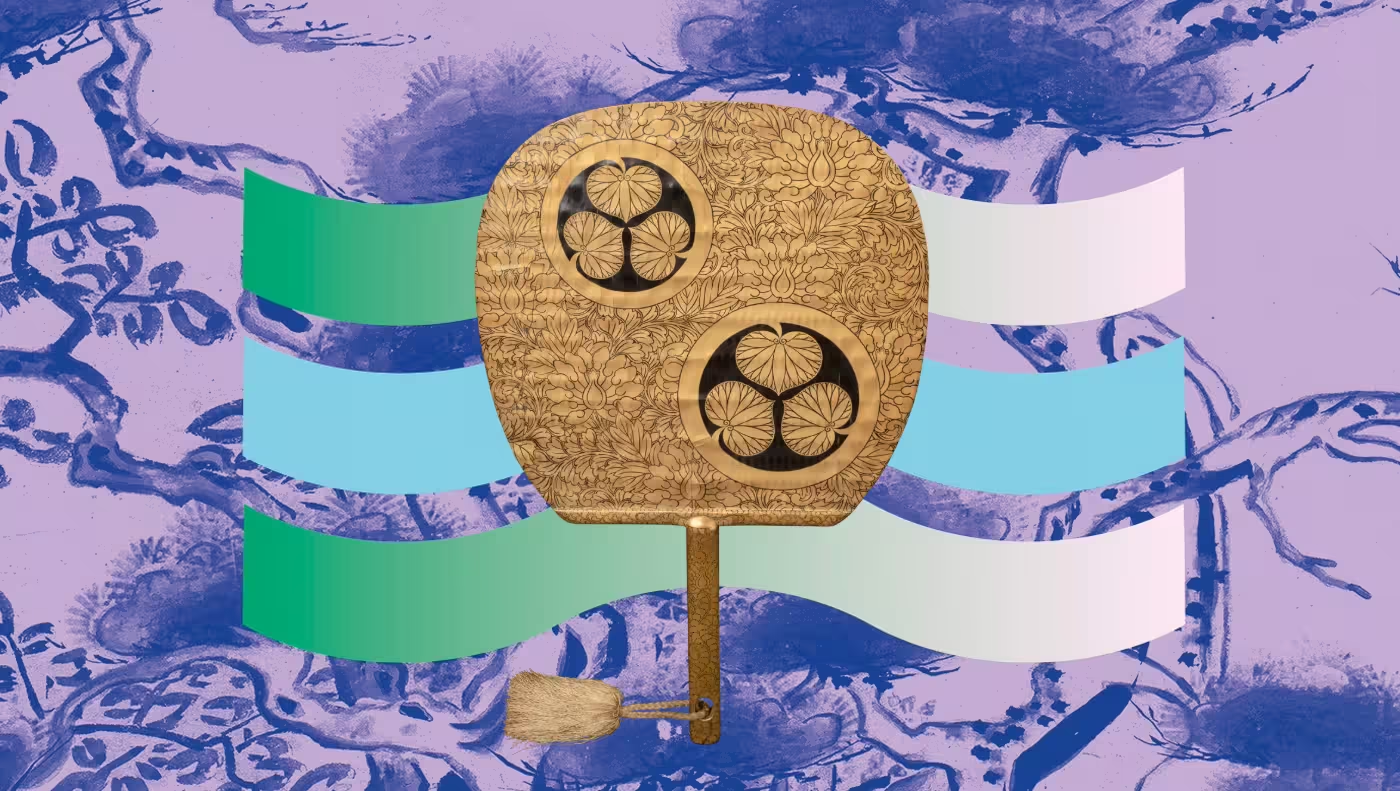
Tokugawa Ieyasu (徳川家康, 1543–1616) was the last of the three unifiers of Japan and founder of the Tokugawa shogunate, which brought Japan 250 years of peace. After decades as a hostage, vassal and patient strategist, he defeated his rivals at the Battle of Sekigahara in 1600 and destroyed the Toyotomi family in the sieges of Osaka in 1614/15. His political system – the bakuhan system with the sankin kōtai (compulsory residence of the daimyō in Edo) – shaped Japan until the Meiji Restoration of 1868. At the Samurai Museum Berlin, several original suits of armour from the Tokugawa era tell of this system and its effects on samurai culture.
THE PATIENCE OF THE HUNTER: IEYASU’S EARLY YEARS
21 October 1600. Fog lay over the plain of Sekigahara. 160,000 warriors faced each other – the largest battle in the history of Japan. In the command tent of the Eastern Army sat a man who had waited 57 years of his life for this moment. Tokugawa Ieyasu, who had grown up as a hostage, who had served for decades under Nobunaga and Hideyoshi, knew: this was his last chance.
The famous saying about the three unifiers sums it up. “What do you do if the cuckoo will not sing?” Oda Nobunaga answers: “I kill it.” Hideyoshi says: “I make it sing.” Ieyasu is silent for a moment, then: “I wait until it sings.”
A Childhood as a Hostage
Born in 1543 in the province of Mikawa, Ieyasu was the child of a small warrior family that was in danger of being ground down between powerful neighbours. At the age of five he was taken hostage by the Oda – then, a year later, handed on to the Imagawa clan. The Matsudaira were a plaything between two great powers, and their heir was the currency. Until his coming-of-age ceremony in 1556 he spent his entire youth in Sunpu, far from home, surrounded by strangers who watched his every step.
Other children would have been broken. Ieyasu learned to wait. He studied the classics, trained with the sword, observed the politics of the court. When his father died in 1549 – possibly through bribed vassals, research is divided – Ieyasu said nothing. He waited.
The Alliance with the Demon King
In 1560 everything changed. At the Battle of Okehazama, Oda Nobunaga defeated the Imagawa army in a daring surprise attack. Imagawa Yoshimoto, Ieyasu’s liege lord, was beheaded. Ieyasu – who had returned to Mikawa in 1556 and had led campaigns as an Imagawa vassal – seized the power vacuum at once.
Another would have sought revenge. Ieyasu recognized his chance. He returned to Okazaki Castle, consolidated control over his home province and concluded an alliance with Nobunaga – the son of that Oda Nobuhide who had once been responsible for the young Ieyasu’s being taken hostage. The alliance held for 22 years. When Nobunaga died in 1582 in the burning Honnō-ji temple, Ieyasu controlled eight provinces and had learned how to survive when geniuses fail.
Under Hideyoshi: The Loyal Vassal
Toyotomi Hideyoshi was faster. Within 13 days of Nobunaga’s death he had defeated the traitor Akechi Mitsuhide and taken control. Ieyasu, who had arrived too late to fight, faced a choice: wage war against Hideyoshi or submit.
In 1584 he chose war – and won. At Komaki and Nagakute he beat Hideyoshi’s army in one of the few battles Hideyoshi ever lost. Ieyasu was clever enough not to turn a tactical victory into a strategic catastrophe. He submitted politically but kept his lands and his army. The message was clear: Ieyasu was not an enemy who could be removed cheaply.
He waited. For 14 years he served the former peasant’s son as an ally, fought in his battles, attended his court, smiled at his feasts. In 1590 Hideyoshi rewarded him with Kantō, the richest region of Japan – and at the same time removed him from the political centre of Kyoto. Ieyasu saw through the manoeuvre, accepted it and systematically expanded his power. He founded Edo – the later Tokyo – as his capital. He planted rice. He waited.
When Hideyoshi died in 1598 and left behind his five-year-old son Hideyori, Ieyasu was 56 years old. He was the richest, most experienced and most patient of the five regents Hideyoshi had appointed to protect the boy. The question was not whether, but when.[1]
SEKIGAHARA 1600: THE DECISIVE BATTLE
At the Samurai Museum Berlin, display case C10V arranges the three unifiers as a trio: Nobunaga, Hideyoshi and Ieyasu. The case documents how three commanders broke through the deadlocked situation of the Sengoku civil-war age – each with different methods, but as a connected sequence.
The fog lifted shortly after eight o’clock in the morning. Ishida Mitsunari, the leader of the Western Army, saw his chance. He had the better position – his estimated 80,000 men held the hills around the plain of Sekigahara. Ieyasu’s roughly 75,000 warriors of the Eastern Army were trapped, hemmed in between mountains and marshy terrain.
Mitsunari gave the signal. Arquebusiers opened fire. Ashigaru spearmen stormed down the slopes. The fight was brutal, chaotic, desperate. For three hours the battle raged without a clear victor. Then, towards midday, something happened that was to determine the history of Japan for the next 250 years.
The Betrayal of the Kobayakawa
Kobayakawa Hideaki sat with 15,000 men on Mount Matsuo and did – nothing. He was officially part of the Western Army, but Ieyasu had made him an offer: switch sides, and I will give you one of the richest provinces of Japan.
Hideaki hesitated. He was young, inexperienced, torn between honour and greed. Ieyasu lost patience. He ordered his arquebusiers to fire on Hideaki’s positions – not to kill, but as a warning. The message was clear: decide now, or you are the next enemy.
Around midday Hideaki’s army stormed down the hill – not against Ieyasu, but against Mitsunari’s flank. The betrayal broke the Western Army. Within two hours the battle was decided. Mitsunari fled, was captured three days later and beheaded in Kyoto. An estimated 30,000 warriors lay dead on the battlefield.[2]
The armour of the Wakisaka clan (display case C07V) at the Samurai Museum Berlin tells precisely this story of switching sides. Wakisaka Yasuharu (1554–1626), one of the legendary “Seven Spears of Shizugatake” under Hideyoshi, switched at Sekigahara from the Western to the Eastern Army. The armour – iron, gold, leather, lacquer and silk from the Momoyama period – makes tangible how personal decisions on the battlefield determined the fate of Japan. Every switch shifted the balance of power, every loyalty was negotiable.
The Purge
Ieyasu was too old for generosity. The leaders of the Western Army were executed – not quickly and honourably by seppuku, but publicly, by the executioner. Their heads were put on display. Their families dispossessed. 87 daimyō lost their fiefs.
Ieyasu filled the gaps with his own men: the fudai daimyō, vassals who had already served him before Sekigahara. They received the strategically most important provinces – passes, harbours, roads to Kyoto. The former enemies, the tozama daimyō, were banished to the periphery: Kyūshū, Tōhoku, Shikoku. Far enough away to be no threat.
A concrete example of Ieyasu’s reward system is shown at the Samurai Museum Berlin by the black-lacquered hishitoji armour of Honda Masashige (display case C07V). Honda (1580–1647) was exactly that type of fudai vassal on whom Ieyasu relied: a fief administrator with an income of 50,000 koku who in the course of his life served several powerful clans – Maeda, Uesugi, Tokugawa – and fought against the Toyotomi at the siege of Osaka in 1614. The unsigned armour of iron, gold, lacquer, leather and silk stands for the generation of war veterans who became administrators under Ieyasu.
In 1603 Ieyasu took the title of shōgun. Officially he ruled in the name of the emperor. De facto he was the ruler of Japan – with one exception.[3]
OSAKA 1614–1615: THE ANNIHILATION OF A DYNASTY
Toyotomi Hideyori was 22 years old and lived in the largest castle in Japan. His father Hideyoshi had built Osaka as an impregnable fortress: five storeys, massive stone walls, three concentric moats. An estimated 100,000 rōnin – masterless samurai who had lost their lords after Sekigahara – had gathered in the castle. They hoped for a chance at revenge.
Ieyasu, by now 71 years old and officially retired, waited for a pretext. In the winter of 1614 he got it: an inscription on a temple bell that Hideyori had donated could be interpreted as an insult. It was ridiculous. It was enough.
The Winter Campaign: The Moats
Around 200,000 Tokugawa soldiers surrounded Osaka. They attempted an assault. The defenders threw them back. About 100 dead with each attempt. The castle was exactly what Hideyoshi had promised: barely takeable.
Ieyasu changed strategy. He brought artillery. European cannon, which he had bought from Dutch traders, began to shoot the inner buildings of the castle to pieces. One cannonball killed two of Hideyori’s concubines. The young lord’s mother, Yodogimi, collapsed. She urged her son to negotiate.
Ieyasu offered peace – on one condition: the outer moats had to be filled in. Hideyori agreed. The armistice was signed. Then Ieyasu filled in not only the outer moats but the inner ones as well. By the time Hideyori’s advisers protested, it was too late. The impregnable fortress was now only a large castle.
The Summer Campaign: The End
In May 1615 war broke out again. This time Osaka had no moats. The Tokugawa army stormed the castle, section by section, storey by storey. On 4 June fire broke out – probably set deliberately. The flames devoured the wooden structures. Hideyori and Yodogimi committed seppuku in the burning ruins.
Ieyasu had Hideyori’s eight-year-old son executed. The Toyotomi line was extinguished. Of the greatest dynasty of the Sengoku period, nothing remained but ash and memory.[4]
PAX TOKUGAWA: THE SYSTEM THAT LASTED 250 YEARS
Ieyasu died in 1616, a year after Osaka. His system outlived him by two centuries. How did one man achieve what Nobunaga and Hideyoshi had not? By relying not on genius but on structure.
The Bakuhan System: Control Through Redundancy
The Tokugawa shogunate was not a centralized state. It was a hybrid: the shogunate controlled foreign policy, coinage and ideology. The daimyō – 260 in number – retained autonomy over their provinces (han). They levied taxes, administered justice, managed their samurai.
But Ieyasu built in control mechanisms. The most important: sankin kōtai (alternate attendance). Every daimyō had to spend every second year in Edo. His wife and his heir remained there permanently – as hostages. The costs were astronomical: journeys with hundreds of retainers, double households, magnificent residences in Edo. A great daimyō spent, by some estimates, up to 70% of his income on sankin kōtai.
It worked. The daimyō were too busy and too poor to rebel.[5]
The armour of the Kaga domain (display case C25V) at the Samurai Museum Berlin illustrates this connection concretely. The Maeda clan – the richest feudal lords of Japan in the early Edo period – could afford this elaborate ceremonial armour from the 18th century, signed by Munetaka and certified as Jūyō Bunka Shiryō (Important Cultural Property). Only the wealthiest could still commission a traditional ō-yoroi armour at all. It was worn not for combat but at the investiture of a new fief lord or on a visit to the shōgun – a ceremonial status symbol of the Pax Tokugawa.
Heinō Bunri: The Separation of the Estates
Hideyoshi had begun to separate warriors and peasants. Ieyasu completed it. Samurai lived in castle towns (jōkamachi), were paid in rice (kokudaka system) and were not allowed to become peasants. Peasants remained on the land, paid taxes and were not allowed to carry weapons. Society froze. Mobility ended. But peace began.
For 250 years no major battle was fought on Japanese soil. The samurai became officials. They studied Confucianism, kept files, administered taxes. The sword became a symbol, not a tool. This transformation – from warrior to bureaucrat – is one of the most remarkable phenomena of Japanese history. The sociologist Eiko Ikegami describes it as the “taming of the samurai”.[6]
How closely craftsmanship and dynastic power were bound together in this time of peace is shown by the helmet of the Iwai master Takayuki (display case C09V) at the Samurai Museum Berlin. The Iwai school, one of the oldest armour-making schools in Japan, received its most important commissions from the gosanke – the three main branches of the Tokugawa family in the provinces of Owari, Kii and Mito. The helmet of iron, gilded bronze and lacquer was made not for combat but as an expression of status and dynastic continuity within the Tokugawa system.
The End: Why the System Broke Apart
The irony: the system that Ieyasu created to secure peace made Japan incapable of adapting to outside changes. When in 1853 Commodore Perry appeared with his “black ships” in the bay of Edo, the façade crumbled. The samurai, who for 250 years had not gone into major battles, were no longer warriors. The shogunate, which had been built on isolation, could react neither militarily nor diplomatically.
In 1868 the Meiji Restoration toppled the Tokugawa regime. The samurai were abolished as an estate. The castle in Edo became the Imperial Palace. But Ieyasu’s legacy remained: the idea that peace is secured through structure, not through heroes.[7]
CONCLUSION: THE PRICE OF PEACE
Tokugawa Ieyasu was no hero. He was a master of survival who learned from the mistakes of Nobunaga (too brutal) and Hideyoshi (too ambitious). His system – bakuhan, sankin kōtai, heinō bunri – created 250 years of peace, but also 250 years of relative stagnation.
The question his rule raises remains relevant: is an authoritarian system that guarantees peace better than an open one that risks war? Ieyasu believed he knew the answer. The Meiji reformers gave a different one.
What remains is the memory of a man who was never the best – only the last to survive.
FREQUENTLY ASKED QUESTIONS
Why is Tokugawa Ieyasu regarded as “patient”, in contrast to Nobunaga and Hideyoshi?
The famous cuckoo saying sums it up: while Nobunaga kills the bird that will not sing and Hideyoshi makes it sing, Ieyasu waits until the bird sings of its own accord. Ieyasu served for 22 years under Nobunaga and over a decade under Hideyoshi, without ever rebelling openly – apart from his military victory at Komaki in 1584, which he cleverly turned into a political submission. He waited until both were dead before taking power. This patience – combined with the systematic building of his own base in Kantō – was his greatest advantage.
How was Ieyasu able to win at Sekigahara, even though the Western Army was numerically superior and better positioned?
The key was Kobayakawa Hideaki’s betrayal. Hideaki commanded 15,000 men of the Western Army but hesitated during the battle. Ieyasu had his positions fired upon – as a warning to decide. Hideaki then switched sides and attacked Mitsunari’s flank, which caused the Western Army to collapse within two hours. The Wakisaka clan, too – whose armour the Samurai Museum Berlin exhibits in display case C07V – switched sides at Sekigahara.
Why did it take 15 years from Sekigahara (1600) to the annihilation of the Toyotomi (1615)?
Ieyasu first had to consolidate his shogunate. After Sekigahara he was de facto ruler, but Hideyori was still alive and had legitimacy as Hideyoshi’s son. Ieyasu systematically dispossessed tozama daimyō, built up the sankin-kōtai system and waited for the right moment. Only when Hideyori came of age and an estimated 100,000 rōnin gathered in Osaka did Ieyasu have the pretext he needed. The attack on Osaka was not panic – it was the last planned step.
What was the sankin kōtai, and why did it work so well?
Sankin kōtai (“alternate attendance”) forced every daimyō to spend every second year in Edo, while wife and heir remained there permanently – effectively as hostages. The costs (journeys with hundreds of retainers, double households) consumed, by some estimates, up to 70% of the income of great daimyō. This made rebellions financially difficult to carry out, but at the same time promoted road building, inns (honjin) and cultural exchange between the provinces. The armour of the Kaga domain at the Samurai Museum Berlin (display case C25V) documents this connection: only the richest clans, such as the Maeda, could afford elaborate ceremonial armours in this period.
Why did the Pax Tokugawa end in 1868, if the system was so stable?
The system was built for a closed world. When Commodore Perry appeared in 1853 with Western warships, the weakness became apparent: 250 years of peace had turned the samurai into officials, without active war experience. The shogunate could react adequately neither militarily nor diplomatically. Lower samurai, frustrated by their powerlessness, joined forces with reform-minded daimyō and toppled the Tokugawa regime in favour of the Meiji Restoration.
Which Tokugawa exhibits does the Samurai Museum Berlin show?
The museum dedicates several display cases to the Tokugawa era: C08V (display case on the Tokugawa regime), C10V (Three Unifiers in comparison), C07V (Wakisaka clan armour and Honda Masashige hishitoji armour – both stand for the Sekigahara moment), C25V (Kaga domain armour of the Maeda clan, Edo period, Jūyō Bunka Shiryō) and C09V (helmet of the Iwai school for the gosanke Tokugawa branches).
Visit the Samurai Museum Berlin
Tokugawa Ieyasu’s world becomes concrete at the Samurai Museum Berlin through several original exhibits: the display case on the Tokugawa regime (C08V), the three unifiers in comparison (C10V), the Wakisaka and Honda Masashige armours (C07V), the Kaga domain ceremonial armour of the Maeda clan (C25V) and the Iwai helmet (C09V). Over 500 original objects from feudal Japan – armours, weapons, everyday objects – await you at Auguststraße 68, Berlin-Mitte. Open daily from 10 a.m. to 7 p.m.
Related Articles
- Oda Nobunaga: The Demon King – History & Legacy
- Toyotomi Hideyoshi: From Peasant’s Son to Ruler of Japan
- Sengoku Jidai: The Age of the Warring Provinces
- Battle of Sekigahara 1600
- Bushidō: The Code of Honour of the Samurai
- Meiji Restoration: The End of the Samurai
List of Sources
Show all 7 sources
[1] Turnbull, Stephen (2022): War in Japan 1467–1615. Osprey Publishing, S. 115–120 (Ieyasu unter Hideyoshi, Komaki 1584, Kantō-Verlegung 1590); Hall, John W. (Hg.) (1991): The Cambridge History of Japan, Vol. 4: Early Modern Japan. Cambridge University Press, Kap. 4, S. 145–150.
[2] Turnbull (2022), S. 115–118 (Sekigahara, Truppenstärken und Kobayakawa-Verrat); Hall (1991), Kap. 4, S. 150–155.
[3] Hall (1991), Kap. 4, S. 150–155 (Säuberung nach Sekigahara, Fudai/Tozama-Distinktion); Friday, Karl F. (2004): Samurai, Warfare and the State in Early Medieval Japan. Routledge, Kap. 6.
[4] Turnbull (2022), S. 118–122 (Belagerung von Osaka, Winter- und Sommerkampagne); Hall (1991), Kap. 5, S. 156–170; Ikegami, Eiko (1995): The Taming of the Samurai: Honorific Individualism and the Making of Modern Japan. Harvard University Press, Kap. 7.
[5] Hall (1991), Kap. 6, S. 170–195 (Bakuhan-System, Sankin Kōtai-Ökonomie); Ikegami (1995), Kap. 8.
[6] Ikegami (1995), Kap. 8–10 (Bürokratisierung der Samurai, „Taming”-These).
[7] Jansen, Marius B. (Hg.) (1989): The Cambridge History of Japan, Vol. 5: The Nineteenth Century. Cambridge University Press, Kap. 1–2 (Bakumatsu, Perry, Meiji-Restauration); Turnbull (2022), S. 120–125.
Museum catalogue: SMB Catalogue 2025, display cases C07V (Wakisaka armour; Honda Masashige hishitoji armour), C08V (Tokugawa regime display case), C09V (Iwai Takayuki helmet), C10V (Three Unifiers), C25V (Kaga domain armour). Description: Alexandra Weber.
You might also like
Sengoku Jidai: The Age of the Warring Provinces (1467–1615)
The Sengoku Jidai (1467–1615) was Japan's 150-year civil war. After the collapse of Ashikaga rule, rival daimyō fought for supremacy…
Artikel lesen
The Heian Period: The Rise of the Warrior Class (794–1185)
The Heian period created the samurai. How provincial administrators became a warrior caste – and why the sword played hardly…
Artikel lesen
Yasuke: The First African Samurai – History & Facts
Yasuke served Oda Nobunaga 1581–1582. What is historically documented? Facts vs. myths about Japan's first Black samurai. Samurai Museum Berlin.
Artikel lesen