 Nominated for the EMYA2026 award
Anyone who holds a Japanese sword in their hand and knows what they are looking at reads an address in it.
The grain of the steel (hada) says: Yamato or Bizen? The hardening line (hamon) says: coarse-grained nie or fine nioi? The curvature (sori) says: Kyoto or Kamakura? And all three together yield an answer to the question: which of the five great traditions produced this sword?
Gokaden — the Five Traditions — is the modern classification system that sums up the Japanese art of the sword in a single term that organises 900 years of craftsmanship. It is not an ancient system: the term itself was only introduced in the Meiji era by Hon’ami Kōson (1879–1955). But the distinctions it names are real — arising from geography, materials, patronage and the personalities of the great masters.
What Are the Gokaden?
Gokaden (五ヶ伝 — literally “Five Traditions”) denotes the five regional swordsmithing traditions that dominated the Japanese art of the sword during the Kotō period (900–1530). About 80 percent of all nihontō produced in this period come from schools that can be assigned to these five traditions.[1]
The five traditions are named after their provinces of origin:
1. Yamashiro — Yamashiro Province (Kyoto)
2. Yamato — Yamato Province (Nara)
3. Bizen — Bizen Province (Okayama)
4. Sōshū — Sagami Province (Kamakura)
5. Mino — Mino Province (Seki/Gifu)
The system was introduced because the earlier classification by place of origin — often simply the province name on the tang — became unwieldy as the number of swords and students from different schools grew. The Gokaden classification organises not by place, but by style and technique: two smiths from different provinces who work in the same style belong to the same tradition.
Sesko emphasises in his Encyclopedia: the Gokaden taxonomy is a retrospective ordering system, not a historical programme. The smiths of the Kamakura period did not think in Gokaden categories — they simply worked as their masters had taught them.[2]
Yamashiro: Courtly Elegance
The Yamashiro tradition has its origin in Kyoto — the imperial capital and the centre of courtly culture. This proximity shapes the aesthetic of the Yamashiro blades: slender, elegant, with an emphasis on the curve near the hilt (koshi-zori), a fine steel grain (ko-itame) and a straight or slightly undulating hardening line (suguha).
The most famous masters of the Yamashiro tradition came from two schools: Awataguchi and Rai. Awataguchi Tōshirō (active around 1200) is regarded as one of the founders of the classical Japanese sword; his students decisively shaped the Kamakura period. The Rai school under Rai Kunimitsu refined the Yamashiro style into the ideal of courtly daintiness.[1]
Characteristic of Yamashiro blades in their forging structure: ko-nie (fine, small hardening points), frequently a suguha hamon, and a surface that under light resembles polished water. It is no coincidence that this aesthetic was favoured at the imperial court: it reflects the same values that shape miyabi (courtly refinement) in other art forms.
Yamato: The Sword of the Warrior Monks
The Yamato tradition arose in Nara — the old capital and a centre of Buddhism. Around 1200, five great swordsmithing schools developed in Nara, directly connected with the powerful Buddhist monasteries: Senjūin, Tegai, Shikkake, Taema and Hōshō.[1]
The monasteries had warriors (sōhei, warrior monks) who needed weapons. This military patronage shaped the Yamato style: practical, robust, without unnecessary daintiness. Characteristic are straight forging structures (masame-hada), coarse-grained hardening points (nie) and predominantly straight hardening lines.
Sesko describes Yamato blades as the “most military” of the five traditions — created for institutions that actually used swords, rather than merely carrying them as status symbols.[2]
The Yamato tradition was heavily decimated by the Sengoku period: when the monasteries lost their military power (especially after Nobunaga’s burning of the Enryaku-ji in 1571), the Yamato schools lost their most important source of patronage. Many smiths migrated to other regions — especially to Mino, where Yamato influences are detectable in the emerging Mino tradition.

Bizen: The Mecca of Sword Production
If one of the five traditions may be called the most productive and influential, then it is Bizen.
The province of Bizen — present-day Okayama Prefecture — had optimal conditions: rich satetsu iron-sand deposits in the rivers of the Chūgoku mountains, fast-flowing rivers for cooling the blades, and a geographical location near the Asian mainland that favoured early technology transfer. The SMB catalogue aptly describes Bizen as the “Mecca of sword production”.[3]
The most important school within the Bizen tradition is Osafune — a collection of smithing clans that supplied the greater part of the Japanese sword market over centuries. In the Sengoku period (1467–1615), Osafune was so productive that warriors from everywhere ordered swords. This had consequences for quality: mass-produced work (kazu-uchi) from Osafune is clearly distinguishable from high-quality signed pieces.
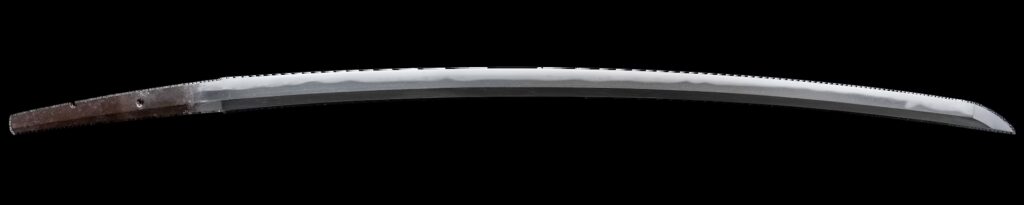
Characteristic of Bizen blades: chōji midare (a clove-pattern-like hardening line), nioi (a fine, misty hardening effect), a gentle curve (tori-sori), and especially the utsuri — a shimmering shadow pattern on the surface of the blade that looks like a reflection of the hamon and is regarded as a hallmark of genuine Kotō Bizen blades. This effect is lost after the Kotō period and can scarcely be achieved any longer in Shintō-period blades.[2]
Sōshū: Wildness and Masamune
The Sōshū tradition arose at the seat of the Kamakura shogunate — and its aesthetic wildness reflects the spirit of that epoch.
At the behest of the Kamakura government, high-ranking smiths moved from other provinces to Kamakura to work there. Among them: Saburo Kunimune from Bizen and Shintōgo Kunimitsu from Yamashiro. From the synthesis of these influences the Sōshū school emerged — and its greatest master: Goro Nyūdō Masamune (active around 1288–1328).
Masamune is regarded as the most famous Japanese swordsmith of all time. His blades show spectacular, irregular hamon patterns — broad nie activity, unexpected bulges and recessions that other traditions do not know. His steel has a broad ō-itame grain (large-scale wood grain). The result is the most visually dramatic sword of the Gokaden.
Sesko describes the craft challenge of the Sōshū tradition: the wild hamon patterns arise through extreme heat and precise timing during quenching. Pulled too early: the hamon becomes flat. Too late: the blade breaks. Masamune mastered this borderline with virtuosity.[2]
A contemporary group of Masamune’s students — the so-called “Jūtetsu” (ten students) — spread the Sōshū style across all of Japan. This made Sōshū the most influential style-setter of the late Kotō period.
Mino: The Pragmatic Mass Solution
The Mino tradition is the youngest of the five Gokaden and the most pragmatic.
Its centre lies in the town of Seki, near Gifu — a region that had no special natural resources, but a favourable geographical location in the heart of central Japan. It is assumed that the Mino tradition descends from the Sōshū tradition: early Mino blades are scarcely distinguishable from Sōshū pieces. The SMB catalogue confirms this kinship and emphasises the characteristic Mino aesthetic: a large, sweeping point (kissaki), an itame grain mixed with masame elements, robust construction.[3]

The Kanemoto school became synonymous with Mino quality: quick to produce, reliably sharp, stable in mass use. In the Sengoku period, Kanemoto was the preferred supplier for armies that had to equip tens of thousands of warriors. This also led to mass production and a quality gradient: high-quality Kanemoto work with a personal signature is clearly distinguishable from cheap serial production.[2]
This shapes the Mino image to this day: less romantic than Yamashiro, less famous than Sōshū, less mystical than Bizen — but in the real warfare of the 15th and 16th centuries the most widely used system.
Kotō and Shintō: Why the Gokaden Lost Importance after 1596
The Gokaden tradition is bound to the Kotō period — the time of the “old swords” up to around 1530–1596. After that the Shintō period (new swords) begins: an era in which the regional differences largely blur.
Why? The Sengoku period had two effects on swordsmithing: on the one hand it drove many smiths out of their ancestral regions — the destruction of the Bizen smithing villages by a flood in 1591 abruptly ended Osafune’s dominance. On the other hand it created a national demand that required supra-regional supply systems. Smiths moved to the new centres of power — Osaka, Edo, Nagoya — and there mixed the regional styles.
The utsuri effect of the Bizen blades is lost in the Shintō period. The ko-nie fineness of the Yamashiro style becomes coarser. The Gokaden features remain recognisable as tradition and reference — but no longer as living regional practice.
What remains is the classification system itself: a master of the Shintō or Shinshintō period states in which Gokaden tradition he works, as a statement about his models and his aesthetic.
The Classification: How an Expert Reads a Blade
When an experienced connoisseur takes an unknown blade in hand, he begins a sequence of observations that — if everything fits together — identifies the Gokaden tradition.
Step 1: Sugata (form). Length, position of the curvature, shape of the point. A koshi-zori (curve near the tang) points to Yamashiro. Torii-sori (an even curve) to Bizen. A broad, massive form to Sōshū.
Step 2: Jigane (steel structure). The surface of the polished steel shows the hada — the forging grain. Ko-itame (a fine, even grain) is typical of Yamashiro. Ō-itame (a coarse, irregular grain) of Sōshū. Masame (a straight wood grain) of Yamato.
Step 3: Hamon. The hardening line is the most important visual feature. Bizen has chōji midare (clove-shaped bulges) with a fine nioi. Sōshū has nie-dominant wild patterns. Yamashiro has a calm suguha or a slightly undulating notare.
Step 4: Boshi. The hardening line at the point (kissaki). Each tradition has characteristic boshi forms.
Step 5: Nakago. The tang — when present and not reworked — bears the rust patina (sabi) as testimony of age and possibly a signature.
Sesko describes this process as the true art of the connoisseur: not the recognition of the signature, but the recognition of the style.[2] A genuine Masamune often bears no signature — a connoisseur recognises it nonetheless.
Modern Relevance: Gokaden in the 21st Century
The Gokaden are no museum relic. They are the active classification system of the international sword-collector community today.
NBTHK assessments (by the Nihon Bijutsu Tōken Hozon Kyōkai, the Society for the Preservation of the Japanese Art Sword) classify blades explicitly according to Gokaden traditions. An assessment that assigns a blade to the Bizen tradition is a direct application of the system that Hon’ami Kōson introduced in the Meiji era.
Auction houses — Christie’s, Bonhams, Ōzutsu in Tokyo — use Gokaden terms in their catalogues. A “Bizen katana, Kotō period, Osafune school” is a precise description that immediately communicates the most important quality features to collectors worldwide.
Conclusion: Why the Gokaden Are Still Relevant Today
The Gokaden are the coordinate system of the Japanese art of the sword. They make it possible to roughly locate a blade without a signature — by period, region and style. They enable comparison: why is this Bizen blade different from that one? What makes a Sōshū blade a Sōshū blade, even when no name is written on it?
The Japanese sword is not one object. It is five traditions and a thousand decisions.
Frequently Asked Questions about the Gokaden
What does Gokaden mean?
“Five Traditions” — the five great regional swordsmithing traditions of the Kotō period (900–1530): Yamashiro, Yamato, Bizen, Sōshū and Mino. The term was introduced in the Meiji era to replace the historical classification by province with a classification by style.
Which Gokaden tradition is the oldest?
Yamashiro and Yamato are regarded as the earliest. The Yamashiro school under Awataguchi Tōshirō is documented for the early 12th century; Yamato smiths worked for the Nara monasteries from about the same time. Bizen may have even earlier roots, but the documented Kotō period begins for all around 900.
Who was Masamune?
Goro Nyūdō Masamune (active approx. 1288–1328) is regarded as the most famous Japanese swordsmith. He founded the Sōshū tradition in Kamakura and created blades with spectacular, irregular hamon patterns. No Masamune blade reliably recognised as genuine bears a signature — authentication is carried out through stylistic analysis.
What is the utsuri effect?
A shimmering shadow pattern on Bizen blades of the Kotō period — a faint reflection of the hamon on the flat part of the blade. This feature is lost in the Shintō period and is regarded as an identifying mark of genuine Kotō Bizen quality. How it arises metallurgically is to this day not fully explained.
Why did the Gokaden disappear after the Sengoku period?
The destruction of regional smithing centres (Bizen by flooding in 1591), the migration of smiths to new centres of power and the intermingling of regional styles in the Shintō period caused the Gokaden to die out as a living practice. They remained as a classification system and as an aesthetic reference for later masters.
Visit the Samurai Museum Berlin
The sword collection in display case H02V of the Samurai Museum Berlin shows signed blades from various Gokaden traditions. Open daily from 10 a.m. to 7 p.m., Auguststraße 68, Berlin-Mitte.
Related Articles
- Japanese Swordsmithing: How a Katana Is Made
- Katana: The Sword of the Samurai
- Tachi: The Magnificent Long Sword
- Daishō: The Pair of Swords of the Samurai
Sources and Further Reading
[1] Sesko, Markus (2010). Genealogies and Schools of Japanese Swordsmiths. Books on Demand. Used: Gokaden schools overview (pp. 27–61), Masamune (p. 38), Osafune (p. 42).
[2] Sesko, Markus (2014). Encyclopedia of Japanese Swords. Lulu Enterprises. Used: Gokaden definition (p. 95), utsuri (p. 480), hada types (p. 31), Kotō/Shintō periodisation.
[3] Samurai Museum Berlin (2025). SMB Catalogue 2025. Display case H02V: Gokaden description (K. Ogorek), Yokoyama Sukenaga, Yamaura Kiyomaro, Yokoyama Sukekane.
[4] Turnbull, Stephen (2010). Katana: The Samurai Sword. Osprey Publishing. Used: development of the smithing schools, Sengoku mass production (pp. 28–35).
[5] Ogawa, Morihiro (ed.) (2009). Art of the Samurai. Metropolitan Museum of Art. Used: Gokaden blade exhibits, iconographic features.
© Samurai Museum Berlin – All rights reserved
You might also like

Tachi: The Magnificent Long Sword of the Heian Samurai
The tachi – the long sword of the Heian samurai. History, manner of wear, gokaden & the path to the…
Read the article
The Yari: The True Spear of the Samurai — Weapon of the Battlefields
The yari was the dominant weapon of the Sengoku battlefields — not the katana. Types, tactics, legendary bearers. Exhibits at…
Read the article
Naginata: The Polearm of the Samurai
The naginata: polearm of the samurai, anti-cavalry instrument and woman's weapon. History, types, and three originals at the Samurai Museum…
Read the article