 Nominated for the EMYA2026 award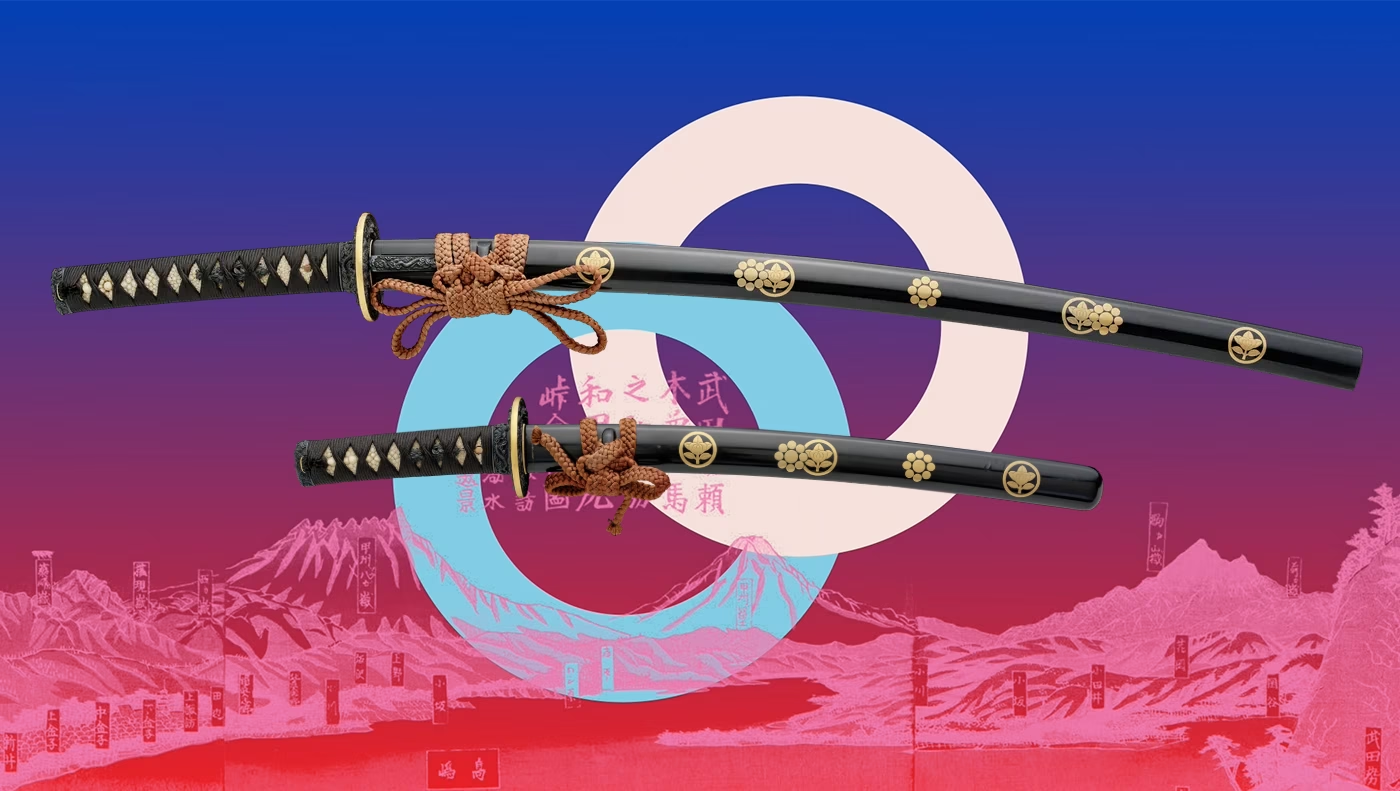
It was not the wearing of the sword that counted. It was the wearing of two swords.
In the Edo period (1615–1868), when Japan lived through 250 years of peace, the sword turned from a weapon into a symbol — and the symbol was precisely coded. Only samurai were allowed to wear the daishō: the long sword (the katana) and the short sword (the wakizashi) together. Merchants were allowed to wear a wakizashi. Peasants none. A rōnin — a masterless samurai — was allowed to wear the daishō, but lost the right to represent his lord with it.
What Is a Daishō?
The word daishō (大小) literally means “large-small.” Worn as a pair, mounted in the same style of koshirae, it was the unmistakable attribute of the samurai class.
Sesko defines in his Encyclopedia: a daishō is only a true pair when both blades are stylistically matched to each other — identical or complementary mountings, coordinated materials, colouring, craftsmen. A samurai who combined an arbitrary katana with any wakizashi wore two swords — but no daishō in the aesthetic sense.[1]
The matching was not trivial. It required either a master who made both blades for the same client or — more commonly — a koshirae-shi (mounting craftsman) who set existing blades into compatible mountings.
The Legal Dimension: The Shi-Nō-Kō-Shō System
The daishō was embedded in the shi-nō-kō-shō class system — the four estates of Edo society: samurai (shi), peasants (nō), craftsmen (kō), merchants (shō).
The Cambridge History of Japan Vol. 4 describes the heinō bunri principle (separation of warrior and peasant): Hideyoshi had, with the sword edict (katanagari) of 1588, prohibited the arming of non-samurai. Tokugawa Ieyasu reinforced this boundary after Sekigahara. The permission to wear a daishō was not a personal permission — it was a status attribute. Whoever was a samurai wore the daishō. Whoever wore the daishō was a samurai.[2]
This had pragmatic consequences: if a samurai killed another man, for example, the legal qualification of that act depended on whether he was entitled to wear the sword he used. The daishō was not only a symbol — it was proof of entitlement.
The Blades of the Daishō: Katana and Wakizashi
The katana (刀) is the long sword of the daishō, with a blade length over 60 cm. It is the offensive weapon for combat in the open. The wakizashi (脇差) is the short sword, 30–60 cm blade length, for close combat, confined spaces and as a backup weapon.
The combination was tactically considered: in a castle or a building, where a long sword becomes a hindrance, the wakizashi remains effective. On a visit to the shogun, the katana had to be handed over — the wakizashi could be kept. The wakizashi was thus also the sword of honour and defence in the civilian sphere.
Sesko describes the dimensional differences precisely: the boundary between katana and wakizashi lies at 60 cm (nishaku — two shaku), the boundary between wakizashi and tantō at 30 cm (issaku — one shaku). This classification is still authoritative today for legal and museum purposes.[1]
The Edo Period: From Combat Pair to Work of Art
Over 250 years of peace, the daishō changed fundamentally.
Since swords were no longer regularly used in combat, attention shifted from the blade to the mounting. The koshirae — scabbard, hilt, sword guard, fittings — became the actual artistic medium.
As Ikegami shows in her analysis of the samurai transformation, swords in the Edo period became codified status signals: the quality of the mounting revealed the wearer’s rank and wealth more precisely than any uniform.[3] A samurai of the highest class wore a daishō with a handcrafted tsuba by a renowned master; a samurai of lower descent wore a daishō with simple standard mounting.
The paradoxical consequence: in the era in which the daishō became most beautiful, it was used least.
The End of the Daishō: Haitōrei 1876
The Haitōrei of 1876 ended the public wearing of the daishō in a single sentence of imperial decree.
The effect was immediately visible: samurai who had walked the streets with the daishō for years laid it down. Some bought Western uniforms. Others opened schools that carried on the art of fencing (kenjutsu) as a sport.
The daishō ceased to be a status code — but the blades themselves survived. As art objects, as heirlooms, as collector’s items. The Samurai Museum Berlin today preserves pieces from this era: blades that have lost their original social context and come into their own again in a new context — the museum context.
The Craftsmen of the Daishō: Smith, Lacquerer, Metal Carver
A daishō was never the work of a single craftsman.
The Japanese system of sword-making is divided into specialized roles in a way that no European weapons production knows. The kaji (smith) produced the blade. The togishi (polisher) worked on it for weeks to perfect the surface — his contribution is so complex that it counts as an independent profession. The tsuka-shi (hilt maker) built the hilt from wood, wrapped rayskin (samegawa) and silk cords. The saya-shi (scabbard maker) built the scabbard from magnolia wood, fitted precisely to the blade. The tsuba-ko (sword-guard carver) created the tsuba. The menuki-shi made the small hilt decorations.
For a high-quality daishō of the Edo period, six to eight specialized craftsmen routinely worked together — coordinated by the client or a master of mounting (koshirae-shi), who was responsible for the overall picture.
The coordination between smith and lacquerer was particularly delicate: the scabbard had to be built from moisture-protecting magnolia wood and then lacquered before the blade was inserted. Too tight, and the blade would damage the lacquer layer; too loose, and the blade would rattle and the maker’s reputation would suffer.
The daishō was thus a social production — a network of specialized craftsmen who collaborated for one client and in doing so risked their own reputations.
Master Signatures and the Problem of Authenticity
One of the most difficult questions in Japanese sword research: is the sword genuine?
The problem is old. Even in the Edo period, famous blades were copied — either with forged signatures or as openly declared homages. A pupil of the great Masamune sometimes signed his work “in the style of Masamune” — was that forgery or recognition?
Sesko describes in his Encyclopedia the nakago (the tang) as the most important authentication feature: the rust (sabi) on the tang is the certificate of age. A brightly polished tang is a warning sign. The yasurime (file marks on the tang) are like a fingerprint: every school, every master has characteristic patterns. The mei (the signature itself) is legible to connoisseurs — not only what it says, but how it is written: the brushwork, the pressure, the characteristic strokes.[1]
The NBTHK (Nihon Bijutsu Tōken Hozon Kyōkai, Society for the Preservation of the Japanese Art Sword) today awards certificates of authenticity at four levels — from Hozon to the highest, Jūyō Bijutsuhin (Important Art Object). These certificates considerably influence the market value: a daishō with a Tokubetsu Hozon certificate for both blades is a different object on the auction market than an uncertified one.
The Daishō as a Literary Motif
In Japanese literature and theatre the daishō is omnipresent — as a symbol, as a prop, as a moral marker.
In the Chūshingura (the Kabuki drama of the 47 rōnin) the laying down of the daishō plays a central role: when Lord Asano, after the attack on Kira, is forced to commit seppuku, he lays down his daishō. When his vassals become rōnin, they lose the right to wear the daishō in their lord’s name — but they keep the right to wear it personally. This nuance is the core of their tragic situation: they are still samurai, but without a lord, without purpose, without standing.
Van Norden shows in his analysis of the Chūshingura how the daishō motif functions throughout the entire drama as a moral compass: whoever keeps his daishō still has dignity. Whoever gives it up has lost everything.[4]
This literary use shows how deeply the daishō penetrated as a concept into the Japanese moral imagination — far beyond the material reality of two swords.
The Koshirae Styles: How to Read a Daishō
Every daishō tells a story — if you know what to look for.
The scabbard (saya) is made of magnolia wood and then lacquered. Black high-gloss lacquer (kuro nuri) was the standard; coloured lacquers, roughened textures or gold-powder inlays (maki-e) signalled wealth and distinction. The shape of the scabbard — whether straight or slightly curved, whether with the characteristic koiguchi (carp-mouth opening) in plain wood or in elaborately fitted metal — reveals epoch and pretension.
The tsuba (sword guard) is the craftsman’s calling card. Masters such as Gotō Yūjō or Hirata Dōnin created tsuba in gold, silver, shakudō (gold-copper alloy) and iron. Motifs ranged from Buddhist symbols to nature scenes to animal motifs.
The menuki — the small metal decorations beneath the hilt wrapping — originally served to fix the grip. In the Edo period they became miniature sculptures: dragons, carp, plum blossoms, historical scenes in a few centimetres of metal.
As Bottomley shows in his Samurai Armour Glossary, there is an established terminology and a hierarchy of assessment for every element of the koshirae: recognized master signatures, high-quality materials, stylistic consistency raise the rank of a daishō.[2]
The Modern Legacy: Daishō in the Present
The daishō died with the Meiji Restoration as a social institution — but as an art object it lives on.
The market for historical Japanese swords is global today: NBTHK-certified pieces change hands at auctions in Tokyo, New York and London for sums from tens of thousands to several hundred thousand euros. The rare Kamakura-period tachi of the great Gokaden masters reach prices in the millions.
At the same time, contemporary smiths (gendaitō masters) produce new blades by traditional methods — the NBTHK also certifies modern work. A daishō by the contemporary master Gassan Sadatoshi (holder of the title Living National Treasure) is not a museum piece but a living craft.
The Samurai Museum Berlin stands in this continuity: its collection comprises objects that represent the entire range — from Edo-period koshirae pairs to Meiji-period masterpieces. They are all arguments that the daishō is more than a historical category.
Frequently Asked Questions About the Daishō
What does daishō mean?
Literally “large-small” — the pair consisting of the long (katana, over 60 cm) and the short (wakizashi, 30–60 cm) sword. It only counts as a daishō when both pieces are stylistically matched to each other.
Who was allowed to wear a daishō?
In the Edo period, exclusively samurai. The wearing of two swords was a class right, not a personal privilege. Merchants were allowed to wear a wakizashi; peasants and craftsmen no swords. The Haitōrei of 1876 ended this system.
What was the wakizashi used for?
As a backup weapon in confined spaces (castles, buildings) where the katana becomes a hindrance. As a weapon of honour in the civilian sphere: on a visit to the shogun, the katana had to be handed over, the wakizashi could be kept.
What is a rōnin?
A masterless samurai — without a lord and thus without social integration. He was formally allowed to wear the daishō but had lost the status to represent it. The 47 rōnin are the most famous example of masterless samurai in Japanese history.
Visit the Samurai Museum Berlin
The sword collection of the Samurai Museum Berlin comprises over forty signed blades, including matched daishō pairs from the Edo period. Display case H04V preserves signed individual pieces by master smiths. Open daily from 10 a.m. to 7 p.m., Auguststraße 68, Berlin-Mitte.
Related Articles
- Katana: The Sword of the Samurai
- Tachi: The Magnificent Long Sword
- Japanese Swordsmithing
- Tantō: The Secret Weapon of the Samurai
- Meiji Restoration: The End of the Samurai
Sources and Further Reading
[1] Sesko, Markus (2014). Encyclopedia of Japanese Swords. Lulu Enterprises. Used: definitions of katana/wakizashi (pp. 5–8), daishō classification.
[2] Hall, John Whitney (ed.) (1991). The Cambridge History of Japan, Vol. 4: Early Modern Japan. Cambridge University Press. Used: heinō bunri, sword edict, shi-nō-kō-shō system.
[3] Ikegami, Eiko (1995). The Taming of the Samurai: Honorific Individualism and the Making of Modern Japan. Harvard University Press. Used: sword as status code in the Edo period.
[4] Van Norden, Bryan W. (2013). A Guide to Reading Chūshingura. Used: daishō as moral symbol in the 47-rōnin drama.
[5] Turnbull, Stephen (2010). Katana: The Samurai Sword. Osprey Publishing. Used: daishō system, Haitōrei (p. 99).
[6] Samurai Museum Berlin (2025). SMB Catalogue 2025. Display case H04V (sword collection, signed blades).
© Samurai Museum Berlin – Last updated: 26.03.2026
You might also like
Sashimono: The Back Banners of the Samurai
Sashimono — the back banners of the samurai. History, function, motifs, clans. Authentic examples at the Samurai Museum Berlin.
Artikel lesen
Yari: The True Spear of the Samurai
The yari was the dominant weapon of the Sengoku battlefields — not the katana. Types, tactics, legendary bearers. Exhibits at…
Artikel lesen
The Katana: History, Forging Technique & 5 Myths Debunked
The Katana: History, Forging Technique & 5 Myths Debunked. What is really true about the most famous sword in the…
Artikel lesen