 Nominated for the EMYA2026 award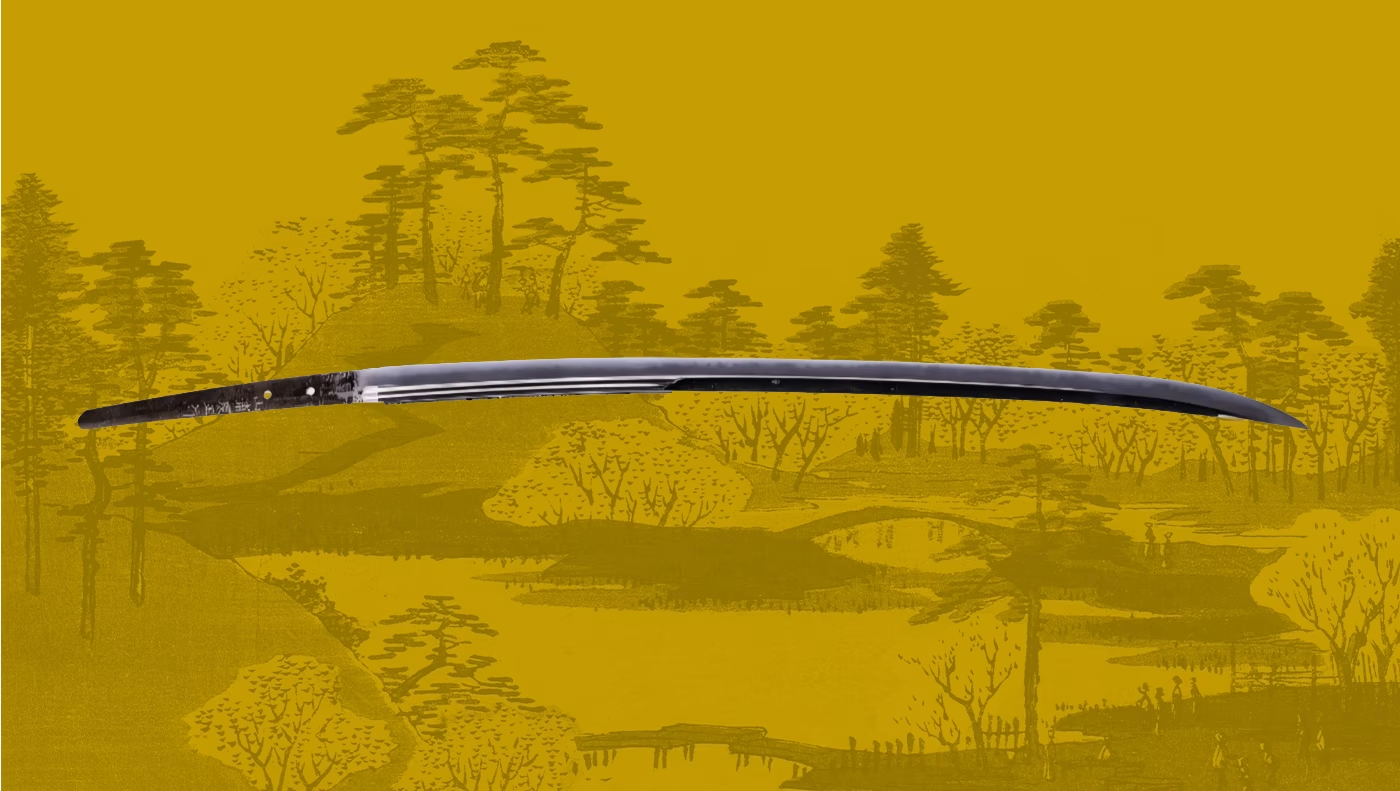
It begins with sand.
Black, heavy iron sand, washed down by rivers from the mountains of the Japanese prefecture of Shimane. Satetsu is what the smiths call it — magnetic sand, rich in iron, poor in impurities. From this sand, in a process that lasts three days and three nights, the raw material for the Japanese sword is made.
Japanese swordsmithing is no simple story of one craftsman and one weapon. It is a system of specialists, perfected over seven centuries to such a degree that the resulting object can scarcely be called a weapon — but rather nihontō: the Japanese sword.
Display case H04V of the Samurai Museum Berlin preserves blades by Gassan Sadakazu — one of the last masters of this tradition, bearer of the imperial title Teishitsu Gigei-in.
The Tatara Furnace: The Foundation
The tatara furnace is neither a blast furnace nor a forge hearth. It is a flat, ground-based clay furnace, about three metres long and one metre high, constructed especially for processing satetsu. It is destroyed and rebuilt after each smelting run — the building of the furnace is part of the process.
For one smelting run, about ten tonnes of satetsu and ten tonnes of charcoal are needed. The process begins in the early morning hours of the first day and ends on the third day. Throughout, charcoal is continuously added and the temperature is held at around 1,100°C by hand-operated bellows (fuigo) — hot enough to melt the sand, but not hot enough for modern molten iron.
The result is a heterogeneous mass of steel called the kera: a lump of about two tonnes in which various carbon contents lie side by side — from soft wrought iron with under 0.5% carbon to hard, almost brittle steel with over 1.5% carbon. The smith breaks this lump open and selects the pieces suitable for tamahagane (jewel steel): pieces with the right carbon content, recognisable by colour, fracture and weight.[1]
Tamahagane: Steel from Selection
The word tamahagane means literally “jewel steel”. It is not simply “good steel” — it is a specific product of a specific process, and its legal meaning is still precise today: a nihontō in the sense of Japanese law must be forged from tamahagane. Blades of industrial steel are called guntō (military swords) or shōwatō — they are swords, but not nihontō.[1]
The selection of the right tamahagane pieces is the first and perhaps most important decision of the smith. Too little carbon: the blade becomes soft and bends. Too much: it becomes brittle and breaks. The masters of the Kamakura period had no chemical analysis — they had decades of experience, and the experience of their teachers, and the experience of their teachers’ teachers.
The Folding: Homogenisation, Not Mystification
One of the most often cited and most misunderstood aspects of Japanese swordsmithing is the folding.
Popular accounts like to claim “thousands of layers” or even “hundreds of thousands”. The reality: a typical smelting run involves ten to fifteen folds. That yields 2^10 = 1,024 to 2^15 = 32,768 layers. More folds produce more layers, but at some point the carbon levels out and the quality drops.
The purpose of the folding is homogenisation: the heterogeneous tamahagane lump contains unevenly distributed carbon concentrations, slag inclusions and microscopic cavities. Through repeated heating to forging temperature (~800°C), hammering and folding, these irregularities are reduced. The result is a steel with a more even crystal structure — and the characteristic hada (blade grain) that becomes visible in highly polished blades.[2]
Sesko describes various hada types: mokume (wood grain), itame (more irregular wood grain), masame (straight parallel lines). These grain patterns are not decorative — they are the visible crystal structure of the steel and give the expert information about smithing school and period.[1]
The Composite Construction: Kawagane and Shingane
The most important innovation of Japanese swordsmithing is the composite construction.
A Japanese sword does not consist of a uniform steel. It consists of at least two different kinds of steel, precisely arranged:
Kawagane (jacket steel): the outer steel, hard through a higher carbon content. It forms the cutting edge and the surface of the blade. It takes the sharp hamon and keeps its edge.
Shingane (core steel): the inner steel, softer through a lower carbon content. It gives the blade its flexibility — when the edge is hard enough to deliver cuts, the core flexes far enough that the blade does not break.
This composite construction solves a fundamental metallurgical problem: hard steel keeps a sharp edge, but breaks. Soft steel bends, but stays blunt. The Japanese solution is the separation of both functions in a single object. Absolon aptly describes the engineering achievement: “The o-yoroi was a magnificent piece of technology… but it was a specialized tool for a specific type of warfare.” The same applies to the sword — a specialised solution for a specific problem.[3]
The Yaki-ire: Differential Hardening
The hamon — the visible hardening line, the aesthetically most striking feature of every Japanese blade — is the result of a precise thermal process.
Before quenching, the smith applies a clay mixture to the blade: thin near the edge, thicker towards the back. The exact composition of this clay mixture is a family secret of the respective school — clay, loam, wood ash, finely ground charcoal, each in secret proportions.
The blade is heated to exactly 750–800°C — the critical temperature at which the steel changes from the austenitic to the martensitic phase, recognisable by the cherry-red glow. Then it is plunged into cold water, edge first.
The thinly covered edge cools quickly: martensite forms, a crystal structure of extreme hardness and characteristic needle-like, prismatic shape. The thickly coated back cools slowly: pearlite or bainite forms, softer and tougher.
The boundary line between these crystal structures is the hamon. It is microscopically visible — and macroscopically in the interplay of light and angle: depending on the lighting, the hamon casts different reflections, which in the Japanese tradition are classified as nie (sparkling crystals) and nioi (a milky haze).[1]
The School of Gassan: The Ayasugi-hada
The Gassan Sadakazu sword in display case H04V is immediately recognisable as belonging to the Gassan school by its forging pattern: the ayasugi-hada.
Ayasugi means literally “ayasugi cypress” — and the pattern imitates the characteristically wave-shaped grain of this tree. It arises through a specific folding technique in which the smith hammers the blade in a wave-like pattern that forces the resulting layers into sweeping, parallel waves.
Sakakibara Kōzan — whose 19th-century handbook on armour-making also treats sword technique — describes how the ayasugi-hada can only be mastered by smiths who have fully internalised the basic technique of the masame-hada: the wave-shaped pattern presupposes precisely straight control.[4]
Gassan Sadakazu, who created the sword in display case H04V, was the last great master of this tradition. He had studied all five Gokaden and mastered the techniques of all the regional schools — which made him one of the most versatile smiths of his time. His 1907 appointment as Teishitsu Gigei-in (imperially authorised craftsman) was the highest distinction a craftsman could attain in Meiji Japan.
The Polisher: The Overlooked Artist
The blade is finished after the forging — but not yet visible.
The togishi (polisher) works with seven to twelve whetstones of differing grit, from the coarse arato stone to the fine hazuya finger polish. An elaborate polishing job takes forty to eighty hours. Without the togishi, the hamon remains invisible, the hada hidden, the nie dull.
Sesko emphasises the independent significance of the togishi: “kaji-togi” (smith’s polishing) and “shiage-togi” (finishing polishing) are two different professions. The kaji grinds the basic form; the shiage-togishi brings out the aesthetic quality. A bad togishi can destroy a magnificent blade; a good togishi can make a mediocre blade respectable.[1]
The Smith in Social Context: Craft and Honour
In the Heian and Kamakura periods, the swordsmith occupied a peculiar social position: his craft was physically connected with death — he forged weapons — but his skill was honoured as a quasi-religious art.
Great smiths received imperial commissions. They were invited to court ceremonies. Their works counted as shinbutsu (sacred property) — swords were consecrated to Buddhist temples and Shintō shrines. That is a paradox: a weapon as a sacred object. But it explains why Japanese smiths never fell into the social marginalisation that affected other metalworkers elsewhere.
Masters and Schools: The Genealogy of the Art
Japanese swordsmithing is an art of genealogy: knowledge is passed from master to student, often through adoption. Technical secrets remain in the family — the son takes over the father’s name, sometimes even his name in full.
Sesko documents in his Genealogies and Schools of Japanese Swordsmiths over a thousand smiths and their relationships of kinship and apprenticeship — a database that maps five centuries of Japanese swordsmithing.[1]
The Gassan house is an example of this continuity: Gassan Sadayoshi (1781–1870) adopted Gassan Sadakazu, who in turn trained Gassan Sadakatsu — a three-generation line reaching from the Edo period through the Meiji era into the early 20th century. Every bearer of the name Gassan mastered the characteristic ayasugi-hada — but each also brought his own signature to the tradition.
The signature on the tang (nakago-mei) is thus more than a proof of authorship: it is the document of a line of descent.
Today: Swordsmithing in the 21st Century
Japanese swordsmithing is alive.
Today there are in Japan about three hundred registered gendaitō smiths (smiths of modern swords) who work according to traditional methods with tamahagane. The tatara process is protected by the Japanese government as intangible cultural heritage; the Nittoho Tatara in Shimane-ken is the only modern facility that produces tamahagane by the traditional method.
The swords of these smiths can be legally bought if they meet the registration requirements of the NBTHK — a maximum of two blades per month per smith, NBTHK certification for each piece. The best contemporary masters achieve prices of twenty to sixty thousand euros per blade.
This economic reality shows that Japanese swordsmithing is no museum survival, but a living craft tradition. Gassan Sadatoshi, today’s bearer of the name and a Ningen Kokuhō (Living National Treasure), continues a line that reaches back to the Kamakura period.
Conclusion: Craft as Philosophy
Japanese swordsmithing is more than technique. It is an argument.
The argument runs: an object that serves life — or death — deserves the highest craftsmanship. Not despite its function, but because of it. Whoever makes a sword commits to an interplay of care and material that tolerates no error. The hamon, the nie, the hada — all of this is the making-visible of this care.
Gassan Sadakazu made the blade in display case H04V at the age of fourteen. That is no prodigy anecdote — it is testimony to a system in which the craft began so early, was taught so deeply, had to be so consistently perfected.
Frequently Asked Questions about Japanese Swordsmithing
What is tamahagane?
Tamahagane is the traditional Japanese steel smelted in the tatara furnace from black iron sand (satetsu). Only blades forged from tamahagane count legally as nihontō (Japanese sword). The term means literally “jewel steel” and denotes both the material and the production method.
How many layers does a real katana have?
After ten to fifteen folds, 1,024 to 32,768 layers arise. The often-cited “thousands of folds” describe a real, if simplified, fact. The folding process serves the homogenisation of the heterogeneous tamahagane, not a layer record.
What is the hamon?
The hardening line — the boundary between the hardened edge steel (martensite) and the softer back steel. It arises through differential hardening: a different clay coating before quenching produces different cooling speeds. The hamon is at once an aesthetic feature, a technical document and a mark of the school.
Who was Gassan Sadakazu?
Gassan Sadakazu (1836–1918) was a master smith of the Shinshintō renaissance. He mastered all the Gokaden traditions and received the imperial title Teishitsu Gigei-in in 1907. Two of his blades are in the collection of the Samurai Museum Berlin (display case H04V).
Visit the Samurai Museum Berlin
The sword collection of the Samurai Museum Berlin comprises over forty signed blades — living testimonies of the Japanese smithing tradition from the Kamakura period to the early 20th century. Display case H04V preserves pieces by Gassan Sadakazu, master smith and bearer of the imperial title. Open daily from 10 a.m. to 7 p.m., Auguststraße 68, Berlin-Mitte.
Related Articles
- Katana: The Sword of the Samurai
- Tachi: The Magnificent Long Sword
- Gokaden: The Five Swordsmithing Traditions
- Daishō: The Pair of Swords of the Samurai
Show sources
[1] Sesko, Markus (2014). Encyclopedia of Japanese Swords. Lulu Enterprises. Used: tamahagane (p. 81), hamon (p. 19), hada types (p. 31), nie/nioi (p. 28), nakago (p. 285).
[2] Turnbull, Stephen (2010). Katana: The Samurai Sword. Osprey Publishing. Used: tatara process (pp. 16–17), folding process (pp. 18–19), yaki-ire (pp. 22–25).
[3] Absolon, Trevor (2017). Samurai Armour, Volume I. Osprey Publishing. Used: composite construction as an engineering solution.
[4] Sakakibara Kōzan (1800/1962). The Manufacture of Armour and Helmets. Translated by H. Russell Robinson. Used: forging techniques; school discipline; choice of material.
[5] Samurai Museum Berlin (2025). SMB Catalogue 2025. Display case H04V: Gassan Sadakazu, Tameshi-Tantō, sword for the coronation of Emperor Taishō.
You might also like
Sashimono: The Back Banners of the Samurai
Sashimono — the back banners of the samurai. History, function, motifs, clans. Authentic examples at the Samurai Museum Berlin.
Read the article
Yari: The True Spear of the Samurai
The yari was the dominant weapon of the Sengoku battlefields — not the katana. Types, tactics, legendary bearers. Exhibits at…
Read the article
Naginata: The Polearm of the Samurai
The naginata: polearm of the samurai, anti-cavalry instrument and woman's weapon. History, types, and three originals at the Samurai Museum…
Read the article