 Nominated for the EMYA2026 award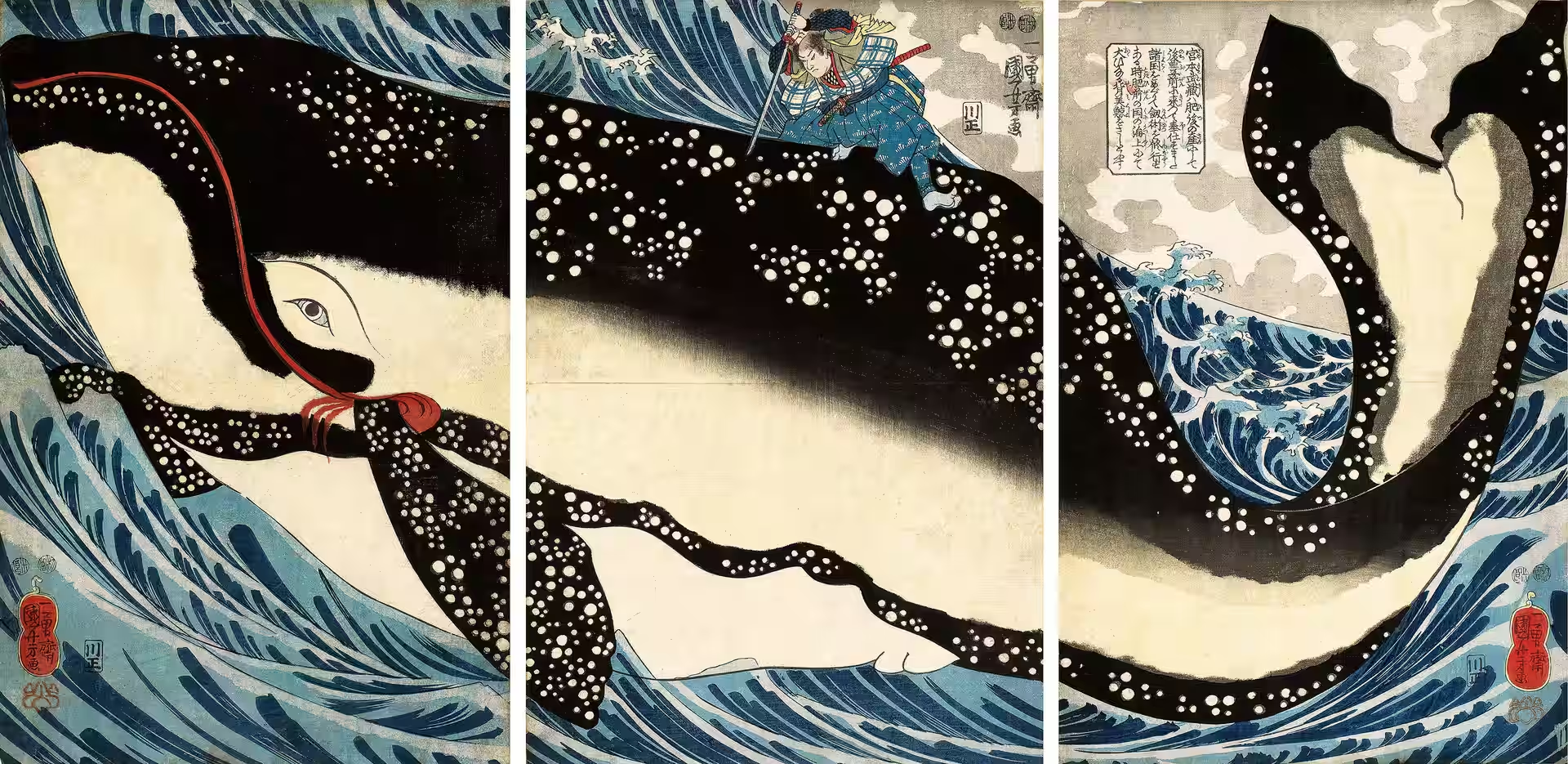
Miyamoto Musashi: Japan’s Legendary Sword Master
Introduction
In the spring of 1612, a man stepped onto a small island in the Kanmon Strait. He deliberately arrived late—one hour after the agreed time. In his hand he held not a forged katana, but a roughly carved wooden sword made from a boat oar, unusually long and unwieldy. His opponent, Sasaki Kojirō, was considered one of Japan’s finest swordsmen, famous for his lightning-fast technique, “Tsubame Gaeshi”—the Swallow Counter. A few minutes later, Kojirō was dead. The man who defeated him was Miyamoto Musashi, and this was his final duel.
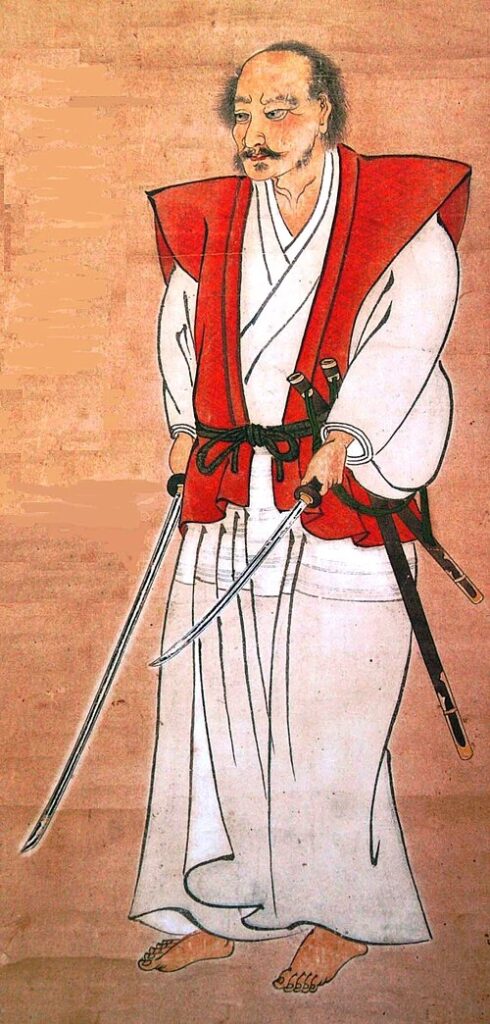
Miyamoto Musashi (1584–1645) is regarded as the embodiment of the samurai as warrior, philosopher, and artist. Born during a period of bloody civil wars, he reportedly fought more than 60 duels and survived them all. He later founded the two-sword school Niten Ichi-ryū and wrote Gorin no Shō (The Book of Five Rings). He was also known for his ink paintings.
Early Years (1584–1600)
Birth and Origins
The exact circumstances of Musashi’s birth remain unclear. Most sources date his birth to 1584 in Harima Province or possibly Mimasaka, in what is now the southwestern part of Okayama Prefecture. His father, Hirata Munisai, was a respected sword master who married into his wife Omasa’s family and adopted the name Shinmen Munisai—a practice that was not unusual at the time.
The name “Miyamoto Musashi” was itself adopted later. As a child, he was called Bennosuke, and it was only at around 16 that he took the name that would make him immortal. “Musashi” may refer to the village where he was born, but it may also have been a deliberate reference to Musashi Province, where the rising capital Edo was located.
The sources on Musashi’s early years are fragmentary. Many details of his life come from Gorin no Shō, which he wrote in old age, as well as later chronicles that were sometimes embellished with legend. Modern historians treat these accounts with due caution.
The First Duel – Arima Kihei
At the age of 13, Musashi killed his first opponent. The man was Arima Kihei, an adult samurai and expert in the sword and spear. According to tradition, Kihei had issued an open challenge in the village square, and the young Musashi, already tall and strong for his age, accepted it.
The fight was short and brutal. Musashi used no refined technique, relying instead on brute force and unconventional tactics: he threw Kihei to the ground, tore the weapon from his hand, and beat him to death with a heavy staff. It was not an elegant victory, but it was a victory—and the beginning of a legend.
This first duel already reveals the essence of Musashi’s later philosophy: victory matters, not the method. Honour lies not in the beauty of a movement, but in survival. This attitude set him apart from many other sword masters of his time, who viewed duels as ritualised contests.
The Battle of Sekigahara (1600)
In 1600, at about 16 years of age, Musashi is said to have taken part in the decisive Battle of Sekigahara—the bloody conflict that brought Japan under Tokugawa rule for the next 250 years. According to some sources, he fought on the side of the Toyotomi loyalists, who were defeated.
If this account is accurate, it would explain why Musashi remained a rōnin—a masterless samurai—for much of his life. The defeat at Sekigahara cost thousands of warriors their lords and lands. Yet while other rōnin ended up as failed men, Musashi turned his lack of a master into a strength: he was beholden to no one but the Way of the Sword itself.
His participation, however, is not historically confirmed. Musashi does not explicitly mention it in Gorin no Shō, and contemporary battle records do not name him. It remains one of the many gaps in his early biography, suspended between legend and history.
The 60 Duels (1600–1612)
The Yoshioka School (Kyoto)
After Sekigahara, Musashi began his musha shugyō—a warrior’s pilgrimage, travelling to perfect his martial skills. He journeyed across Japan and challenged established sword masters, often to the dismay of local authorities. His reputation preceded him: a wild, unpolished fighter who saw duels not as courtly rituals but as struggles for survival.
In Kyoto, he encountered the Yoshioka school, one of Japan’s most prestigious sword schools, which had taught the shoguns for generations. Tradition recounts three duels: first against Yoshioka Seijūrō, the head of the school; then against his younger brother Denshichirō; and finally against Matashichiro, the family’s underage heir, who was accompanied by dozens of armed students.
What distinguished these fights was not Musashi’s technical superiority—the Yoshioka were highly trained masters—but his psychological warfare. He arrived late, appeared in unexpected places, and used the sun as a weapon. In the third duel, he is said to have hidden in the bushes and ambushed the young Matashichiro, an act many samurai would have regarded as treachery under their code of honour. For Musashi, only the result mattered: he lived; his opponents did not.
Historian Stephen Turnbull writes of this period: “Musashi’s duels were characterised by deception and psychological intimidation. He understood that a fight begins long before the swords cross.” It was a lesson he would later systematise in Gorin no Shō.
Ganryū-jima – The Legendary Duel (1612)
On 13 April 1612, one of the most famous duels in Japanese history took place: Miyamoto Musashi versus Sasaki Kojirō on the small island of Ganryū-jima in the Kanmon Strait, near present-day Shimonoseki.
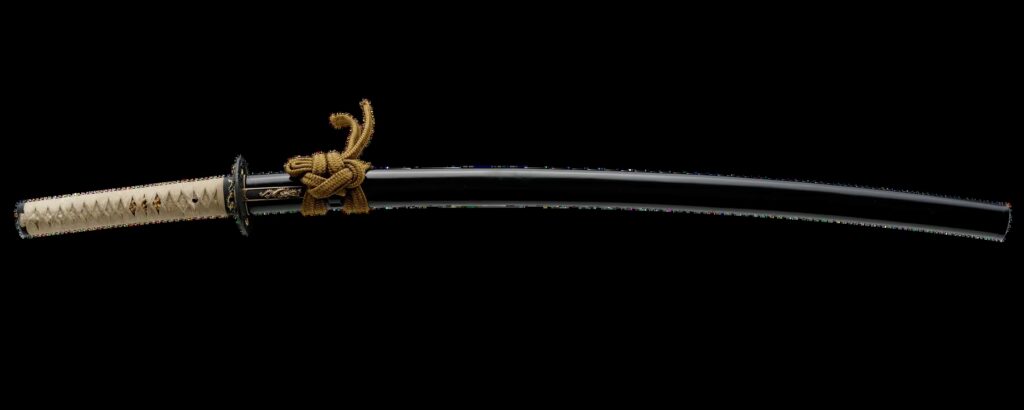
Sasaki Kojirō was Musashi’s opposite in every way: an elegant technician, famous for his speed and signature technique, Tsubame Gaeshi (the Swallow Counter)—a lightning-fast counterattack said to imitate a swallow’s flight with extraordinary precision. His weapon was an exceptionally long forged nodachi known as the “Dry Holly.”
Musashi arrived an hour late—a calculated insult intended to enrage Kojirō. When he finally jumped from the boat, he carried no forged sword, but a roughly carved bokken made from a boat oar. It was a foot longer than Kojirō’s blade, giving him a decisive advantage.
The fight lasted only seconds. Musashi used the morning sun shining into Kojirō’s face and struck with a single, brutal blow. The wooden sword hit Kojirō’s skull. The master of the Swallow technique fell, and Musashi jumped back into the boat without a word. Only hours later did he learn that Kojirō had died of his injuries.
The island has since borne Kojirō’s name: Ganryū-jima, the “Island of the Ganryū Style”—a posthumous honour for the defeated man. For Musashi, this victory meant more than another notch on his sword. He was 29 and had come to understand that true mastery lay not in killing, but in understanding.
From Warrior to Strategist
After Ganryū-jima, Musashi never again killed anyone in a duel. Although he continued to accept challenges, he now fought with a bokken, a wooden sword, and spared his opponents.
This change was more than a moral awakening; it was a philosophical shift. The brutal duels of his youth had shown him that technique alone was not enough. True mastery required an understanding of rhythm, timing, and an opponent’s mind. “Mastering the enemy’s mind is more important than defeating his body,” he later wrote in Gorin no Shō.
He began to systematise his experiences, meditate, and paint. The sword master became a philosopher, the killer an artist. Yet the shadows of the 60 dead would never leave him entirely—they flowed into every line of his masterpiece, as both warning and wisdom.
The Philosopher – Niten Ichi-ryū and The Book of Five Rings
The Two-Sword School (Niten Ichi-ryū)
Musashi’s greatest legacy is not the number of his victories, but the martial arts school he founded: Niten Ichi-ryū, the “School of Two Heavens as One.” The name refers to wielding two swords simultaneously—the long katana and the shorter wakizashi—a technique that was revolutionary when it was developed.
Samurai of the Edo period traditionally carried both swords as a mark of status (daishō). The katana was wielded with both hands to generate maximum power. Musashi radically broke with this convention: he wielded both swords at once, the katana in his right hand and the wakizashi in his left.
His reasoning was pragmatic, not aesthetic: “To die with a weapon unused in your belt would be regrettable.” Every available resource had to be used. In practice, Musashi attacked with the katana while parrying counterattacks with the wakizashi—a tactic that forced opponents to focus on two independent threats at once.
Historian Karl Friday places Niten Ichi-ryū in the broader context of ryūha (martial arts schools): “Musashi’s system was less a collection of techniques than a strategic philosophy. He taught principles, not movements.” The school has survived to this day, though with a small number of students, and is practised mainly in Japan and the United States.
The Book of Five Rings (Gorin no Shō)
In 1643, two years before his death, Musashi withdrew to Reigandō Cave in the mountains of Kumamoto. There, at the age of 60, he began his principal philosophical work: Gorin no Shō, The Book of Five Rings.
The work is divided into five books, named after the elements:
- Earth (Chi): Fundamentals of strategy and the warrior’s bearing
- Water (Sui): Flexibility and adaptation—“Be like water”
- Fire (Ka): Combat itself—aggression, timing, and surprise
- Wind (Fū): Criticism of other schools and their weaknesses
- Void (Kū): The highest level—acting without thought, intuitive mastery
The work’s central thesis is that strategy is universal. “The Way of strategy is the Way of all things,” Musashi writes. A carpenter building a house follows the same principles as a general commanding an army or a businessperson conquering a market. This universality later made Gorin no Shō a bestseller in management literature; from Wall Street to the Pentagon, it has been read as a guide to competition and conflict.
Yet Musashi explicitly warned against applying methods mechanically: “Study rhythm in all things, but do not become enslaved by rhythm.” Flexibility defeats rigid methods. An enemy who can predict your next move has already beaten you.
Zen, Strategy, and the Void
The fifth book, the Book of the Void (Kū), is the shortest and also the most enigmatic. Musashi writes: “The Void is that in which nothing exists and nothing does not exist. If you know the Void, you know the Way.”
At first glance, this sounds like classical Zen Buddhism, and Musashi was indeed deeply influenced by Zen concepts. But he was neither a monk nor a dogmatist. His Zen was combative and pragmatic—a state of mind that could determine life or death in a fraction of a second.
For Musashi, the concept of the Void does not mean passivity, but the highest level of responsiveness: a state in which the body acts without the mind intervening, because conscious intervention is too slow. “If you think, you are already dead” could sum up the essence of this teaching.
Translator William Scott Wilson describes it this way: “Musashi sought a state beyond technique. A master does not react to an attack—he is already moving before it begins, because he understands his opponent’s rhythm, not his intention.”
This philosophy distinguishes Musashi from other sword masters of his time. While schools such as Yagyū Shinkage-ryū focused on perfecting kata, Musashi taught the opposite: forget the form and understand the principle.
The Artist
Musashi was not only a sword master but also a recognised painter and calligrapher. His works—mostly in the ink-painting technique known as sumi-e (墨絵)—are regarded as a direct manifestation of the philosophical enlightenment he attained through the sword.
His best-known paintings were created in the final years of his life at Reigandō Cave. “Shrike on a Dead Branch” (枯木鳴鵙図, Koboku Meigeki-zu) depicts a bird perched on a sparse branch, painted with a few powerful strokes. The deliberate emptiness around the subject embodies Musashi’s concept of Kū (the Void) from the Book of Heaven. His depiction of Daruma—the Zen patriarch Bodhidharma—is equally radical, capturing the immediacy of Buddhist insight through raw energy.
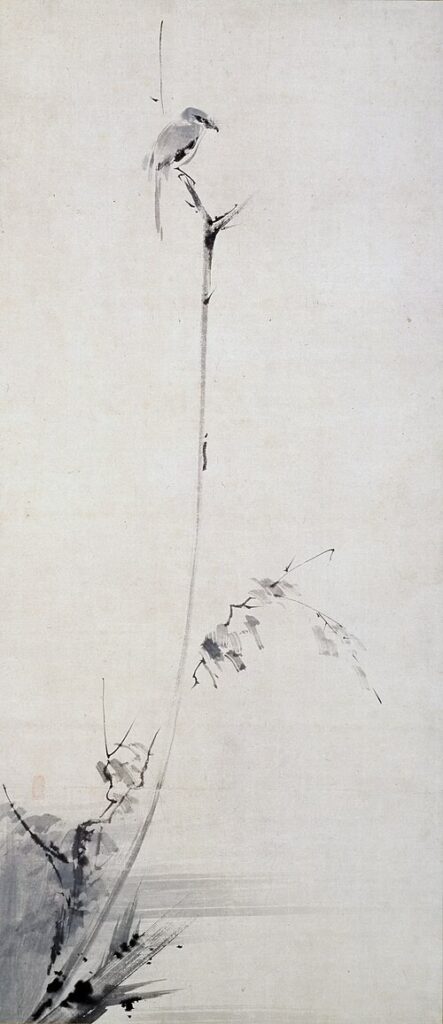
Kenji Tokitsu, who analysed Musashi’s work as a martial arts master and historian, writes: “His ink painting is an expression of enlightenment through the sword” (p. 360). The pared-down, spontaneous brushstrokes are not a side pursuit, but another expression of the same Way. They reflect the principles of Gorin no Shō: efficiency, clarity, and freedom from the unnecessary. What is the single decisive strike in combat becomes the single perfect stroke in art.
Musashi’s calligraphy—often Zen sayings such as “Under heaven, nothing is useless”—was valued by samurai and Zen monks alike. Some of his works are now considered Japanese national treasures; others have been lost or survive only as copies.
Final Years and Death (1643–1645)
Retreat to Reigandō Cave
In 1643, at around 60 years of age, Musashi withdrew into seclusion. His retreat was Reigandō Cave in the mountains of Kumamoto on the island of Kyushu. The local daimyō, Hosokawa Tadatoshi, had invited him as a guest and adviser—an honour for a lifelong rōnin.
Reigandō Cave (“Cave of the Spirit Rocks”) lies on Mount Iwato, surrounded by dense forest. Here, in complete silence, Musashi meditated and wrote down his philosophical legacy: Gorin no Shō. The place itself was symbolic—a cave, a threshold between worlds, between life and death, between combat and the Void.
In these final years, Musashi received few visitors. One was his student Terao Magonojo, to whom he handed the completed manuscript of Gorin no Shō a few weeks before his death. “This is the Way I have followed,” he is said to have told him. “You must discover for yourself whether it is the right one for you.”
Death and Legacy
On 13 June 1645, in the second year of the Shōhō era, Miyamoto Musashi died in Reigandō Cave. He was 62. The exact cause of death is unknown; he probably succumbed to an illness, possibly cancer, as some sources speculate.
His death was like the life he had lived: without drama, without an audience. No final duel, no spectacular seppuku. Only the silence of the cave and the mountain watching over him.
Musashi was buried in Kumamoto, wearing full armour and with his two swords. His grave later became a pilgrimage site for swordsmen from across Japan. Reigandō Cave is now a small museum and shrine where visitors can see the place where Gorin no Shō was written.
His true legacy, however, is not made of stone: it is the words, principles, and philosophy of a man who killed 60 people in order to learn how not to kill again.
Musashi Today – Reception and Popular Culture
The Musashi Myth
Today, nearly 380 years after his death, Miyamoto Musashi is more present than ever. In Japan, he is revered as a kensei, or “sword saint,” an honorific reserved for the greatest masters. Ganryū-jima, the site of his legendary duel with Sasaki Kojirō, is a popular tourist destination. Every year, thousands make a pilgrimage there to stand where the two swordsmen met.
A monumental bronze statue in Kumamoto commemorates the city’s most famous resident. Reigandō Cave has been turned into a shrine where martial artists from around the world pay their respects. Musashi’s grave in Kumamoto is maintained and regularly visited, especially by practitioners of Niten Ichi-ryū who honour their founder.
But the Musashi cult is not confined to Japan. Gorin no Shō has been translated into more than 30 languages and is standard reading at military academies and management seminars in many countries. The universality of its principles—flexibility, timing, and psychological warfare—has made the work timeless.
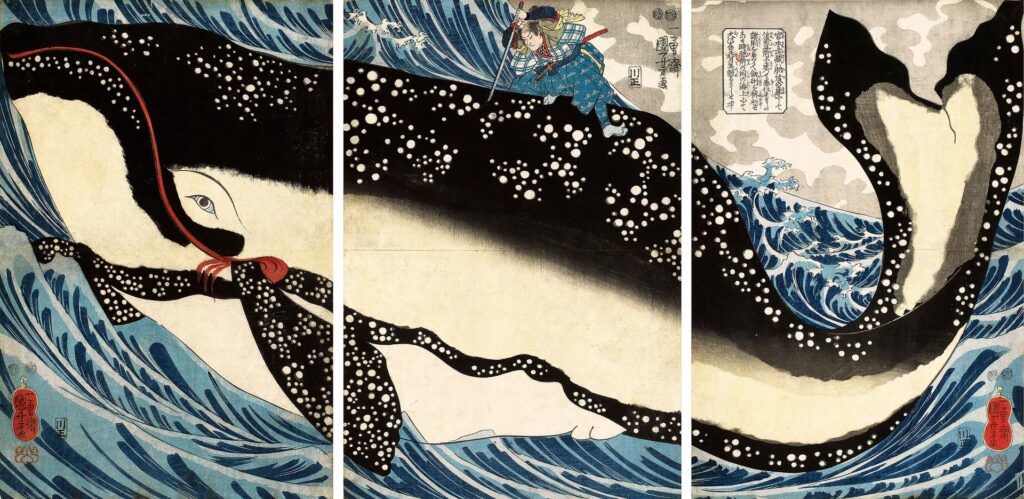
Vagabond and Other Adaptations
Modern popular culture has made Musashi one of its icons. The most influential portrayal comes from the novel Musashi by writer Eiji Yoshikawa, published as a serial between 1935 and 1939. Yoshikawa’s version is romanticised and partly fictional, but it shaped the image of Musashi around the world. The novel has sold more than 120 million copies and is considered one of the most widely read Japanese books of all time.
Takehiko Inoue’s manga Vagabond (1998–2015), which tells Musashi’s life across more than 300 chapters, is also based on Yoshikawa’s novel. The manga combines historical research with artistic freedom and has won numerous awards. Inoue’s drawings are works of art in their own right; some have been exhibited in galleries.
Musashi also became a legend on film. The best-known adaptation is the Samurai Trilogy (1954–1956), starring Toshirō Mifune. Mifune’s raw, animalistic portrayal of Musashi set the visual standard for decades and influenced later depictions of samurai in cinema around the world.
Musashi also appears in video games (Nioh, Soulcalibur), anime series, and even music: the Swedish metal band Sabaton dedicated the song “The Duelist” to him.
Niten Ichi-ryū Today
The Niten Ichi-ryū martial arts school still exists, although its number of students is very small. It is practised mainly in Japan, with a few dojos in the United States and Europe. Unlike modern sports such as kendo, it focuses on preserving historical techniques and forms (kata), rather than competition.
The school’s current grandmaster holds the title sōke and is the direct successor in an unbroken line dating back to Musashi himself—a living link to a man who lived nearly four centuries ago
Frequently Asked Questions about Miyamoto Musashi
1. How many duels did Musashi win?
In Gorin no Shō, Musashi claimed to have fought more than 60 duels and won them all. However, only a few are historically confirmed, including the famous duel against Sasaki Kojirō on Ganryū-jima (1612) and the fights against the Yoshioka school in Kyoto. The exact number remains disputed because many accounts were recorded decades after his death.
2. Why did Musashi fight with two swords?
Musashi’s Niten Ichi-ryū (Two-Sword School) was based on the principle of using every available resource. While other samurai carried the short wakizashi only as a backup weapon, Musashi actively used it in combat: the katana for attacks and the wakizashi for defence. “To die with a weapon unused in your belt would be regrettable,” he wrote.
3. What is The Book of Five Rings?
Gorin no Shō is Musashi’s principal philosophical work, written between 1643 and 1645 in Reigandō Cave. It describes strategic principles in five sections (Earth, Water, Fire, Wind, and Void) and was later read around the world as a guide to management and military affairs.
4. Was Musashi really invincible?
According to the surviving accounts, not a single defeat of Musashi has been documented. However, the source material is incomplete, and many details of his life have been embellished by legend. Historians treat these accounts with caution.
5. What works of art did Musashi create?
Musashi was a recognised master of ink painting (sumi-e) and calligraphy. His style is powerful and restrained, influenced by Zen Buddhism. Many of his works are held in Japanese museums. He also designed tsuba (sword guards) featuring distinctive motifs.
Sources and Further Reading
- Turnbull, Stephen (2008): Samurai Swordsman. Osprey Publishing.
- Wilson, William Scott (2012): The Book of Five Rings. Shambhala Publications.
- Wilson, Sean Michael & Kutsuwada, Chie (2012): The Book of Five Rings: Graphic Novel. Shambhala Publications.
- Hall, John Whitney (Hrsg.) (1991): Cambridge History of Japan, Volume 4: Early Modern Japan. Cambridge University Press.
- Friday, Karl F. & Seki, Humitake (1997): Legacies of the Sword: The Kashima-Shinryū and Samurai Martial Culture. University of Hawaii Press.
- Sánchez García, Raúl (2019): The Historical Sociology of Japanese Martial Arts. Routledge.
- Tokitsu, Kenji (2004): Miyamoto Musashi: His Life and Writings. Shambhala Publications.
- Atkins, E. Taylor (2017): A History of Popular Culture in Japan: From the Seventeenth Century to the Present. Bloomsbury Academic.
Visit the Samurai Museum Berlin
Experience the exhibits and themes discussed in this article first-hand in the permanent exhibition of the Samurai Museum Berlin. More than 500 original objects from feudal Japan—including armour, weapons, and everyday items—await you at Auguststraße 68, Berlin-Mitte. Open daily from 10 am to 7 pm.
→ Tickets & Opening Hours
→ Overview of All Exhibitions
Related Articles
- Samurai: History, Culture and Legacy
- Bushidō: The Honour Code of the Samurai
- The Katana: Myth and Reality
© Samurai Museum Berlin – All rights reserved
You might also like
Tokugawa Ieyasu: The Last Unifier of Japan
Tokugawa Ieyasu (1543–1616), Japan's last unifier. Sekigahara, Osaka, Pax Tokugawa. 250 years of peace – with original exhibits at the…
Read the article
Hattori Hanzō: The Shadow of Iga and Tokugawa’s Lifesaver
On the morning of 21 June 1582, Tokugawa Ieyasu was sitting in a teahouse in Sakai when a messenger arrived…
Read the article
Meiji Restoration: The End of the Samurai (1868–1912)
The Meiji Restoration ended 700 years of warrior rule. How Saigō Takamori, the sword ban and Shiroyama sealed the end…
Read the article