 Nominated for the EMYA2026 award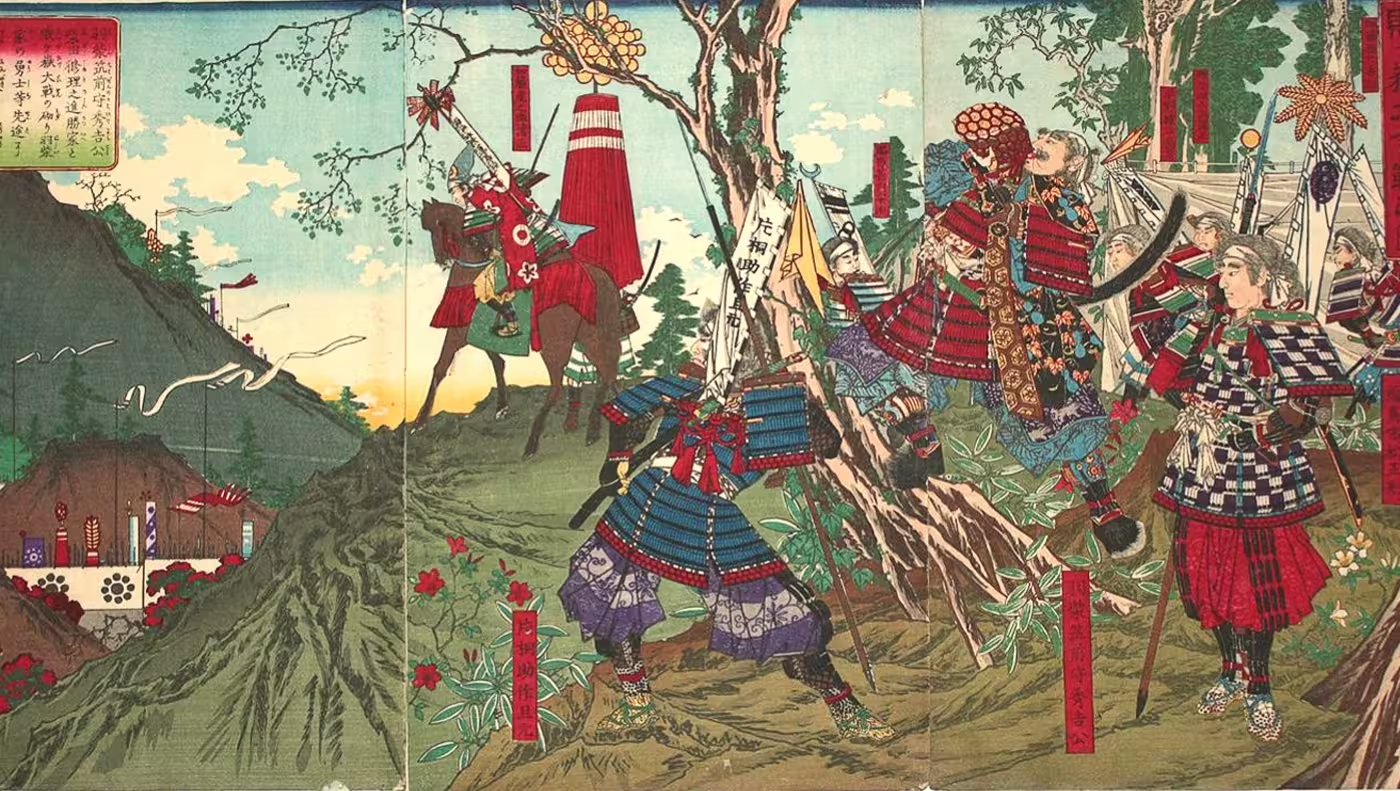
When Nobunaga died at the Honnō-ji Temple in 1582, Hideyoshi reacted faster than anyone else. He immediately made peace with the Mōri – without consulting Nobunaga’s heirs – and marched 200 kilometres back to Kyoto in five days. This „Great Return March“ is unparalleled in military history. Hideyoshi’s troops covered an average of 40 kilometres per day, through mountains and in the rain. At Yamazaki he met Akechi Mitsuhide, Nobunaga’s betrayer. Hideyoshi won through sheer numbers and speed. Mitsuhide fled and was allegedly killed by peasants. Hideyoshi presented himself as the avenger of his lord. It was brilliantly staged.
The Takeover: How Hideyoshi Seized Power
Nobunaga’s heirs – his eldest son Nobukatsu and his second son Nobutaka – were weak, divided and inexperienced. Hideyoshi played them off against each other. In 1583 came the confrontation with Shibata Katsuie, another of Nobunaga’s generals. At Shizugatake Hideyoshi defeated him. Katsuie committed seppuku. With that, the way was clear.
Hideyoshi’s strategy differed fundamentally from Nobunaga’s. Where Nobunaga broke, Hideyoshi forged alliances. He offered defeated daimyō generous terms: keep your territories, acknowledge me as overlord, provide troops when I call. Berry describes this system as a compromise: the daimyō lost their autonomy but kept their landholdings (Berry 1982: p. 85).
The test came in 1584. At Komaki-Nagakute Hideyoshi encountered the one opponent he could not defeat militarily: Tokugawa Ieyasu. The campaign ended in a stalemate. Instead of continuing the war, Hideyoshi sent his own mother as a hostage to Ieyasu – an unprecedented act of self-abasement that worked: in 1586 Ieyasu formally submitted. Berry assesses this as Hideyoshi’s strategic masterstroke: he accepted a tactical draw in order to win a political victory (Berry 1982: pp. 64–80).
The last and most impressive demonstration came in 1590 before Odawara. The Hōjō, the last independent power in the east, had entrenched themselves behind their castle walls. Hideyoshi besieged them not with assault, but with patience – and theatricality. Before the gates he had a tea festival staged, invited travelling merchants, erected a provisional town. After three months the Hōjō clan capitulated. Japan was unified.
The Kampaku Title: A Political Invention
Yet military power was not enough. Hideyoshi needed legitimacy. The title of shōgun was traditionally reserved for the Minamoto clan. Hideyoshi, a nobody without lineage, could not claim it. So he circumvented the system.
In 1585 he had himself adopted into the Fujiwara family and took the title Kampaku – imperial regent, the highest civil dignity after the emperor. In 1586 the emperor bestowed on him the new family name Toyotomi – a name that had not existed before. On paper, the nameless peasant’s son had become an aristocrat.
The Taikō’s State: Reforms and Control
Taikō Kenchi: The Surveying of Power
Hideyoshi’s first instrument was the earth itself. Between 1582 and 1598 he had all of Japan surveyed – the Taikō Kenchi, a cadastral survey of unprecedented scale. Every rice field was recorded, classified and assigned to a specific taxpayer. The survey stripped local elites of control over landholding and tax revenue. The standardised koku system (one koku ≈ 180 litres of rice, the annual ration of an adult) made wealth measurable and performance comparable. Berry calls it „the fiscal foundation of the Toyotomi state“ (Berry 1982: p. 145).
Katanagari and Heinō Bunri: The Door Closes
In 1588 came the second blow: the Katanagari edict, the „sword hunt“. All peasants had to surrender their weapons. Officially, a great Buddha was to be cast from the metal. In fact, it was the end of social mobility.
The principle of Heinō Bunri – „separation of warriors and peasants“ – became law. A samurai remained a samurai, a peasant remained a peasant. Hideyoshi, who had himself risen from foot soldier to ruler, closed the door behind him. Berry interprets the sword hunt not as disarmament, but as targeted social engineering: it served the separation of the estates, not peace (Berry 1982: pp. 206–215).
Tea as Politics: The Fall of Sen no Rikyū
Under the Taikō, chanoyu became a political instrument. Precious tea bowls served as substitutes for fiefs. Hideyoshi himself staged the „Great Kitano Tea Gathering“ in 1587 – a mass spectacle to which everyone was invited, from daimyō to peasant.
At the centre of this world stood Sen no Rikyū, the greatest tea master of his time. Rikyū served Hideyoshi as a cultural adviser, but his influence grew too great. In 1591 Hideyoshi ordered his closest confidant to commit seppuku. Berry reads the conflict as a power struggle over cultural authority (Berry 1982: pp. 168–180).
At the Samurai Museum Berlin, the armour of the Wakisaka clan (display case C07V) illustrates the system of daimyō co-optation. The Wakisaka survived through timely side-switching and declarations of loyalty – precisely the pattern that made Hideyoshi’s federal order possible and at the same time undermined it.
The Korea Catastrophe: Hideyoshi’s Greatest Mistake
In 1592 Hideyoshi invaded Korea. Japan was unified, but the warriors were restless. Hundreds of thousands of samurai had spent their lives fighting. Berry suspects behind this less madness than calculation: the war was meant to direct the energy of the united warrior caste outward, before it turned inward (Berry 1982: p. 225).
The first invasion began spectacularly. 158,000 Japanese soldiers landed in Pusan and captured Seoul in 20 days. But three factors destroyed Hideyoshi’s plans: Admiral Yi Sun-sin destroyed the Japanese supply lines with armoured „turtle ships“ (Geobukseon). China intervened with 50,000 soldiers. Korean guerrillas made occupation impossible.
In 1597 Hideyoshi launched a second invasion – doomed to failure from the start. When he died in September 1598, the invasion collapsed at once. Over 100,000 Japanese were dead – for nothing. Korea lay devastated.
Faith and Power: Hideyoshi’s Policy Towards Christians
Hideyoshi’s relationship with Christianity was pragmatic – until it became dangerous. When he took power, an estimated 150,000 Christians lived in Japan. Nobunaga had tolerated the Jesuits because they controlled the silk trade between Macao and Nagasaki (Hall 1991: p. 321).
In 1587 Hideyoshi recognised the problem: several daimyō had become Christians and formed a network that undermined his control. On 24 July 1587 he issued the Bateren tsuihō rei – the edict for the expulsion of the missionaries. In practice many missionaries remained in the country, as long as they operated discreetly. On 5 February 1597, 26 Christians were crucified in Nagasaki.
At the Samurai Museum Berlin, display case C22V documents this development. The exhibition shows how trade, religion and politics were inextricably intertwined in Japan’s „Christian century“ – and how Hideyoshi’s policy towards Christians laid the foundation for the complete isolation (sakoku) under the Tokugawa shōguns.
The Legacy: Death and Fragile Succession
The Hidetsugu Affair
Hideyoshi’s only son Tsurumatsu died in 1591 at the age of three. He adopted his nephew Hidetsugu and made him Kampaku. In 1593 another son was born: Hideyori. Suddenly Hidetsugu was no longer heir, but rival. In 1595 Hideyoshi ordered his nephew to commit seppuku. Then he had Hidetsugu’s entire family executed – more than thirty people. Berry judges that Hideyoshi’s political rationality waned in his final years (Berry 1982: p. 236).
The Council of Five Regents
When Hideyoshi died in 1598, Hideyori was only five years old. The dying Taikō had installed a Council of Five Regents (Go-Tairō) – Tokugawa Ieyasu, Maeda Toshiie, Ukita Hideie, Mōri Terumoto and Uesugi Kagekatsu. It was an unstable construct. Berry’s verdict: Hideyoshi failed to create institutions that could outlast his death (Berry 1982: p. 238).
In 1600 the factions faced each other at Sekigahara – the greatest samurai battle in history, with over 160,000 soldiers. Ieyasu won. In 1603 he founded the Tokugawa shogunate. In 1615 Osaka Castle fell. Hideyori died. The House of Toyotomi was extinguished.
And yet: the social order that Hideyoshi had created outlived him. The rigid separation of the estates, the bureaucratisation through the kenchi, the control through sanctions and oaths of loyalty – Tokugawa Ieyasu took over not only the power but also the system. Edo society, which kept Japan at peace for two and a half centuries, was Hideyoshi’s creation. Ieyasu only completed it.
Hideyoshi at the Samurai Museum Berlin
The Momoyama period (1573–1615), Hideyoshi’s era, was an age of exuberance. After decades of civil war, culture exploded: golden folding screens, extravagant helmets, magnificent armour. The Samurai Museum Berlin shows several objects from this period.
The armour of the Wakisaka clan (display case C07V) connects directly to Hideyoshi’s policy of daimyō co-optation. Display case C22V documents the intertwining of trade, mission and persecution of Christians under Hideyoshi – from the 1587 edict to the 26 martyrs of Nagasaki.
Frequently Asked Questions
Was Hideyoshi really a peasant?
His exact origins are unclear. Contemporary sources call his father an ashigaru (foot soldier). Hideyoshi had no interest in glorifying his origins – he reinvented himself as a self-made man. Berry documents how, after his rise, he systematically abolished the social mobility that had made him possible in the first place.
Why did Hideyoshi’s Korea invasion fail?
Three main reasons: Admiral Yi Sun-sin destroyed the Japanese supply lines at sea. China intervened with 50,000 soldiers. Korean guerrillas made occupation impossible. Berry argues that the war was intended as an outlet for unemployed warriors – but was doomed to failure logistically from the start.
Did Hideyoshi really unify Japan?
Militarily, yes. By 1590 he had subjugated all the great daimyō. Politically, the unification was fragile – it hung on his person. Berry calls the system a „fragile federalism“. After Hideyoshi’s death in 1598, the balance collapsed, until Tokugawa Ieyasu seized power at Sekigahara (1600).
Why is Hideyoshi called „the monkey“?
Hideyoshi’s nickname Saru („monkey“) came from his gaunt face and small stature. Nobunaga called him this – partly in jest, partly in contempt. Hideyoshi accepted the nickname pragmatically. Later, as Taikō, he avoided it, but the designation stuck in the chronicles.
What was the Katanagari edict?
The Katanagari („sword hunt“) of 1588 ordered all peasants to surrender their weapons. Officially, Buddha statues were to be cast from them. In fact, it was the foundation of the estate-based society (Heinō Bunri) that defined Japan until 1868. Berry shows: the edict was not a disarmament programme, but targeted social policy.
Why did Hideyoshi persecute Christians?
Hideyoshi at first tolerated Christians because of the lucrative silk trade with the Portuguese. In 1587 he recognised that Christian daimyō in Kyūshū formed a network that undermined his control. The Bateren tsuihō rei was a political, not a religious decision.
What was the Taikō Kenchi?
The Taikō Kenchi was a nationwide cadastral survey (1582–1598) that recorded every rice field in Japan and assigned it to a taxpayer. Berry calls it „the fiscal foundation of the Toyotomi state“ – without it, Hideyoshi could neither have taxed nor controlled his daimyō.
Visit the Samurai Museum Berlin
You can experience the exhibits and themes of this article up close in the permanent exhibition of the Samurai Museum Berlin. Over 500 original objects from feudal Japan await you at Auguststraße 68, Berlin-Mitte. Open daily from 10 a.m. to 7 p.m.
Related Articles
- Samurai: History, Culture and Legacy
- Bushidō: The Code of Honour of the Samurai
- The Katana: Myth and Reality
List of Sources
- Berry, Mary Elizabeth (1982): Hideyoshi. Harvard University Press.
- Hall, John Whitney (ed.) (1991): The Cambridge History of Japan, Vol. 4: Early Modern Japan. Cambridge University Press.
- Turnbull, Stephen (2022): War in Japan 1467–1615. Osprey Publishing.
- Cooper, Michael (1965): They Came to Japan. University of California Press.
- Samurai Museum Berlin (2025): Exhibition catalogue. Display cases C07V, C22V.
© Samurai Museum Berlin – All rights reserved
You might also like
Tomoe Gozen: Japan’s Most Famous Female Warrior (ca. 1157–1247)
Tomoe Gozen – warrior, legend, question. What do we really know about Japan's most famous onna-musha? History & fact-check at…
Artikel lesen
Battle of Sekigahara 1600: Japan’s Decision — Won Through Betrayal
Sekigahara 1600 — Japan's largest samurai battle, decided by betrayal. Course, strategy, consequences. Exhibits at the Samurai Museum Berlin.
Artikel lesen
Sanada Yukimura: Japan’s Bravest Warrior (1567–1615)
Sanada Yukimura defended Ōsaka against Tokugawa Ieyasu's army – and became an icon of the honourable last stand. History, myth…
Artikel lesen