 Nominated for the EMYA2026 award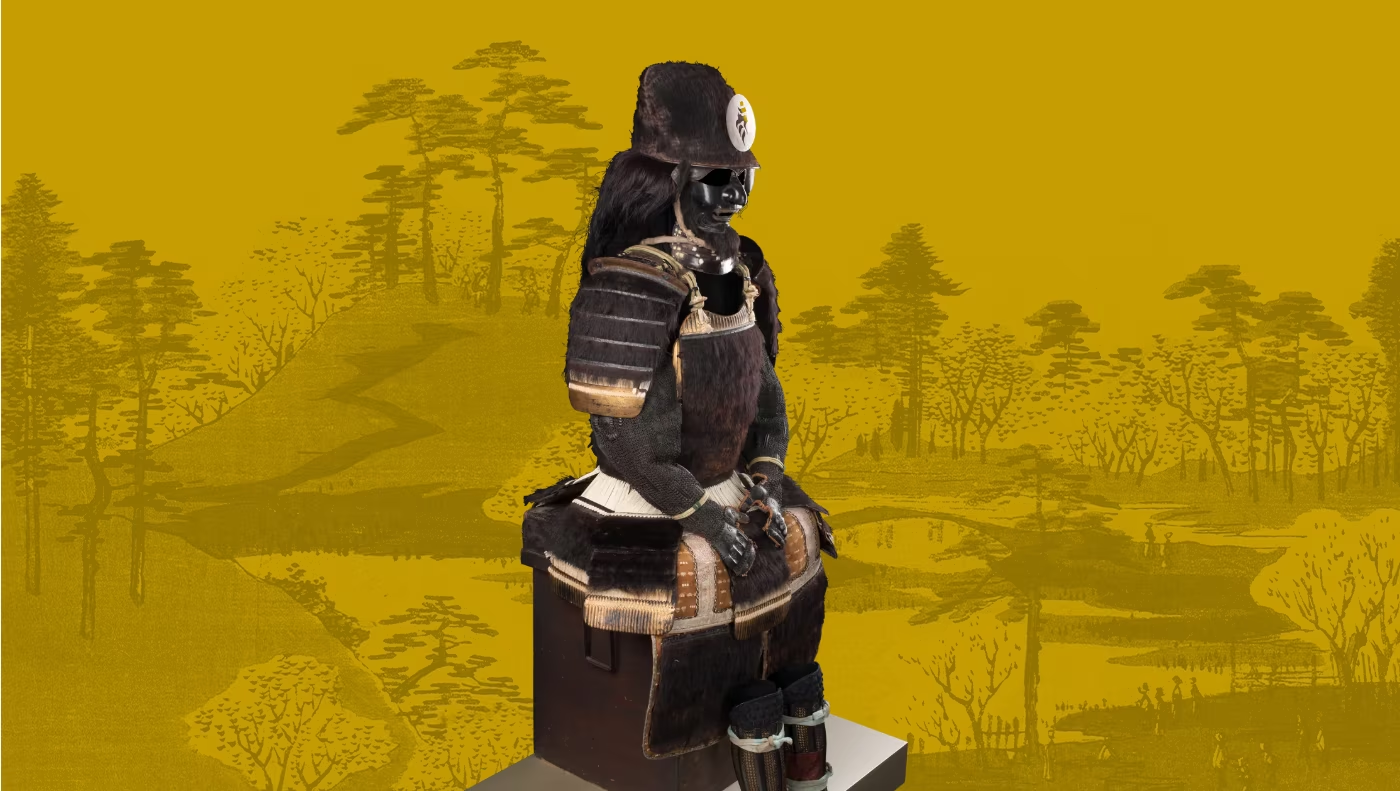
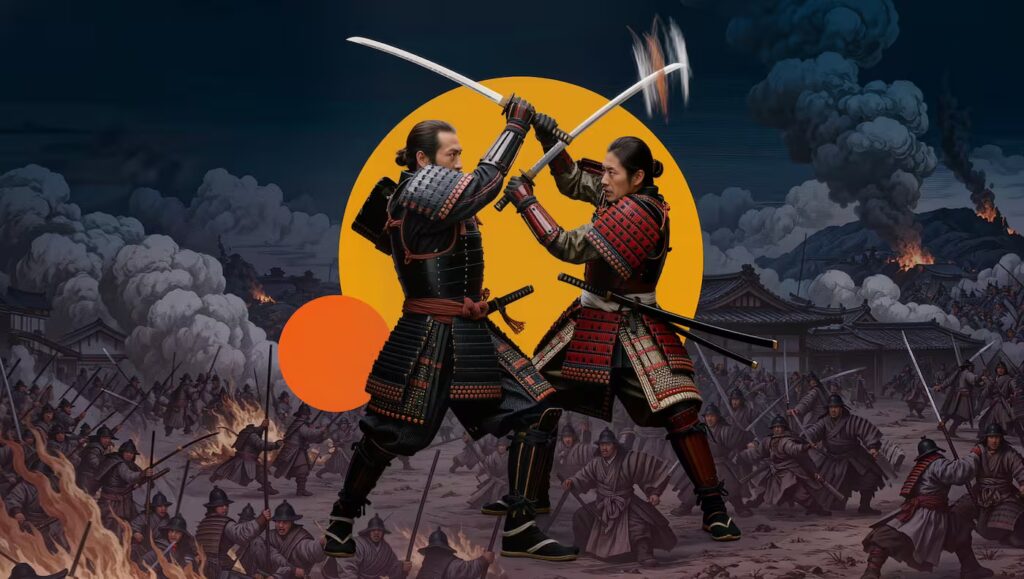
The Sengoku Jidai (Jap. 戦国時代, “Age of the Warring Provinces”) was an epoch of civil war in Japan from 1467 to 1615. After the collapse of Ashikaga rule, rival daimyō fought for supremacy until Oda Nobunaga, Toyotomi Hideyoshi and Tokugawa Ieyasu forcibly unified the country. This era shaped samurai culture through new weapon technologies, radical social upheavals and the rise of the Bushidō ideal.
In the winter of 1467, Kyoto burned. Not by chance, not through a natural disaster – but because two samurai clans could not agree on who was allowed to determine the next Shōgun. What began as a dispute over succession became a conflagration. Tens of thousands of warriors turned the imperial city into a landscape of ruins. When the Ōnin War ended after eleven years, the central power was destroyed. The Shōgun ruled only over ashes.
From this vacuum grew an epoch that was to change Japan forever: the Sengoku Jidai, the “Age of the Warring Provinces”. For over 150 years, rival warlords tore at one another for supremacy. Traitors became heroes, peasants became generals, Buddhist monks became warlords. The sword decided who ruled – until the first arquebus shots shot the old equilibrium to pieces.
This is the story of a country in chaos that reinvented itself through violence.
The Collapse: From the Golden to the Silver Pavilion
The contrast could hardly have been sharper. Ashikaga Yoshimitsu, the third Shōgun of the Muromachi bakufu, had the Golden Pavilion built in Kyoto in 1397 – a symbol of power, wealth and the ability to pacify the country. During his rule (1368-1408), the daimyō obeyed, taxes flowed, order prevailed. The Golden Pavilion gleamed not only with gold leaf but also as a metaphor for the stability of the Ashikaga dynasty.
Sixty years later, Yoshimitsu’s grandson, Ashikaga Yoshimasa, completed another structure: the Silver Pavilion. But unlike what the name suggests, the pavilion was never clad in silver. Yoshimasa ran out of money. Not because the country had become poor, but because the Shōgun had lost control. Daimyō refused levies, ignored orders, waged private wars. When disputes over Yoshimasa’s succession escalated in 1467, both sides called their allies to Kyoto – and no one could stop them any more.
The Ōnin War (1467-1477) was not a battle but a years-long positional carnage in the streets of the capital. The Western faction (Yamana Sōzen) and the Eastern faction (Hosokawa Katsumoto) barricaded themselves in temples and aristocratic palaces. The war ended not through military victory but through exhaustion. When both leaders died in 1477 – presumably of old age – the conflict simply trickled away.
But the power vacuum remained. The Shōgun continued to sit in Kyoto, yet his authority scarcely reached beyond the city walls. In the provinces, regional warlords – the Sengoku daimyō – took command. The “right of the stronger” became the only law. What followed, Japanese chroniclers called gekokujō: “The low defeat the high”.
What the warriors of this transitional period wore on the battlefield is shown by a rare exhibit at the Samurai Museum Berlin: a happuri face mask from the late Muromachi period (display case C02V). This type of mask – literally “half head” – protected the forehead and cheeks and had been in use since the Kamakura period. The Berlin example of wrought iron and copper alloy dates from the 16th century and is among the few surviving pieces that document the moment of upheaval: the last generation of an old armour tradition before the civil war changed everything.
Sources:
- Turnbull (2022): War in Japan, pp. 10, 33 (Golden vs. Silver Pavilion as metaphor)
- Hall (1991): Cambridge Vol. 4, Ch. 2, pp. 40-45 (Collapse of Ashikaga authority)
- SMB Catalogue: display case C02V (happuri mask, late Muromachi)
Gekokujō: When Servants Become Lords
Hisahide Matsunaga began as a simple soldier. He ended as lord over a third of Yamato Province. His path there: murder, betrayal, political opportunism. Matsunaga killed his own lord, overthrew his son, assassinated the Shōgun Ashikaga Yoshiteru and placed a puppet on the throne. When he was besieged by Oda Nobunaga in 1577, he blew himself up together with his precious tea bowl – a final act of control in a life that had broken every rule.
Matsunaga was not an isolated case but a prototype. The Sengoku period knew no more birthrights. Whoever was skilful enough, ruthless enough, could rise. Gekokujō – “the low defeat the high” – became the defining principle of the epoch.
Historians count about 250 significant daimyō who fought for territory during the Sengoku period. Many of them did not come from old noble families but were risen samurai, skilful strategists or successful merchants. The Uesugi were originally retainers of the Kantō Kanrei before they stripped them of power. The Hōjō – not related to the famous Kamakura clan – were usurpers who appropriated the name of a former ruling dynasty.
The system worked because loyalty was redefined. No longer did the bond to a lord count, but the ability to guarantee protection and booty. A daimyō who lost battles, had to give up land or could not pay his retainers risked betrayal. No code of honour kept samurai from changing sides if the new lord offered better terms.
Turnbull describes the case of Matsukura Hidemasa, an ashigaru (light infantryman) who rose through bravery to captain, made a strategic marriage and finally received his own fief. His grandson became a daimyō. Three generations from foot soldier to feudal lord – impossible in the rigid hierarchy of the later Edo period, everyday life in the Sengoku Jidai.
The social upheavals are also reflected in armour history. At the Samurai Museum Berlin, a haramaki armour from the late Muromachi period (display case C04V) shows the armour of the rising class. The haramaki – literally “belly wrap” – was originally the simpler, lighter armour variant for low-ranking infantrymen, in contrast to the heavy Ō-Yoroi of the knightly elite. In the course of the 14th century, high-ranking samurai too adopted improved versions of this type. The Berlin example consists of black-lacquered iron scales with a silk lacing in a cherry-blossom pattern – and precisely this motif is no coincidence: the cherry blossom was, in feudal Japan, the symbol of the warrior’s early death and the transience of life. Whoever fought in the Sengoku period reckoned with dying young.
The sword too tells of the power struggles of this epoch. A sword mounting (koshirae) in display case H02V bears the nadeshiko dianthus crest of the Saitō clan from Mino Province – today Gifu Prefecture. The Saitō were typical Sengoku daimyō: influential, ambitious and ultimately fallen victim to gekokujō. It was the young Oda Nobunaga who defeated the Saitō in 1567 and used their province as a springboard for his own rise.
Sources:
- Turnbull (2022): pp. 27-32 (Gekokujō examples, Matsunaga, social mobility)
- Hall (1991): Cambridge Vol. 4, Ch. 2, pp. 53-60 (Structural change of daimyō rule)
- SMB Catalogue: display case C04V (Haramaki, late Muromachi)
- SMB Catalogue: display case H02V (Tachi koshirae with Saitō kamon)
The New Weapons: Arquebus and Ashigaru
In 1543, Portuguese traders landed on the island of Tanegashima, south of Kyushu. They brought wares, stories from distant lands – and two arquebus guns. The local daimyō, Tanegashima Tokitaka, immediately recognised the potential. He bought both weapons for an outrageous amount of money and ordered his smiths to copy them.
Within thirty years, Japan produced more firearms than any European nation. The Sengoku daimyō had understood: the arquebus was an equaliser. An ashigaru – a simple foot soldier, often a part-time peasant – could, after a few weeks of training, kill a mounted samurai from 50 metres’ distance. The centuries-old sense of superiority of the warrior elite began to crumble.
The Battle of Nagashino (1575) became a textbook lesson for the new warfare. Oda Nobunaga positioned 3,000 arquebusiers behind palisades and divided them into three ranks. While the first rank fired, the others reloaded – a continuous barrage. When the famous Takeda cavalry attacked, the riders rode into a wall of lead. Even the feared “Red Devils” of Takeda Katsuyori, armoured and disciplined, collapsed under the hail. The arquebus had replaced the cavalry as the dominant branch of arms.
But firearms alone won no wars. What distinguished Nobunaga was his ability to revolutionise logistics. While traditional daimyō mobilised their samurai only for campaigns and then sent them home, Nobunaga maintained standing troops. He paid salaries in rice, built magazines, organised supply lines. His army was more professional, more disciplined – and more expensive. Only daimyō with large territories and efficient tax administration could keep pace.
The professionalisation changed not only combat but also the equipment. At the Samurai Museum Berlin, a Yumi Dai set in display case F02V shows this development through the example of the oldest samurai weapon: the bow. The set comprises two bows of equal length, a ring-shaped container for the spare string and a closeable quiver (utsubo). It is precisely this closed quiver that is an indicator of the Sengoku period: open quivers, as were customary earlier, protected the arrows poorly against rain and moisture. In an epoch in which armies were on the march for weeks and months, a soaked supply of arrows could decide between victory and defeat. The closed utsubo therefore prevailed during the civil war period – an inconspicuous but telling detail of military professionalisation.
The most radical change, however, was undergone by the armour. The introduction of the arquebus (teppō) in 1543 forced a fundamental reconception: the old lamellar armours (kozane), assembled from hundreds of small scales and effective against arrows, offered no sufficient protection against lead bullets. Ian Bottomley, former curator of the Royal Armouries in Leeds, describes this upheaval in the catalogue Armours of the Samurai (2021): with the advent of firearms, the armours changed from the wide, box-shaped constructions of the medieval period to the body-hugging Tōsei Gusoku.
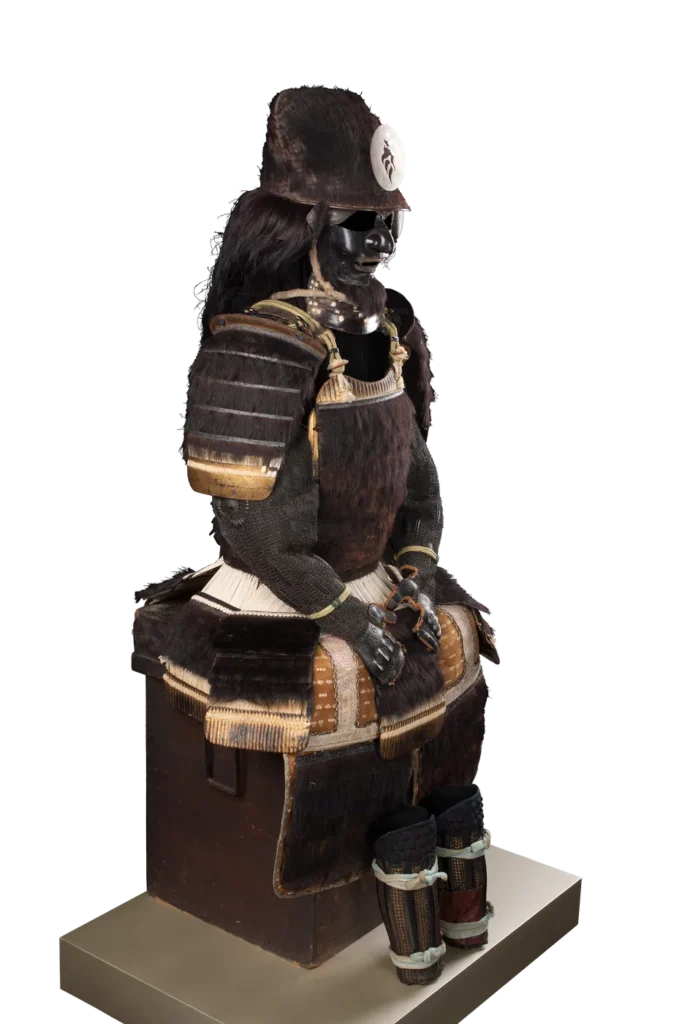
What this change concretely meant is shown by one of the most impressive objects at the Samurai Museum Berlin: a complete armour from the 16th century, covered with black bear fur (display case C16V). The cuirass no longer consists of small-scale lamellae, but of massive iron plates – robust enough to withstand arquebus bullets at a distance. The plates are connected by hinges, which simplified putting it on and eased transport. By dispensing with elaborate lacing (odoshi), production time and costs were saved – and the armour stayed lighter in wet conditions, because it absorbed hardly any water.
The bear fur itself is more than decoration. In Japan, the bear was feared and admired as the “king of the animals”. The fur on helmet, cuirass and shoulder plates was meant to transfer the wildness and strength of the animal onto the wearer – an unconventional taste that reflects the spirit of the Sengoku daimyō: pragmatic, terrifying and without regard for tradition.
The ashigaru, long regarded as cannon fodder, rose. With the arquebus in hand, they were no longer mere auxiliary troops but the backbone of the armies. Nobunaga and later Hideyoshi recruited peasants en masse, trained them, equipped them. The boundary between “warrior” and “peasant” blurred. A man could plant rice in the summer and storm a castle in the autumn.
This development disturbed the established samurai families. If anyone with a weapon could be a warrior, then what made a samurai special? The answer came later, under Toyotomi Hideyoshi: the forcible separation of the estates. But in the 1560s and 1570s, Sengoku society was still fluid. The weapon in hand counted more than the name.
Sources:
- Turnbull (2022): pp. 56-60 (Tanegashima, Nagashino, arquebus tactics)
- Hall (1991): Cambridge Vol. 4, Ch. 2, pp. 62-68 (Military innovation and professionalisation)
- Bottomley in SMB (2021): Armours of the Samurai, p. 25 (Firearms influence on armour design)
- Absolon (2017): Samurai Armour Vol. I, pp. 196-249 (Sengoku transition: Kozane → plate)
- SMB Catalogue: display case F02V (Yumi Dai set with closed utsubo)
- SMB Catalogue: display case C16V (Tōsei Gusoku with bear fur, 16th c.)
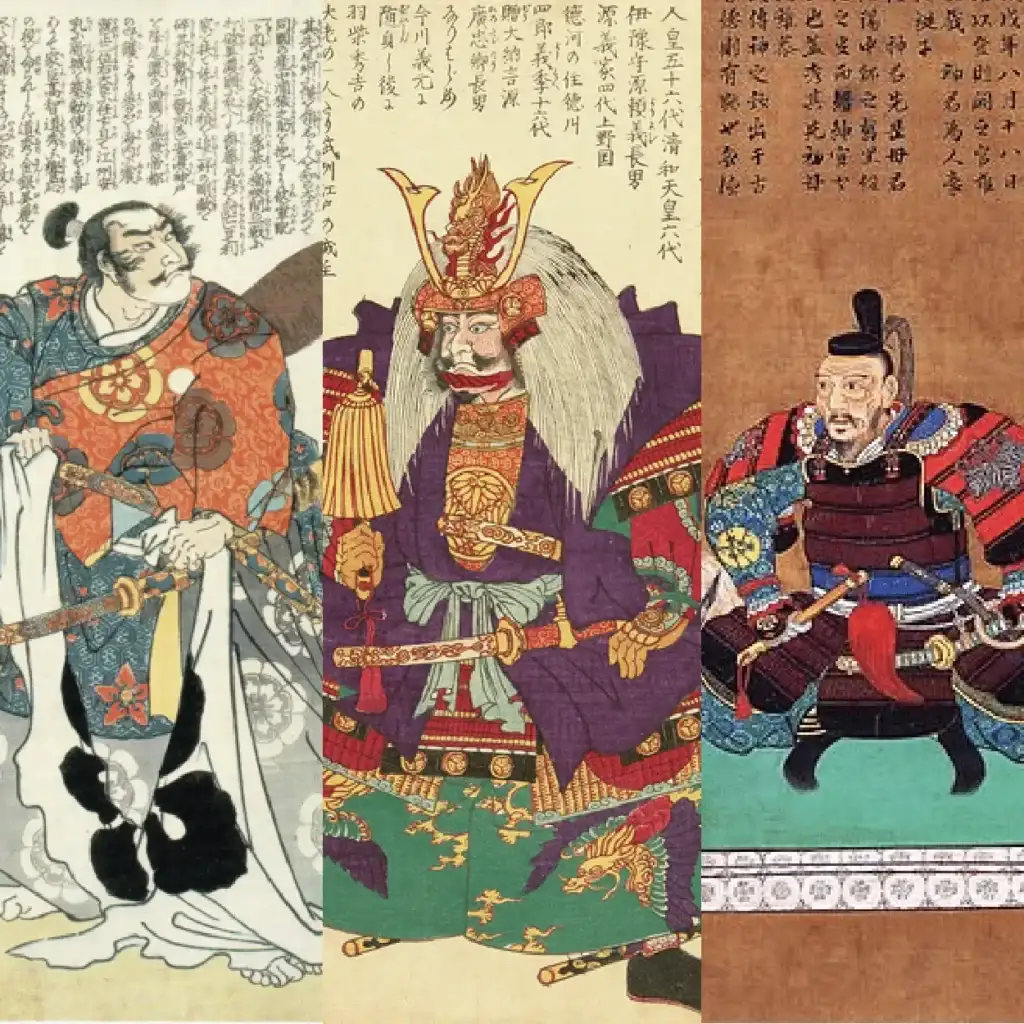
The Three Unifiers: Nobunaga, Hideyoshi, Ieyasu
A Japanese proverb sums up the three men who forcibly unified Japan:
“If the cuckoo will not sing, Nobunaga kills it.
If the cuckoo will not sing, Hideyoshi persuades it.
If the cuckoo will not sing, Ieyasu waits.”
The metaphor is simple, but apt.
Oda Nobunaga was no diplomat. When the Buddhist monks of the Enryaku-ji monastery on Mount Hiei opposed him, he burned the temple down – together with 20,000 inhabitants. Men, women, children. “Whoever stands against me, dies”, was his motto. Nobunaga did not fight for ideals. He fought to win.
Born in 1534 as the son of an insignificant daimyō in Owari, Nobunaga was considered a scatterbrain. His contemporaries called him “Owari no Ōutsuke” – the “great fool of Owari”. But the fool turned out to be a brilliant strategist. In 1560, with 3,000 men, he defeated an army of 25,000 at Okehazama – through a surprise attack in a thunderstorm. The victory catapulted him into the first rank of the Sengoku daimyō.
Nobunaga used every innovation: arquebus guns, professional troops, modern castles, economic reforms. He promoted trade, monopolised markets, built roads. His castle Azuchi, completed in 1579, was a marvel of seven storeys, a gilded interior and a strategically perfect location. It embodied his vision: Japan under his absolute control.
But in 1582 his rise ended abruptly. Akechi Mitsuhide, one of his generals, rebelled and forced Nobunaga to take his own life in the Honnō-ji temple. The motives of the betrayal remain unclear – insult, calculation of power, personal hatred? Nobunaga died before he could complete his work.
Toyotomi Hideyoshi was the opposite of his lord. Where Nobunaga broke, Hideyoshi forged alliances. Where Nobunaga burned, Hideyoshi bought. Born as the son of a foot soldier – some sources name his mother a concubine, his father unknown – Hideyoshi rose through talent. Nobunaga made him a general. After Nobunaga’s death, Hideyoshi avenged his lord within days, defeated Akechi Mitsuhide at Yamazaki and took over the leadership.
By 1590, Hideyoshi had subdued all the great daimyō – some militarily, many through diplomacy. He offered them autonomy as long as they recognised him as overlord. This strategy worked because Hideyoshi was himself an upstart. He understood the fears of the daimyō, their vanity, their pragmatism.
But Hideyoshi knew cruelty too. In 1587 he issued an edict against Christian missionaries. In 1597 he had 26 Christians crucified in Nagasaki – a signal to foreign powers that Japan would not be colonised. And when his samurai became unemployed after the unification, he directed their violence outward: in 1592 and 1597 he invaded Korea. Both invasions failed miserably – due to supply problems, Korean turtle ships and Chinese intervention forces.
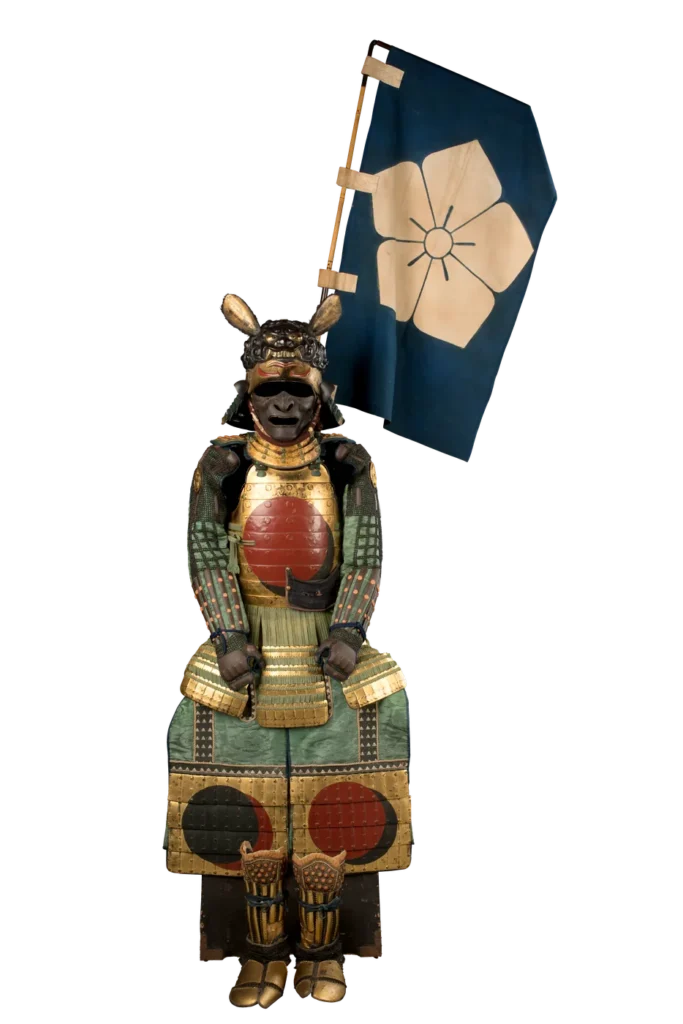
A sashimono banner at the Samurai Museum Berlin (display case C35V) connects this story with a concrete actor: it bears the janome motif (snake’s eye) of the Katō clan. Katō Kiyomasa (1561-1611), the best-known representative of this clan, was related to Hideyoshi and took part in both Korea campaigns. Notorious for his tiger hunts on the Korean peninsula, Kiyomasa was frequently depicted in art in combat with a tiger. The light-blue silk banner with the red ring motif is a rare testimony to the Sengoku field signs that on the battlefield decided over life and death – for whoever carried the wrong banner died at the hands of his own people.
Hideyoshi died in 1598, exhausted and embittered. His son Hideyori was still a child. The daimyō smiled and waited.
Tokugawa Ieyasu had perfected patience. He had been allied with Nobunaga, had served Hideyoshi – but always with one hand on his own sword. When Hideyoshi died, Ieyasu was among the most powerful daimyō of Japan. He controlled the Kantō plain, had the richest rice fields, the most disciplined troops.
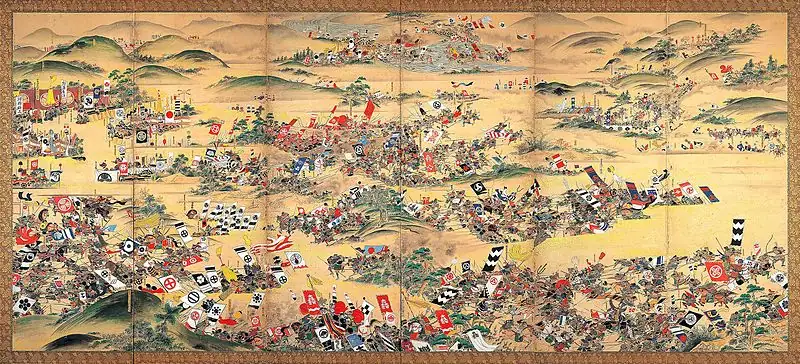
In 1600 the decision came. At Sekigahara, two coalitions clashed: the Eastern Army under Ieyasu and the Western Army, which claimed to fight for Hideyori’s inheritance. The battle lasted only a day. Ieyasu’s victory was owed not only to military strength but to espionage, bribery and the skilful timing of betrayal. Several generals of the Western Army switched sides in the middle of the fighting. The battle was decided before it had properly begun.
At the Samurai Museum Berlin, a sashimono with the mallow-blossom crest (Aoi-Mon) of the Tokugawa (display case C37V) recalls the clan that emerged from the chaos as victor. The white crest on a red silk ground shows the stylised hollyhock, which was to become the symbol of a rule lasting 250 years. During the Sengoku period, the sashimono had a vitally important function: in battles with tens of thousands of fighters in close quarters, the commanders had to be able to recognise which units belonged to which army. The armours of the late Muromachi period therefore possessed special holders (gattari and machi uke) on the back plate, into which the banner pole could be inserted.
Ieyasu waited a further 15 years before he annihilated Hideyoshi’s son. In 1614 and 1615 he besieged Osaka Castle – Hideyori’s last fortress. The first siege ended with an armistice. The second with fire, blood and the end of the Toyotomi line. In 1615, after the destruction of Osaka, Japan was finally united. Ieyasu had won because he lived longer than all the others.
Sources:
- Turnbull (2022): pp. 59-70, 115-123 (Nobunaga, Hideyoshi, Ieyasu – biographies and strategies)
- Hall (1991): Cambridge Vol. 4, Ch. 2, pp. 78-95 (Political structures of unification, Kōgi concept)
- SMB Catalogue: display case C35V (Sashimono Katō clan, Janome motif)
- SMB Catalogue: display case C37V (Sashimono Tokugawa, Aoi-Mon)
War and Culture: Tea, Theatre, Aesthetics
Matsunaga Hisahide – the traitor, murderer and usurper from the gekokujō chapter of this story – owned one of the most famous tea bowls of Japan. When Oda Nobunaga besieged him in 1577 and demanded the surrender of the bowl, Matsunaga blew himself up together with the vessel. He sacrificed his life to destroy a piece of ceramic. This episode is no curiosity but a key to understanding the Sengoku period: the same men who besieged castles by day cultivated by evening an aesthetic of radical simplicity. From the devastations of the civil war grew one of the most creative cultural flowerings of Japan. The courtly elegance (miyabi) of the Heian period gave way to new ideals – wabi, the beauty of the simple, and sabi, the charm of the transient. In a world in which nothing endured, the broken became an aesthetic principle.
No one embodied this connection of war and culture more strongly than Sen no Rikyū (1522–1591), who shaped the tea ceremony (chanoyu) into the language of power of the Sengoku daimyō. Under Toyotomi Hideyoshi, tea became diplomacy: alliances were sealed over tea, submissions negotiated over tea, political messages coded in the choice of utensils. Rikyū himself paid for this proximity to power with his life – in 1591 Hideyoshi forced him to commit seppuku, for reasons that are debated to this day. Rikyū’s legacy lived on in his pupils. Furuta Oribe (1544–1615), daimyō and tea master first to Hideyoshi, then to Tokugawa Ieyasu, created a new sensibility for the deliberately flawed: deformed shapes, deep cuts, thick glaze layers. At the Samurai Museum Berlin, a Kuro Oribe tea bowl (display case M03V) shows this aesthetic: a black iron-oxide glaze leaves a triangular window free, through which chidori plovers become visible on the raw clay surface – a symbol of longevity that has run through Japanese poetry since the 10th century. The bowl comes from Mino Province, the centre of Oribe ceramics, and dates to 1610 – the last year before the definitive peace.
What the tea bowl was for the quiet aesthetic, the Nō stage became for the drama. Since Zeami Motokiyo (1363–1443) had codified the foundations of Nō theatre, it was the preferred medium of the warrior elite – an art form that translated stories of fallen heroes, vengeful spirits and the transience of fame into stylised slowness. In display case C31V of the museum, a Hannya mask from the Edo period preserves this legacy: carved from a single piece of cypress wood, it shows a woman who, through rejection, transforms into a demon – the central figure of the play Dōjōji. Depending on how the actor tilts the mask, its expression shifts between grief and frenzy. The Samurai Museum Berlin possesses on its upper floor an original Nō stage, which was made in Japan with traditional materials and techniques and erected in Berlin: hinoki cypress wood, open architecture after a Buddhist model, ceramic vessels under the stage floor as resonance bodies for combat scenes. Every 30 minutes, visitors can immerse themselves in performance excerpts – an experience that no Wikipedia article can replace.
Sources:
- Yamamura (1990): Cambridge Vol. 3, Ch. 10, pp. 447-488 (Varley: cultural life, aesthetic change Miyabi → Wabi/Sabi, Zeami, Rikyū)
- SMB Catalogue: display case M03V (Kuro Oribe Chawan, 1610)
- SMB Catalogue: display case C31V (Hannya mask, Edo period)
- SMB Catalogue: Nō stage & tea house (upper floor, traditional manufacture in Japan)
The End of the Chaos: From Warrior to Bureaucrat
The irony of the Sengoku period lies in its end. 150 years of war produced a warrior class of unprecedented size – and then the war was taken away from it.
Toyotomi Hideyoshi understood the problem: hundreds of thousands of armed men, trained for violence, without occupation. His solution was radical. In 1588 he issued the Katanagari edict – the “sword hunt”. All peasants had to surrender their weapons. Officially, to cast a great Buddha from them. In fact, to prevent uprisings and to make the boundary between samurai and peasant insurmountable.
The Heinō Bunri principle – “separation of warriors and peasants” – cemented the new order. From now on the rule was: a samurai is a samurai, a peasant is a peasant. No more rising. No more fluid mobility. The Kokudaka system calculated income in rice yields and bound samurai to their lords. Whoever received 100 koku (enough rice for 100 persons per year) had to serve for it – and, if need be, to die.
The Tokugawa shōguns perfected this system. They forbade samurai to leave their lords’ land. They established the Sankin Kōtai system: daimyō had to reside alternately in Edo, while their families remained there as hostages. The costs of these journeys – hundreds of retainers, magnificent equipment – ruined the daimyō financially and made rebellion impossible.
The samurai themselves were transformed. Warriors became officials. Instead of fighting battles, they administered taxes, settled disputes, studied Confucius. The sword became a status symbol – worn, but seldom drawn. The Bushidō code, later romanticised as an “ancient code of honour”, arose only in this period: as a retrospective justification for a warrior class without wars.
Even the firearms that had decided the war were domesticated in the new order. A teppō pistol at the Samurai Museum Berlin (display case C40V) shows this transition: the handgun of the Bajōzutsu type – small enough to be fired from horseback – is decorated over its entire barrel with a cloud-dragon motif in inlaid gold-copper work (zōgan). The stock bears on three sides the mallow-blossom crest of the ruling Tokugawa family. A weapon of the civil war had become an art object – representative, precious and, in the peace of the Edo period, hardly more than a status symbol.
Armour craft too tells of this transformation. A helmet of the Saiga group (display case C21V) connects Japanese craftsmanship with European influence: the helmet bowl of vertical iron plates recalls in its form the Spanish morion, and between ornamented cover plates four Chinese characters in seal script are inlaid with silver – 元 (original), 亨 (prospering), 利 (beneficial), 貞 (steadfast) –, the four virtues from the Book of Changes. Long white horsehair crowns the helmet. European form, Chinese philosophy, Japanese craft: in a single object, the globality of the Sengoku period condenses, when Portuguese traders, Chinese scholars and Japanese warlords met one another.
The Sengoku Jidai had transformed Japan. It ended the power of the old aristocracy, established a new elite and created the foundations for 250 years of peace. But the price was high: a rigidified society in which birth counted for everything and talent for nothing.
Sources:
- Turnbull (2022): pp. 125-130 (Consequences of unification, Pax Tokugawa)
- Hall (1991): Cambridge Vol. 4, Ch. 3, pp. 99-127 (Social consequences, Katanagari, Kokudaka system)
- SMB Catalogue: display case C40V (Teppō pistol, Tokugawa Aoi-Mon)
- SMB Catalogue: display case C21V (Saiga helmet, morion form)
Frequently Asked Questions About the Sengoku Jidai
How long did the Sengoku Jidai last?
The Sengoku Jidai began in 1467 with the Ōnin War and ended officially in 1615 with the destruction of Osaka by Tokugawa Ieyasu. In all, it spanned about 150 years of intense civil-war fighting, with the phase of unification under Nobunaga, Hideyoshi and Ieyasu (1560-1615) being particularly brutal.
Why is Oda Nobunaga called the “Demon King”?
Nobunaga occasionally referred to himself as Dairokuten-Maō (“Great Demon King of the Sixth Heaven”), a Buddhist figure who prevents enlightenment. The title was a provocation: Nobunaga hated political Buddhism and wanted to position himself as a ruler beyond religious authority. His contemporaries used the term both admiringly and fearfully.
How many daimyō fought during the Sengoku period?
Historians count about 250 significant daimyō who fought for territory during the Sengoku Jidai. At the beginning (1467) there were considerably more local warlords, but through conquests and consolidation their number was reduced. At Sekigahara (1600), about 90 daimyō fought against each other in two coalitions.
Why did Hideyoshi’s Korea invasion fail?
The invasions of Korea (1592-1598) failed for several factors: First, Admiral Yi Sun-sin destroyed the Japanese supply lines at sea with his “turtle ships”. Second, China intervened with massive troops. Third, Korean guerrillas fought stubbornly. Fourth, Japan overstretched its logistics – to feed hundreds of thousands of soldiers in a foreign country was impossible.
What is the difference between a Sengoku daimyō and an Edo daimyō?
Sengoku daimyō attained power through conquest, cunning and military talent – their legitimacy stemmed from strength. Edo daimyō, by contrast, ruled by appointment of the Shōgun and were part of a hierarchical system. Sengoku daimyō had to fight constantly to survive; Edo daimyō administered peaceful territories and became bureaucrats.
How did firearms change samurai armour?
The introduction of the arquebus (teppō) from 1543 forced a radical change: the old lamellar armours of small scales (kozane) offered no sufficient protection against lead bullets. Armourers – especially the Myōchin and Saotome schools – developed the Tōsei Gusoku (“modern full equipment”) of massive iron plates, which had to be bulletproof. At the Samurai Museum Berlin, an armour from the 16th century with bear fur documents this transition.
Visit the Samurai Museum Berlin
Experience the Sengoku period in the original: armours from the era of the warring provinces (display case C16V), the Tokugawa sashimono (display case C37V) and the Kuro Oribe tea bowl of 1610 (display case M03V). Open daily from 10 a.m. to 7 p.m., Auguststraße 68, Berlin-Mitte.
Related Articles
- Oda Nobunaga: The Demon King
- Toyotomi Hideyoshi: From Peasant’s Son to Ruler
- Tokugawa Ieyasu: Japan’s Last Unifier
List of Sources
- Turnbull, Stephen (2022): War in Japan 1467-1615. Osprey Publishing.
- Hall, John Whitney (ed.) (1991): The Cambridge History of Japan, Vol. 4: Early Modern Japan. Cambridge University Press.
- Yamamura, Kōzō (ed.) (1990): The Cambridge History of Japan, Vol. 3: Medieval Japan. Cambridge University Press.
- Bottomley, Ian (2021): Essay in Armours of the Samurai. SMB Catalogue.
- Absolon, Trevor (2017): Samurai Armour, Volume I: The Japanese Cuirass. Osprey Publishing.
- SMB Catalogue 2025: display cases C02V, C04V, C16V, C21V, C31V, C35V, C37V, C40V, F02V, H02V, M03V.
© Samurai Museum Berlin – Last updated: 26.03.2026
You might also like
Honda Tadakatsu: The Unbeatable Warrior of the Tokugawa
When Honda Tadakatsu died in 1610 at Kuwana Fortress at the age of sixty-two, he left behind a record unparalleled…
Read the article
Ashikaga Takauji: Founder of the Second Shogunate (1305–1358)
Ashikaga Takauji overthrew Emperor Go-Daigo and founded the Muromachi shogunate – yet is still regarded as a traitor in Japan.…
Read the article
Tomoe Gozen: Japan’s Most Famous Female Warrior (ca. 1157–1247)
Tomoe Gozen – warrior, legend, question. What do we really know about Japan's most famous onna-musha? History & fact-check at…
Read the article