 Nominated for the EMYA2026 award
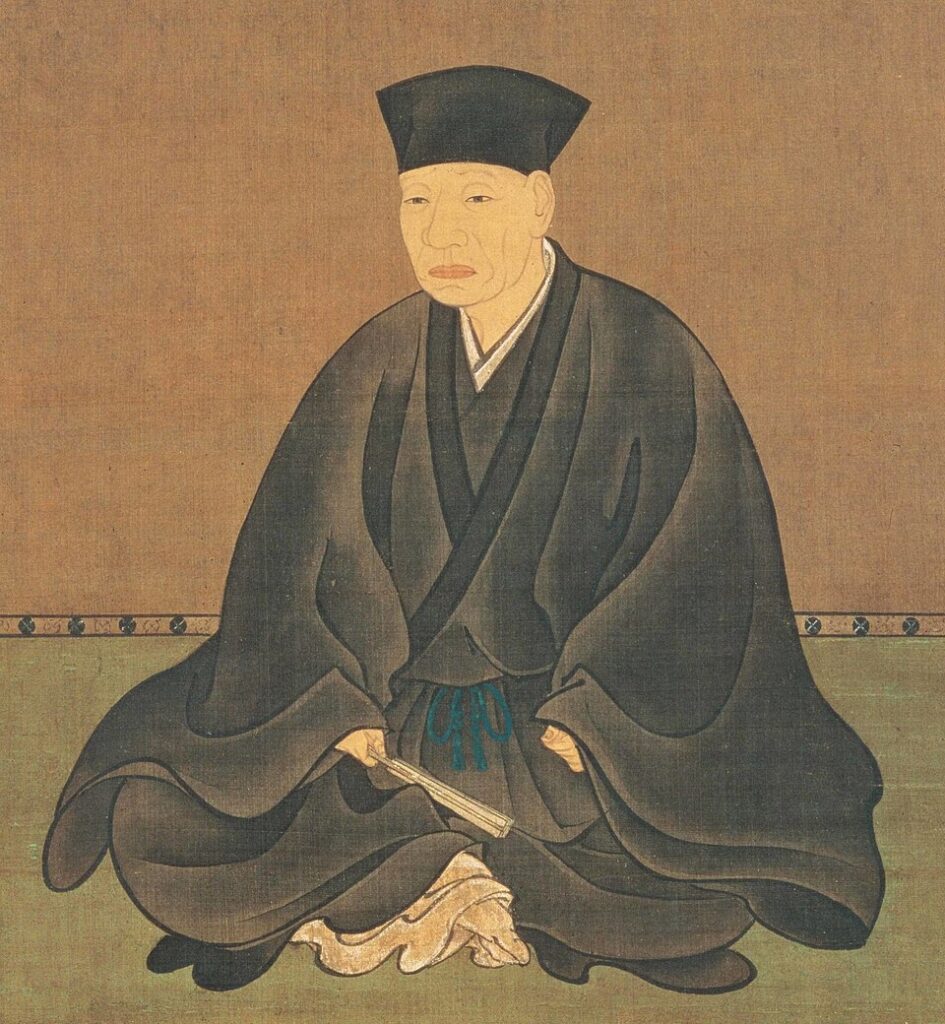
In April 1591, Sen no Rikyū, Japan’s most important tea master and personal tea adviser to the most powerful man in the realm, opened the garden gate of his residence in Sakai. Standing there was a messenger from Toyotomi Hideyoshi, the regent whom Rikyū had served for twenty years. The messenger delivered an order: ritual suicide (seppuku). Rikyū accepted the order, prepared a final tea ceremony for close friends, wrote his death poem, and cut open his abdomen. He was 69 years old. The exact reasons for Hideyoshi’s order remain disputed — historians discuss personal tensions, political conflicts, Rikyū’s allegedly excessive tea bowls, and possibly his refusal to give his daughter to Hideyoshi. What is beyond doubt is that the death of a tea master in 1591 was an event that preoccupied Japan’s rulers. The tea ceremony was not a harmless hobby of the warrior elite — it was a political instrument of the highest importance.[1]
The Japanese tea ceremony — Chadō (茶道, “Way of Tea”) or Chanoyu (茶の湯, “hot water for tea”) — is often reduced in Western perception to an aesthetic ritual. In fact, it is one of the most complex cultural systems Japan has produced. It combines Zen Buddhism, ceramics, architecture, calligraphy, flower arrangement, cuisine, and social choreography into a single practice. For the samurai class from the Momoyama period (1573–1615) through the Edo period (1615–1868), it was not merely a cultural pastime. It was a place for political negotiations, a medium for demonstrating status, a discipline of self-control, and at the same time a meditative practice that prepared the mind for possible death in battle.
This article reconstructs the tea ceremony from the perspective of samurai culture: How did a spiritual practice rooted in Buddhist monasteries reach the warriors? Why did a regent reward the most powerful military commanders in the realm with tea bowls? How did the aesthetic concept of Wabi-Sabi — the beauty of imperfection — emerge, and why did it resonate so strongly with the samurai in particular? The Samurai Museum Berlin preserves an Oribe tea bowl from 1610, an important testimony to this era: an object that condenses the tea ceremony of the late Momoyama and early Edo periods into a single, artistically deformed ceramic vessel.
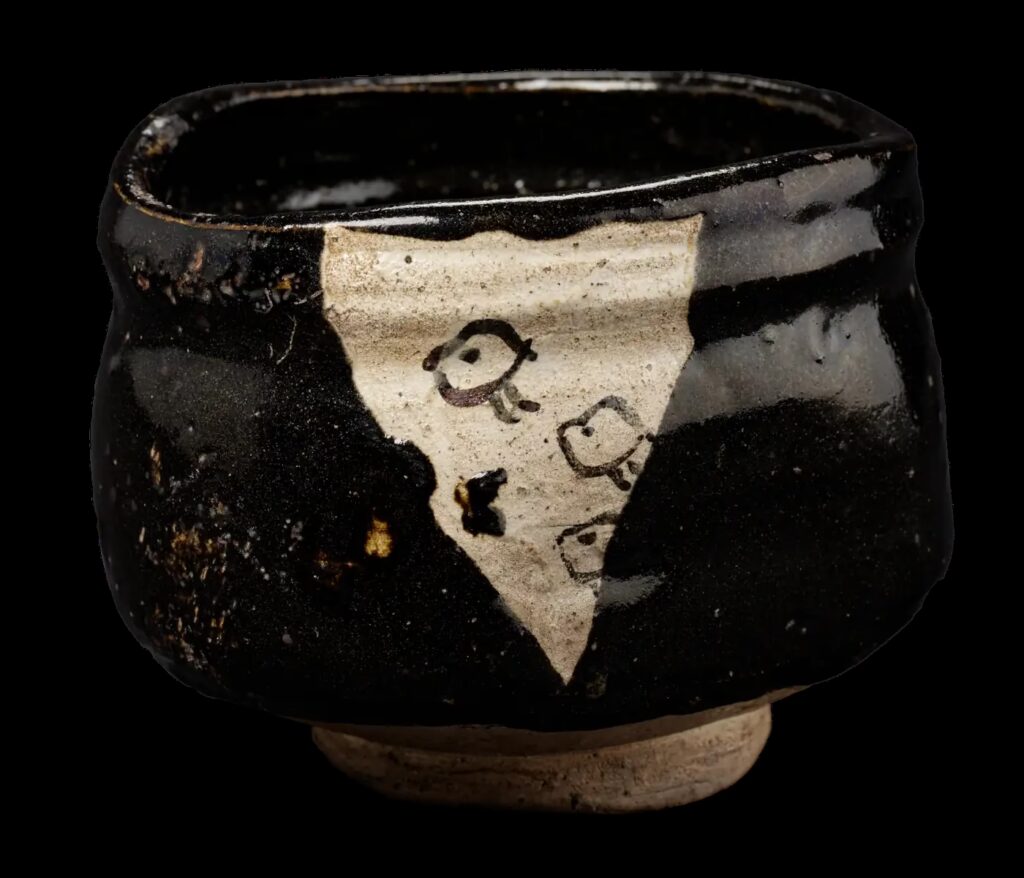
At the Samurai Museum Berlin, visitors can study an original Oribe tea bowl from around 1610 and enter the reconstructed traditional tea house on the upper floor — an authentic insight into the material and spatial culture of the Japanese tea ceremony.
Origins: From Zen Monastery to Samurai Household
The powdered green tea (matcha) at the center of the Japanese tea ceremony came to Japan from China in the 12th century through the Zen monk Eisai (1141–1215). Eisai, founder of the Rinzai school of Zen Buddhism, had learned in Chinese Song monasteries to use whisked powdered tea to support long periods of meditation. His treatise Kissa Yōjōki (“Drink Tea and Live Long”, 1211) was the first Japanese work to praise the health and spiritual qualities of tea. He presented a copy to the shōgun Minamoto no Sanetomo — together with a dose of matcha for his hangover. The gift sent a signal: tea was useful to warriors.[2]
From the 13th to the 15th century, matcha spread from Zen monasteries into the elite circles of the samurai and court nobility. In this early phase, tea gatherings were often lavish social events in which guests competed to identify teas of different origins. The style was pompous, and the equipment was often imported from China — expensive porcelain from Jingdezhen, exquisite bronze objects, and elaborate lacquerware. This early tea style later became known as Shoin-cha, after the formal shoin reception rooms in which it was practiced.
In the late 15th century, a counter-movement began. The tea masters Murata Jukō (1423–1502) and Takeno Jōō (1502–1555) developed a new tea style that consciously turned away from the Chinese-import luxury of Shoin-cha. They promoted a restrained, ascetic aesthetic in which simple Japanese ceramics were valued and the tea room was kept small and plain. This direction became known as Wabi-cha (“tea of quiet restraint”). It found its fullest expression in Sen no Rikyū (1522–1591), the tea master who brought the Wabi-cha tradition to its classical form and connected it with the political and military milieu of the late Sengoku period.
Rikyū came from a wealthy merchant family in the trading city of Sakai. He first became a tea teacher to Oda Nobunaga and, after Nobunaga’s death in 1582, the principal adviser on tea matters to Toyotomi Hideyoshi. In this role, he shaped the Japanese tea ceremony in ways that influenced all subsequent periods. He defined the dimensions of the ideal tea room (typically 4.5 tatami mats, approximately 7.5 square meters), established the aesthetic principles (Wa-Kei-Sei-Jaku — harmony, respect, purity, tranquility), and promoted a new ceramic tradition that placed Japanese craftsmanship above Chinese imports. Under Rikyū’s influence, the famous Raku tea bowls of the potter Chōjirō emerged — black, hand-shaped objects whose deliberately imperfect surfaces perfectly embodied the Wabi-cha ideal.
Rikyū’s political role was not decorative but substantive. Tea gatherings at Hideyoshi’s court were places where high-ranking samurai, daimyō, and court officials came together — in a setting that temporarily suspended the usual political hierarchies. In the tea room, everyone sat at the same level on the floor, everyone drank from shared bowls, and everyone was an equal participant in the aesthetic practice for the duration of the ceremony. This temporary suspension of political rank made the tea house an ideal setting for sensitive conversations, alliance negotiations, and the resolution of conflicts. Rikyū was as indispensable as a mediator in these conversations as he was as a tea aesthete. Probably that very political power position became his downfall.
Bukecha: The Tea Ceremony of the Warriors
The samurai reception of the tea ceremony was not identical to the Wabi-cha of urban merchant and priestly traditions. Out of the specific military and political context of the warrior class, a distinct style developed in the late Momoyama and early Edo periods known as Bukecha (“warrior tea”). This distinction is often neglected in Western reception, but is important in Japanese scholarship. The term emphasizes that for samurai, the tea room was a different kind of place from that experienced by a tea practitioner from the priestly or scholarly classes.[3]
The catalog essay in the Samurai Museum Berlin collection’s Armours of the Samurai (2021) formulates the distinction precisely: for the warrior, the tea room was a place of discipline and political negotiation, distinct from the aesthetic contemplation of the court nobility. This characterization captures the essence of Bukecha. For a samurai, the tea ceremony was not primarily an aesthetic practice but a discipline. It trained attention, bodily control, and precise sequences of movement — skills that could decide life or death on the battlefield. A warrior who had learned to hold a tea bowl at exactly the right angle for fifteen seconds in the absolute silence of the tea room had also learned to hold the angle of his sword with absolute attention during close combat.
Alongside its disciplinary function, Bukecha had a political dimension. The tea ceremony was the format in which daimyō negotiated with one another — often over the life or death of entire provinces. Oda Nobunaga systematically used tea utensils as a political reward system. He granted famous tea implements to his followers as signs of the highest favor; a precious tea bowl could be more valuable than an entire province. Hideyoshi continued and expanded this practice. In 1587 he staged the famous “Great Kitano Tea Ceremony”, a public grand event to which every citizen of Japan was invited, regardless of status, provided they brought a tea bowl and a matcha whisk. The event was propaganda in the best sense: it presented Hideyoshi’s new political order as culturally inclusive, while firmly binding it to the tea ceremony as a cultural reference system.[4]
Furuta Oribe (1544–1615), Rikyū’s student and successor, continued this tradition as tea master to the Toyotomi regent and later to the Tokugawa shōgun. Oribe was himself a daimyō — he commanded his own troops during the Battle of Sekigahara — and thus embodied the close connection between warrior identity and tea practice. Under his influence, the distinctive Oribe aesthetic developed, deliberately favoring asymmetrical and deformed tea bowls. The Oribe-style tea bowl at the Samurai Museum Berlin from 1610 is a direct testimony to this tradition. The bowl was first formed on the potter’s wheel into a cylindrical tsutsu-chawan shape and then carefully reworked by hand around the rim. The resulting slight irregularity was not a technical flaw but an aesthetic program: the preference for unconventional forms and surfaces is a characteristic feature of the Oribe school, and the tsutsu form — cylindrical, slightly compressed, with an irregular rim — embodies the Wabi ideal precisely.[5]
Oribe’s fate mirrored that of his teacher Rikyū. In 1615, after the destruction of the Toyotomi clan by Tokugawa Ieyasu during the siege of Ōsaka, Oribe was suspected of sympathizing with the Toyotomi side. He was sentenced to seppuku by Ieyasu and carried it out in July 1615, at the age of seventy. As with Rikyū, art and politics became intertwined in the death of this tea master. The two greatest tea masters of the classical Wabi-cha tradition both ended their lives through ritual suicide on the orders of their respective political lords — a detail that underscores the weight of the tea ceremony as a political practice.
The Four Principles: Wa, Kei, Sei, Jaku
Sen no Rikyū formulated the aesthetic-spiritual foundations of the tea ceremony in four core principles that have formed the theoretical basis of Chadō since the late 16th century. They are Wa-Kei-Sei-Jaku (和敬清寂) — harmony, respect, purity, tranquility. In modern reception these four terms have often become mere labels; in their original meaning they precisely describe what is meant to happen in a tea ceremony.[6]
Wa (和) — Harmony. The term describes the mutual coordination of all elements: the participants with one another, the participants with the room, the room with the season, the tea bowl with the tea, and the tea with the utensils. A tea ceremony may appear ritualistic to an observer — in reality it is a system of interlocking adjustments. The choice of tea bowl depends on the season (thick-walled, wide bowls in winter to retain heat; thin-walled, slender ones in summer). The calligraphy scroll in the tokonoma changes according to the occasion. Floral arrangements follow a specific seasonal aesthetic. In this multilayered coordination, Wa is realized.
Kei (敬) — Respect. Participants in a tea ceremony show respect for one another — through bows, through the way the tea bowl is handed over, and through the precisely defined order in which guests enter the room. This respect also extends to objects: the tea bowl is received with both hands, appreciated, and rotated before one drinks from it. Appreciation of the object is not mere politeness, but an attitude that asks the user to perceive the object’s history, craftsmanship, and intention.
Sei (清) — Purity. The physical cleanliness of the tea room, utensils, and hands is a prerequisite for every ceremony. Before entering the tea house, guests wash their hands at a stone basin. The tea master ritually cleans the tea bowl with a cloth. The cleaning movements are highly choreographed — they serve not only actual cleaning but symbolic acts intended to purify the mind of the tea master and guests as well.
Jaku (寂) — Tranquility. Silence generally prevails in the tea room. Conversation, if any, is brief, formal, and focused on what is happening. No small talk. No political topics. Silence is not merely the absence of noise but an active, attentive silence — one in which the sound of water being poured, tea being whisked, and lips touching the bowl can be perceived. In this silence lies a form of meditation that directly realizes the Zen Buddhist heritage of the tea ceremony.
These four principles cannot be separated from one another. They form a system of mutual conditions: without purity there is no tranquility, without tranquility there is no harmony, without harmony there is no respect, without respect there is no purity. Rikyū’s genius lay in operationalizing this entire system in a practice that every participant — samurai or otherwise — could internalize through attentive repetition.
The Tea Room: Architecture as Philosophy
The architecture of the traditional tea house is one of the remarkable chapters of Japanese architecture. It realizes philosophical principles in spatial form — a coincidence of thought and building for which Western architectural history has parallels in only a few structures, such as Vierzehnheiligen or the Bauhaus circular hall.[7]
The classical tea house (Sōan or Chashitsu) is small. The ideal tea room has a floor area of 4.5 tatami mats, about 7.3 square meters. Within this confined space, host and up to five guests are brought together. The deliberate limitation serves several purposes. It forces physical proximity and thus attention to the people present. It reduces perception to a manageable space, encouraging concentration on the details of the ceremony. And it constitutes a radical rejection of the representative reception halls of daimyō castles — in the tea room no one is more powerful than anyone else because no one can occupy more space.
The entrance is another philosophical element. The Nijiriguchi — the “crawling entrance” — is a low opening, only about 66 centimeters high, through which every guest must stoop and crawl. This is not an architectural whim but deliberate. The act of crawling is a gesture of humility. No one can enter the tea room standing upright — not even the most powerful daimyō. Rikyū is said to have introduced this element explicitly to mark the equality of rank among all participants in the tea room. Samurai had to leave their swords on a special sword rack (Katana-kake) before entering.
The tea room itself is reduced to minimalist essentials. In the tokonoma — an alcove in the room — hangs a calligraphy scroll, often a Zen saying by the host or a respected teacher. Beneath it there is usually a simple seasonal flower arrangement. The walls are made of clay plaster incorporating straw fibers; the colors are muted, often natural tones. The floor is covered with tatami mats whose arrangement determines the participants’ positions. In the center or along the edge is the hearth (ro in winter, furo in summer), above which water for the tea is heated.
This reduction is aesthetically programmatic. It serves to concentrate attention on what matters: the participants, the tea bowls, and the prepared tea. Every unnecessary decorative element would be a distraction. The tea house is one of the most radical examples of a “less is more” aesthetic in world architecture — centuries before Mies van der Rohe’s famous maxim.
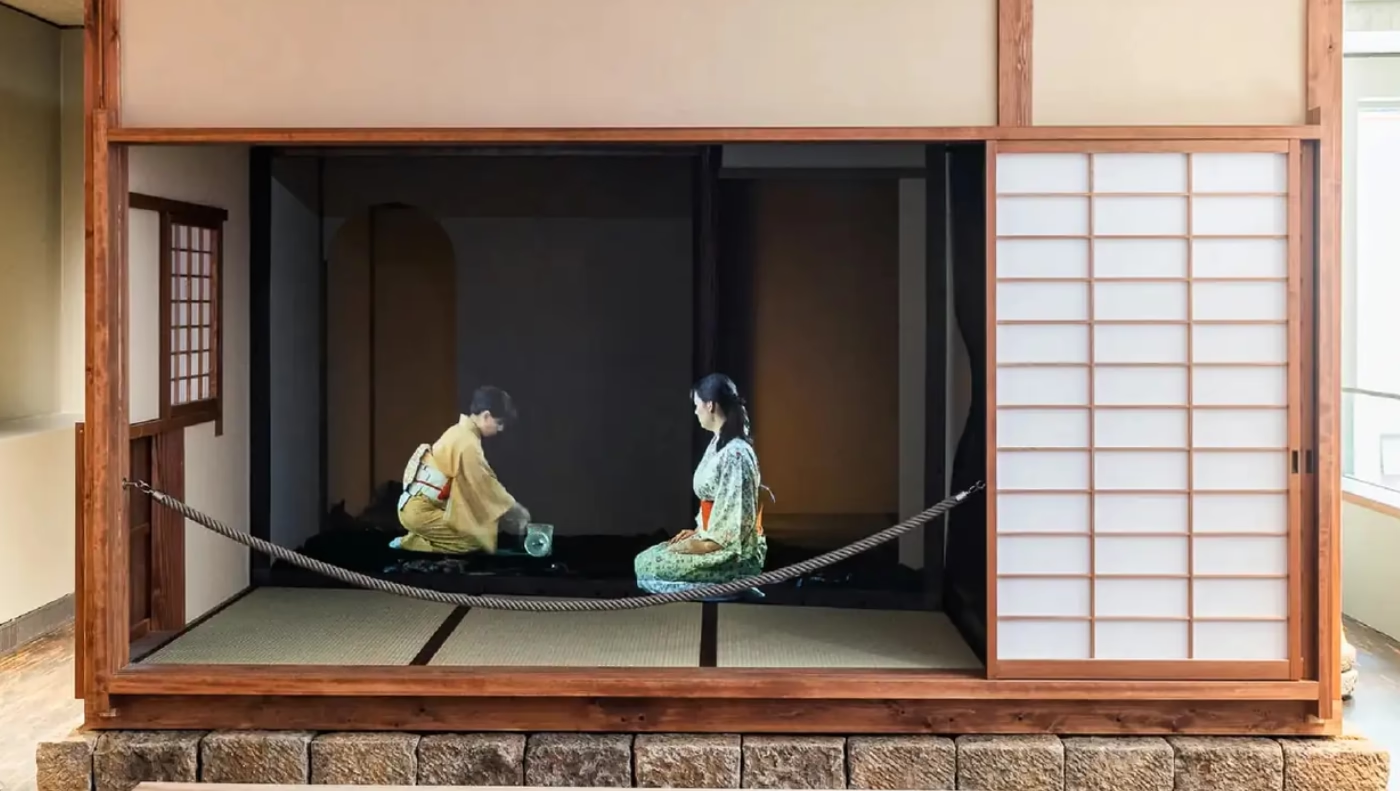
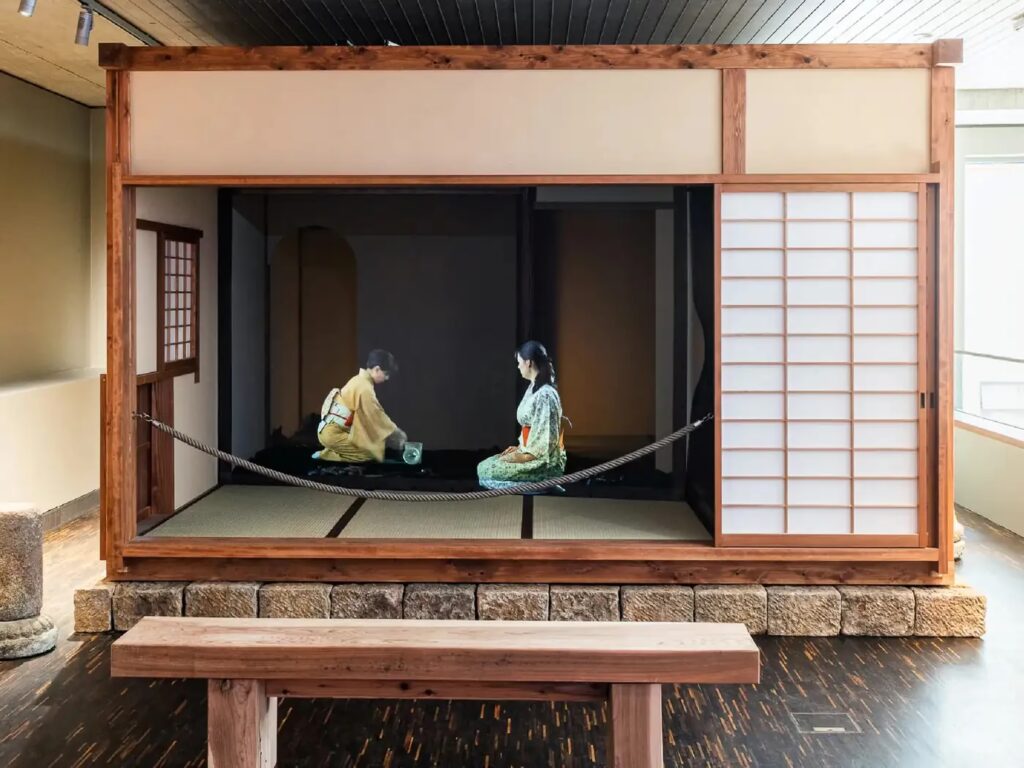
The Samurai Museum Berlin has brought an authentic example of this architectural tradition into Berlin’s museum landscape with its reconstructed tea house on the upper floor. The tea house was made in Japan using traditional materials and techniques and then assembled in Berlin. This construction follows classical Edo-period models and allows visitors to experience the spatial dimensions of the tea ceremony directly.[8]
The Tea Bowl: Raku, Oribe and the World of Things in the Ceremony
The tea bowl (Chawan) is the central object of the tea ceremony. Tea is drunk from it, prepared in it, and the participants’ main attention revolves around it. The choice of bowl, its visual and tactile qualities, and its iconographic history — all of these are central elements of every ceremony. Among the many Japanese ceramic traditions, two have become particularly associated with the tea ceremony: Raku and Oribe.[9]
Raku ceramics are inseparable from Sen no Rikyū. The potter Chōjirō (d. 1592), who worked under Rikyū’s guidance, developed a ceramic tradition that deliberately broke with established conventions. Raku bowls are not thrown on the wheel but built by hand. They are fired in a small kiln at relatively low temperatures (about 1,000–1,200 °C). They are removed from the glowing kiln with tongs, producing characteristic cracks and discolorations. Chōjirō’s black Raku bowls were deliberately imperfect, irregular, “raw”. These qualities made them perfect vessels for Wabi-cha. A Raku bowl is not beautiful despite its irregularity, but because of it. It embodies the philosophical principle that the imperfect is the true — Wabi-Sabi in ceramic form.
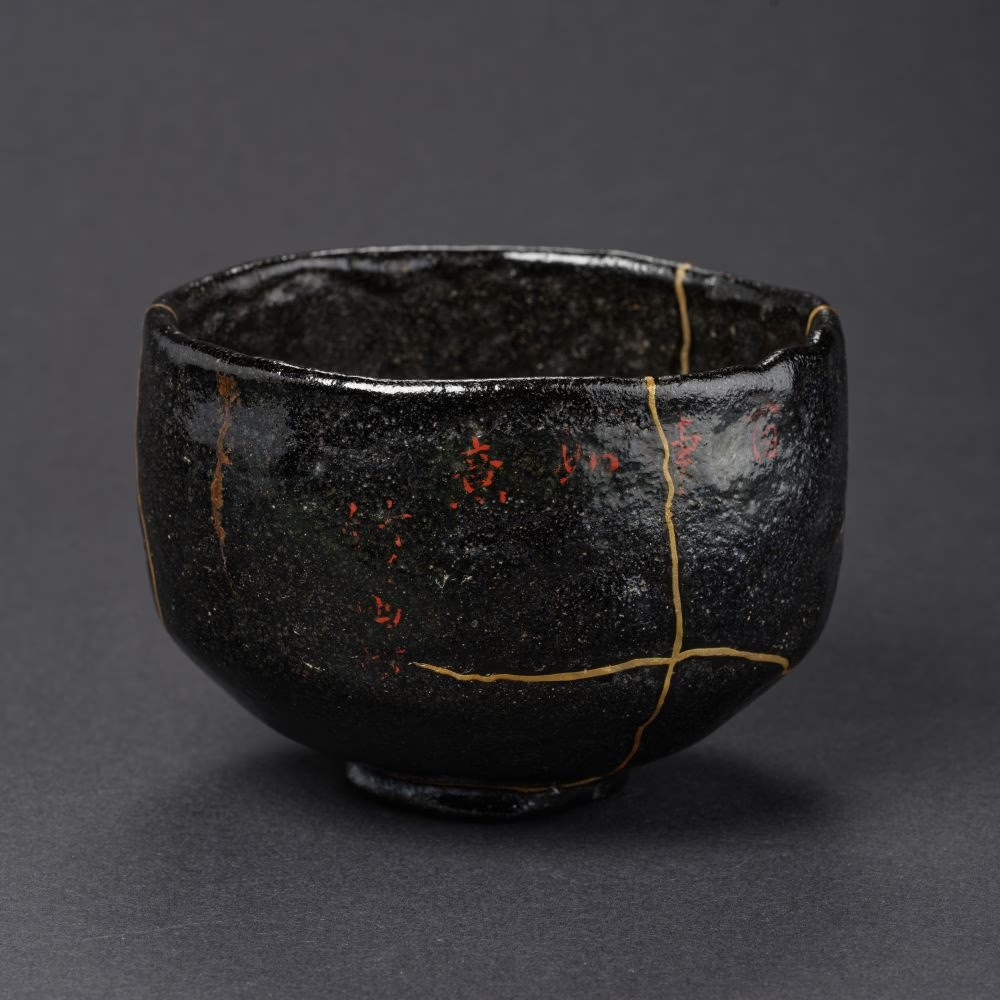
Oribe ceramics emerged a few decades later under the influence of Furuta Oribe. It is the freer, more dynamic variant: stronger deformations, green or brown glazes, and often asymmetrical forms. The Oribe bowl at the Samurai Museum Berlin is a characteristic example. The cylindrical tsutsu-chawan form was first made on the wheel and then worked by hand around the rim to create a slight irregularity. The Samurai Museum Berlin entry clarifies the line of development: the preference for unconventional forms and surfaces can be traced to Furuta Oribe, who exerted a major influence on these ceramics. As Sen no Rikyū’s student and successor, Oribe was first tea master to regent Hideyoshi and later tea master to shōgun Tokugawa Ieyasu.[10]
Both traditions, Raku and Oribe, illustrate an important principle of tea ceremony aesthetics: objects are not interchangeable tools but subjects of attention. A single tea bowl can have a name, a history, and a value that exceeded that of entire provinces. Oda Nobunaga gave famous tea bowls to his followers as the highest distinction. A documented tea bowl named Unzan Katatsuki — named after an imagined mountain and a frog-like handle — changed hands several times during the Sengoku period and each time was worth more than a castle. In the tea ceremony, the history of each individual object was actively brought to mind. Participants in a ceremony learned — typically while silently contemplating the bowl before drinking — its origin, its maker, and its previous owners. This historical aspect made every tea bowl an object of cultural memory.
The Ceremony in Practice
Die klassische Teezeremonie folgt einem festgelegten Ablauf, der je nach Stil und Schule variiert, aber über die Jahrhunderte bemerkenswerte Konstanz aufweist. Eine formelle Vollzeremonie kann mehrere Stunden dauern und umfasst mehr als nur das Trinken von Tee.[11]
Der Gast trifft vor der festgelegten Zeit im vorgelagerten Warteraum (Machiai) ein. Von dort wird er zum Gartenpfad gerufen, den er im Schweigen zum Teehaus durchquert. Der Pfad durch den Garten ist selbst Teil der Zeremonie: Er soll den Geist auf die bevorstehende Erfahrung vorbereiten, indem er die Gedanken an die äußere Welt ablegen lässt. Am steinernen Becken wäscht der Gast Hände und Mund rituell. Dann bückt er sich, kriecht durch den Nijiriguchi in das Teehaus, begrüßt stumm den Gastgeber und die bereits anwesenden anderen Gäste, studiert die Kalligrafie-Rolle und das Blumenarrangement im Tokonoma.
Der erste Teil der Zeremonie ist das Mahl (Kaiseki). Dieses mehrgängige, aber strikt bemessene Essen — ursprünglich abgeleitet aus der Zen-buddhistischen Klosterküche — besteht aus saisonalen Zutaten, fein geschnitten und kunstvoll präsentiert. Nach dem Kaiseki verlassen die Gäste das Teehaus zu einer kurzen Pause, während der Gastgeber den Raum neu arrangiert: Das Blumenarrangement wird ausgetauscht, die Teeutensilien werden aufgestellt.
Der Hauptteil ist die eigentliche Teebereitung. Der Gastgeber kniet am Herd, erhitzt das Wasser, wiegt den Matcha-Tee ab, schöpft das heiße Wasser in die Teeschale, rührt mit dem Bambuspinsel (Chasen) den Tee zu einer schaumigen Emulsion. Jede Bewegung ist choreografiert. Dann wird die Teeschale an den ersten Gast überreicht — mit festgelegten Verbeugungen, in einer bestimmten Orientierung. Der Gast nimmt die Schale, hält sie, dreht sie in den Händen (um die “Vorderseite” nicht mit den Lippen zu berühren), nippt, wischt den Rand mit einem kleinen Seidentuch ab, reicht die Schale an den nächsten Gast weiter.
Die Zeremonie kennt verschiedene Tee-Arten. Koicha (“dicker Tee”) ist eine zähflüssige, intensive Matcha-Zubereitung, die aus einer gemeinsamen Schale getrunken wird — alle Gäste trinken aus demselben Gefäß. Dies ist der formellste und spirituell dichteste Teil. Danach folgt oft Usucha (“dünner Tee”) — eine leichtere, schäumigere Zubereitung, die aus individuellen Schalen serviert wird und bei der das Gespräch etwas freier wird.
Die Zeremonie endet mit der abschließenden Verbeugung, dem Verlassen des Teeraums durch das Kriech-Türchen und dem Durchqueren des Roji-Gartens zurück zum Ausgang.
Wabi-Sabi and the Aesthetics of Imperfection
The philosophical attitude that shapes the tea ceremony has carried the name Wabi-Sabi (侘寂) since the 16th century. The term is difficult to translate because it describes a specifically Japanese combination of aesthetics, ethics, and spirituality.[12]
Wabi (侘) denotes a beauty found in simplicity, poverty, and restraint. The word derives from an older Japanese term meaning “loneliness” or “desolation”. In the tea context, Wabi is the quality that a simple ceramic bowl made by an anonymous potter in a rural village can possess — a quality that elaborate, perfectly formed Chinese porcelain bowls cannot have.
Sabi (寂) denotes the beauty that arises from aging and transience. A tea bowl that has been used for generations and slightly damaged, whose glaze has worn away and whose ceramic body bears traces of use, carries Sabi within it. A new, shiny bowl does not.
The interplay of these two qualities — Wabi-Sabi — has been the aesthetic foundation of the Japanese tea ceremony since Sen no Rikyū. It deliberately contrasts with the Western classical aesthetic, which aims at perfection, symmetry, and ideal form. Wabi-Sabi seeks beauty in the imperfect, the asymmetrical, the weathered, and the old. An Oribe tea bowl with its deliberately deformed sides and irregular glaze realizes this aesthetic directly.
For the samurai reception, Wabi-Sabi was especially significant because it articulated an attitude suited to warrior existence. A samurai had to be able to accept death at any moment; the Wabi-Sabi aesthetic reminded him that transience was not only a threat but also a source of beauty. The concept also corresponded with Bushidō ideals of simplicity, rejection of luxurious waste, and appreciation of craftsmanship over mere representation. In the tea room, the samurai encountered Wabi-Sabi in material form — in a simple tea bowl, in a single camellia blossom, in the strokes of a calligraphy that made transience itself its subject.
Five Myths About the Tea Ceremony
Myth 1: “The tea ceremony is a peaceful, purely aesthetic ritual.” Historically, the tea ceremony was closely linked to political power. Oda Nobunaga and Toyotomi Hideyoshi used it as an instrument of political display; Sen no Rikyū was ordered to his death by his lord. For centuries, the tea room was also a place for high-level political negotiations.
Myth 2: “The tea ceremony is typical of all Japanese people.” Historically, the tea ceremony was a practice of the elite — samurai, wealthy merchants, and priests. The wider population did not participate in it. Even today, Chadō practice in Japan is a minority interest, although it is highly respected.
Myth 3: “The tea ceremony is essentially a Zen practice.” The tea ceremony has Zen Buddhist roots, but it is not Zen meditation in the strict sense. It is an independent cultural practice with its own aesthetic, political, and social logic, of which the Zen element is only one component.
Myth 4: “All tea ceremonies follow the same pattern.” There are several major schools (Ryū) with different ceremonial forms — Urasenke, Omotesenke, Mushakōjisenke, and others. There are also regional variants and seasonal adaptations. Within a basic pattern, there is considerable variation.
Myth 5: “The tea ceremony is expensive and exclusive.” Historically, both existed: exclusive ceremonies with precious utensils and simple, popular tea gatherings. Hideyoshi’s “Great Kitano Tea Ceremony” of 1587 was explicitly open to everyone. The Wabi-cha ideal itself favored simple, affordable utensils over expensive imports.
Conclusion: Why the Samurai Drank Tea
The Japanese tea ceremony is one of the most complex cultural practices produced by a warrior society. Within a very small space — seven square meters, five participants, four hours — it combines multiple cultural dimensions: spiritual (Zen heritage), political (space for negotiation), aesthetic (Wabi-Sabi), social (status system), disciplinary (training attention), and cultural (memory of objects). For the samurai of the Momoyama and Edo periods, it was therefore not a hobby alongside martial arts but a complementary discipline. The tea room and the battlefield were two places where the same warrior had to exercise the same abilities: precision, calm, attention, readiness.
The surviving tea utensils in today’s museums — such as the Oribe-style tea bowl at the Samurai Museum Berlin from 1610 — are material condensations of this culture. Every bowl, every whisk, every lacquer box bears traces of a time when warriors spent several hours a week consciously attending to their own movements while drinking tea. This practice shaped not only the aesthetics of the Edo period but also the personality of a class that had to be both martial and cultivated.
When looking at an Oribe tea bowl in the museum, one should imagine a daimyō of the early 17th century holding it, turning it, drinking the tea, and then remaining in absolute silence before the next conversation began. In this interval — between the last sip and the first word — lies something that makes the tea ceremony one of Japan’s enduring cultural achievements. It is the quality of an attention that has learned to find depth in simplicity.
Frequently Asked Questions
What is the Japanese tea ceremony?
The Japanese tea ceremony (Chadō 茶道 or Chanoyu 茶の湯) is a highly ritualized event in which powdered green tea (matcha) is prepared and consumed together according to prescribed rules. It combines Zen Buddhist, aesthetic, political, and social elements and, from the Momoyama period (1573–1615), became a central cultural practice of the samurai class.
Who was Sen no Rikyū?
Sen no Rikyū (1522–1591) was the most important tea master in Japanese history. He first served Oda Nobunaga and then Toyotomi Hideyoshi as chief adviser on tea matters. He formulated the aesthetic-spiritual foundations of Wabi-cha and defined standards that influenced all subsequent periods. In 1591 he was ordered by Hideyoshi to commit seppuku.
What does Wabi-Sabi mean?
Wabi-Sabi (侘寂) is the aesthetic foundation of the Japanese tea ceremony. Wabi denotes the beauty of simplicity and restraint; Sabi the beauty of aging and transience. Together they form an aesthetic that places the imperfect, asymmetrical, and transient above classical perfection.
Why was the tea ceremony important to samurai?
The tea ceremony was relevant to the samurai class on several levels: it was a medium for political negotiations, a discipline of bodily control and attention, a space for cultural education, and also a meditative practice that prepared the warrior for possible death. The specific samurai style was called Bukecha (“warrior tea”).
What is an Oribe tea bowl?
Oribe tea bowls are ceramic bowls in the style of the tea master and daimyō Furuta Oribe (1544–1615). They are characterized by unconventional, often asymmetrical forms, green or brown glazes, and deliberately deformed handcrafted surfaces. The Samurai Museum Berlin’s Oribe tea bowl from 1610 is an important example of this tradition.
Can the tea ceremony still be experienced today?
In Japan, several major tea ceremony schools, including Urasenke and Omotesenke, offer instruction and public ceremonies. Established tea ceremony communities can also be found throughout Europe and North America. At Samurai Museum Berlin, a monthly tea ceremony is led by Atsuko Sōto Isoyama-Osiander, a tea practitioner of the Urasenke school in Kyoto, offering visitors an opportunity to experience the ritual, aesthetics, and principles of Japanese tea culture. (Advance reservation is required.)
Visit the Samurai Museum Berlin
The Samurai Museum Berlin displays an important example of Japanese tea ceremony culture in its Oribe tea bowl from 1610. In the context of the reconstructed tea house on the upper floor, which was made in Japan using traditional materials and then assembled in Berlin, visitors can directly experience the spatial and material dimensions of the tea ceremony. Together with the collection’s other cultural objects — from tea utensils to lacquerware — it creates a comprehensive picture of samurai-period cultural practice.
Sources and Further Reading
This article is based on academic research, primary sources, and the expert catalogs of the Samurai Museum Berlin. All cited works are documented in the complete bibliography of the Knowledge Hub.
Primary Sources
- [1] Samurai Museum Berlin (2025). SMB Catalog 2025 — Tea Utensils and Cultural Objects. [Used: M03V_68 Oribe tea bowl from 1610]
Secondary Literature
- [2] Pitelka, Morgan (2005). Handmade Culture: Raku Potters, Patrons, and Tea Practitioners in Japan. University of Hawai’i Press. [Used: Raku ceramic tradition, Chōjirō, Sen no Rikyū, Oribe tradition, deconstruction of tea mythology]
- [3] Samurai Museum Berlin (ed.) (2021). Armours of the Samurai. Samurai Museum Berlin. Catalog essays. [Used: Bukecha concept, warrior tea vs. court-nobility tea, Oda Nobunaga’s use of tea utensils]
- [4] Berry, Mary Elizabeth (1982). Hideyoshi. Harvard University Press. [Used: Kitano Tea Ceremony 1587, Hideyoshi-Rikyū relationship, political dimension of tea]
- [5] Varley, Paul; Kumakura, Isao (eds.) (1989). Tea in Japan: Essays on the History of Chanoyu. University of Hawai’i Press. [Used: Eisai, Murata Jukō, Takeno Jōō, development of Wabi-cha]
- [6] Hirota, Dennis (1995). Wind in the Pines: Classic Writings of the Way of Tea as a Buddhist Path. Asian Humanities Press. [Used: Wa-Kei-Sei-Jaku principles, spiritual dimension of tea]
- [7] Mason, Penelope (2005). History of Japanese Art. 2nd ed., Prentice Hall. [Used: Wabi-Sabi aesthetics, tea house architecture, Momoyama context]
- [8] Hall, John Whitney (ed.) (1991). The Cambridge History of Japan, Vol. 4: Early Modern Japan. Cambridge University Press. [Used: Tokugawa shogunate, Edo-period cultural patronage, daimyō culture]
- [9] Ikegami, Eiko (1995). The Taming of the Samurai: Honorific Individualism and the Making of Modern Japan. Harvard University Press. [Used: samurai cultural practices of the Edo period, Bun-Bu dualism]
- [10] Turnbull, Stephen (2012). Toyotomi Hideyoshi. Osprey Publishing. [Used: Hideyoshi’s life, Rikyū death context, political dimensions of the tea ceremony]
- [11] Sen, Sōshitsu XV (1998). The Japanese Way of Tea: From Its Origins in China to Sen Rikyū. University of Hawai’i Press. [Used: sequence of the classical ceremony, Kaiseki meal, Koicha and Usucha]
Museum Catalogs and Expert Reports
- [12] Samurai Museum Berlin (2025). Exhibit Documentation — Tea Utensils and Tea House. [Used: dating of Oribe tea bowl, tsutsu-chawan form, tea house construction]
© Samurai Museum Berlin – All Rights Reserved
You might also like
Shogun: The Military Rulers of Japan — History & Significance
Shogun – the military rulers of Japan: who they were, how they ruled & why they never abolished the emperor.…
Read the article
Kendō: History, Philosophy & Practice of the Art of the Sword
Kendō – the way of the sword: from Kenjutsu to a modern martial art. History, equipment, philosophy & historical exhibits…
Read the article
Seppuku: History, Ritual and Meaning of the Stomach-Cutting
Seppuku – history, ritual and meaning of the stomach-cutting. From battle tactic to Edo ceremony: what really drove the samurai…
Read the article