 Nominated for the EMYA2026 award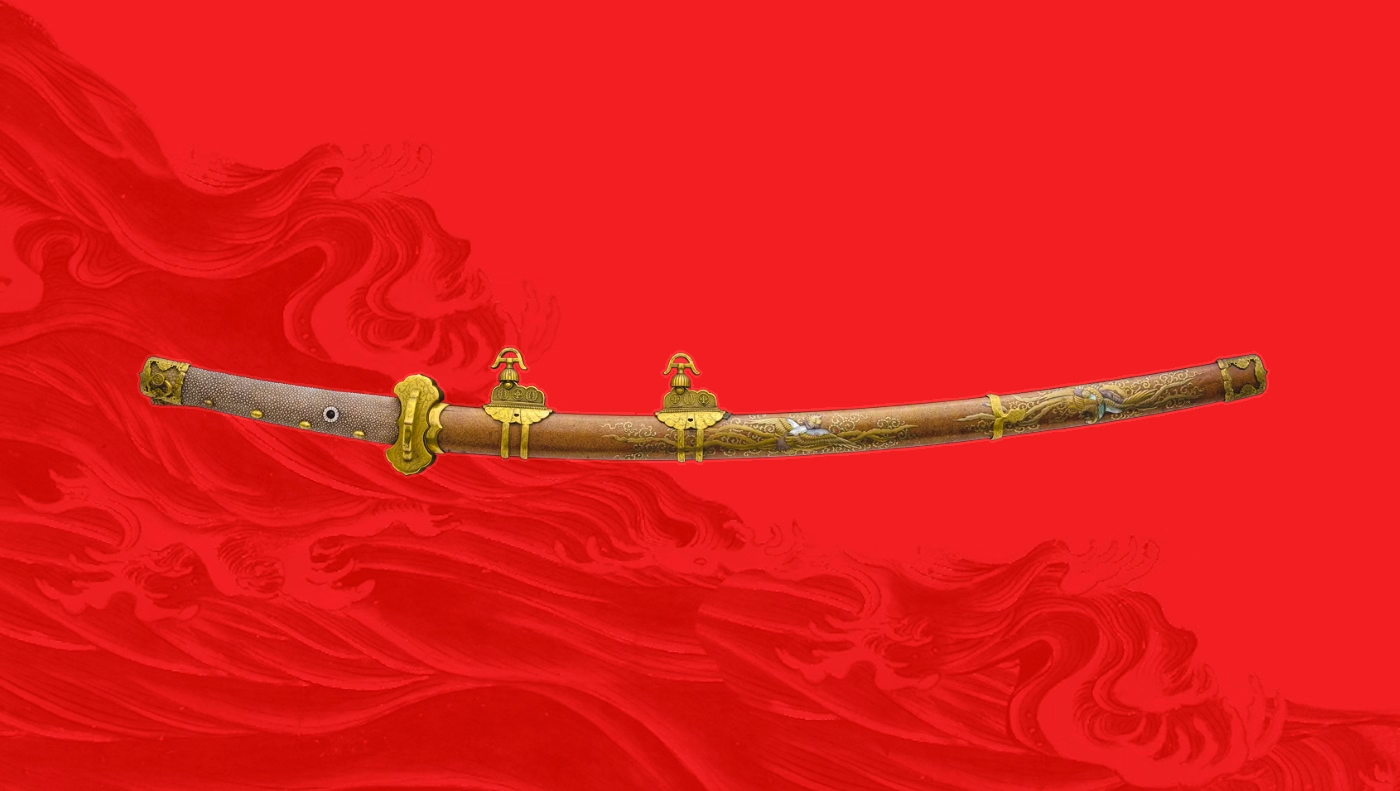
In the year 940, a rebel rode through the province of Musashi and called himself emperor. His name was Taira no Masakado; he was the grandson of an emperor and had waged land feuds for years. Now he had conquered six provinces. The court in Kyoto sent no army. It sent another warrior: Fujiwara no Hidesato, who defeated Masakado in battle, cut off his head and sent it to the capital.
What remains: the court paid warriors to defeat warriors. That was new.
Three centuries earlier, the imperial court still had an army of its own. The Ritsuryō system provided for conscript regiments in every province. But conscription became expensive, the peasants fled, the regiments decayed. In 792, Emperor Kanmu abolished conscription and replaced it with what Karl Friday describes as the “privatization of violence”: the state stopped training warriors — and began to buy them. From this purchase agreement the samurai class emerged.
From Tsuwamono to Bushi: How a Warrior Class Comes Into Being
Samurai — from saburau, “to serve someone” — originally denoted simply a bodyguard at court. The samurai were not born as a caste. They were needed as a caste.
The Emishi wars in northeastern Japan had triggered a military revolution. The old conscript army on foot was inferior to the mounted archers of the Emishi. In this way, dynasties of specialists arose in the eastern provinces, whose sons became specialists in turn — with the horse, the bow and the sword as inherited tools of a craft that no one else had mastered.
At the same time, the central administrative system collapsed. The shōen system — private estates withdrawn from the capital’s tax reach — expanded through the 9th and 10th centuries. Whoever owned an estate needed someone to defend it. Warriors were needed not in spite of the decay of the state — they were needed because of the decay of the state.
Horse and Bow: What a Samurai Really Was
Here begins one of the most persistent misconceptions about the early samurai: the sword is not the weapon of the early samurai. It was the emergency weapon, drawn when the arrows had been spent. The actual weapon was the bow. Kyūba no michi: the way of horse and bow. That is what the Heian warriors called their art.
Friday’s analysis makes this unmistakable: “The sword was the weapon of last resort… For the Heian and Kamakura warrior, battle was primarily an exchange of arrows; closing to grapple with swords and daggers occurred only when arrows were exhausted.” Japanese horses were not warhorses but robust ponies with a shoulder height of barely over 130 centimetres — unsuited to shock charges.
The ō-yoroi armour — the iconic emblem of the Heian warrior — was constructed for precisely this style of combat. Its powerful shoulder plates (ō-sode) protected against arrows from the side while the warrior shot from horseback. On foot, the ō-yoroi was a burden. The Samurai Museum Berlin preserves a replica in display case C02V that makes this connection tangible.
Court Politics and Civil War: How the Warriors Took Power
The Insei system — abdicated emperors who governed from monasteries — had produced an unintended result: two imperial lines, both with a claim to power, both with a need for protective troops. When, in 1156, Emperor Sutoku and Ex-Emperor Go-Shirakawa came into conflict, both sides called warriors to their aid. The Hōgen Rebellion lasted a single day. In its significance it marked the breaking of an epoch: warriors could now decide imperial conflicts.
The Taira under Kiyomori had at first done exactly what the court had always wanted: bought loyalty, forged marriage alliances, taken over court offices. Kiyomori became chancellor, his daughter the consort of an emperor. The difference from the Fujiwara was hard to name — except that he was a warrior. The Minamoto did not forget that.
The Genpei War (1180–1185) was the first all-Japan war. It ended in the spring of 1185 in the strait of Dan-no-ura, where the Taira fleet was annihilated by the Minamoto. The Heian period had not created warriors. It had created a society in which warriors became indispensable — and then unstoppable.
Capital and Province: Two Worlds, One History
In the capital, court ladies wrote novels. Murasaki Shikibu composed the Genji Monogatari around the year 1010 — the oldest work of world literature commonly classified as a novel. The aesthetic canon of miyabi — courtly refinement, a sensibility for the transient — shaped the elite’s self-image.
Two hundred kilometres to the east, warriors were honing blades.
The Heike Monogatari — composed in the decades after the Genpei War — mourns the Taira not as enemies but as bearers of a culture that perished. This shows how deeply Heian aesthetics had penetrated even the language of war — or how much the warriors in the end wanted to become Kyoto themselves.
Frequently Asked Questions About the Heian Period
When did the Heian period begin and what ended it?
The Heian period began in 794 with the transfer of the capital to Heian-kyō (Kyoto) and ended in 1185 with the Minamoto victory in the Genpei War. The subsequent establishment of the Kamakura shogunate marks the transition to the Kamakura period.
Why did the samurai emerge in the Heian period?
The court abolished the conscript army in 792 and outsourced military tasks to professional warrior clans. This “privatization of violence” (Friday 2004) created a demand for specialists who developed over generations into an independent warrior caste.
What was the most important weapon of the Heian samurai?
The bow (yumi), not the sword. The Heian warriors called their martial art Kyūba no michi — the way of horse and bow. The sword was the weapon of last resort, drawn when arrows had been used up.
Why did the imperial court lose power to the samurai?
The Insei system created rival imperial lines, both of which depended on warriors as protective troops. When the Hōgen Rebellion broke out in 1156, the military balance of power decided the outcome of a succession dispute. With that, the principle was established: warriors could answer imperial questions.
Visit the Samurai Museum Berlin
Display case C02V preserves a replica of an ō-yoroi armour, showing the warrior type of the late Heian and early Kamakura period in its original form. Display case C03V shows a hoshi kabuto (star helmet) from the Kamakura period. Open daily from 10 a.m. to 7 p.m., Auguststraße 68, Berlin-Mitte.
Related Articles
- Kamakura & Muromachi: The First Shogunate and the Mongol Storm
- Ō-Yoroi: The Great Armour of the Heian Samurai
- Kabuto: The Helmet of the Samurai
List of Sources
- Friday, Karl F. (2004): Samurai, Warfare and the State in Early Medieval Japan. Routledge.
- Shively, Donald H. & McCullough, William H. (eds.) (1999): The Cambridge History of Japan, Vol. 2: Heian Japan. Cambridge University Press.
- Absolon, Trevor (2017): Samurai Armour, Volume I. Osprey Publishing.
- Varley, H. Paul (1994): Warriors of Japan as Portrayed in the War Tales. University of Hawaii Press.
- Samurai Museum Berlin (2021): Armours of the Samurai.
© Samurai Museum Berlin – All rights reserved
You might also like
Nanboku-chō: The War of the Two Imperial Courts (1336–1392)
For 56 years, Japan was ruled by two emperors at once. The Nanboku-chō period: civil war, the collapse of loyalty,…
Artikel lesen
The 47 Rōnin: Japan’s Legendary Tale of Revenge
The true story of the 47 Rōnin: how 47 masterless samurai avenged their lord in 1703 – and why not…
Artikel lesen
Toyotomi Hideyoshi: From Peasant’s Son to Ruler of Japan
Toyotomi Hideyoshi (1537–1598): how a nameless foot soldier became the unifier of Japan. History, reforms & exhibits at the Samurai…
Artikel lesen