 Nominated for the EMYA2026 award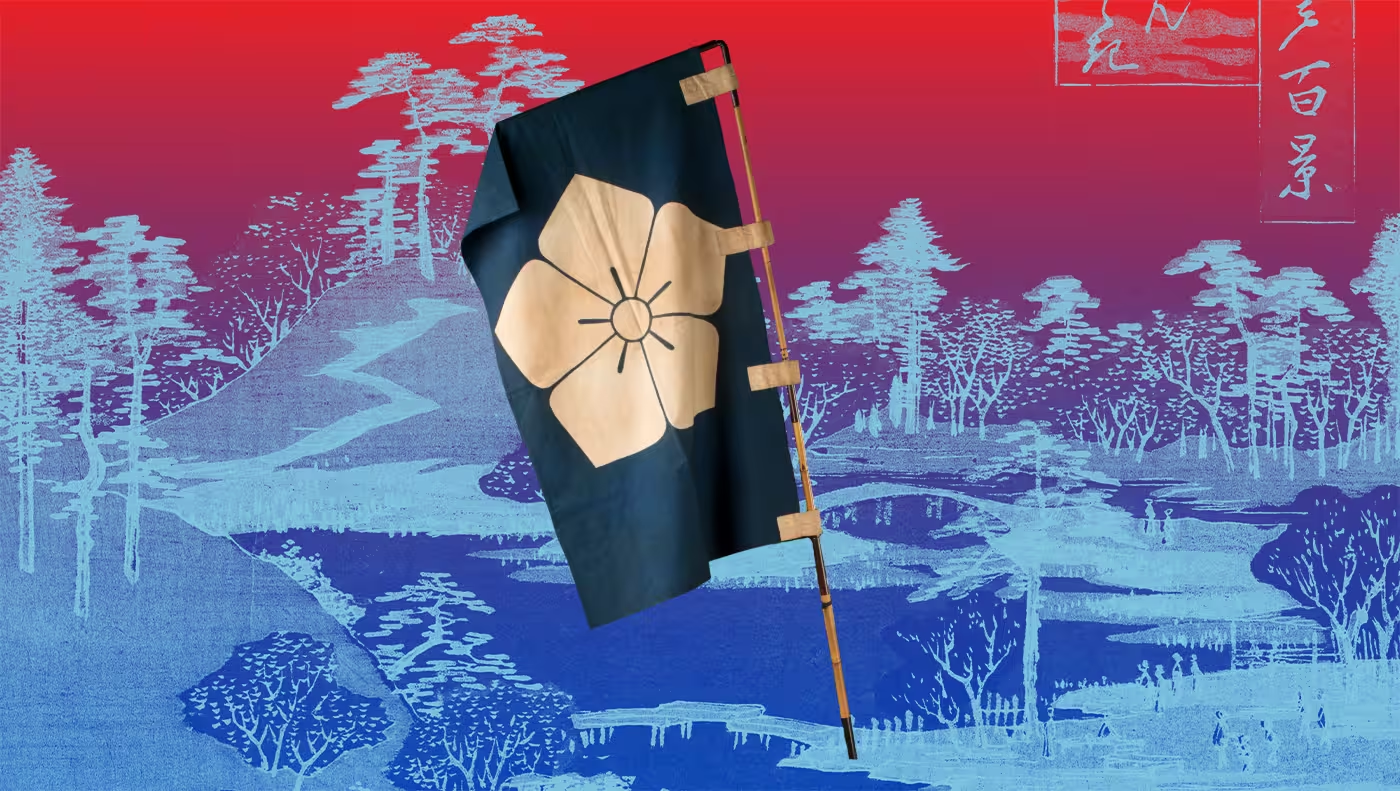
The Battle of Nagashino in 1575 took place in a narrow river plain. As the Takeda cavalry charged across the plain, the observer on a command hill saw not individual riders, but a waving forest. Above each individual suit of armor fluttered a narrow banner — red, white, black, with the crests of the corresponding unit. The Takeda army was not merely a gathering of warriors; it was a visibly structured formation. This system had a name: Sashimono.
What is a sashimono?
The word Sashimono (指物) literally means “display thing” — a visual identifying feature that was meant to allow identification of the wearer on the battlefield. In its standard form, a sashimono was a rectangular banner of silk or linen (50 to 80 cm in height, 25 to 40 cm in width), attached to a bamboo pole and inserted into a special holder on the back of the armor.
This holder consisted of two elements: the gattari was a metal hook on the upper edge of the back plate; the machi uke was a tube on the lower edge. Together they held the pole upright behind the wearer’s back. An important distinction: the sashimono was the personal back banner of an individual warrior. The nobori was a larger long flag carried by a standard-bearer. The uma-jirushi was the large personal standard of the daimyō himself.
The emergence from the organizational problem of mass armies
The Sengoku period (1467–1615) brought a transformation of Japanese warfare: army sizes grew dramatically. At the Battle of Sekigahara (1600), an estimated 80,000 to 100,000 warriors faced one another. Under these conditions, identification on the battlefield became an acute problem. In a throng of thousands of uniformly armored ashigaru, amid gunpowder smoke and clouds of dust, the spontaneous recognition of friend and foe was scarcely possible any longer.
The innovation of the Sengoku period was the universality of the system: from the simple peasant soldier to the high-ranking samurai, all wore a sashimono. Earlier identification practices had distinguished above all the elite; the mass of ordinary combatants was often barely marked.
The kamon and their bearers — Two examples from the Samurai Museum Berlin
The Hachisuka sashimono (C36V_34) shows a black swastika (manji) within a ring on red silk fabric. The manji crest was the kamon of the Hachisuka clan, which resided in Awa Province. The Hachisuka were originally vassals of Toyotomi Hideyoshi; after his death they joined Tokugawa Ieyasu and fought on his side at Sekigahara. The manji — in Buddhist traditions a symbol of eternal peace — was their identifying mark on the battlefield.
The Katō Kiyomasa sashimono (C35V_33) bears the janome crest, the “snake’s eye” of the Katō clan. Its best-known representative was Katō Kiyomasa (1561–1611), who had married into the close family of Toyotomi Hideyoshi. Kiyomasa became especially known for his role in the Korean campaigns of 1594 and 1598. His tiger hunts during these campaigns became legendary — portraits and ukiyo-e prints frequently depict him in combat with a tiger.
Motifs and their meaning — The semiotics of the back banners
Family crests (kamon) formed the core of the motif repertoire. The Tokugawa used the aoi (hollyhock); the Toyotomi the kiri (paulownia leaf); the Oda the mokkō (quince blossom); the Takeda the bishimon (four lozenges).
Religious motifs were widespread. Buddhist bonji — Sanskrit syllables for particular deities. Namu Amida Butsu was especially common among the Ikkō-Ikki. Kuroda Nagamasa and other Christian daimyō at times bore crosses on their banners.
Mythological and animal motifs: dragons for power; tigers (especially after the Korean campaigns); cranes for longevity. Uesugi Kenshin’s sashimono bore the character Bishamon — the Buddhist war god Bishamonten, whose protection Kenshin claimed for himself.
Craftsmanship and material
Silk banners were the most expensive examples — for high-ranking samurai. For simpler troops and mass production, linen or coarse cotton was used. Crests could be applied to the fabric by stencil stamping, hand-painted touch-ups, or embroidery. For the most demanding pieces, appliqués were used — separate pieces of fabric were sewn on.
From battlefield to ceremony — The Edo transformation
With the end of the great battles after 1615, the sashimono lost its original military function. At sankin-kōtai processions — the alternating residence movements of the daimyō between their provinces and Edo — sashimono were a central visual element. The Edo-period examples are often even more elaborately worked than their Sengoku predecessors.
The fire brigades (hikeshi) of the large cities developed the matoi — standards that were conceptually related to sashimono and uma-jirushi. The sashimono idea thus had an influence far beyond the samurai warrior culture.
Five myths about sashimono
Myth 1: “Sashimono were only for samurai officers.” Ordinary ashigaru also wore sashimono — that was precisely the innovation of the Sengoku period.
Myth 2: “Every sashimono was made individually for its bearer.” The mass production for ashigaru followed standardized templates.
Myth 3: “Sashimono were a hindrance in close combat.” The system was constructed so that the bamboo pole scarcely affected movement during close-combat techniques.
Myth 4: “Sashimono always showed the crest of the warrior himself.” Often they showed the crest of the daimyō or immediate liege lord, not the personal crest.
Myth 5: “Sashimono disappeared with the Sengoku period.” As ceremonial objects they continued to exist throughout the entire Edo period.
Frequently asked questions
What is a sashimono?
A sashimono (指物) is a Japanese back banner worn by samurai and ashigaru foot soldiers during the Sengoku period and Edo period. It consisted of a rectangular fabric banner on a bamboo pole, fastened in a holder (gattari and machi uke) on the back of the armor.
What function did the sashimono have?
The visual identification of the wearer on the battlefield. Due to the growing army sizes, without systematic marking it was scarcely possible to distinguish friend from foe or to coordinate one’s own units.
What is the Katō Kiyomasa sashimono?
The sashimono of the Katō clan bore the janome motif — a ring on a silk-fabric background. Its best-known bearer was Katō Kiyomasa (1561–1611), who became known for his role in the Korean campaigns and his legendary tiger hunts.
Visit the Samurai Museum Berlin
The Samurai Museum Berlin displays several original sashimono — among them the red Hachisuka manji sashimono and the Katō Kiyomasa janome sashimono. The presentation in the context of the complete suits of armor with their gattari-machi uke holders allows visitors to study the back banners in their original setting. Open daily from 10 a.m. to 7 p.m., Auguststraße 68, Berlin-Mitte.
Related articles
- Tōsei Gusoku: The Bulletproof Armor of the Sengoku Era
- Kabuto: The Helmet of the Samurai
- Menpō: The Face Mask of the Samurai
- Jinbaori: The Armor Coat of the Samurai
List of sources
- Samurai Museum Berlin (2025): SMB Catalog 2025.
- Turnbull, Stephen (2022): War in Japan 1467–1615. Osprey Publishing.
- Conlan, Thomas (2022): Samurai Sourcebook. Hackett Publishing.
- Hall, John Whitney (ed.) (1991): The Cambridge History of Japan, Vol. 4. Cambridge University Press.
- Absolon, Trevor (2017): Samurai Armour Vol. I. Osprey Publishing.
© Samurai Museum Berlin – All rights reserved
You might also like
The Katana: History, Forging Technique & 5 Myths Debunked
The Katana: History, Forging Technique & 5 Myths Debunked. What is really true about the most famous sword in the…
Artikel lesen
Dō — The Cuirass of the Samurai: History & Development
The dō – the heart of every samurai armour. From Heian lamellae to the bulletproof Sengoku cuirass: history, types &…
Artikel lesen
Kabuto: The Helmet of the Samurai — History & Anatomy
The kabuto – protection, identity, and work of art in one. History, anatomy & smithing traditions of the samurai helmet.…
Artikel lesen