 Nominated for the EMYA2026 award
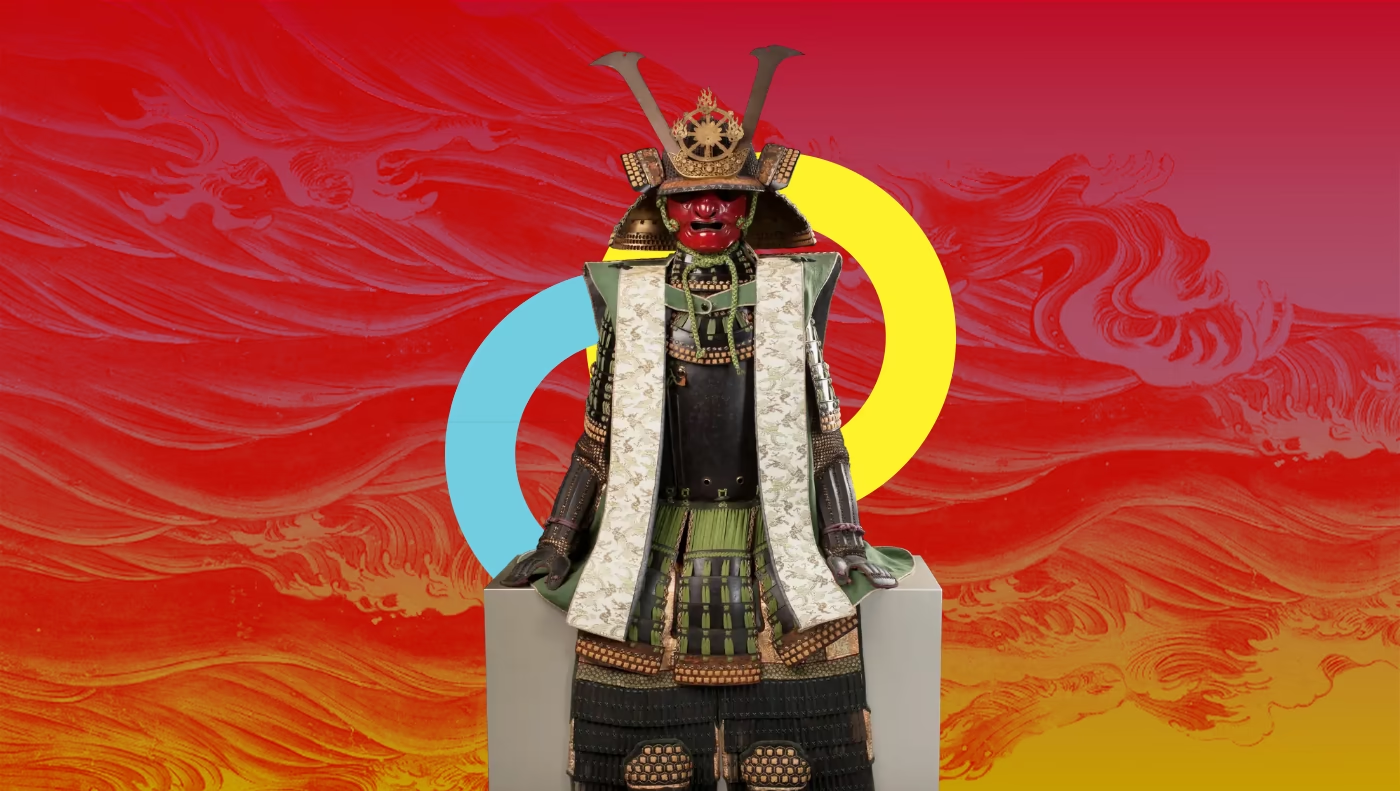
Jinbaori: The Armour Coat That Brought the World to Japanese Battlefields
Anyone looking today at Japanese depictions of battles from the 16th and early 17th centuries — the byōbu folding screens of the Battle of Sekigahara, the ukiyo-e woodblock prints of the Siege of Osaka, the portraits of the great Daimyō — will see almost all of them wearing a Jinbaori over their armour. The sleeveless outer garment in brilliant red, deep blue, rich green or white falls over the black and lacquered lamellar cuirasses, bears the family crest on the back and marks the wearer so that he can be seen from afar. Among the commanders on the command hills, among the envoys at the rendezvous before the battle, among the prisoners who surrender: everywhere the Jinbaori serves as both an identifying mark and a status symbol.
This article reconstructs the Jinbaori as a cultural object between the military and fashion, between field camp and audience hall, between European trade and Japanese tradition. It shows how a practical form of weather protection for commanders on rain-soaked battlefields became a highly developed craft product that shaped the luxury economy of the Edo period.
At the Samurai Museum Berlin, visitors can experience several Jinbaori in their full splendour of colour — from the simple white Katō clan coat to the elaborately embroidered Shishi Jinbaori with gold and appliqué embroidery.
What Is a Jinbaori?
The word jinbaori is made up of two components: jin (陣, “field camp” or “troop position”) and haori (羽織, “over-jacket”). Literally, then, it means “field camp jacket” — and that was exactly its original function.[1] The Jinbaori is a sleeveless outer garment that was worn over samurai armour. It served primarily as protection against the weather: against rain on rain-soaked battlefields, against the cold in the night hours of a field camp, against wind on open plains and mountain passes. When battle began, it was usually taken off; during pauses for negotiation, at command positions and after the fighting, it was put back on.
The form was largely standardised, whereas the fabric and design were highly individual. The basis was a rectangular cut that was open at the front of the chest and fastened with buttons or ties. Wide armholes made it possible to pull it on over the armour. A long back slit (roughly from the lower third to the hem) made walking, riding and fighting easier. The lining was often made of silk, occasionally with patterns of stylised flowers, clouds or geometric shapes. Collars and lapels were often worked in contrasting colours and decorated with gold embroidery. Gold borders or additional embroidery are frequently found on the shoulders, hems and closing edges.
The central identifying feature was the family crest (Kamon) on the back — and often also on the shoulders or the buttons. The Jinbaori thus also served as personal identification on the battlefield: from a command hill, one could recognise the direction in which a troop unit was moving by the crests on the commanders’ backs. In formal negotiations and surrenders, too, the immediate recognisability of the wearer by his crest was of practical importance.
Three major distinctions help in understanding the diversity of Jinbaori. First, the material category: Expensive Jinbaori were made of imported European wool (rasha) — a coarsely woven cloth that betrayed access to world trade. There were also Jinbaori made of domestic silk, of brocade, of velvet. Wool dominated in field use because of its weather resistance; silk and brocade dominated in Edo-period ceremonial Jinbaori. Second, the functional category: the original field Jinbaori was simpler and more practical, the later ceremonial Jinbaori of the Edo period more elaborate and more fragile. Third, the period category: the early Jinbaori of the late Muromachi and Sengoku periods still reflect military practice; the Edo Jinbaori increasingly show ostentatious symbolism without any real combat use.
Rasha — The Wool from Europe and Japan’s Global Entanglement
The wool from which many examples were made was called rasha in Japan. The word derives from the Portuguese raxa — a coarse woollen cloth used in Europe mainly for coats and military uniforms. When the Portuguese were stranded on Tanegashima in 1543 and, a few years later, established regular trade relations with Japan, rasha was among the first fabrics they brought to Japan. Wool had been unknown in Japan until then; sheep were not kept in any significant numbers in the Japanese archipelago, and domestic textiles were based on hemp, linen, cotton and silk.[2]
The Portuguese initially brought rasha in smaller quantities. The real breakthrough came with the Dutch, who traded from 1609 from a trading post on the island of Hirado and, from 1641, exclusively from the artificial island of Dejima off Nagasaki. Under the Sakoku regime — the Tokugawa policy of isolation after 1639 — the Dutch were the only Europeans permitted to maintain official trade relations with Japan. They imported rasha, velvet, silk fabrics from India, glass beads, printed books and countless other goods; they exported silver, copper, lacquerware and porcelain.
Rasha became a luxury good in Japan. Its price was far above that of comparable domestic fabrics. A Jinbaori made of rasha was therefore not merely a garment but economic proof of status. The Samurai Museum Berlin’s catalogue entry on the Hachisuka Jinbaori clearly documents this aspect: wool was considered a rare and expensive luxury good that only wealthy samurai could afford. Through exotic materials, varied motifs and strong colours, the samurai were able to express their individual taste and wealth.[3]
Colour was a further factor. European wool dyers had mastered shades that could not be achieved with Japanese plant dyes, or only with great effort — intense reds from cochineal, brilliant blues from indigo, rich greens from repeatedly dyed wool fibres. In Japan, this colour palette met a culture that placed high value on visual signals on the battlefield. A commander’s red Jinbaori was clearly visible from several hundred metres away; it marked the commanders and gave orientation to their own troops.
The arc that rasha wool spanned — from the looms of Leiden or Ghent, via Portuguese and Dutch trading ships, to the field camps of the Sengoku Daimyō — is one of the clearest examples of the global interconnectedness of the early modern period. The Samurai Museum Berlin presents this global dimension in several exhibits at once: rasha Jinbaori, alongside Daishō koshirae with blue Murano glass inlays, and armour with Nanban tsuba showing European influence. Each individual piece documents the fact that the supposedly “closed” samurai world of the early modern period was deeply embedded in global trade flows.
The Jinbaori in the Field Camp — Function on the Battlefield
The practical function of the Jinbaori on the battlefield can be reconstructed from several surviving sources: from contemporary chronicles, from the few surviving field-camp Jinbaori, and from the portraits and battle depictions of the late Sengoku period. Three central areas of use emerge.
First: Weather protection. Japanese military campaigns often took place in months when the weather was difficult to predict. The Battle of Sekigahara (October 1600) began in dense morning fog. The campaign against Osaka (winter 1614/15) took place in freezing conditions. The Korean invasions (1592 and 1597) exposed Japanese troops to extreme climatic situations with hot summers and cold winters. Under these conditions, a weatherproof wool coat over the armour was a decisive gain in comfort. Rasha was water-repellent, heat-retaining and comparatively heavy — properties that the domestic alternatives made of silk or hemp did not offer.
Second: Command marking. On the Sengoku-period battlefield, with thousands to tens of thousands of combatants, the visibility of the commanders was a decisive element of troop leadership. A Daimyō on his command hill signalled his position by means of Sashimono (back banners), Gunbai (war fans) and, indeed, the Jinbaori.
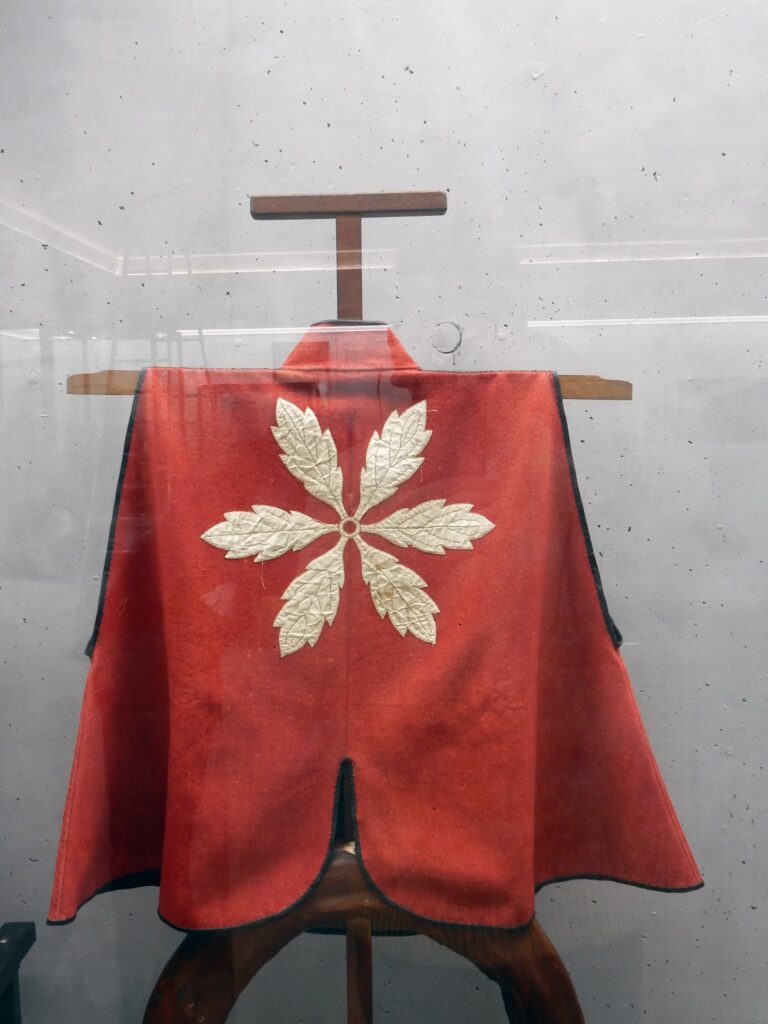
Third: Representation at meetings. When Daimyō met one another in the run-up to a battle — for negotiations, hostage exchanges, alliance talks — each appeared in his best armour and wearing his most splendid Jinbaori. The visibility of wealth and craftsmanship was a signal of power; anyone who could wear rasha demonstrated access to international trade and the corresponding financial means. The Katō clan Jinbaori (C35V_33), with its plain white and the family crest painted on in black, shows this representative function in its clearest form: the imported woollen cloth in which the Dutch traded in Nagasaki forms the basis; the family crest of the Katō clan on the back communicates the identity of the wearer.[5]
With the end of the great battles after 1615, usage shifted. The Sengoku field Jinbaori became inherited showpieces, kept in the clan treasuries of the Daimyō houses. New Jinbaori continued to be made, but now predominantly for the ceremonial needs of the Pax Tokugawa: for the Sankin-kōtai processions of the Daimyō between their provinces and Edo, for hunts, for receptions, and for firefighting operations in the fire-prone large cities.
Ornament and Meaning — How a Jinbaori Was Read
The elaborate decoration of many Jinbaori is not merely an aesthetic element. Every motif, every pattern, every colour could carry meaning — religious, mythological, genealogical or political. A knowledgeable contemporary observer could “read” a Jinbaori like a text and deduce from it the wearer’s rank, family tradition, political sympathies and often even spiritual convictions.
Probably the most striking example in the Samurai Museum Berlin is the Shishi Jinbaori
— an Edo-period piece with a multitude of iconographically charged elements. The coat is made of blue and red wool as well as gold silk fabric. On the back, worked in relief, sits a Shishi lion surrounded by blossoming peonies. The flowers and leaves are applied using the appliqué technique; the lion and the rock are embroidered with coloured and gold threads (kinran). In East Asia, the Shishi lion is the classic symbol and guardian animal of Buddhism.[6]
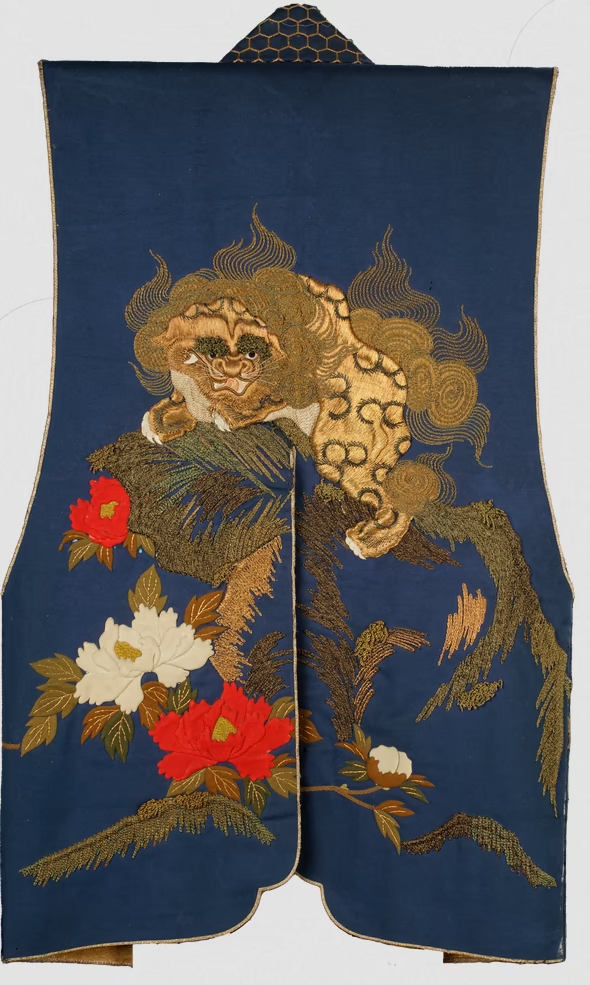
The collar and lapels of this Jinbaori show the Kikkōmon — the tortoiseshell pattern made up of hexagons that symbolises longevity. On the shoulder sections there is a shark-tooth or sawtooth pattern embroidered with gold threads on a red ground. The hems are decorated with gold borders. The lining consists of gold silk fabric with stylised flowers. Together, these elements form a dense web of meaning: Buddhist auspicious signs on the back, longevity patterns on the collar, symbolism of martial strength on the shoulders. A Jinbaori of this complexity was a personal statement — at once pious, art-loving and militarily self-confident.
Politically charged Jinbaori are particularly valuable for historiography. They show how clothing in the Edo period served to communicate complex political relationships. As a Tozama Daimyō — that is, as a clan that had only gone over to the Tokugawa side after Sekigahara — the Hachisuka clan had to stage its loyalty in the Pax Tokugawa with particular care. A Jinbaori bearing both crests is an object of compromise: the clan’s own history is not denied (the Toyotomi crest remains visible), but the Manji crest of the Hachisuka themselves dominates in size, placement and number of instances.
Other recurring motifs on Jinbaori are dragons (for power and imperial connotations), waves (for endurance), cherry blossoms (for the transient beauty of samurai life) and bamboo (for flexibility and strength of character). An experienced observer could read these motifs not only in isolation but also in combination. The semiotic density of a high-quality Jinbaori was comparable to the European heraldic tradition — with the difference that it was far less formally codified and offered greater scope for individual design.
From Object of War to Work of Art — The Edo-Period Evolution
The Pax Tokugawa (1615–1868) changed every dimension of samurai culture, including the Jinbaori. In the first century of Tokugawa rule, the practical field Jinbaori of the Sengoku tradition continued to exist; many clan houses preserved them as mementos and displayed them on important occasions. But new Jinbaori were increasingly made according to different criteria. The military function receded; the ceremonial function came to the fore.
In the Sankin-kōtai processions — the system of alternate residence that obliged every Daimyō to travel regularly between his province and Edo — presentation was a central element. Hundreds, and in the case of the greatest Daimyō even thousands, of retainers marched in formalised ranks along the Tōkaidō and Nakasendō roads. At the head rode the Daimyō himself, dressed in his most magnificent equipment. A Jinbaori was part of this — but now no longer a plain field coat; instead, it was a ceremonial robe of the finest rasha or Chinese brocade silk, embroidered with gold threads and set with rare fittings.
At the same time, secondary Jinbaori traditions developed. The large Edo-period cities — especially Edo itself, but also Osaka and Kyōto — were extremely fire-prone. The wooden and paper houses burned down at very short intervals; a single moment of carelessness could devastate entire districts. The fire brigades (Hikeshi) developed into highly specialised professional groups with their own uniforms. They wore so-called Hikeshi-Banten — fire-resistant garments that were conceptually similar to the Jinbaori, made of heavy, water-soaked fabrics and often painted or embroidered with striking motifs (dragons, tigers, waves). These Hikeshi-Banten are a direct further development of the Jinbaori form.[8]
In Kabuki theatre, in turn, the Jinbaori became a stage costume. Historical plays that portrayed the Sengoku period and its generals used Jinbaori as part of their actors’ samurai outfits. These stage Jinbaori were often even more elaborate than the genuine contemporary examples — they were meant to be visible from afar and to make a dramatic impression. At times the boundary between real clothing and theatrical prop became blurred; some actors became trendsetters whose Jinbaori designs were copied outside the theatre as well.
The hunts of the Tokugawa Shōguns and the great Daimyō — above all the falconry hunts in the parks around Edo — became further occasions on which Jinbaori were worn. Special motifs with hunting iconography emerged here: falcons, horses, deer, bamboo. The transition from military campaign to hunt, from military to ceremonial function, can be traced in detail in the design canon of the Jinbaori over the 265 years of the Edo period.
A further line of development led to the Jinbaori as a pure art object. The passion for collecting among wealthy samurai and rich merchants (especially in Osaka) created demand for exceptional pieces — Jinbaori made as display pieces without any direct functional purpose. Such objects often display the highest level of craftsmanship: perfect gold embroidery, the rarest imported materials, the most elaborate motifs.
The End, the Afterlife, the Museum
With the Meiji Restoration of 1868, the use of the Jinbaori as samurai clothing came to an end in a very direct sense. The abolition of the samurai class, the introduction of Western military uniforms on the Prussian and French model, the sword ban of 1876 — all these measures brought an institutional end to traditional samurai equipment. Jinbaori lost their function. The great clan collections of the Daimyō houses were partly broken up, partly transferred to private collections and partly placed in newly founded museums.
The firefighters’ Jinbaori tradition lived on for a few more decades in the specialised fire brigade corps of the urban districts, but it too was displaced when the Japanese fire service was modernised along Western lines. By the early 20th century, Jinbaori existed almost exclusively as historical artefacts in museums and private collections.
The internationalisation of Japanese samurai cultural heritage from the 1870s onwards meant that many of the finest Jinbaori found their way into European and American collections. Dealers such as Siegfried Bing in Paris, the Victoria and Albert Museum in London, and later the major American institutions in Boston, New York and Chicago — all of them built up holdings of Japanese textiles and armour components in which Jinbaori were prominently represented. Japanese cultural heritage was thus, paradoxically, both weakened (by the massive export) and strengthened (by the international visibility of the surviving examples).
The Samurai Museum Berlin takes its place in this tradition of Western samurai collections — with a specific focus on the combination of armour, weapons and accompanying clothing that reconstructs the military world of the Japanese warriors in its entirety. The Jinbaori in the collection each cover a different aspect of the Jinbaori tradition: the command function, political coding, iconographic density, simple representation. Together they form a richly detailed picture of this form of clothing — a dimension of samurai culture that is often underrepresented in popular perception, yet was an inseparable part of the concrete everyday world of the Sengoku and Edo warriors.
Today, several historical processes can be studied at once in surviving Jinbaori. The global interconnectedness of the early modern period. Political communication through crests. Iconographic density. Social hierarchy as luxury consumption. The development of craftsmanship in embroidery, appliqué and lacquering on textiles. A single Jinbaori can display all these dimensions — provided the observer knows what to look for.
Conclusion: A Coat as a Nexus of Cultural History
The Jinbaori is not a mere garment. It is a dense nexus of cultural history at which global trade, military practice, aesthetic tradition and political communication intersect. A Sengoku-period rasha Jinbaori documents the fact that the supposedly isolated samurai world was deeply embedded in international flows of goods — with wool from Flanders, silks from China, dyes from South America, and trade routes that connected Lisbon and Amsterdam with Nagasaki.
The development of the Jinbaori from a practical field camp jacket to a ceremonial robe of state mirrors the transformation of Japanese warrior culture as a whole: from active combat to symbolic representation, from battlefield to audience hall, from functional object to work of art. In this sense, the Jinbaori is an ideal object of study for understanding the long developmental curve of the samurai class — from the civil wars of the Sengoku era to the end of the Edo period.
Anyone who looks at a Jinbaori should therefore never see only the garment. They should recognise the looms of Flanders, the Dutch trading ships off Dejima, the workshops of the Edo master embroiderers, the ceremonial processions of the Sankin-kōtai, the Buddhist legends of Mount Tiantaishan, the political calculations of the Tozama Daimyō and — not least — the body warmth of the samurai who wore the coat over his armour on a rain-soaked October night, perhaps just as he was planning the next morning’s battle. All of this lies within a single object — if one knows how to read it.
Frequently Asked Questions
What is a Jinbaori?
The Jinbaori (陣羽織) is a sleeveless outer garment worn by samurai over their armour. It emerged in the 16th century and originally served as protection against the weather in the field camp and on the battlefield. The word literally means “field camp jacket”. In the Edo period (1615–1868), the Jinbaori developed into a ceremonial robe of state worn at Sankin-kōtai processions, hunts and audiences.
What material was a Jinbaori made of?
Among other materials, they were made from imported European wool (rasha) — a coarse woollen cloth that the Portuguese and later the Dutch brought to Japan. There were also Jinbaori made of brocade, silk, velvet and combinations of different fabrics. Rasha was a luxury good in Japan that only wealthy samurai could afford.
Why did samurai wear a Jinbaori?
Three main reasons: first, weather protection against rain and cold on the battlefield. Second, command marking — a Jinbaori bearing a family crest made the wearer identifiable on the battlefield and supported troop leadership. Third, the representation of status and wealth, especially at meetings with other Daimyō and in ceremonial contexts.
What do the motifs on a Jinbaori mean?
The motifs were iconographically charged and referred to religious, political or genealogical associations. Family crests marked clan membership. Dragons stood for power, phoenixes for rebirth, Shishi lions for Buddhist protection, peonies for prosperity, hexagonal patterns (kikkōmon) for longevity. An experienced observer could read a Jinbaori like a text.
What is the difference between a Sengoku and an Edo Jinbaori?
Sengoku Jinbaori (before 1615) were primarily functional field garments — weatherproof, robust, with a clear command function. Edo Jinbaori (1615–1868) increasingly became ceremonial robes of state, often with elaborate gold embroidery and rare imported materials. With the end of the great battles, the Jinbaori shifted from a military to a ceremonial function.
What is rasha?
Rasha (羅紗) is a coarse woollen cloth of European origin that was imported into Japan by Portuguese and later Dutch traders from the mid-16th century onwards. The word derives from the Portuguese raxa. Since there was no sheep farming in Japan, wool was an exotic and very expensive import. Rasha became the preferred material for the most magnificent Jinbaori of the samurai.
Visit the Samurai Museum Berlin
In its permanent exhibition, the Samurai Museum Berlin presents an outstanding selection of Jinbaori documenting various aspects of this clothing tradition. The collection allows visitors to study the full range of the Jinbaori tradition at first hand — an opportunity that is rare in Europe.
Related Articles
- Tōsei Gusoku: The Bulletproof Armour of the Sengoku Era
- Kabuto: The Helmet of the Samurai
- Dō: The Cuirass of the Samurai
- Japanese Swordsmithing: From Tamahagane to the Finished Sword
- Daishō: The Pair of Swords as a Symbol of the Samurai Class
- Battle of Sekigahara 1600
- Tokugawa Ieyasu: The Last Unifier of Japan
Sources and Further Reading
This article is based on academic research, primary sources and the expert catalogues of the Samurai Museum Berlin. All cited works are documented in the complete bibliography of the knowledge hub.
Primary Sources
- [1] Samurai Museum Berlin (2025). SMB Catalogue 2025 — Jinbaori and Samurai Textiles. [Used: C27V_29 Shishi Jinbaori, C36V_34 Hachisuka Jinbaori, C35V_33 Katō Jinbaori, C05H_11 Obata Jinbaori with Gunbai]
Secondary Literature
- [2] Bottomley, Ian; Hopson, A.P. (1988). Arms and Armor of the Samurai. Crescent Books. [Used: Jinbaori typology, rasha wool, function on the battlefield]
- [3] Absolon, Trevor (2017). Samurai Armour Vol. I: The Japanese Cuirass. Osprey Publishing. [Used: Jinbaori in the context of Sengoku armour, command marking]
- [4] Turnbull, Stephen (2005). Warriors of Medieval Japan. Osprey Publishing. [Used: field camp practice, signalling systems on the battlefield, Sashimono/Gunbai/Jinbaori combination]
- [5] Hall, John Whitney (ed.) (1991). The Cambridge History of Japan, Vol. 4: Early Modern Japan. Cambridge University Press. [Used: Sankin-kōtai system, Sakoku policy, Dutch trade via Dejima]
- [6] Totman, Conrad (2005). A History of Japan. Blackwell. [Used: global trade interconnections of the early modern period, Meiji transformation]
- [7] Cooper, Michael (ed.) (1965). They Came to Japan: An Anthology of European Reports on Japan, 1543–1640. University of California Press. [Used: Portuguese and Dutch trade reports, European textiles in Japan]
- [8] Mason, Penelope (2005). History of Japanese Art. Prentice Hall. [Used: textile iconography, appliqué technique, gold embroidery in the Edo period]
Museum Catalogues and Expert Reports
- [9] Samurai Museum Berlin (2025). Exhibit Documentation — Jinbaori Collection. [Used: Hachisuka double-crest analysis, Shishi-peony iconography, Obata-Gunbai combination, Katō clan representation]
© Samurai Museum Berlin – All rights reserved
You might also like
The Katana: History, Forging Technique & 5 Myths Debunked
The Katana: History, Forging Technique & 5 Myths Debunked. What is really true about the most famous sword in the…
Read the article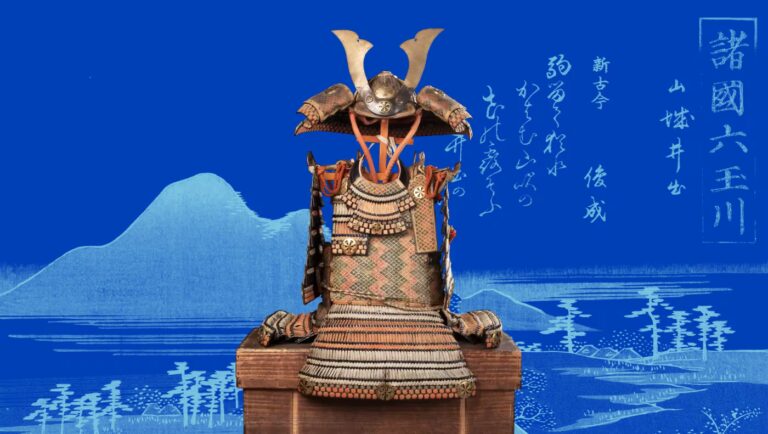
Ō-Yoroi: The Great Armour of the Heian Samurai
Ō-Yoroi – the great armour of the Heian samurai. Not decoration, but a machine for the mounted archer. History &…
Read the article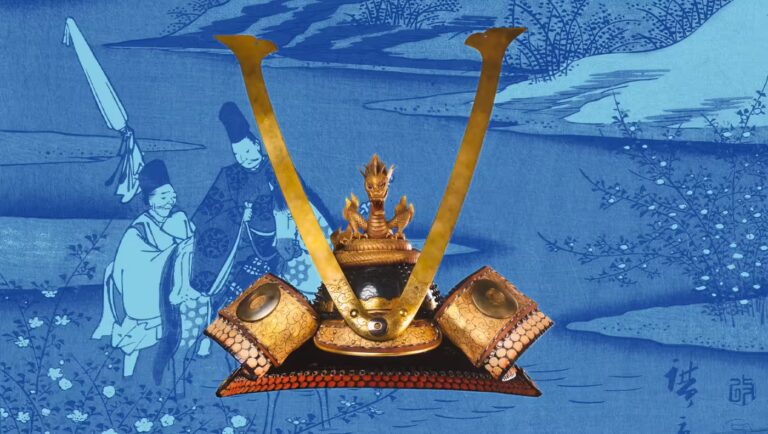
Kabuto: The Helmet of the Samurai – History & Construction
The kabuto – protection, identity, and work of art in one. History, anatomy & smithing traditions of the samurai helmet.…
Read the article