 Nominated for the EMYA2026 award

In the early morning of 21 October 1600, dense fog lay over a narrow valley basin in Mino Province. Two armies faced each other: some 160,000 samurai, ashigaru, archers and horsemen. From their hilltop positions, the commanders could barely make each other out. It was the largest field battle Japan had ever seen — and none of those present knew that within a few hours it would shape the country for the next 265 years.
At 8 o’clock the fog lifted. By midday the decision had been made. Tokugawa Ieyasu had won, Ishida Mitsunari was in flight, the Western Army was disintegrating. Three years later, Ieyasu assumed the title of shōgun. His dynasty ruled until 1868.
But anyone who understands the Battle of Sekigahara only as a military masterpiece misses the essential point. The historian Stephen Turnbull put it pointedly: Sekigahara was not a tactical duel, but a political one. Ieyasu won not through superior troop movements, but through letters, secret meetings and promises of betrayal that had been arranged weeks and months before the day of battle. When the volleys began, the outcome had already been sealed.
This article reconstructs the road to Sekigahara, the two coalitions, the course of the battle and its far-reaching consequences. It shows why Sekigahara is still regarded today as the birth of modern Japan — and why the popular narrative of the “decisive samurai battle” does not stand up to historical criticism on key points.
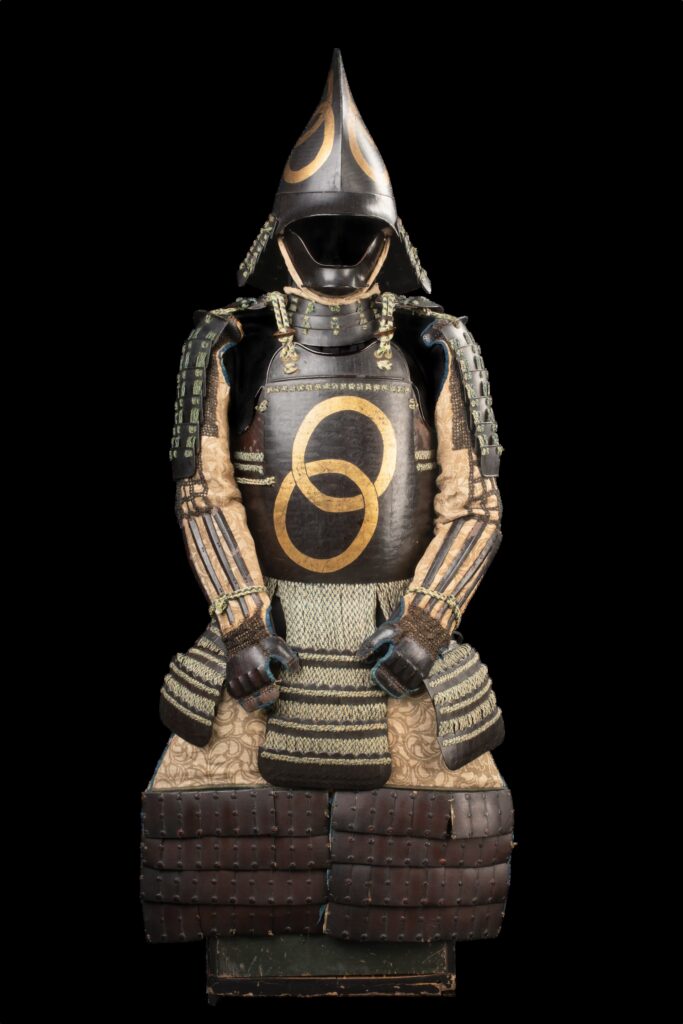
At the Samurai Museum Berlin, visitors can experience the armour of the generation that fought at Sekigahara — including a rare suit of armour of the Wakisaka clan, whose change of sides contributed to Ieyasu’s victory.
21 October 1600 — What Sekigahara Decided
The Battle of Sekigahara took place on 21 October 1600 — according to the lunar calendar then in use in Japan, on the 15th day of the 9th month of the year Keichō 5. The setting was a narrow valley basin about two kilometres wide, located in Mino Province (today Gifu Prefecture), at the junction of two of Japan’s most important highways: the Tōkaidō, which linked Edo with Kyōto, and the Nakasendō, which connected the same cities via the mountain route.[1]
The troop strengths made Sekigahara the largest field battle in Japanese history. Estimates by modern historians put the figures at around 88,000 men on the side of Tokugawa Ieyasu’s Eastern Army and about 82,000 men on the side of the Western Army under its nominal commander-in-chief, Mōri Terumoto — who, however, did not appear on the battlefield in person. The actual leadership of the Western Army lay with Ishida Mitsunari, a close confidant of the late Toyotomi Hideyoshi.[2]
Both armies, with their troops of almost 90,000 men each, were evenly matched throughout the battle. Tokugawa Ieyasu’s victory was finally secured when Kobayakawa Hideaki switched sides and attacked Mitsunari’s Western Army — and other lords followed him.[3] This single observation holds the key to understanding the battle: it was decided not by tactical superiority, but by a political change of sides at the critical moment.
Sekigahara marked the end of an era. Since the outbreak of the Ōnin War in 1467, Japan had lived through 133 years of almost uninterrupted civil war — the Sengoku period, the Age of Warring Provinces. Oda Nobunaga had initiated unification, Toyotomi Hideyoshi had continued it. After Hideyoshi’s death in 1598, the work threatened to fall apart. Sekigahara was the moment that decided whether Japan would fall back into an era of civil wars or come to rest under a new dynasty. The result was the Pax Tokugawa — 265 years of domestic peace under an isolationist military government.
The Road to Sekigahara — Power Vacuum after Hideyoshi’s Death
Toyotomi Hideyoshi died on 18 September 1598 in his castle at Fushimi. His legacy was a fragile construct. He had unified Japan, ended the Sengoku wars and, with his two unsuccessful invasions of Korea (1592 and 1597), exhausted the samurai class. But his only son and heir, Toyotomi Hideyori, was only five years old at the time. Hideyoshi knew that an underage heir in a society that had only just overcome a civil war would not survive without strong protection.[4]
His attempted solution was a system of collective regency. Five of the most powerful daimyō were appointed regents (Go-Tairō): Tokugawa Ieyasu, Maeda Toshiie, Mōri Terumoto, Ukita Hideie and Uesugi Kagekatsu. Below them were five civil administrators (Go-Bugyō) — among them Ishida Mitsunari, a long-standing personal confidant of Hideyoshi with administrative but limited military talent. The arrangement was meant to prevent abuse of power through mutual control. It did not work for even two years.
At 57, Ieyasu was the oldest and politically most experienced of the five regents. He had fought at Nobunaga’s side at the Battle of Nagashino (1575), secured the eastern provinces under Hideyoshi and built up his power base in Edo on the Kantō plain. When Maeda Toshiie died in the spring of 1599, the anti-Ieyasu faction lost its most important dissenting voice on the council of regents.
Ishida Mitsunari watched these developments with growing alarm. He was the most prominent advocate of the young Hideyori’s interests and a symbol of loyalty to the Toyotomi. But Mitsunari was personally unpopular. Many of Hideyoshi’s veteran generals — including Fukushima Masanori and Katō Kiyomasa, two of the former Shichi-hon-yari of Shizugatake — had fallen out bitterly with him during the Korean campaigns. They regarded him as a desk-bound bureaucrat who had belittled their military achievements. When open conflict broke out between Ieyasu and the Toyotomi faction, these combat veterans defected to Ieyasu — not out of love for the Tokugawa, but out of hatred for Mitsunari.
The outbreak came in the summer of 1600. Uesugi Kagekatsu, ruler of Aizu in the north-east, refused to account to the council of regents, which was interpreted as a declaration of war on Ieyasu. Ieyasu marched north-east with a large army. During his absence, Mitsunari seized the opportunity, assembled an anti-Ieyasu coalition and declared Ieyasu a rebel against the House of Toyotomi. Many historians suspect that Ieyasu had deliberately provoked this reaction — the Aizu campaign would have served him as a pretext to lure his opponents into a hasty offensive. Deliberately or not: Ieyasu turned around, marched back westwards, and the two coalitions moved along the two great military roads towards a crossing point in Mino — towards Sekigahara.
The Two Coalitions — East against West
The terms Eastern Army and Western Army refer to the geographical distribution of the daimyō territories involved. The Tokugawa alliance recruited mainly from the eastern provinces around Edo and the central territories along the Tōkaidō. The coalition loyal to the Toyotomi relied on the western provinces, including Mōri lands in Chūgoku, Shimazu Satsuma in the south and the Ukita possessions around Okayama.[6]
The Eastern Army under Tokugawa Ieyasu was considerably more coherent politically. Its core group consisted of the Tokugawa vassals, who had been organised in fixed hierarchies for decades — the Fudai daimyō, loyal since the early Sengoku days. They were joined by the battle-hardened Hideyoshi generals who hated Mitsunari: Fukushima Masanori, Katō Kiyomasa (both from the circle of the Shichi-hon-yari), Kuroda Nagamasa, Hosokawa Tadaoki and Asano Yoshinaga. A special case was Date Masamune, the “One-Eyed Dragon of Oshu” — an ambitious daimyō from the north-east who had concluded a private pact with Ieyasu and promised to tie down the Uesugi in the rear.
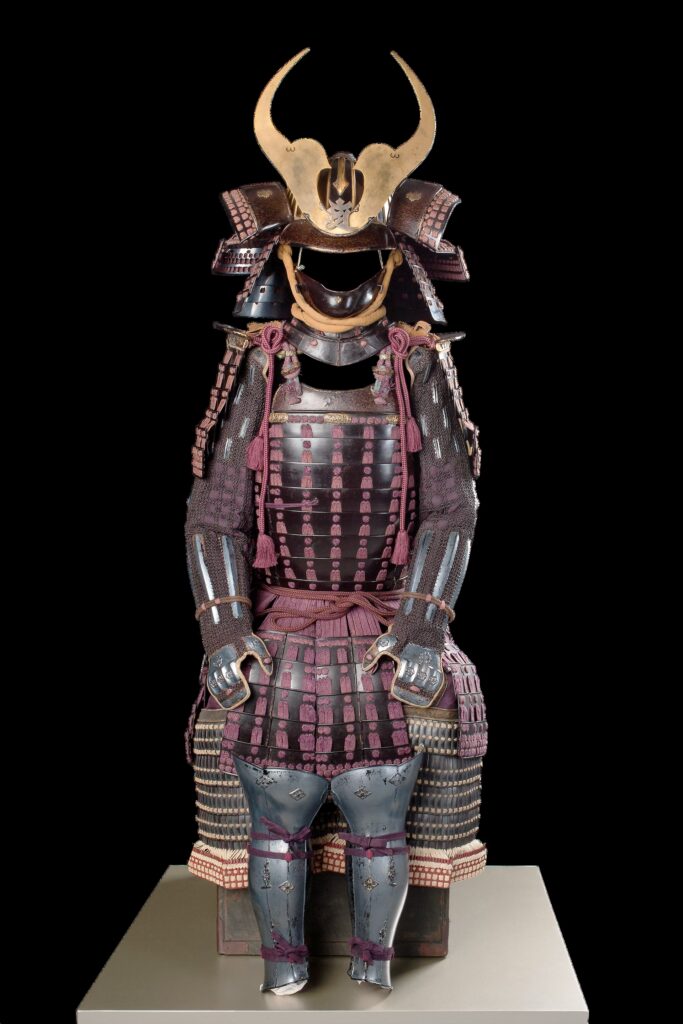
The Western Army was a fragile coalition. Nominally, Mōri Terumoto stood at its head, one of the five regents and lord of a realm of around 1.2 million koku in western Chūgoku. But Terumoto did not appear on the battlefield. He remained in Osaka, officially to protect the young Hideyori, but in truth also out of uncertainty about the outcome. Actual command lay with Ishida Mitsunari and his closest ally, Ukita Hideie. They were joined by Konishi Yukinaga (a Christian and Korea veteran), Ōtani Yoshitsugu (Mitsunari’s closest friend, suffering from leprosy), Shimazu Yoshihiro (leader of Satsuma, politically ambivalent) and numerous smaller daimyō.
On the periphery of the Western coalition stood the waverers — daimyō whose loyalty had already been compromised by the time of the battle. Kobayakawa Hideaki, at 23 the youngest daimyō, was closely connected to the Toyotomi family through his aunt Nene. He had served in the Korean campaign and had fallen out with Mitsunari. For weeks he had been in secret correspondence with Ieyasu. Kikkawa Hiroie, nephew of Mōri Terumoto, had likewise already made arrangements with the Eastern side — during the battle he would simply not intervene, even though he occupied a key position in the south. Wakisaka Yasuharu, one of the former Seven Spears of Shizugatake, had also signalled his willingness to switch sides.
This instability of the Western Army is no accident of the historical record. Ieyasu had built it up systematically. For him, the months between May and October 1600 were a phase of intensive letter diplomacy. Messengers travelled back and forth between Edo and a large number of daimyō residences, carrying sealed letters, promises, threats and concrete offers: allocations of land after a victory in return for neutrality or a change of sides at the decisive moment. In a certain sense, the military confrontation at Sekigahara was thus merely the staging of a decision that had long since been made in political correspondence.[7]
The armour is distinguished by a rare Hakeme lacquer finish — a brush-pattern technique that was drawn with a comb into the still-wet layer of lacquer and was hardly ever used during the Sengoku period. Wakisaka armours are considered the only known examples of this variant. More than a dozen were probably made for clan members before the Battle of Sekigahara; only a few have survived.[8] On that October morning, Wakisaka Yasuharu initially fought for the Western Army — and switched sides at midday.
The Battle — 21 October 1600, from 8 a.m. to Midday
During the night before 21 October, both armies marched into the valley basin. Heavy autumn rain had softened the ground, and when the rain eased, dense fog rose over the valley. The commanders on both sides could barely make out their own flanks; patrols repeatedly ran straight into each other in the darkness without reacting immediately.
Mitsunari had positioned his main forces on the northern edge of the valley, with his command post on Sasao-san. From there he could survey the front. Ukita Hideie stood at the centre of the Western Army, flanked by Konishi Yukinaga and Ōtani Yoshitsugu. On Mount Matsuoyama, south-east of the battlefield, were encamped the 15,000 men of Kobayakawa Hideaki — officially part of the Western Army, unofficially already in a pact with Ieyasu. Ieyasu himself took up his command position to the south of it, on a hill that later bore the name Momokubari-yama.
At around 8 o’clock the fog lifted. The first documented action came from the Eastern Army: Fukushima Masanori launched a frontal attack on Ukita Hideie’s positions. Masanori, one of the Shichi-hon-yari, had a personal motive — he wanted to bring Mitsunari down before his own eyes. The attack met massive resistance. The Ukita troops were roughly equal in number, held the better ground and were initially able to repel Masanori’s advance.[10]
Over the following hours, fierce close combat unfolded across the entire breadth of the front. The battle followed the typical pattern of the late Sengoku period: teppō ashigaru opened with musket volleys, yumi ashigaru provided support with archery, then the yari pike blocks clashed. Samurai cavalry struck at the flanks, where the infantry lines grew thinner. Nowhere did either side achieve a decisive breakthrough. By around 11 o’clock both armies had suffered heavy losses, but the front lines held.
Then came the moment Ieyasu had been waiting for for weeks. Kobayakawa Hideaki on the Matsuoyama did not move. Although his position would have allowed him to break into the exposed flank of the Eastern Army and decide the battle in favour of the Western Army, he watched events idly. His 15,000 men were numerically one of the largest individual contingents on the field — a strategic weight that would have carried either side to victory.
According to an account found in several contemporary chronicles, Ieyasu lost patience. He ordered a small detachment of teppō ashigaru to fire on the Kobayakawa positions — on his own supposedly allied troops. The musket volley was meant as a signal: an ultimate “Decide now.”[11] Hideaki decided. He ordered the attack — not on the Eastern Army, however, but on Ōtani Yoshitsugu’s Western troops in the centre.
The betrayal triggered a chain reaction. Ōtani, who had probably seen Hideaki’s change of sides coming, had aligned his troops accordingly and was able to parry the first attack. But a few minutes later further defections followed: Wakisaka Yasuharu, Kutsuki Mototsuna, Ogawa Suketada and Akaza Naoyasu — four smaller daimyō of the former Western Army — also switched sides and attacked Ōtani from the rear. Ōtani’s troops disintegrated; the gravely ill commander committed seppuku rather than be taken prisoner.
With that, the Western Army was broken. Konishi Yukinaga’s line crumbled next, and Mitsunari’s centre fell into panic. The Shimazu under Yoshihiro carried out a heroic retreat — they cut through the Eastern Army in a direct thrust and escaped towards Satsuma with a fraction of their troops. Mitsunari himself fled into the mountains; he was captured three days later, taken to Kyōto and publicly executed on 6 November together with Konishi Yukinaga and Ankokuji Ekei, another Western leader.
Around midday — about four hours after the fighting began — the largest field battle in Japanese history had been decided. According to modern estimates, total losses amounted to around 30,000 dead on both sides combined, most of them in the Western Army after its collapse.
Why Ieyasu Won — Politics Instead of Tactics
The retelling of the battle suggests an explanation that has been gaining acceptance in the academic literature for decades: Sekigahara was not a tactical decision, but a political one.[12] Ieyasu did not win because his generals planned the battle better, because his troops fought with greater discipline or because his position was topographically more favourable. He won because, before the first musket shot, he already knew that Kobayakawa Hideaki, Wakisaka Yasuharu, Kikkawa Hiroie and at least four other prominent Western commanders would switch sides or remain idle once the fighting began.
Stephen Turnbull puts it clearly in his overall account of samurai military history: the decisive battle of 1600 was not a tactical masterpiece, but a political one. Ieyasu won not through troop movements, but through the betrayal of Kobayakawa Hideaki, which he had arranged before the battle.[13] This assessment is no revisionist fringe view — it reflects the consensus of modern Japanese and Western research on Sekigahara.
Three structural advantages made this political strategy work in the first place. First: Ieyasu was by far the most experienced politician of his generation. As a boy he had served under the Imagawa, then as Nobunaga’s equal partner, then as Hideyoshi’s regent. Sixty years of observation and manipulation had made him a master of daimyō diplomacy. Mitsunari, on the other hand, was a brilliant administrator, but a political amateur. He did not see the dislike he had provoked among many daimyō as a risk to his plans, but regarded it as a personal injustice that he could overcome through a formal claim to Toyotomi loyalty.
Second: Ieyasu had enormous material resources at his disposal for bribery. Promises of land after a victory were the currency of Sengoku diplomacy. With a base of 2.5 million koku of his own and the prospect of redistributing confiscated Western lands, Ieyasu could hold out realistic rewards. Many of those who switched sides had precise assurances before Sekigahara as to which provinces would fall to them. These assurances were honoured after the battle with remarkable precision.
Third: Ieyasu had the luck — or the calculation — of favourable timing. Hideyoshi’s death was only two years in the past, Hideyori was still a child. The Korean campaigns had exhausted and embittered the Sengoku veterans. Many daimyō simply wanted peace and economic recovery — and Ieyasu could promise this peace more credibly than Mitsunari, whose victory would have meant a continuation of the Toyotomi rivalries.
That does not mean that the battle was tactically unimportant. The Eastern Army had to hold its positions until Kobayakawa’s change of sides came. Fukushima Masanori’s aggressive frontal attack on Ukita Hideie was not a matter of course — it tied down the Western Army and prevented Mitsunari from staging a tactical relief operation. The deployment of the teppō ashigaru was also decisive: after the experience of Nagashino (1575), every side knew that superior firepower decides battles. Both coalitions had fielded large numbers of matchlock guns, and the noise of the gunfire is said to have been audible in the surrounding villages. After the first exchange of musket fire, close combat with the yari was decisive — the classic sequence of late Sengoku tactics, which is described in detail in the article on the yari.[14]
The Consequences — From Victory to the Pax Tokugawa
The redistribution of landholdings after Sekigahara was the largest in Japanese history. In total, around 6.3 million koku were confiscated and redistributed. 87 daimyō families of the Western side lost all their land, and a further 34 were considerably reduced. The Eastern allies were rewarded in return, some of them dramatically: Fukushima Masanori received Hiroshima (around 500,000 koku), Katō Kiyomasa Kumamoto, Kuroda Nagamasa Fukuoka. Date Masamune received the territorial gains in the north-east that he had hoped for.[16]
Ieyasu restructured the daimyō hierarchy. He divided the daimyō into three categories that remained in place until the end of the Tokugawa shōgunate in 1868. Shinpan were daimyō from the direct Tokugawa family, especially the gosanke (the three houses of Owari, Kii and Mito). Fudai daimyō were those families who had already been loyal to Ieyasu before Sekigahara — they were favoured and later provided most of the shōgunate’s ministers. Tozama daimyō — literally “outsiders” — were the former Western allies who only submitted to the new regime after their defeat. They often retained very large territories, but were systematically kept away from positions of power in the bakufu and were subject to special controls.
This threefold division was a brilliant instrument of stability — and at the same time the seed of its downfall. The Tozama domains of Satsuma (Shimazu), Chōshū (Mōri) and Tosa (Yamauchi) in western Japan remained a latent opposition to the Edo regime for centuries. 268 years after Sekigahara, it was to be precisely these clans that, under the slogan “Sonnō Jōi” (Revere the Emperor, Expel the Barbarians), overthrew the Tokugawa shōgunate and led the Meiji Restoration of 1868. The resentment over the defeat of 1600 was passed down over a quarter of a millennium — one of the long chains of Japanese history.
Ieyasu himself waited another three years after Sekigahara before taking the decisive step. On 24 March 1603, the emperor appointed him Seii Taishōgun — the “Great General Who Subdues the Barbarians”. He established his court in Edo, and within a few decades the small fishing settlement grew into one of the largest cities in the world.[17] Craftsmen, merchants and artists streamed into the new capital; the infrastructure of the Sankin-kōtai processions, the daimyō’s obligation of alternate residence at the Edo court, secured both political control and a permanent economic exchange between the provinces and the centre.
But Sekigahara was not the final end of the Sengoku era. Toyotomi Hideyori was still alive — by now a young man in his Osaka Castle, with his own vassals, his own wealth and his own claim to recognition. As long as he existed, Tokugawa rule remained open to challenge. The winter and summer sieges of Osaka in 1614 and 1615 — in the latter, the legendary Sanada Yukimura fell in battle — brought the final decision. With the burning of Osaka Castle in the summer of 1615, the last great chapter of the Sengoku wars came to an end.
Between 1600 and 1615, Ieyasu had also positioned his son Hidetada as his political successor. As early as 1605, only two years after his appointment as shōgun, Ieyasu abdicated in favour of Hidetada. As Ōgosho (retired shōgun), he remained the de facto ruler until his death in 1616, but the ritual of the formal handover secured dynastic continuity. Fifteen Tokugawa shōguns followed. The dynasty only ended in 1867 with the resignation of the last of them, Tokugawa Yoshinobu, under pressure from the Meiji movement.
Sekigahara Today — Battlefield, Culture of Remembrance, Museum
Anyone who wants to visit Sekigahara today will find a small town of around 7,000 inhabitants in Gifu Prefecture, which can be reached in a few hours from Kyōto or Nagoya on the JR Tōkaidō Line. The historic battlefield is largely preserved: an open valley basin between wooded hills, crossed by farm tracks and rice fields. The original command positions are marked with stelae. Sasao-san, Mitsunari’s headquarters, bears a memorial plaque; Ieyasu’s position on Momokubari-yama is marked, as are Kobayakawa’s positions on the Matsuoyama. A hiking trail connects the most important points and can be walked in about three to four hours.
Since 2020, the town has been home to the Gifu Sekigahara Battlefield Memorial Museum, which presents the battle using modern exhibition technology. Numerous other smaller memorial sites — temples, archery shrine complexes and graves — commemorate individual commanders. Sekigahara tourism has become a fixed part of regional identity; every October, commemorative processions take place with hundreds of participants in samurai armour.
The memory of Sekigahara has changed over the centuries. In the Edo period, official historiography was pro-Tokugawa: Ieyasu appeared as Hideyoshi’s rightful successor, Mitsunari as a misguided troublemaker. This portrayal dominated until the Meiji Restoration. With the fall of the shōgunate in 1868, the picture was partly reversed — the new Meiji elites, many of them from the former Tozama domains of Satsuma and Chōshū, had little interest in glorifying the Tokugawa. Mitsunari was increasingly portrayed as a loyal samurai who had fallen for the legitimate rule of the Toyotomi.
Today, the historiographical consensus is closer to Turnbull’s political reading. Contemporary popular culture, however, has often placed the emphasis elsewhere. James Clavell’s novel Shōgun (1975) and the TV adaptations based on it, most recently the highly acclaimed FX series of 2024, depict the period immediately after Hideyoshi’s death with a fictionalised Ieyasu figure called “Toranaga”. Video games such as the Samurai Warriors series (Koei Tecmo) make Sekigahara one of their central settings. The Japanese feature film Sekigahara (2017) attempted to bring the battle to the screen with historical accuracy — with mixed success among critics and at the box office.
Despite all its media presence, some misconceptions persist stubbornly in popular reception. Sekigahara is often presented as “Japan’s greatest military masterpiece”, which does not do justice to the historical reality of a battle decided politically in advance. The role of betrayal is either glorified (Kobayakawa as a “clever pragmatist”) or demonised (Kobayakawa as a “defiler of samurai honour”) — both projections of later eras. A historically appropriate portrayal must see both: the genuine uncertainty of all those involved in the weeks before the battle, and Ieyasu’s cold-blooded calculation, which drew a structural advantage from this uncertainty.
Five Myths about Sekigahara — and What Is Really True
Hardly any battle in Japanese history has been retold as often as Sekigahara, and hardly any is so systematically distorted in popular accounts. Five widespread myths are worth correcting.
Myth 1: “Sekigahara was a surprising, short battle.” The fighting did indeed last only four to five hours, and the troops only reached the valley basin in the hours before dawn. This tempts one to assume that it was an improvised collision. In fact, Sekigahara was the result of months of strategic preparation. Ieyasu’s Aizu campaign, his march back, the positioning of the Eastern Army along the Tōkaidō, the correspondence with potential defectors — from the summer of 1600 at the latest, all of this formed an interlocking system of political and military operations, at the end of which the battle stood as the release.
Myth 2: “Kobayakawa Hideaki’s betrayal was spontaneous.” Popular accounts often paint the picture of a young, indecisive daimyō who only switched sides at the last second under the pressure of the battle and Ieyasu’s signal shot. The sources argue against this. Hideaki had been in secret correspondence with Ieyasu for weeks. That he hesitated at first is probably not due to a crisis of loyalty, but to a simple question of timing: he wanted to switch sides at a point when victory was already plausible — in order to gain the greatest possible political credit without being left isolated in the event of a possible defeat for Ieyasu. The famous signal shot — if it took place in that form at all — was not a wake-up call, but an ultimatum.[18]
Myth 3: “Ieyasu was militarily superior.” In terms of numbers, the two armies were almost evenly matched. Topographically, the Western troops even had advantages: Mitsunari’s position on Sasao-san was higher, his central position was better protected, and the Western Army could have built up an enveloping formation had it acted in unison. Ieyasu’s decisive advantages were not military in nature, but political and organisational: the more coherent leadership, the more motivated group of veterans, the greater firepower among the teppō ashigaru and, above all, the defections that had already been arranged.
Myth 4: “The battle decided Japan’s future immediately.” Sekigahara was a necessary but not a sufficient condition for the Tokugawa dynasty. As long as Toyotomi Hideyori was alive and gathering vassals and resources in Osaka Castle, Ieyasu’s rule remained open to challenge. Only the sieges of Osaka in 1614 and 1615 — that is, fifteen years after Sekigahara — finally sealed the end of the Toyotomi option. Anyone who speaks of Sekigahara as the “birth of the Pax Tokugawa” ignores a decade and a half of continued uncertainty.
Myth 5: “Mitsunari was an incompetent commander.” Tokugawa historiography portrayed Mitsunari as an arrogant, tactically weak bureaucrat. More recent research corrects this picture. Mitsunari was a competent administrator and not a bad general; his positioning at Sekigahara was solid, his plan for an enveloping formation strategically sensible. His mistake was not military, but political: he underestimated the hostility he had provoked among Hideyoshi’s generals during the Korean campaigns, and he overestimated the binding force of formal Toyotomi loyalty compared with the daimyō’s real interest in a peaceful new beginning. That he paid for this miscalculation with his head is a consequence of Sengoku logic — not a consequence of his incompetence.[19]
Conclusion: Why Sekigahara Still Matters Today
This article began with the fog over a narrow valley basin in Mino. When it lifted, four hours began that were to shape Japan for 265 years. Anyone who wants to understand those hours must leave the field on which they took place. The battle was not decided in the valley of Sekigahara, but in the weeks and months before it, in sealed letters, secret messengers and calculated promises.
Ieyasu knew that. Over sixty years he had learned that military decisions are the crystallisation of political preparation. Nobunaga had innovated ruthlessly, Hideyoshi had unified through charisma. Ieyasu was the first of the three great unifiers to secure unification through institutions. His dynasty lasted longer than any other in Japanese history — not because the Tokugawa were particularly warlike, but because they systematically channelled, redirected and defused warlike energy.
The flip side of this stability was rigidity. The social order that Ieyasu cemented — samurai as a hereditary class of officials, peasants as the productive base, craftsmen and merchants in a strict hierarchy — suited the early 17th century. It no longer suited the 19th century, when Western steamships appeared off Uraga and the outside world turned its back on the Edo period. The Tozama daimyō who had lost at Sekigahara waited 268 years. Then they took over Japan.
That is perhaps the real lesson of Sekigahara: battles decide less than their myths would suggest. Ieyasu won in 1600, but the long-term losers — Satsuma, Chōshū, Tosa — won in 1868. The dynamic chain of transfers of power that led Japan from the Sengoku era via the Pax Tokugawa to Meiji modernisation is unthinkable without the pivotal point of Sekigahara. But Sekigahara alone does not explain it.
Frequently Asked Questions
When did the Battle of Sekigahara take place?
The battle took place on 21 October 1600 (according to the Japanese lunar calendar of the time, on the 15th day of the 9th month, Keichō 5). It lasted from about 8 a.m. until midday — around four hours. The location was a narrow valley basin in Mino Province, today the town of Sekigahara in Gifu Prefecture.
Who fought whom at Sekigahara?
The Eastern Army under Tokugawa Ieyasu (around 88,000 men) faced the Western Army under Ishida Mitsunari (around 82,000 men). The Eastern Army represented the Tokugawa faction and its allies; the Western Army was formally loyal to the House of Toyotomi around the underage Hideyori. Nominally, Mōri Terumoto stood at the head of the Western Army, but he did not appear on the battlefield in person.
Why did Tokugawa Ieyasu win at Sekigahara?
Ieyasu won primarily through political preparation, not through tactical superiority. In the weeks before the battle, he had made secret agreements with several Western Army commanders. When Kobayakawa Hideaki switched sides at midday and was followed by four other daimyō, the Western coalition collapsed. At the start of the battle, the military balance of power was almost even.
What does Sekigahara have to do with the shōguns?
Through his victory at Sekigahara, Tokugawa Ieyasu secured political supremacy in Japan. Three years later, in 1603, the emperor appointed him Seii Taishōgun, and he founded the Tokugawa shōgunate in Edo (today Tōkyō). Fifteen Tokugawa shōguns ruled until 1867 — a dynasty that lasted longer than any other military government in Japanese history.
Can you visit the battlefield today?
Yes. The town of Sekigahara in Gifu Prefecture can be reached from Nagoya on the JR Tōkaidō Line in about 40 minutes. The historic command positions are marked with stelae and connected by a hiking trail. Since 2020 there has been the Gifu Sekigahara Battlefield Memorial Museum, with a modern exhibition on the battle. Every October, commemorative processions take place with participants in samurai armour.
Visit the Samurai Museum Berlin
The armour and weapons of the Sekigahara generation can be studied in their original condition at the Samurai Museum Berlin. The Wakisaka armour, with its rare Hakeme lacquer technique, is one of the few surviving examples from the circle of those daimyō who switched sides during the battle. Together with further armour, swords and polearms of the late Sengoku period, it creates a detailed picture of the generation that decided Japan’s fate on 21 October 1600.
Related Articles
- Tokugawa Ieyasu: Japan’s Last Unifier
- Toyotomi Hideyoshi: From Peasant’s Son to Ruler of Japan
- Oda Nobunaga: The Demon King — History & Legacy
- Sanada Yukimura: Japan’s Bravest Warrior (1567–1615)
- Date Masamune: The One-Eyed Dragon of Oshu (1567–1636)
- Yari: The True Spear of the Samurai
- Tōsei Gusoku: The Bulletproof Armour of the Sengoku Era
- Shogun: The Military Rulers of Japan
Sources and Further Reading
This article is based on academic research, primary sources and the expert catalogues of the Samurai Museum Berlin. All cited works are documented in the complete bibliography of the knowledge hub.
Primary Sources
- [1] Samurai Museum Berlin (2025). SMB Catalogue 2025 — Arsenal, Armour & Historical Context. [Used: C23V_25 Battle of Sekigahara, C10V_16 Bottomley overview, C07V_13 Wakisaka armour, C09V_15 Iwai Masusaburō Takayuki]
- [2] Bottomley, Ian (SMB catalogue text). Toyotomi Hideyoshi, Tokugawa Ieyasu and the Unification of Japan. Samurai Museum Berlin (C10V_16). [Used: regency system, Ieyasu’s preparation of the way, Sekigahara context]
Secondary Literature
- [3] Turnbull, Stephen (1977). The Samurai: A Military History. Macmillan/Osprey. [Used: Sekigahara as a political decision, Kobayakawa’s betrayal, Tokugawa consolidation]
- [4] Turnbull, Stephen (2022). War in Japan 1467–1615. Osprey Publishing. [Used: Sekigahara as the largest samurai engagement, Ieyasu’s political manipulation, consequences for the Pax Tokugawa]
- [5] Turnbull, Stephen (2005). Warriors of Medieval Japan. Osprey Publishing. [Used: ashigaru tactics, use of firearms in the late Sengoku phase]
- [6] Hall, John Whitney (ed.) (1991). The Cambridge History of Japan, Vol. 4: Early Modern Japan. Cambridge University Press. [Used: institutional succession structures, land distribution after 1600, Shinpan/Fudai/Tozama system]
- [7] Totman, Conrad (2005). A History of Japan. Blackwell. [Used: long-term consequences of Sekigahara, Tozama daimyō as latent opposition, line to the Meiji Restoration]
- [8] Berry, Mary Elizabeth (1982). Hideyoshi. Harvard University Press. [Used: power vacuum after Hideyoshi’s death, regency system, causes of the escalation in 1600]
- [9] Conlan, Thomas D. (2022). Samurai and the Warrior Culture of Japan, 471–1877: A Sourcebook. Hackett Publishing. [Used: selection of primary sources, critical assessment of the Sekigahara tradition]
Museum Catalogues and Expert Reports
- [10] Samurai Museum Berlin (2025). Exhibit Documentation — Armour of the Sengoku Generation. [Used: Wakisaka armour C07V_13, Iwai fern armour for Ieyasu C09V_15]
© Samurai Museum Berlin – All rights reserved
You might also like
Heian Period: The Rise of the Warrior Class (794–1185)
The Heian period created the samurai. How provincial administrators became a warrior caste – and why the sword played hardly…
Read the article
Sanada Yukimura: Japan’s Bravest Warrior (1567–1615)
Sanada Yukimura defended Ōsaka against Tokugawa Ieyasu's army – and became an icon of the honourable last stand. History, myth…
Read the article
Kamakura & Muromachi: The First Shogunate and the Mongol Invasion (1185–1467)
The Kamakura shogunate, the Mongol wars, and the Muromachi bakufu: How Japan developed samurai rule between 1185 and 1467. Samurai…
Read the article