 Nominated for the EMYA2026 award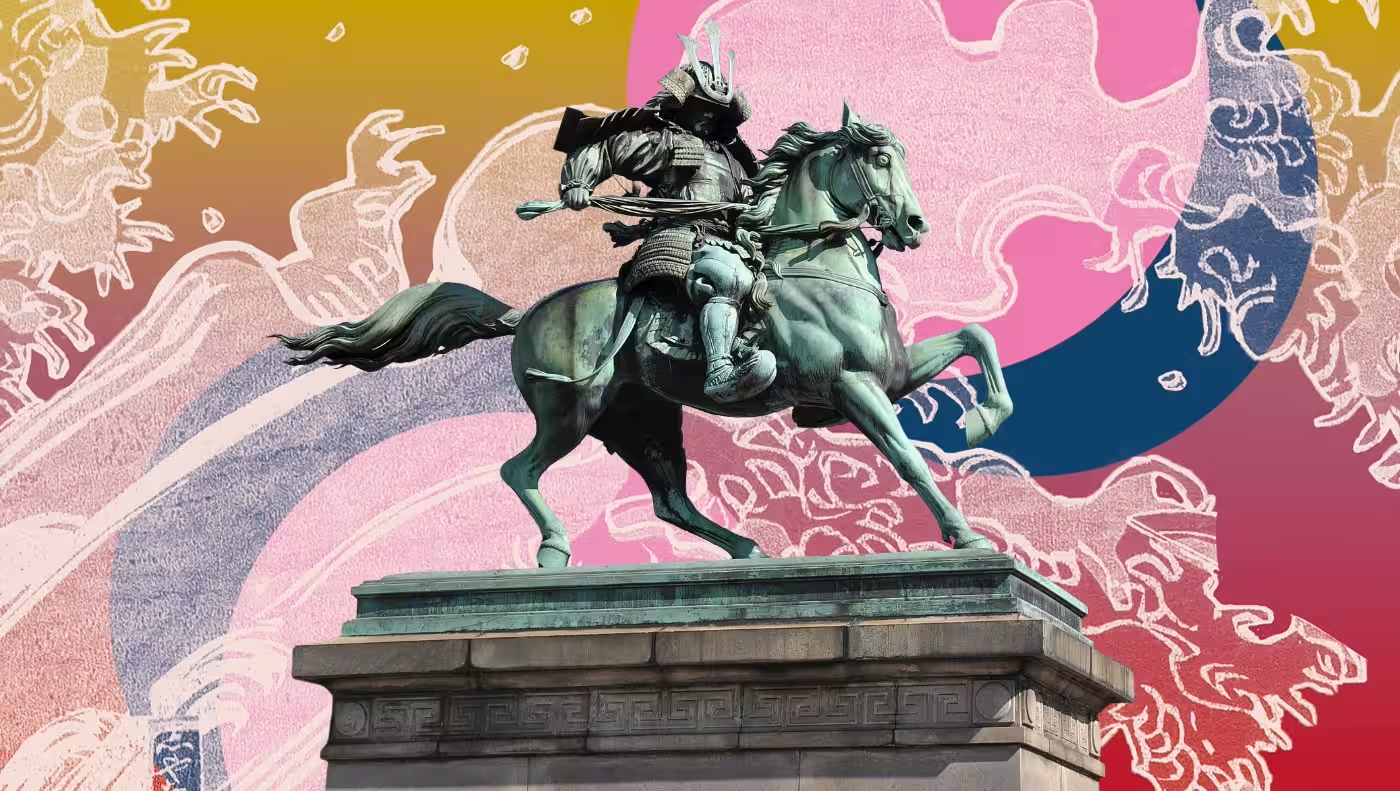
Kusunoki Masashige: The Warrior Who Chose the Death He Saw Coming
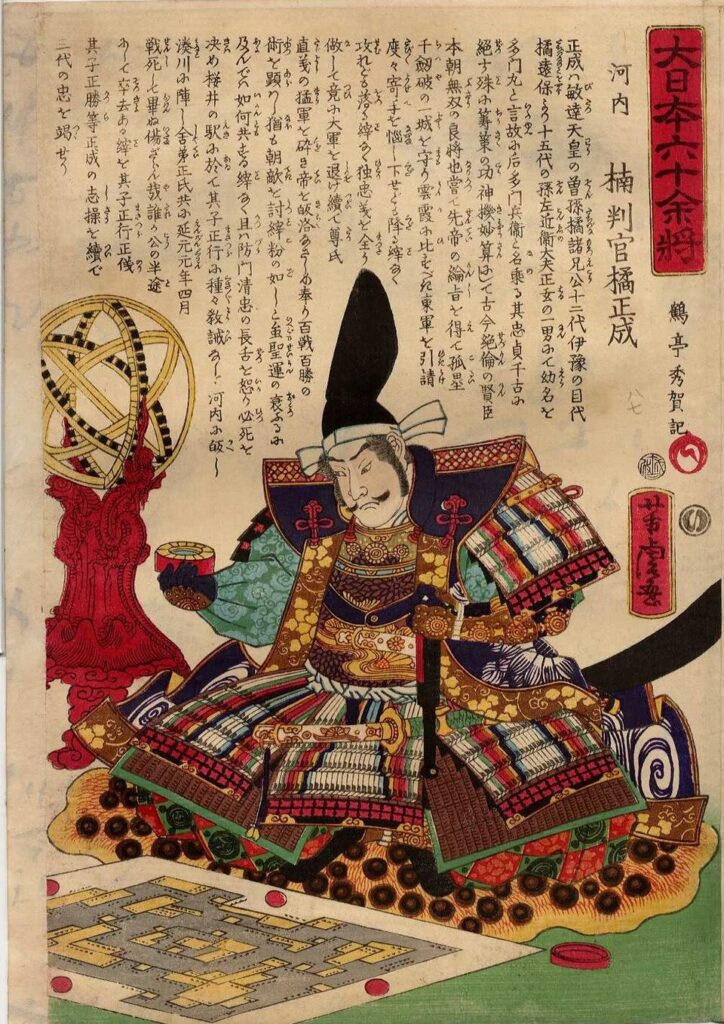
In early summer 1336, Kusunoki Masashige asked the emperor for an audience.
He had a request — more precisely, a strategic recommendation, formulated with the precision of a man who had been winning wars from a position of inferiority for years. He asked Emperor Go-Daigo to abandon the capital, move north and leave the enemy alone until time and geography were on their side again. Guerrilla warfare instead of a frontal battle. Patience instead of prestige.
The emperor refused.
Masashige bowed. Then he told his son Masatsura, eleven years old, that they would probably not see each other again in this life. He embraced him. Then he rode into defeat.
The Battle of Minatogawa on 5 July 1336 lasted all day. Masashige fought with 700 men against an army that — depending on the source — outnumbered him tenfold. In the end he was wounded and surrounded. He asked his brother Masasue to die the ritual death. “How many lives would you still have to fight for the emperor?” asked Masasue. “Seven,” Masashige is said to have answered. Shichishō hōkoku — seven lives for the fatherland. Then both died.
That was the man. The legend begins afterwards.
An Unknown Appears: Masashige’s Origins
We know almost nothing certain about Kusunoki Masashige’s origins.
He appeared in 1331 — not through noble birth, not through court rank, not with family crests going back generations. He appeared because Emperor Go-Daigo had begun an uprising against the Kamakura bakufu and desperately needed supporters. Masashige came forward. Where he came from, what his status was, whether he was a landowner or a provincial administrator or something in between — the sources are silent or contradict each other.
What he had was one ability: he could wage war without sufficient resources.
The Hōjō counterstrike against Go-Daigo’s rebellion was predictable and massive. Masashige withdrew with his men to the mountain fortress of Akasaka — a site that was too weak to withstand a serious attack. He held it for a month. Then, when its fall became inevitable, he disappeared. He set the fortress on fire as if everyone inside had died. Hōjō troops advanced and found ashes but no bodies.
Masashige was already gone, to build another stronghold.
This episode — improvised deception, faked death, rapid retreat and fresh start — became his tactical trademark. As Varley shows in his analysis of the Taiheiki, Masashige fought in a way that classical samurai chronicles explicitly marked as “dishonourable”: ambushes, night attacks, feints. He understood that his enemy was stronger — and that a fair fight was a lost fight.[1]
That makes him historically interesting. It also makes him contradictory: History turned this pragmatic tactician into the epitome of unconditional loyalty.
The Political Context: Two Emperors, One Throne, No Peace
To understand Masashige, one has to understand what he was defending — and why it was so hopeless.
Emperor Go-Daigo (1288–1339) was a man of big ideas and poor execution. He wanted to restore direct imperial rule, smash the Kamakura bakufu and place the court nobility above the warriors. In 1331 he began his uprising. In 1333 he actually succeeded — with the help of Ashikaga Takauji and other warriors who deserted the bakufu. The Kamakura shogunate fell.
The Kemmu Restoration (1333–1336) was Go-Daigo’s moment. He ruled directly, distributed offices, wrote decrees. And he made mistakes, one after another. Warriors who had helped him received inadequate rewards. Court nobles were given positions for which they were unsuited. Ashikaga Takauji, the most powerful warrior in the country, was passed over politically.
In 1335 Takauji openly broke with Go-Daigo. He defeated his armies, marched on Kyoto, drove out the emperor and installed another emperor from a rival line: Emperor Kōmyō. Now there were two emperors — the Northern Court in Kyoto installed by Takauji and Go-Daigo’s Southern Court in Yoshino. Both claimed legitimacy. Both had supporters. Both had armies.
That was the Nanboku-chō — the war of the two imperial courts that tore Japan apart from 1336 to 1392.
Masashige fought for Go-Daigo. Not because he was the stronger, but because he was the legitimate one — at least in Masashige’s eyes. Or because Masashige had already committed himself so deeply that withdrawing would have destroyed his own identity. Why a person keeps fighting in a hopeless situation can rarely be read from the documents.
Tactical Genius: The Guerrilla War of the Nanboku-chō Period
The military history of the 14th century is, as Thomas Conlan shows through his analyses of wounds, a history of the dirty reality behind the heroic epics.[2]
Masashige understood this instinctively.
His methods at the fortress of Chihayajō (1332) became a textbook example: when Hōjō troops climbed the rocky slope, his men rolled tree trunks down. When the besiegers moved closer, stones were thrown. Makeshift dummies in samurai armour were set up at night to divert forces. Boiling water. Burning torches. Everything that was available.
Chihayajō held for a hundred days against an army that, by the logic of classical warfare, should have taken it in hours.
What Masashige did not have: cavalry in sufficient numbers, sword elites in large numbers, the prestige of the old warrior nobility. What he had: terrain, surprise, local knowledge and the ability to motivate men who followed him out of personal ties of loyalty — not out of obligations towards the shogunate.
The Taiheiki, the great chronicle of the Nanboku-chō wars, describes Masashige on the one hand as a brilliant tactician, on the other as a man of deep imperial loyalty. Varley analyses how the Taiheiki combines these two dimensions: “Kusunoki represents a new kind of hero… one whose actions are governed by an absolute, abstract loyalty to the throne, transcending mere feudal obligation.” (p. 182)[1]
That was new. The Heian and Kamakura warriors had fought for land and rewards — Conlan proves this statistically through analyses of Gunchan.[2] Masashige fought for a principle: legitimacy loyal to the emperor, regardless of personal benefit.
Whether he really felt this way, or whether the Taiheiki attributed it to him retrospectively — the two cannot be separated. What matters: the model of loyalty that his name embodied became the cultural template for centuries.
Chihayajō: A Hundred Days against an Army
In the winter of 1332, the Kamakura bakufu ordered the capture of the mountain fortress of Chihayajō.
It lasted a hundred days. The fortress did not fall.
Every day that Chihayajō held cost the bakufu resources, morale and political energy. In an already unstable system — and in 1332 the Kamakura bakufu was on the path to disintegration — time is a weapon. Masashige understood this with a clarity that went far beyond most of his contemporaries.
The siege was finally interrupted by external counteroffensives loyal to the emperor. Chihayajō had held. Masashige had become a legend — even before he had chosen his death.
This success explains why Go-Daigo trusted Masashige so much — and why Masashige could not defy the emperor when the latter sent him to his death in 1336. Anyone who once holds out where no one thought it possible owes the one who believed in him more than logical arguments.
Minatogawa: The Deliberate Downfall
The decision before the last battle is the core of the Masashige legend — and its most fascinating historical moment.
Masashige knew he would lose. That was not a hunch, not a premonition — it was strategic analysis. Ashikaga Takauji had united the western armies and was marching on Kyoto. Go-Daigo’s ally Nitta Yoshisada was to attack him by sea; Masashige was to stop him on land. The plan was bad: the fleet was too weak, the land army too small, the coordination unreliable.
Masashige told the emperor so.
Go-Daigo responded with an accusation of cowardice. A warrior who recommended retreat when the emperor’s army was ready to fight?
Masashige bowed and rode.
“Kusunoki fought knowing he would lose, choosing death not in despair but as the ultimate act of fidelity.” — This is how Varley summarises the episode, and he shows that this constellation is deliberately constructed in the Taiheiki: Masashige as a tragic hero who recognises the futility of his sacrifice and makes it nonetheless.[1]
The question that the Taiheiki asks and does not answer: is this heroism or madness? Must an order that one considers wrong nevertheless be obeyed if it comes from the emperor?
Medieval Japan knew no simple answer. The Bushidō literature of the Edo period, which cites Masashige as a role model, would say: yes, always. The reality of the Nanboku-chō war looked different — Conlan’s wound reports show warriors who freely switched between sides when the rewards were not right.[2] Masashige was the exception, not the rule.
The Taiheiki does not answer. It shows.
On 5 July 1336, Masashige fought with about 700 men against Ashikaga Takauji. The figures are uncertain — medieval chronicles systematically exaggerate, as Conlan shows convincingly.[2] But the disparity was real. Masashige was attacked from three sides, lost men, was wounded. When evening came, he had 73 men left. He withdrew into a farmhouse and asked his brother Masasue to die together with him.
Shichishō hōkoku. Seven lives for the fatherland.
It is the only time that the word hōkoku — serving the country — appears in this context. It became the battle cry of Japanese ultranationalists six hundred years later.
The Afterlife: How a Medieval Warrior Became a State Myth
Here begins the story that outlived the man — and changed him.
In the Edo period (1615–1868), Masashige became the example of loyalty par excellence: Confucian scholars quoted him, instructional works for samurai praised him, theatrical performances made his farewell to his son Masatsura a standard scene. The pragmatic dimension — the guerrilla tactician who used deception and ambush — faded into the background. What remained was the image of the man who died for his principle without hesitating.
In the 19th and early 20th centuries, the Masashige cult exploded. As Japan modernised and nationalised, it needed role models of unconditional identification with the state. Masashige supplied the perfect image: loyalty to the emperor over self-preservation, duty over reason, sacrifice for the state as the highest virtue. As Oleg Benesch shows in his study of the invention of bushidō, medieval figures such as Masashige were systematically embedded in nationalist ideology — reinterpreted retrospectively and rewritten until the image matched the need.[3]
In Tokyo an equestrian statue of Kusunoki Masashige stands in front of the Imperial Palace — one of the best-known samurai sculptures in Japan. It was erected in 1900, shortly after the Sino-Japanese War. The message was unmistakable.
Masashige himself — the man with 700 warriors who rolled tree trunks down slopes — might have found the statue strange.
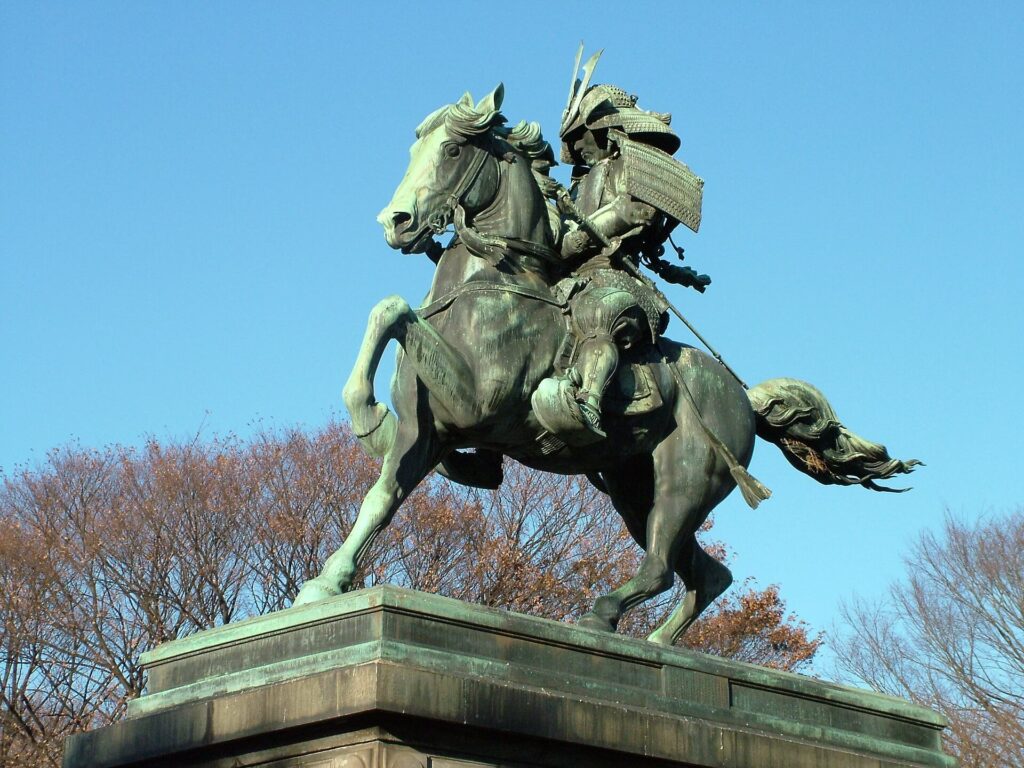
The contrast between the historical guerrilla tactician and the bronze equestrian figure in front of the Imperial Palace is not only aesthetic. It is epistemic: it shows how myths arise. A real person with contradictory traits is reduced to one element — here, loyalty to the emperor — which is then politically useful at a particular historical moment. The rest falls away. The feints, the improvised weapons, the strategic retreat, the contradiction of the emperor — none of this is present in the national monument any longer.
Academic history in the 20th and 21st centuries has reconstructed this process. Benesch shows how figures such as Masashige, Yamamoto Tsunetomo (Hagakure) or the 47 Ronin were systematically inscribed into a canon of national virtues that served primarily for political mobilisation.[3] This is not a criticism of Masashige — it is a warning against taking every myth at face value.
Varley aptly summarises the paradox: the Taiheiki shows Masashige as a complex human being who combines guerrilla tactics with imperial loyalty. Later mythology reduces him to the second element and eliminates the first. The reduction to “blind loyalty” is an interpretation of the 17th to 20th centuries — not the medieval original.[1]
Armour of the Nanboku-chō Period: What Masashige’s Men Wore
The shift from cavalry to infantry, which the Nanboku-chō wars accelerated, forced armourers to adapt. The heavy Ō-yoroi with its sweeping shoulder plates was made for a mounted archer — in mountain defence and fighting on foot it was a hindrance. The Haramaki, lighter and offering 360-degree protection, became established as the standard armour for infantry fighters.
What Masashige’s men wore at Chihayajō has not been recorded. But the logic of the mountain fortress — rapid movement, improvised weapons, terrain as an advantage — points more to functional armour for fighting on foot than to heavy cavalry equipment.
Conclusion: What Masashige Tells Us Today
Masashige said goodbye to his eleven-year-old son Masatsura before he rode to his last battle. The Taiheiki describes the scene: Masatsura wanted to ride with him, ready to die. Masashige sent him back. He told him to live, to obey his mother, and to carry on the task if Go-Daigo’s situation improved.
Masatsura survived the defeat of 1336. He fought for the Southern Court for twelve years until he fell in the Battle of Shijōnawate in 1348 — following his father in the image of the loyal son who completes the legacy.
Whether this genealogy of loyalty is historically accurate or whether the Taiheiki constructed it is difficult to separate. But it shows how far the cultural model reached: Masashige alone was heroism. Masashige and Masatsura together were dynastic loyalty — and that was even stronger than individual ethics.
The story of Kusunoki Masashige is uncomfortable — and that is its value.
It shows a man who was tactically brilliant and strategically ignored. Who clearly recognised the consequences of a wrong decision and followed it nonetheless. Whose loyalty — or its staging in the Taiheiki — constructed an ideal that was misused six centuries later for mass mobilisation and the glorification of war.
Benesch shows that the problem does not lie with Masashige himself, but with the layers of interpretation that have been laid over his name.[3] The historical Masashige was a pragmatist with a principle. What his successors made of this principle was not his responsibility.
Frequently Asked Questions about Kusunoki Masashige
Who was Kusunoki Masashige?
Kusunoki Masashige (c. 1294–1336) was a Japanese warrior of the Nanboku-chō period who supported Emperor Go-Daigo against the Kamakura bakufu and later against Ashikaga Takauji. He is known for his guerrilla tactics in mountain fortresses (especially Chihayajō, 1332) and his death in the Battle of Minatogawa (1336), where he deliberately took on a fight he could not win. Little is known about his origins and his social status before 1331.
Why is Kusunoki Masashige so well known?
In Japanese history, Masashige is regarded as the epitome of unconditional loyalty to the emperor (Chukun). The Taiheiki (14th century) stylises him as a tragic hero who dies for a principle. In the Meiji and Taishō periods, his name was exploited for nationalist loyalty propaganda. His equestrian statue stands in front of the Imperial Palace in Tokyo.
What were Masashige’s tactics?
Masashige used guerrilla warfare: mountain fortresses, feints, improvised weapons (tree trunks, stones, boiling water), faked defeats and night attacks. These methods were described as “dishonourable” by classical chronicles, but were militarily effective against superior forces.
What does Shichishō hōkoku mean?
“Seven lives for the fatherland” — Masashige’s last words before his death, as recorded in the Taiheiki. He is said to have answered that he would want to defend the emperor for seven lives. In the 20th century, the word hōkoku (serving the country) became the battle cry of Japanese nationalists.
How did Kusunoki Masashige really die?
In the Battle of Minatogawa (5 July 1336), after a long fight against superior forces. Wounded and surrounded, he asked his brother Masasue to join him in a ritual death together. That was neither an execution nor a classic seppuku — but a decision made by two men in a hopeless situation.
Was Masashige really the most loyal samurai in Japan?
That is a question of interpretation. Historically, Masashige fought for Emperor Go-Daigo for reasons that we do not fully know — possibly also out of strategic calculation or personal attachment. The Taiheiki constructs “blind loyalty” retrospectively. Oleg Benesch and other historians show that the Masashige mythology is a later creation that overlays the historical man.
Visit the Samurai Museum Berlin
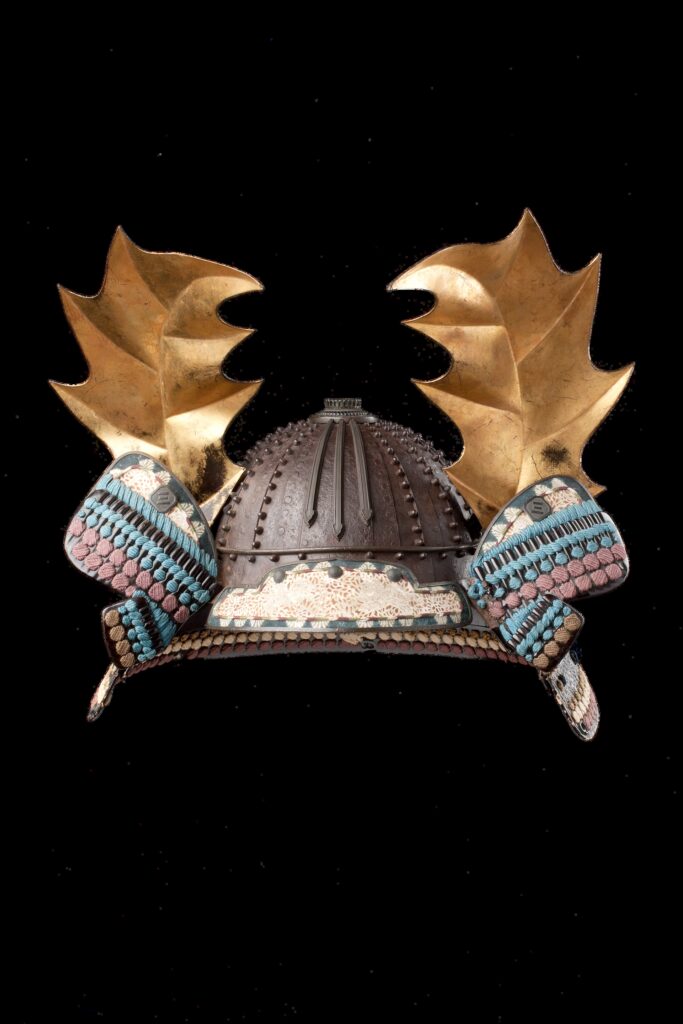
The Nanboku-chō period in which Kusunoki Masashige fought is documented by original exhibits at the Samurai Museum Berlin. The museum shows a helmet bowl from this era and a Haramaki armour from the same period. These objects — from an era of chaos and divided imperial rule — convey the real context behind the legend. Open daily from 10 a.m. to 7 p.m., Auguststraße 68, Berlin-Mitte.
Related Articles
- Nanboku-chō: The War of the Two Imperial Courts
- Kamakura & Muromachi: The First Shogunate and the Mongol Storm
- Seppuku: The Ritual Suicide of the Samurai
- Samurai: History, Culture and Legacy
- Bushido: The Samurai Code of Honour
Sources and Further Reading
This article is based on academic research and the expert catalogues of the Samurai Museum Berlin.
Primary Sources
- [1] Varley, H. Paul (1994). Warriors of Japan as Portrayed in the War Tales. University of Hawaii Press. Used: ch. 5 (Taiheiki, Kusunoki Masashige, construction of loyalty, basara).
- [2] Conlan, Thomas D. (2003). State of War: The Violent Order of Fourteenth-Century Japan. University of Michigan Center for Japanese Studies. Used: ch. 1–2 (myth of the duel; wound analysis; loyalty as a transaction).
Secondary Literature
- [3] Benesch, Oleg (2014). Inventing the Way of the Samurai: Nationalism, Internationalism, and Bushidō in Modern Japan. Oxford University Press. Used: analysis of the exploitation of Masashige in Meiji nationalism.
- [4] Yamamura, Kōzō (ed.) (1990). The Cambridge History of Japan, Vol. 3. Cambridge University Press. Used: ch. 3 (decline of the Kamakura bakufu), ch. 4 (Muromachi context).
- [5] Turnbull, Stephen (1977/1996). The Samurai: A Military History. Routledge. Used: ch. 4 (Kemmu Restoration, Minatogawa).
Museum Catalogues and Expert Reports
- [6] Samurai Museum Berlin (2021). Armours of the Samurai. Display case E04V (hoshi kabuto bachi, Nanboku-chō); display case C04V (Haramaki armour, Muromachi period).
© Samurai Museum Berlin – All rights reserved
You might also like
Sanada Yukimura: Japan’s Bravest Warrior (1567–1615)
Sanada Yukimura defended Ōsaka against Tokugawa Ieyasu's army – and became an icon of the honourable last stand. History, myth…
Read the article
Ashikaga Takauji: Founder of the Second Shogunate (1305–1358)
Ashikaga Takauji overthrew Emperor Go-Daigo and founded the Muromachi shogunate – yet is still regarded as a traitor in Japan.…
Read the article
Miyamoto Musashi: Life, Duels & The Book of Five Rings
Miyamoto Musashi – 60 duels, not a single defeat too few. The life, philosophy & Book of Five Rings of…
Read the article