 Nominated for the EMYA2026 award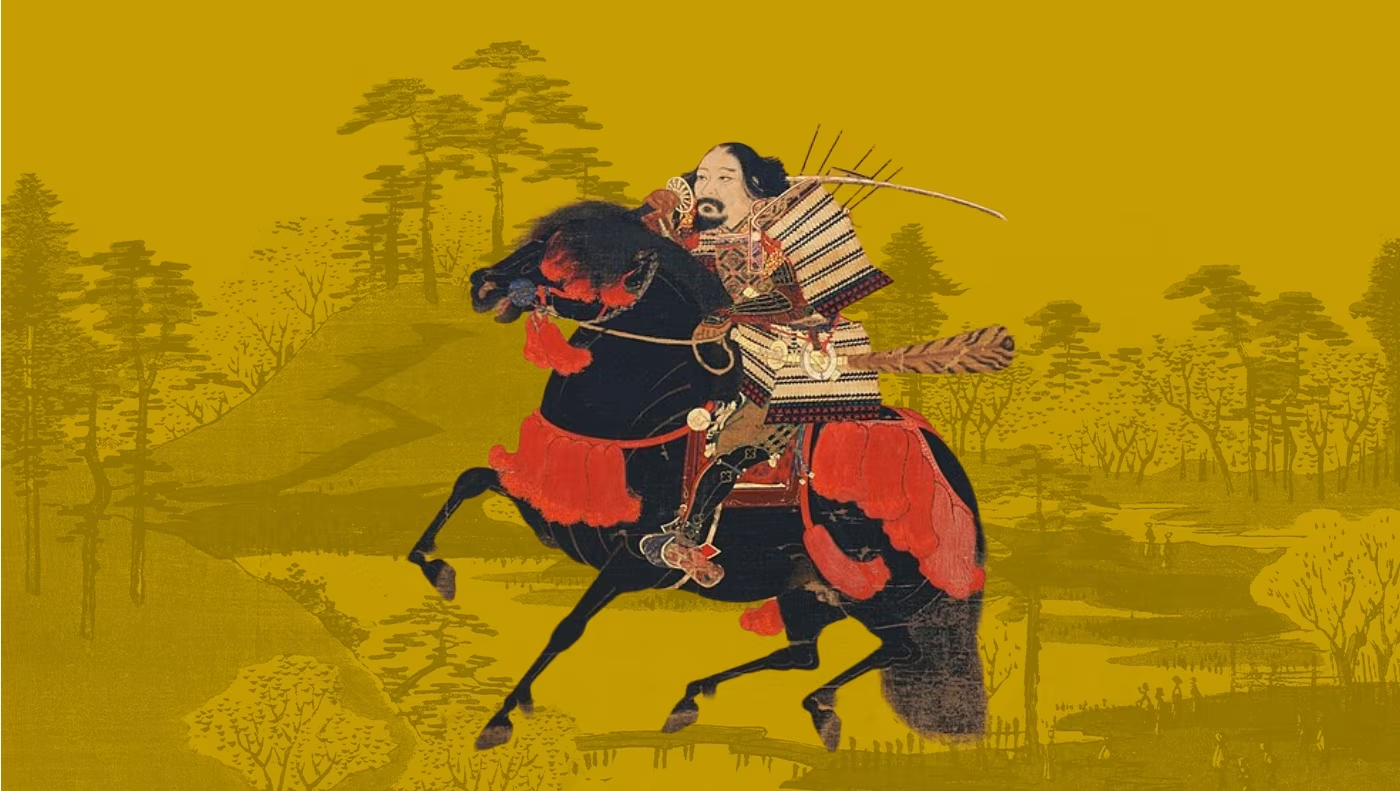
In 1336, Japan was ruled by two emperors at the same time.
One sat in Kyoto, installed by Ashikaga Takauji, the most powerful warrior in the land: Emperor Kōmyō of the Northern Court. The other sat in Yoshino, deep in the mountains south of Osaka, with the imperial regalia in his baggage and a claim to legitimacy that he would not relinquish: Emperor Go-Daigo of the Southern Court.
Both had followers. Both had armies. Both had priests who certified them as the true emperor. Japan had room for only one.
What followed was the Nanboku-chō — literally “Southern-Northern dynasties” — a 56-year civil war that ground Japan down like a millstone. Battles without decisions. Alliances that shattered overnight. Families that split into hostile camps. And in the end, a settlement so weary that it scarcely imposed any conditions at all.
At the Samurai Museum Berlin, display case E04V preserves a helmet bowl from precisely this era — a utilitarian object from a time in which being put to use decided over life and death.
The Prehistory: How Japan Broke in Two
The split had a history that reached far back before 1336. In the 13th century, the imperial house had divided into two rival lines — the Jimyōin line and the Daikakuji line. The Kamakura bakufu had resolved this conflict pragmatically: alternating succession to the throne. A formula that satisfied no one, but kept the peace.
Emperor Go-Daigo, of the Daikakuji line, ascended the throne in 1318 — and immediately resolved to break this formula. He wanted his own son as successor and direct imperial rule without bakufu control. In 1331 his uprising began. In 1333 — with the help of warriors such as Nitta Yoshisada and Ashikaga Takauji — he toppled the Kamakura shogunate.
Then he made the mistake of believing he had won.
The Kenmu Restoration (1333–1336) was Go-Daigo’s hour and his downfall at once. He distributed offices, ignored the warriors who had fought for him, and ruled with a mixture of Confucian idealism and tactical blindness. Ashikaga Takauji, the most powerful of the warriors, did not receive the reward he expected. Go-Daigo underestimated him. That was the final mistake.
In 1335 Takauji broke openly with Go-Daigo. In the spring of 1336 he marched into Kyoto. Go-Daigo fled — with the three imperial regalia, without which no accession to the throne could be considered legitimate. He made the mountain fortresses south of Kyoto his court-in-exile. And he refused to give up the throne.
Go-Daigo: Visionary and Catastrophe
Emperor Go-Daigo is a figure in whom historical sympathy and historical judgment come into conflict. He toppled the Kamakura bakufu — something that for decades had been regarded as impossible. And then the Kenmu Restoration: three years in which he showed that he wanted to rule Japan without knowing how.
He favored court nobles over warriors in awarding lucrative posts. He failed to compensate Nitta Yoshisada and Ashikaga Takauji adequately — the two men without whom he would never have won. Hall shows in his analysis: “neither shogun nor shugo acquired the capacity for enforcement needed to fully exercise their legal authority.” This applied to imperial authority as well — legitimacy without the power to enforce is principle without practice.
Ashikaga Takauji: The Victor Who Never Won
Ashikaga Takauji (1305–1358) toppled the Kamakura bakufu, helped Go-Daigo onto the throne, drove Go-Daigo out, and installed another emperor. He founded the Muromachi shogunate — and spent the first twenty years of his life as shogun fighting his own brother and putting down rebellions.
He was depressive. Contemporary sources describe periods of exhaustion. He was a Buddhist who had warriors killed by the thousands, and he founded temples as memorials for the fallen of both sides. What he established — the Muromachi bakufu — was structurally weaker than Kamakura. That was the price of victory: he needed the support of too many warrior families to truly command them all afterward.
The Taiheiki: How the War Was Told
Anyone who wants to understand the Nanboku-chō period must begin with a warning: the principal source is a catastrophe for historians. The Taiheiki — literally “Chronicle of the Great Peace” — was written by monks who sympathized with the Southern Court. It blends historical facts, literary inventions, and political propaganda in a mixture that is impossible to disentangle.
Conlan reveals the fundamental problem: the Taiheiki cites armies of hundreds of thousands. The logistical documents attest to thousands. Troop strengths were systematically inflated by a factor of 10 to 100. Even so, the Taiheiki is indispensable — not as a historical document, but as a cultural one. As Varley shows, it constructs the moral landscape of the era: Who is a hero? Who is a traitor? The Taiheiki answers: Masashige is virtuous, Takauji is morally problematic, even though he wins.
56 Years of War: What Really Happened
The Nanboku-chō war had no battles that decided everything. It had hundreds of battles that decided nothing. The basic problem was structural: neither side had the resources to annihilate the other completely. The Southern Court had legitimacy (the imperial regalia) and the mountainous region around Yoshino as a natural fortress, but hardly any manpower. The Northern Court had the capital and the shogunate, but could not bring the mountain warfare to an end.
Kusunoki Masashige represented the best the Southern Court had: a tactician who achieved much with little. After his death in 1336, Go-Daigo’s cause no longer had any figure of his military quality. Go-Daigo himself died in 1339 in Yoshino — ill, in exile, the regalia in his hands, never truly giving up the throne.
Conlan shows how contract-based and conditional loyalty was in this period: if the reward fell short, one switched sides. This was not the exception, it was the rule. In this atmosphere arose the phenomenon that the Taiheiki describes as basara: a deliberate rejection of old norms, an eccentric display of wealth and individuality by the new warrior-rulers.
Aesthetics Amid Chaos: Nō, Tea, and Wabi
It is the strangest fact of the Nanboku-chō period: in the decades of civil war, the foundations of classical Japanese aesthetics were laid. Zeami Motokiyo (1363–1443) codified Nō theater. The tea ceremony developed its philosophical foundation in this period. As Varley shows, these aesthetics were not a reaction to the war in spite of the war — they were a reaction through the war. Mujō — Buddhist impermanence — was no longer a literary theme; it was everyday life.
The Samurai Museum Berlin possesses an original modern Nō stage, crafted in Japan with traditional materials and assembled in Berlin. It connects the aesthetic tradition of this era with the visitor’s museum experience.
The Settlement of 1392: A Peace Without Winners
The third Ashikaga shogun, Yoshimitsu (1358–1408), negotiated a unification with the Southern Court in 1392: the Southern emperor Go-Kameyama would hand over the regalia, and in return the succession would henceforth alternate once more. Go-Kameyama handed over the regalia. The alternation never took place. Yoshimitsu had triumphed by the oldest of means: he promised what he did not keep.
Japanese historiography of the Meiji period long wrestled with this episode. Since the Meiji emperor was a descendant of the Southern Court, the settlement of 1392 was, from this perspective, a betrayal. In 1911 the Japanese parliament resolved the problem by decree: the Southern Court is officially recognized as the legitimate one.
Armor in Transition: The Nanboku-chō Period as a Technological Turning Point
The shift from mounted cavalry to mass infantry accelerated dramatically in the Nanboku-chō period. The mountain warfare and long marches of the 56-year wars required warriors who could maneuver on foot. The helmet bowl in display case E04V of the Samurai Museum Berlin, dated to the Nanboku-chō period, shows a technological intermediate phase: the prominent hoshi rivets of the Kamakura tradition are still present — but alongside them are flattened, recessed rivet variants that made the helmet lighter and more resistant to sword strokes.
The Reality of War: What the Documents Show
Thomas Conlan’s analysis of administrative records, land transfers, and wound reports from the Nanboku-chō period is the most important corrective in the field. His key findings:
First — armies were small. Where the Taiheiki speaks of hundreds of thousands, logistical documents attest to thousands. Second — arrows dominated: 72% of wounds from 1,302 evaluated wound reports came from arrows. The sword was a close-combat last resort. Third — loyalty was for sale: warriors switched sides when rewards failed to materialize. “Loyalty was contractual and conditional, not blind. Warriors served for land.”
This makes the Nanboku-chō period one of the sharpest arguments against the romantic image of the samurai. Masashige was the exception — not the rule. And that is precisely why the mythology needed him.
Frequently Asked Questions About the Nanboku-chō Period
What does Nanboku-chō mean?
Literally “Southern-Northern Courts” — referring to the Southern Court in Yoshino and the Northern Court in Kyoto. The period lasted from 1336 to 1392 and was marked by simultaneous, rival imperial claims.
Why were there two emperors in Japan?
After the fall of the Kamakura shogunate (1333) and the failed Kenmu Restoration (1336), Ashikaga Takauji drove Emperor Go-Daigo out of Kyoto. Go-Daigo fled with the imperial regalia to Yoshino and refused to give up the throne. Takauji installed an emperor from a rival line — thus two simultaneous court states existed.
What is the Taiheiki?
The Taiheiki (14th c.) is the principal chronicle of the Nanboku-chō wars. It contains historical facts, literary inventions, and political propaganda. For historical facts on troop strengths it is unreliable (systematic exaggeration); for the cultural self-image of the era it is indispensable.
How did the Nanboku-chō period end?
In 1392 Shogun Ashikaga Yoshimitsu negotiated a settlement with the Southern emperor Go-Kameyama: Go-Kameyama handed over the imperial regalia in exchange for the promise of an alternating succession. The promise was not kept. The civil war ended through exhaustion and political betrayal.
Which weapons were mainly used?
Thomas Conlan analyzed 1,302 wound reports: 72% of wounds came from arrows, about 20% from swords. Surprisingly frequent: stones, especially in mountain sieges. The image of the sword duel is a literary fiction.
Visit the Samurai Museum Berlin
Display case E04V preserves a helmet bowl from the Nanboku-chō period — a technological transitional form between Kamakura tradition and Muromachi innovation. Display case C04V shows a haramaki armor whose construction principles are rooted in the demands of the Nanboku-chō wars. Open daily from 10 a.m. to 7 p.m., Auguststraße 68, Berlin-Mitte.
Related Articles
- Kusunoki Masashige: Japan’s Most Loyal Warrior
- Kamakura & Muromachi: The First Shogunate and the Mongol Storm
- Kabuto: The Helmet of the Samurai
- Sengoku Jidai: The Age of the Warring Provinces
Bibliography
- Conlan, Thomas D. (2003): State of War: The Violent Order of Fourteenth-Century Japan. University of Michigan Center for Japanese Studies.
- Varley, H. Paul (1994): Warriors of Japan as Portrayed in the War Tales. University of Hawaii Press.
- Absolon, Trevor (2017): Samurai Armour, Volume I: The Japanese Cuirass. Osprey Publishing.
- Yamamura, Kōzō (ed.) (1990): The Cambridge History of Japan, Vol. 3: Medieval Japan. Cambridge University Press.
- Samurai Museum Berlin (2021): Armours of the Samurai.
© Samurai Museum Berlin – All rights reserved
You might also like
Sengoku Jidai: The Age of the Warring Provinces (1467–1615)
The Sengoku Jidai (1467–1615) was Japan's 150-year civil war. After the collapse of Ashikaga rule, rival daimyō fought for supremacy…
Read the article
Kamakura & Muromachi: The First Shogunate and the Mongol Storm
The Kamakura shogunate, the Mongol wars, and the Muromachi bakufu: How Japan developed samurai rule between 1185 and 1467. Samurai…
Read the article
Kusunoki Masashige: Japan’s Most Loyal Warrior
Kusunoki Masashige – guerrilla tactician, imperial loyalist, myth. Who was the most loyal samurai really? History, facts & exhibits at…
Read the article