 Nominated for the EMYA2026 award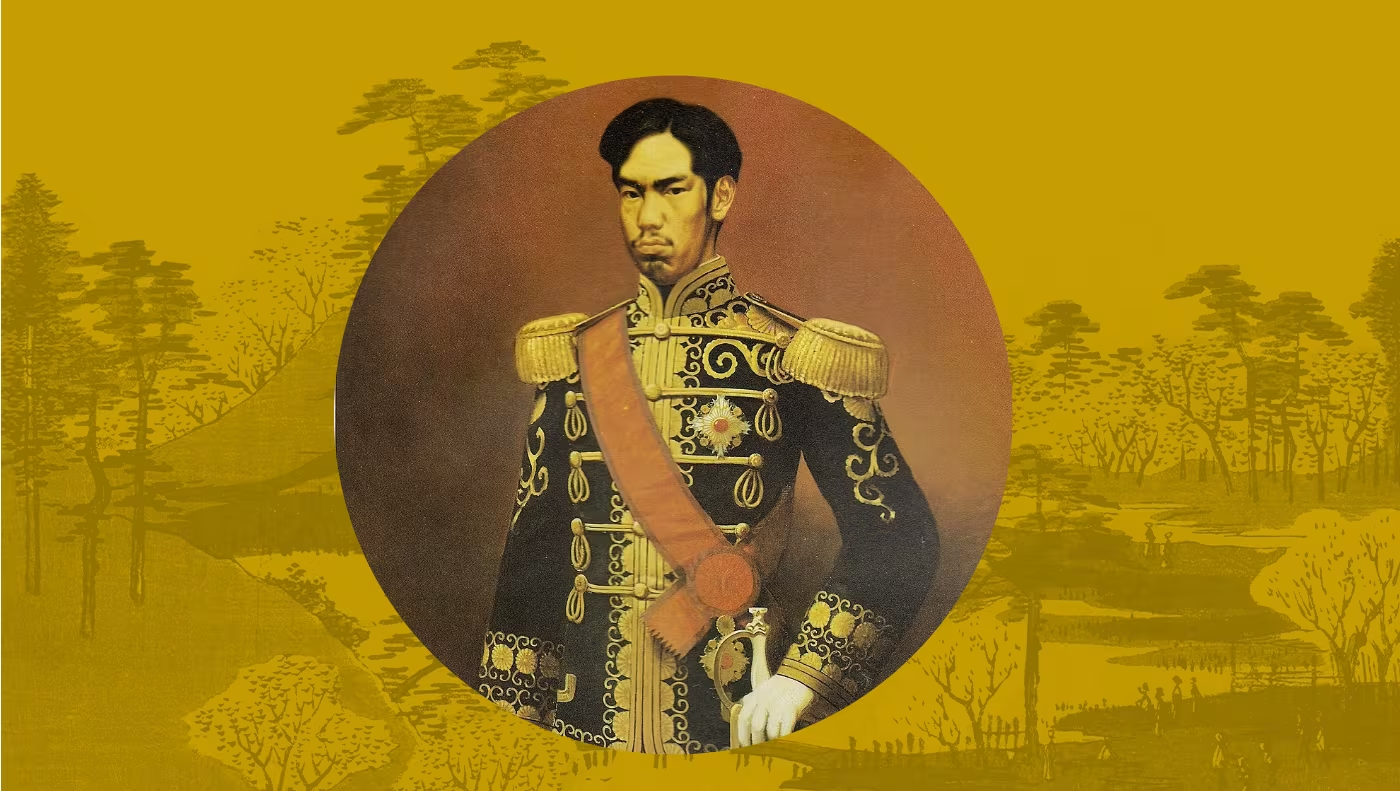
Saigō Takamori lay on a rocky slope outside Kagoshima, shot in the thigh, surrounded by thirty thousand government soldiers. Around him: three hundred exhausted men — the last survivors of his private schools, the Shigakkō, which had once numbered twenty thousand students. There was no longer any way to escape. He asked his loyal follower Beppu Shinsuke to cut off his head.
Twelve years later, the Meiji government that had condemned him posthumously pardoned him and restored his rank. In 1898, a bronze statue of Saigō was unveiled in Ueno Park in Tokyo — showing him in a casual kimono, walking a dog, harmless and folksy. The dangerous rebel had been turned into a national mascot.
That is the story of the Meiji Restoration in brief: a revolution that swallowed its own fathers — and set up its own opponents as national icons.
Bakumatsu: Why the Shogunate Collapsed
The Tokugawa shogunate ruled Japan for 250 years. It did not collapse because of Saigō Takamori or because of gunboats. It collapsed because it had lost its own economic foundation.
The Tempō crisis of the 1830s and 40s was a decade of crop failures, famines and social unrest. The bakufu responded with reforms that reformed nothing. As Jansen shows in his analysis of the 19th century, the structural weakness of the shogunate was not military but fiscal: the domains fell into debt, the central state had no means of redistribution, and the samurai class gradually became impoverished.[1]
Then came the Black Ships.
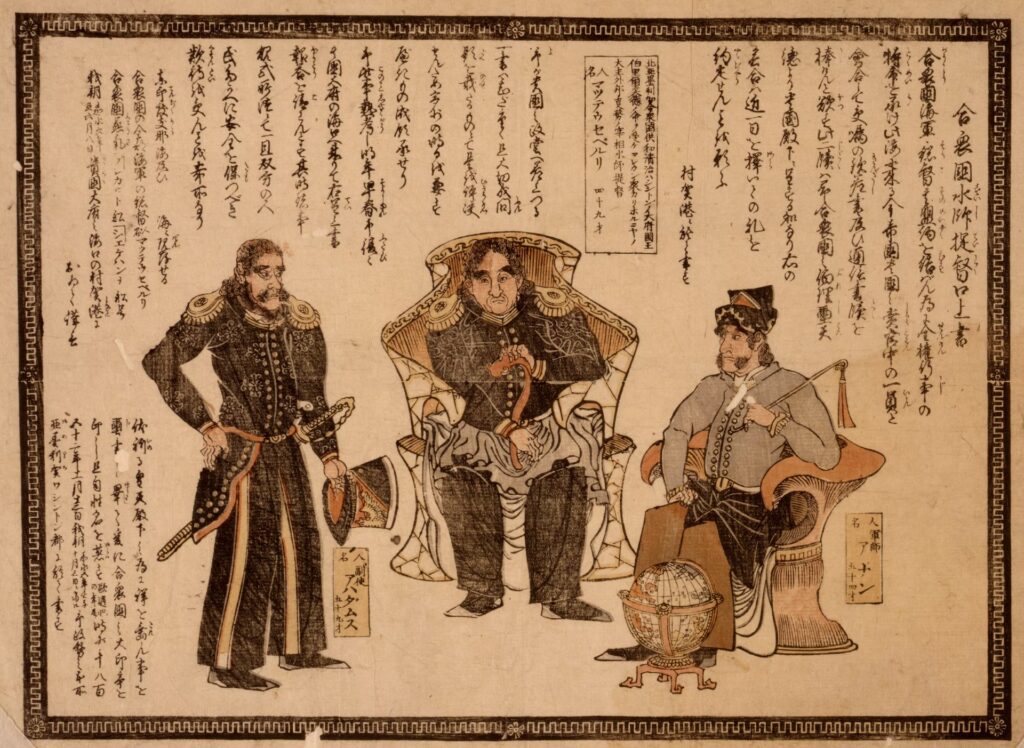
In 1853, Commodore Matthew Perry appeared off the port of Uraga with four steam-powered warships. His message was short: Japan would open itself to trade or bear the consequences. The bakufu, which had no navy, no modern artillery and no experience of this kind of diplomacy, signed the Treaty of Kanagawa in 1854.
That triggered a crisis that the shogunate could not survive. The Sonnō-jōi movement — “Revere the Emperor, expel the barbarians” — used the forced opening as proof that the bakufu could not protect Japan. Low-ranking samurai from the domains of Satsuma and Chōshū organised the resistance. They called it Sonnō-jōi, but what they really wanted was power.
In 1866, Satsuma and Chōshū concluded a secret alliance — the Sakamoto Ryōma agreement, named after its mediator. Saigō Takamori represented Satsuma. He had previously outmanoeuvred both sides: as a hard-line opponent of Chōshū, he gained credibility for the rapprochement through the Nixon-in-China principle. “Saigo’s change of heart thus had a ‘Nixon goes to China’ effect: having pressed for the destruction of Choshu, Saigo could argue for leniency without appearing soft.” (Ravina 2004, p. 141)[2]
In 1868, a short military campaign swept away the Tokugawa shogunate. The last shogun, Yoshinobu, stepped down. The Meiji Restoration was complete.
What followed was no return to the imperial rule of the Heian period. It was a modern dictatorship of low-ranking samurai.
The Reforms: How a Warrior Caste Abolished Itself
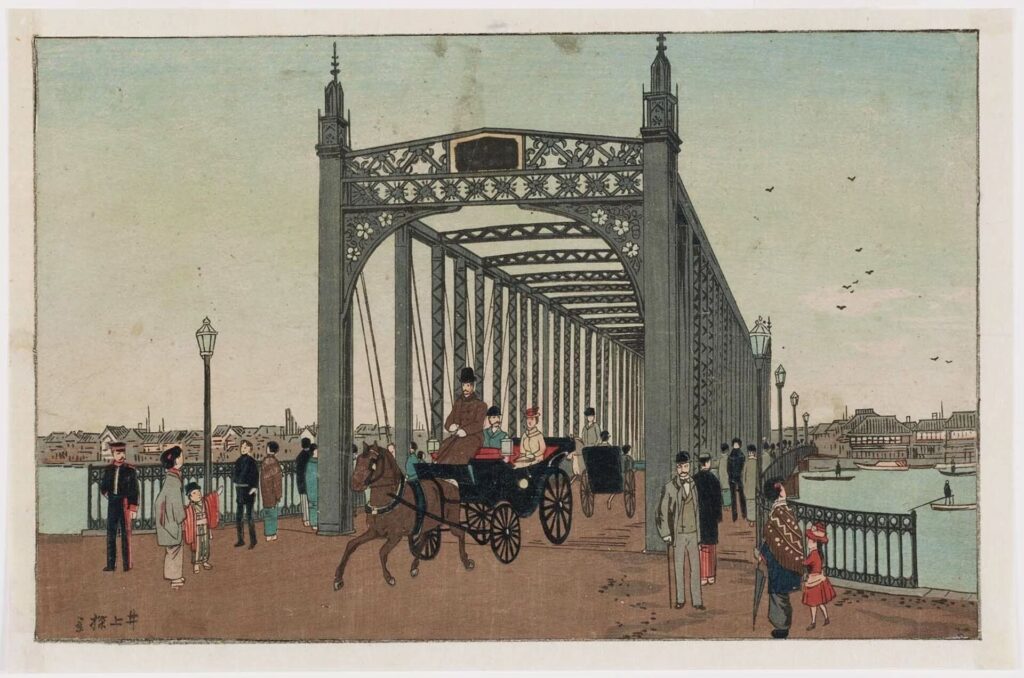
The Meiji oligarchs — Ōkubo Toshimichi, Kido Takayoshi, Itō Hirobumi, Yamagata Aritomo — were samurai. And they abolished the samurai.
That was not irony but logic. To make Japan a modern great power, they needed a conscript army, not feudal warriors. A professional army, not a hereditary warrior class. A centralised state, not 260 autonomous domains.
1871: The domains (Han) are dissolved and replaced by prefectures under direct government control. The domain lords lose their power base.
1873: The Conscription Law comes into force. Every Japanese man between 20 and 40 can be called up — regardless of the status he was born into.
1876: The Haitōrei — the sword ban. From now on, only members of the military may carry swords in public. For samurai, who saw their sense of status embodied in the sword, this was an expropriation.
Turnbull describes the moment when Saigō Takamori girds on his father’s sword and goes to war as a deliberate gesture: the sword as the last symbol of a class that did not want to give itself up.[3]
At the same time, the samurai were financially ruined. Their pensions (koku payments) were replaced by one-off bonds — whose value fell. Samurai without a traditional occupation and without capitalist training were left with worthless pieces of paper.
Saigō’s break with the Meiji government must be understood against this background. He was no reactionary — he had himself helped to build the modernisation. But he believed in a “government of virtue” based on Confucian principles. What he saw was corruption, self-enrichment and the systematic humiliation of the warrior class to which he had devoted his life. “Saigo’s break with the Meiji government was based on his Confucian conviction that a government must lead through virtue, not through Machiavellianism.” (Ravina 2004, p. 190)[2]
The Satsuma Rebellion: The Last Stand
In 1877 the pent-up anger exploded in the rebellion that bears Saigō’s name — although he did not want it.
The Shigakkō, the private schools that Saigō had founded in Satsuma, were training camps for disillusioned samurai. Twenty thousand students practised old martial arts, lived under strict discipline and cultivated Saigō’s anger at the Meiji government. In January 1877, radical students stole government ammunition from an arsenal magazine. The government responded with arrests. The students escalate. Saigō, ill and undecided, allowed himself to be placed at the head. “Saigo was reluctantly pushed to the fore by the radicalism of his followers. He led the rebellion he had not planned, in a fatalistic act of loyalty to those who had followed him.” (Ravina 2004, p. 225)[2]
The rebellion lasted nine months. Despite all the heroism of the mythology, it was a military catastrophe for the rebels. The Meiji army was armed with modern weapons and had artillery and supplies. The Satsuma warriors had samurai armour, antiquated tactics and dwindling ammunition. Ironically, Turnbull shows that Saigō did in fact use modern weapons: it was not a fight of sword against rifle, but of a small modern army against a large modern army.[3]
Shiroyama on 24 September 1877 was the end: 300 against 30,000. Saigō was wounded and had himself beheaded. Japan had defeated its last samurai uprising.
What the Sword Ban Really Meant
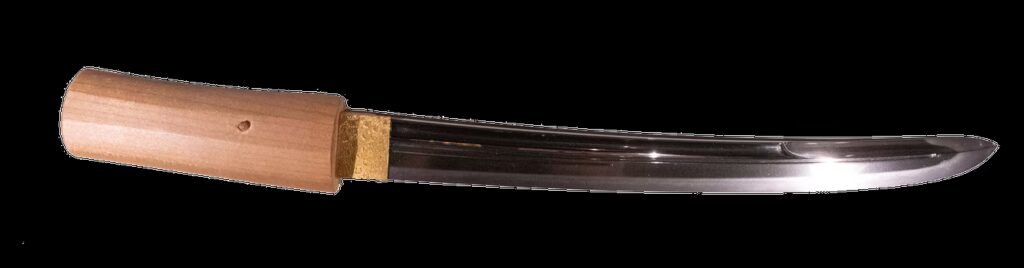
The Haitōrei of 1876 has become, in samurai mythology, the symbolic death blow to the warrior class. The reality is more nuanced.
As a combat weapon, the sword had been marginalised at the latest since the introduction of the arquebus in 1543. In the Edo period it was above all a status symbol — worn, not drawn. The Haitōrei removed the symbol, not the martial art. Kenjutsu, jujutsu, archery — these traditions survived as sports and arts.
What the sword ban really hit was the visual identity of the class. For contemporaries, a samurai without a sword was no longer a recognisable social category. As Turnbull describes it: the Haitōrei was the formal dissolution of the samurai as a visible class — not as individuals, but as an estate.[3]
The economic dissolution had begun earlier. Samurai pensions, calculated in rice, were replaced by bonds whose real value shrank. Many samurai opened shops or became teachers, officials or journalists. The Meiji government absorbed capable samurai into the modern state apparatus — in a certain sense it was created by samurai for samurai, even though it formally abolished the samurai class.
The Afterlife: How the Samurai Became a Brand
In 1889, Saigō Takamori received his imperial pardon. In 1898 his statue was unveiled. That was politically clever: a rebel who has been pardoned and immortalised can no longer be feared.
But the Saigō example was only the beginning of a larger transformation. In the late 19th and early 20th centuries, the samurai class was retrospectively declared an elite of virtue — the foundation of the national identity of the new Japan. Nitobe Inazō’s Bushido: The Soul of Japan (1900) set down a code of honour that had never existed as such, in a book that was written in English and intended above all for Western readers. As Benesch shows, bushidō was the retroactive construction of a tradition intended to underpin Meiji state ideology.[4]
The samurai thus became a double myth: once really abolished, once imaginarily immortalised. Modern Japan needed the warrior ancestor as a moral reservoir — but no longer needed the living warrior as a social reality.
This mythologisation had consequences. The bushidō cult of the early 20th century supplied a language of legitimation for militarism and imperialism. Saigō Takamori — the moderniser who had rebelled against corruption — became a role model for officers who perverted his intentions.
Perry and the Black Ships: The External Trigger
In the Japanese national narrative, Commodore Perry’s four steamships in July 1853 appear like a moment of creation — the moment when Japan was awoken from its sleep.
Academic research is more nuanced. Jansen shows that the shogunate had already been weakened by internal crises before Perry arrived. The Tempō crisis had forced attempts at reform, which failed. The financial situation of the domains was dire. The samurai class gradually became impoverished because their rice stipends lost value in a money economy. Perry’s arrival was the catalyst, not the cause.[1]
What Perry delivered was a crisis of legitimacy. For 250 years the shogunate had claimed to protect Japan. Now it signed a treaty that opened Japan — without even consulting the emperor, which was at least legally questionable. The Sonnō-jōi movement made the most of this: the bakufu had betrayed Japan. Only direct imperial rule could save Japan.
That was politically opportunistic. It was also politically effective.
The four steamships triggered a debate that the shogunate could not win: if Japan opened up, it would lose legitimacy among the traditionalists. If it did not, it would be forced open or overwhelmed by the Western powers. There was no way out that preserved the old order.
Saigō’s Modern Army — and Its Failure
One of the most persistent misconceptions about the Satsuma Rebellion is the image of a hopeless fight with obsolete weapons.
The reality: Saigō tried to obtain modern artillery. His troops carried Western rifles where available. The problem was not philosophy but logistics — the government controlled the supply routes and had more resources. Turnbull demonstrates that the decisive factor was not weapons technology but the balance of forces: a regional army of a few thousand against a national army of tens of thousands with superior artillery.[3]
That makes the rebellion a modern civil war, not a nostalgic sword-versus-rifle spectacle. Its mythologisation as the last stand of the old against the new is — as so often with Saigō — a later projection.
Saigō himself had helped to build both sides. He had helped to design the conscript army that defeated him. That is the real tragedy — not a clash of civilisations, but the man who built the machine that crushed him.
Meiji Japan as a Mirror: What the West Saw
Saigō’s rehabilitation in 1889 coincided with something the Japanese government was keeping a close eye on: Japan’s international image.
The Western press of the 1870s and 1880s reported on Japan’s modernisation with both fascination and concern. Would Japan become a “civilised” country — or would it fall back into barbarism? The term “civilisation” was a term of power: it meant primarily conforming to Western economic and legal norms.
Japan responded to this pressure with a dual strategy. Outwardly: Western institutions, Western fashion, Western diplomacy. Inwardly: a nationalism built on a selectively constructed Japanese tradition. The concept of bushidō was an export product — Nitobe wrote it in English for Western readers in order to explain why Japan retained its own identity despite modernisation.
Ravina shows how this dual strategy worked in dealing with Saigō’s death: the suppression of the rebellion proved order and state strength. The subsequent honouring of Saigō proved magnanimity and moral depth. Both were foreign policy.[2]
That is the real legacy of the Meiji Restoration for samurai mythology: it created an image of the Japanese warrior for global consumption — and this image lives on to this day, in films, video games and martial arts studios all over the world.
Conclusion: What the End of the Samurai Means
The last samurai died in 1877 at Shiroyama. Or he died in 1876 with the Haitōrei. Or he died in 1868, when the shogunate fell. Or he lives on to this day — in the martial arts, in aesthetics, in the image we have of Japan.
All of these answers are correct, depending on which samurai one means: the social class, the military warrior, the cultural type, the national myth.
What the Meiji Restoration ended was the first of these categories — and in doing so it created all the others. It abolished the samurai as an estate and created the samurai as an icon. It modernised Japan with methods that samurai had planned and implemented, and in doing so destroyed the samurai as a category.
Frequently Asked Questions about the Meiji Restoration
What was the Meiji Restoration?
The Meiji Restoration (1868) was the seizure of state power by a coalition of low-ranking samurai from Satsuma and Chōshū, formally in the name of the young Emperor Meiji (Mutsuhito, 1852–1912). It ended the Tokugawa shogunate and initiated Japan’s modernisation: industrialisation, conscription, Western institutions. In practice it was a coup d’état by one samurai elite against another.
What was the Haitōrei?
The Haitōrei (1876) was an imperial edict that restricted the public carrying of swords to members of the military. For the samurai class, it was the formal removal of its most visible mark of status. Since swords had primarily been status symbols since the Edo period, the edict affected the warriors’ social identity more than their fighting ability.
Who was Saigō Takamori really?
Saigō Takamori (1828–1877) was a Satsuma politician and military strategist who played a key role in the Meiji Restoration. He was not a technophobic traditionalist but a pragmatic moderniser who used Western methods. His break with the government was political and moral: he opposed the corruption of the new oligarchs. He led the Satsuma Rebellion reluctantly; he chose his death deliberately.
Was the Meiji Restoration a revolution?
That is a matter of perspective. Cambridge describes it as an “aristocratic revolution from above” — the initiative came from an elite, not from a popular movement. The reforms (conscription, compulsory schooling, industrialisation) changed Japan profoundly; political power, however, was initially concentrated in the same samurai elites that had overthrown the shogunate.
When did the samurai class officially end?
The samurai class effectively ceased to exist with the introduction of conscription (1873) and formally with the Haitōrei (1876). The Satsuma Rebellion (1877) was the last military uprising of former samurai. The status designations were abolished in 1869 and replaced by the new class system of the Meiji period.
Visit the Samurai Museum Berlin
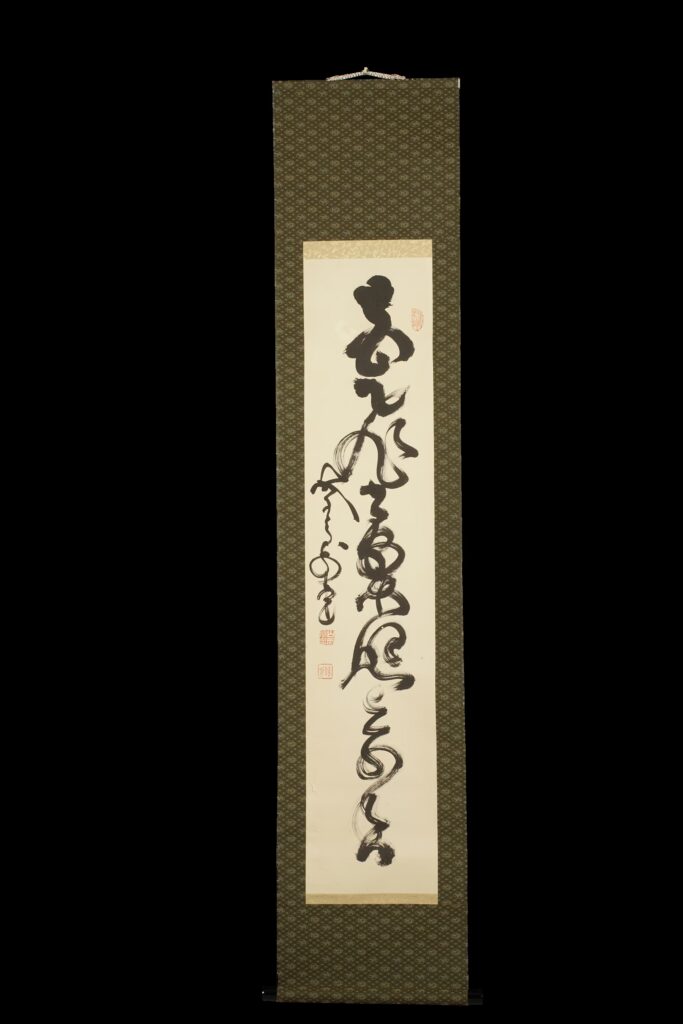
The Meiji period left behind objects that were created at the interface of two worlds: The Samurai Museum Berlin shows a calligraphy by Yamaoka Tesshū, sword master and Meiji politician, as well as a tantō from the Bakumatsu period (1853-1867). Open daily from 10 a.m. to 7 p.m., Auguststraße 68, Berlin-Mitte.
Related Articles
- Samurai: History, Culture and Legacy
- Bushido: The Samurai Code of Honour
- Seppuku: The Ritual Suicide of the Samurai
- Katana: The Sword of the Samurai
- Last Samurai: Film vs. Reality
Sources and Further Reading
Primary Sources
- [1] Jansen, Marius B. (ed.) (1989). The Cambridge History of Japan, Vol. 5: The Nineteenth Century. Cambridge University Press. Used: ch. 5 (Bakumatsu crisis, Tempō reforms), ch. 6 (Meiji Restoration), ch. 7 (Satsuma Rebellion).
- [2] Ravina, Mark (2004). The Last Samurai: The Life and Battles of Saigō Takamori. John Wiley & Sons. Used: ch. 3 (Nixon effect, Chōshū alliance), ch. 4 (Seikanron, moral government), ch. 5 (Satsuma Rebellion), epilogue (posthumous mythologisation).
Secondary Literature
- [3] Turnbull, Stephen (2010). Katana: The Samurai Sword. Osprey Publishing. Used: pp. 99–106 (Haitōrei, Satsuma Rebellion, modern military vs. samurai).
- [4] Benesch, Oleg (2014). Inventing the Way of the Samurai. Oxford University Press. Used: construction of bushidō in Meiji nationalism; Saigō as a nationalised icon.
- [5] Ravina, Mark (2010). “The Apocryphal Suicide of Saigō Takamori: Historiography of a Myth.” Journal of Asian Studies 69(3), pp. 691–721. Used: beheading vs. seppuku debate (source evidence).
Museum Catalogues
- [6] Samurai Museum Berlin (2021). Armours of the Samurai. Display case C22V (Nanban-dō, Bakumatsu); display case C39V (Tesshū calligraphy, Meiji); display case C41V (Bakumatsu tantō).
© Samurai Museum Berlin – All rights reserved
You might also like
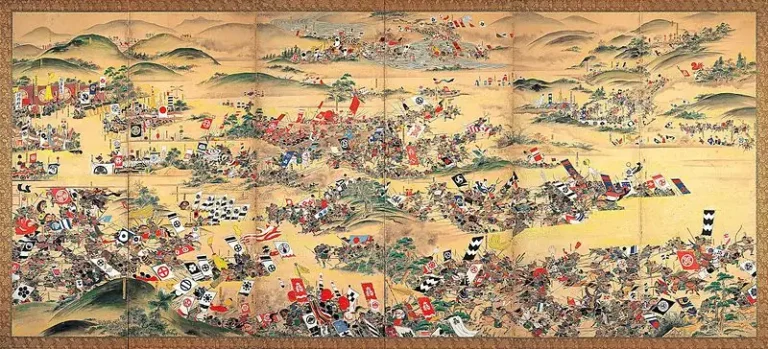
Battle of Sekigahara 1600: Japan’s Decision — Won through Betrayal
Sekigahara 1600 — Japan's largest samurai battle, decided by betrayal. Course, strategy, consequences. Exhibits at the Samurai Museum Berlin.
Read the article
Yasuke: The First African Samurai – History & Facts
Yasuke served Oda Nobunaga 1581–1582. What is historically documented? Facts vs. myths about Japan's first Black samurai. Samurai Museum Berlin.
Read the article
Miyamoto Musashi: Life, Duels & The Book of Five Rings
Miyamoto Musashi – 60 duels, not a single defeat too few. The life, philosophy & Book of Five Rings of…
Read the article