 Nominated for the EMYA2026 award
The Last Samurai: Film vs. Reality – How Historically Accurate Is Tom Cruise’s Samurai Epic?
Shiroyama, September 24, 1877. Dawn breaks over a volcanic hillside in southern Japan, and a man with swollen legs is carried up the mountain in a palanquin. He can no longer ride — a tropical disease has ravaged his body. Around him, three hundred exhausted rebels crouch behind makeshift barricades. Facing them are thirty thousand government troops armed with modern rifles and artillery. Everyone knows how this day will end.
When the first bullet tears through Saigō Takamori’s thigh, he collapses. No white kimono, no ritual pose — just a wounded man asking his follower Beppu Shinsuke to cut off his head before the enemy can capture him alive. It is not seppuku. It is a merciful death (Ravina 2010: 692).
Twenty-six years later, Tom Cruise’s The Last Samurai would make this man famous around the world — while telling a story that bears little resemblance to historical reality. Ken Watanabe’s Katsumoto dies in full armour, sword in hand, surrounded by imperial soldiers who kneel before his sacrifice. It is one of the most iconic scenes in 21st-century cinema. And it is fictional from beginning to end.
Who was the real “last samurai”? What actually happened at Shiroyama? And why does Hollywood tell a lie that sounds smoother than the truth — even though the truth is far more complex?
The Film: The Last Samurai at a Glance
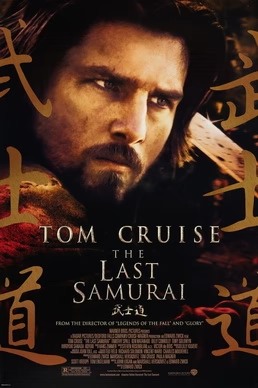
Edward Zwick’s 2003 historical epic tells the story of Nathan Algren (Tom Cruise), a disillusioned American army officer sent to Japan in the 1870s to train the newly formed Imperial Army. After suffering defeat at the hands of a group of rebel samurai, Algren is captured and spends several months in the village of their leader, Katsumoto (Ken Watanabe). There, he comes to understand samurai culture, finds a sense of inner peace — and ultimately joins Katsumoto in the rebels’ final battle against the modernized Meiji Army.
The film was a commercial success, grossing $456 million worldwide at the box office and receiving four Academy Award nominations, as well as a Golden Globe nomination for Ken Watanabe for Best Supporting Actor. Critics were more divided: praise for Watanabe’s performance and Hans Zimmer’s score was accompanied by criticism of the film’s “white savior” narrative structure, which places an American outsider at the moral centre of a Japanese story.
Understanding the film’s basic premise is crucial: *The Last Samurai* does not tell a Japanese story — it tells an American story set against a Japanese backdrop. The samurai serve as a projection screen for Western yearnings for authenticity, honour, and a lost pre-modern world. Film scholars have placed the movie within the tradition of Orientalism: the “noble savage” is idealized through Western eyes, while his complexity is reduced to a set of picturesque virtues.
In Japan itself, the film received an ambivalent response. On the one hand, critics praised Watanabe’s performance and the visually elaborate depiction of Japanese culture. On the other, Japanese film critics objected to the central role given to an American protagonist in a Japanese story — as well as to the film’s historical inaccuracies. The irony is that the very scenes Western audiences considered “authentically Japanese” often struck Japanese viewers as the most artificial.
This idealization centres above all on one historical figure: Saigō Takamori, the real-life inspiration for Ken Watanabe’s Katsumoto. And this is where the real story begins — a story far more contradictory than any screenplay.
Katsumoto and Saigō: Who Was the Real “Last Samurai”?
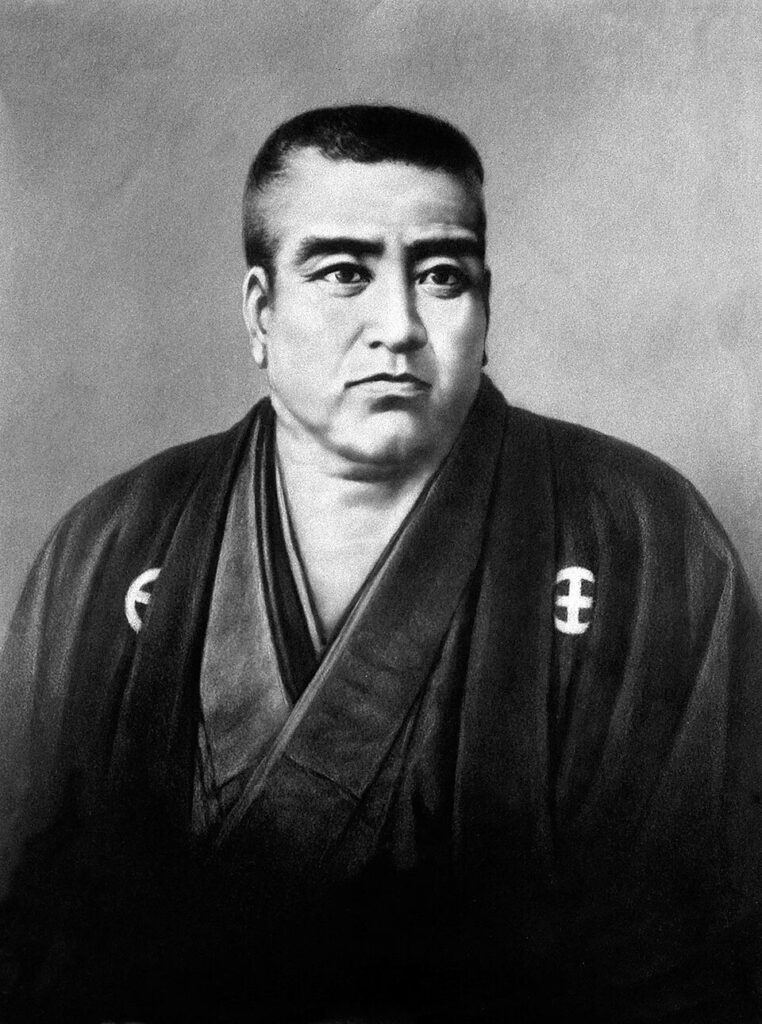
Ken Watanabe’s Katsumoto is one of the most memorable figures in modern historical cinema: an aristocratic warrior who despises Western technology, fights in traditional armour, and preserves the honour of the samurai through ritual suicide. The inspiration for this character — Saigō Takamori (1828–1877) — was, in almost every respect, his opposite.
The Real Saigō: From Reformer to Rebel
Saigō was born in Kagoshima, the capital of the Satsuma domain in southern Japan. As a low-ranking samurai, he grew up in one of the country’s most powerful, but also most conservative, domains. His early political career was driven by pragmatism rather than romanticism: he initially advocated rapprochement between the imperial court in Kyoto and the Tokugawa shogunate — the policy known as Kōbu Gattai (Ravina 2004: 60).
But Saigō’s rise was far from straightforward. He was exiled twice — first in 1858 to the subtropical island of Amami-Ōshima, where he spent three years living in impoverished conditions, married a local woman, and fathered children. A second exile followed in 1862 on the even more remote island of Okinoerabujima. On both occasions, Satsuma’s daimyō sacrificed him for political reasons. These experiences shaped Saigō’s character more profoundly than any battle: he developed a combination of stoic acceptance of fate and deep scepticism toward political power — qualities the film completely ignores.
When the shogunate proved incapable of reform, Saigō changed strategy. In 1866, he helped forge the secret alliance between Satsuma and its longtime rival Chōshū, an alliance that ultimately made possible the overthrow of the Tokugawa. Ravina compares this diplomatic manoeuvre to “Nixon goes to China”: because Saigō had previously advocated the destruction of Chōshū, he could credibly argue for an alliance without appearing weak (Ravina 2004: 141). After the Boshin War (1868–1869), Saigō became one of the architects of the new Meiji state — helping to establish the conscript army and abolish the feudal domain system.
Film vs. Reality: A Systematic Comparison
The differences between Katsumoto and Saigō are not matters of nuance — they are fundamental.
Katsumoto in the film categorically rejects everything Western. He wears traditional armour, fights exclusively with the sword, and embodies a Japan resisting modernity. His death by seppuku becomes the ultimate act of resistance against a world that has no place for him.
Saigō in reality was himself a modernizer. He established artillery schools, purchased modern rifles, and wore a French-style general’s uniform on official occasions. His break with the Meiji government was not a rejection of Western technology, but a protest against what he saw as the moral corruption of the new oligarchs (Ravina 2004: 190). Saigō did not seek a return to feudalism. He wanted a different kind of modernization — one grounded in Confucian ethics of virtue rather than political expediency.
Ravina captures the tragedy of Saigō’s life in a single sentence: “He was a modernizer who helped to build a conscript army and a modern state. The tragedy of his life was not that he opposed change, but that he could not control the changes he helped to unleash” (Ravina 2004: 8).
What Really Motivated Saigō
The key to understanding Saigō’s motivations lies not in the film’s version of Bushidō, but in his Confucian belief that government should function through moral example. As his former ally Ōkubo Toshimichi increasingly centralized power and the Meiji oligarchs enriched themselves, Saigō saw this as a betrayal of the spirit of the Restoration (Ravina 2004: 190).
The Korea crisis of 1873 (Seikanron) illustrates this worldview. The film suggests a cultural conflict; historically, the dispute was primarily diplomatic. Korea refused to recognize the Japanese emperor as an equal sovereign, which Japan regarded as an affront. Saigō proposed offering himself as an envoy: he intended to travel to Korea, provoke his own assassination, and thereby give Japan a morally legitimate pretext for war (Ravina 2004: 201). This was not simply a desire for war — it was a high-risk diplomatic strategy rooted in a Confucian ethic of self-sacrifice.
When the government rejected his plan, Saigō resigned and withdrew to Kagoshima. What followed was not his original plan, but an escalation that he could no longer control.
Hollywood vs. History: The Ultimate Fact Check
The Last Samurai is not a documentary — nobody expects it to be. Yet the film presents its fiction so convincingly that millions of viewers may take it for historical truth. A systematic examination reveals that many of the film’s central claims are either historically inaccurate or heavily distorted.
What the Film Claims — and What Really Happened
Samurai fought with katanas against Gatling guns. This iconic scene — swords against machine guns — is the film’s most effective historical fiction. The Satsuma rebels of 1877 were not technophobic traditionalists. They possessed rifles, cannons, and modern artillery. Saigō’s forces did not lose because they brought swords to a gunfight; they ultimately ran out of ammunition (Ravina 2004: 225). The truth is less cinematic but historically more significant: this was a war between two modern-armed forces, not a clash between the past and the future.
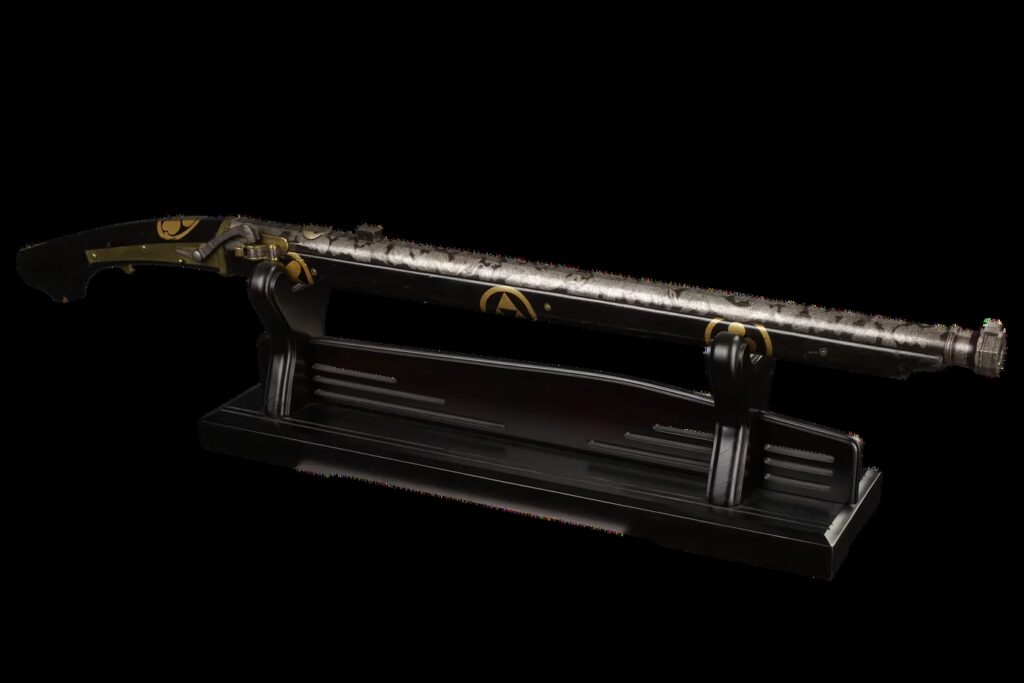
Katsumoto categorically rejects Western technology. The historical Saigō was one of the architects of the Meiji military reforms. He established artillery schools, helped organize the new conscript army, and himself wore a French-style general’s uniform (Ravina 2017: 157).
Katsumoto commits ritual seppuku. The iconic final scene, in which Katsumoto drives a sword into his abdomen while enemy soldiers kneel before him, is historically impossible. Saigō had been rendered immobile by a gunshot wound to the thigh and also suffered from filariasis, a tropical disease that caused severe swelling and made kneeling impossible. He died by decapitation at his own request, not by ritual suicide (Ravina 2010: 692). We will examine this particular myth in a separate chapter below.
A white American becomes a samurai. The historical figures who most closely resemble Nathan Algren were not Americans but Frenchmen: Jules Brunet and Eugène Collache fought on the side of the shogunate during the Boshin War (1868–1869). Both were military advisers, not disillusioned outsiders searching for spiritual redemption.
Bushidō as an ancient samurai code. In the film, the samurai follow a centuries-old code of honour called Bushidō. Historian Oleg Benesch has shown, among other things, that the term does not appear in medieval texts (Benesch 2014: 16). Bushidō in its modern form was constructed around 1900 — after Saigō’s death. We will devote a separate chapter to this myth as well.
The Three Most Important Film Scenes — and Their Historical Reality
Three key scenes deserve particular attention because they distort the historical picture most dramatically.
The ninja attack on Katsumoto’s village is pure fiction. There were no historical ninja assassins operating in Japan in the 1870s. The last documented activities of spies and saboteurs who could reasonably be described as ninja date back centuries. The scene draws on a Western stereotype that has little to do with the Meiji period.
The idyllic village, where Algren discovers the “pure” culture of the samurai, suggests a pre-modern utopia. In reality, rural Japan in the 1870s was marked by poverty, food shortages, and profound social upheaval. The abolition of the samurai status had left hundreds of thousands of former warriors facing economic hardship — hardly the picturesque setting for spiritual contemplation portrayed in the film.
The final cavalry charge against Gatling guns is cinematically brilliant but historically implausible. The Satsuma rebels themselves possessed rifles and artillery. Frontal cavalry assaults against fortified positions were already widely recognized as highly dangerous by 1877, following the experience of conflicts such as the American Civil War (1861–1865). In the context of Japan in 1877, such an attack would have been tactically reckless rather than heroic.
The Pattern Behind the Errors
The film’s historical inaccuracies are not entirely random. They follow a pattern that literary theorist Edward Said described as Orientalism: the West projects its own desires onto another culture. Japan becomes a canvas for a story about the “noble savage” living in harmony with nature while modernity destroys everything authentic. The same narrative pattern can be found in Dances with Wolves, Avatar, and numerous other Hollywood productions — the “white savior” who supposedly understands a foreign culture better than the people who belong to it.
The problem is that this narrative turns real historical actors into supporting characters in their own history. The historical Saigō was not a passive victim of modernization — he was one of its architects. His conflict was not simply tradition versus progress, but a political struggle over the kind of modernization Japan should pursue. That is more complicated than Hollywood’s black-and-white narrative — and precisely for that reason, historically more significant.
The Satsuma Rebellion: What Really Happened
The film presents a clear-cut narrative: traditionalist samurai rise up against a government determined to destroy their culture. The reality of the Satsuma Rebellion of 1877 was far more complicated — a political power struggle within the Meiji elite, fought by men who had once worked together to overthrow the shogunate and were now divided over the future of Japan.
The Trigger: The Sword Ban and the Private Academies
After Saigō resigned from the government in 1873, he returned to Kagoshima and established private academies (Shigakkō) that combined military training with Confucian ethics. He did not plan an uprising — but his students became increasingly radicalized. When the Meiji government introduced the Haitōrei edict in 1876, banning the public wearing of swords, resentment grew. For many former samurai, the sword was not merely a weapon but a symbol of status — and its prohibition represented the final loss of their privileged social position.
The situation escalated when government agents attempted to seize weapons from the Kagoshima arsenal. Saigō’s students took up arms. Saigō himself reluctantly assumed leadership — not out of revolutionary enthusiasm, but out of a fatalistic sense of loyalty toward his followers: he could not abandon them (Ravina 2004: 225).
The War: Modern Weapons, Not Medieval Combat
The Satsuma army that marched north in February 1877 bore little resemblance to the force depicted in the film. Some 40,000 men — including former samurai, but also farmers and other recruits — took part in the rebellion. They did not march in traditional armour. They wore field clothing and carried rifles, artillery, and ammunition wherever supplies allowed.
The siege of Kumamoto Castle lasted more than fifty days and ended unsuccessfully. At Tabaruzaka, a mountain pass north of Kumamoto, some of the bloodiest fighting of the entire war took place. For seventeen days, government troops and rebels fought from trenches less than a hundred metres apart — conventional positional warfare accompanied by artillery fire that resembled the battlefields of the American Civil War far more than medieval samurai duels. Thousands were killed on both sides, and the Satsuma army lost many of its most effective fighting units at Tabaruzaka.
The End: Shiroyama
By September 1877, Saigō’s army had been reduced to only a few hundred men. On Shiroyama, a hill overlooking Kagoshima, they made their final stand. Thirty thousand government troops faced roughly three hundred rebels. The outcome was clear from the outset.
The rebellion ultimately claimed more than 12,000 lives on both sides and imposed costs that pushed the Meiji state toward the brink of bankruptcy (Jansen 1989: 388). It was the last major uprising of former samurai — but not the romantic downfall of a noble warrior class portrayed by the film. It was a bloody modern war, fought with modern weapons and driven by political struggles over power and the future of Japan.
Saigō’s Death – The Film’s Greatest Historical Fiction
The final scene of The Last Samurai is one of the film’s most powerful moments: Katsumoto, mortally wounded, performs seppuku on the battlefield. The enemy soldiers kneel before him. The camera rises. Hans Zimmer’s score swells. It is great cinema — and it is entirely fictional.
What the Sources Actually Tell Us
In 2010, historian Mark Ravina published a forensic analysis of Saigō’s death in the Journal of Asian Studies, a leading peer-reviewed journal in the field. His conclusion is clear: Saigō could not have killed himself in the manner described by the popular legend. Instead, he was incapacitated by a gunshot wound and decapitated by one of his followers (Ravina 2010: 692).
The facts are these: on the morning of September 24, 1877, a bullet struck Saigō in the area of his thigh and hip. The wound left him unable to move. He also suffered from filariasis, a parasitic disease that caused severe swelling and had already made it impossible for him to ride a horse before the battle. He was transported in a palanquin, not on horseback. The conventional seppuku position — kneeling and driving a short sword into the abdomen — would therefore have been physically impossible under these circumstances (Ravina 2010: 699).
Saigō asked his follower Beppu Shinsuke to grant him a merciful death. Beppu decapitated him. Saigō’s followers then attempted to hide his head so that the enemy could not identify him. The Meiji army nevertheless found the head and identified the headless body through a detail that later official accounts largely avoided discussing: the severe swelling of his testicles caused by filariasis (Ravina 2010: 699).
How the Myth Was Created
The seppuku legend was not simply a spontaneous popular memory — it also served a political purpose. Ravina shows how nishiki-e woodblock prints produced only days after the battle already depicted Saigō in full armour and in a ritual pose. These images created a visual “truth” that spread faster than eyewitness accounts. The effect was to transform Saigō into an exemplary figure of samurai honour rather than a dangerous challenger to the state (Ravina 2010: 696).
The Meiji government had reasons to accommodate such a legend. A rebel who dies honourably through ritual suicide is easier to rehabilitate than a wounded man whose followers had to decapitate him. In 1889, Emperor Meiji granted Saigō a posthumous pardon. The famous bronze statue in Tokyo’s Ueno Park depicts him in a simple kimono with his dog — unarmed, depoliticized, and domesticated. The transformation from revolutionary to popular patriot was part of the later remaking of Saigō’s image (Ravina 2004: 250).
Another popular belief shows just how deeply the mythologization took hold. When Mars appeared unusually bright in the autumn of 1877, a rumour spread that Saigō was not truly dead but had become visible in the heavens as a star. Newspapers referred to the planet as Saigō-boshi — the “Saigō Star.” A rebel who had challenged the government during his lifetime was transformed after his death into a celestial guardian.
The “last samurai” had not simply died — he had been turned into a legend. More than a century later, Hollywood drew on the same impulse: transforming a deeply contradictory historical figure into an almost flawless symbol.
Bushidō in the Film – A Myth That Tells a Myth
In The Last Samurai, the samurai follow an ancient code of honour called Bushidō — seven virtues that supposedly governed the lives of the warrior class for centuries. Nathan Algren learns these virtues in the samurai village and discovers in them the clarity that Western civilization could not provide. It is an appealing image. It is also historically untenable.
The Invention of Bushidō
In 2014, historian Oleg Benesch published the most comprehensive study to date of the concept of Bushidō with Oxford University Press. His conclusion: the term does not appear in medieval texts. What we know today as the “centuries-old samurai code” was constructed between 1894 and 1900 by intellectuals seeking to give Japan a distinct cultural identity during the age of imperialism (Benesch 2014: 16).
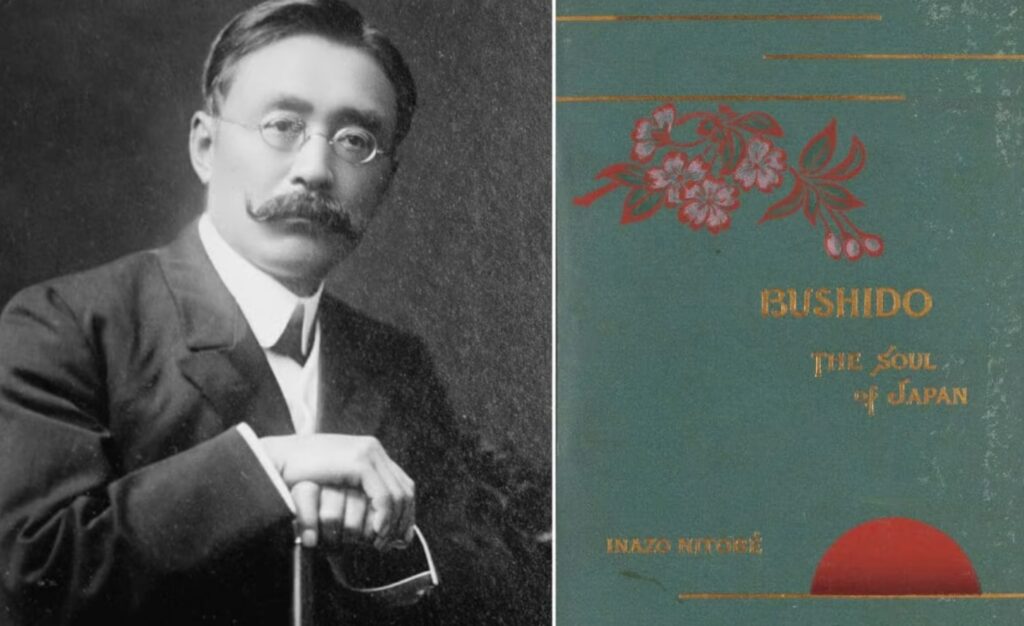
The decisive step came with Nitobe Inazō. His book Bushido: The Soul of Japan was published in 1900 — in English, in Philadelphia, not in Japan. Nitobe, a Christian Quaker, was responding to a question from a Belgian jurist who asked how Japan could teach morality without a Christian tradition. His answer was Bushidō. Yet Nitobe projected Western ideals of chivalry onto the samurai. His “seven virtues” were not a historical analysis, but a cultural translation written for a Western audience unfamiliar with Japan.
The paradox is that Nitobe’s book was initially criticized in Japan itself. Japanese scholars accused him of romanticizing the samurai. Only after the book became a success in the West did Japanese nationalists adopt Nitobe’s version and use it as military propaganda in the 1930s (Benesch 2014: 199).
The Real Ethics of the Samurai
The historical Saigō Takamori knew no “Bushidō” in this modern sense — the concept only became influential after his death. What shaped his political outlook was Confucian virtue ethics: the belief that a ruler should govern through moral example rather than violence or self-interest (Ravina 2004: 190).
The Cultural Feedback Loop
The Last Samurai therefore tells a myth based on another myth: Nitobe constructed Bushidō partly as a cultural explanation for a Western audience. Hollywood transformed that construction into a cinematic vision of samurai Japan. The film was then received around the world as an image of “authentic Japan.”
This creates a remarkable feedback loop: a Western interpretation of Japan travels through Japanese nationalism, into Hollywood, and back into Western popular culture as supposedly authentic history. In that sense, this may be the most revealing story the film tells — without ever realizing that it is
Back to Shiroyama, September 1877. The real Saigō Takamori did not die like a movie hero — no white kimono, no ritual sword, no enemies kneeling before him. A wounded man asked for a swift death, and his friend granted him that final service.
And yet that is precisely what makes Saigō’s story more revealing than any screenplay. Here was a man who helped modernize his country and was exiled twice for his political convictions. A man who helped restore imperial rule and later rebelled against the government he had helped create. A man who established artillery schools and wore a French military uniform, yet remained committed to the Confucian belief that power without morality is worthless. No Hollywood screenwriter could have invented these contradictions — they are simply too human for a heroic legend.
Tom Cruise’s Nathan Algren finds an answer to his crisis of purpose in Japan. Historical reality offered no easy answers. Saigō, Ōkubo, and the Meiji oligarchs were all grappling with the same fundamental question: How do you modernize a country without losing its soul? That question is as relevant today as it was in 1877. Every society undergoing profound change — whether through technology, globalization, or political upheaval — faces a version of Saigō’s dilemma: How much change can a culture absorb before it loses something of itself? Hollywood answers the question with nostalgia. History answers it with complexity.
At the Samurai Museum Berlin, visitors can encounter objects from precisely this period of transformation. Among them is a Momoyama-period tantō, signed by the swordsmith Umetada Myōju, with an Edo-period sword mounting — an object that spans several historical eras, much like the people of this period who found themselves caught between worlds.
The real “last samurai” was neither Tom Cruise nor Ken Watanabe. He was a deeply contradictory human being, caught between tradition and modernity — and whose true story Hollywood could never fully tell. Not because it is less dramatic, but because it is too complex for a happy ending.
Frequently Asked Questions About The Last Samurai
Is The Last Samurai historically accurate?
No. The film takes considerable liberties with historical events. The biggest departures concern the character of Katsumoto — the historical Saigō Takamori was a modernizer, not an opponent of technology — the portrayal of the Satsuma Rebellion — the rebels fought with rifles and artillery, not swords against machine guns — and the death of the central character. Saigō did not die by seppuku; after being wounded by a gunshot, he was decapitated at his own request. The concept of Bushidō as presented in the film also did not exist in this form during Saigō’s lifetime. It was developed around 1900, notably through the writings of Nitobe Inazō.
Who was the real-life inspiration for Katsumoto?
Ken Watanabe’s character is based on Saigō Takamori (1828–1877), one of the most important political figures of the Meiji Restoration. Saigō helped overthrow the Tokugawa shogunate and played a major role in building the modern Japanese state. His break with the Meiji government ultimately led to the Satsuma Rebellion of 1877 — the last major uprising of former samurai. Unlike the film’s Katsumoto, Saigō was not opposed to modernization. His conflict with the government centred largely on the political and moral direction of the new state.
Was there really an American samurai?
Nathan Algren has no direct historical counterpart. The real Western military advisers serving in Japan during the 1860s and 1870s were predominantly French, including Jules Brunet and Eugène Collache, who fought on the side of the shogunate during the Boshin War. Neither became a “samurai” in the way portrayed by the film, and neither fought in the Satsuma Rebellion.
How did Saigō Takamori really die?
On September 24, 1877, Saigō was seriously wounded by a bullet in the thigh during the fighting at Shiroyama. He also suffered from filariasis, which made kneeling extremely difficult. He asked his follower Beppu Shinsuke to decapitate him, providing a swift death rather than performing ritual seppuku himself. According to historian Mark Ravina, the widely circulated seppuku story became part of a political mythology that helped facilitate Saigō’s later rehabilitation by the Meiji state.
What does the title The Last Samurai mean?
The title refers to the Satsuma Rebellion of 1877 as the last major uprising associated with the former samurai class. The Haitōrei edict of 1876, which restricted the public wearing of swords, symbolized the formal dismantling of samurai privileges and status. The Satsuma Rebellion was the last major armed uprising of former samurai against the Meiji government. In the film, however, the title is deliberately ambiguous, referring both to Katsumoto and, in a different sense, to Algren.
Visit the Samurai Museum Berlin
Discover the true history behind the film in our permanent exhibition. Open daily from 10 am to 7 pm at Auguststraße 68, Berlin-Mitte.
Related Articles
- Bushidō: The Samurai Code of Honour
- Seppuku: The Ritual Suicide of the Samurai
- Samurai: History, Culture and Legacy
Quellenverzeichnis
- Benesch, Oleg (2014): Inventing the Way of the Samurai: Nationalism, Internationalism, and Bushidō in Modern Japan. Oxford University Press.
- Jansen, Marius B. (ed., 1989): The Cambridge History of Japan, Vol. 5: The Nineteenth Century. Cambridge University Press.
- Nitobe, Inazō (1900): Bushido: The Soul of Japan. Leeds & Biddle, Philadelphia.
- Ravina, Mark (2004): The Last Samurai: The Life and Battles of Saigō Takamori. John Wiley & Sons.
- Ravina, Mark (2010): “The Apocryphal Suicide of Saigō Takamori: Historiography of a Myth.” Journal of Asian Studies 69(3), pp. 691–721.
- Ravina, Mark (2017): To Stand with the Nations of the World: Japan’s Meiji Restoration in World History. Oxford University Press.
© Samurai Museum Berlin – All rights reserved
You might also like
Ninja Pop Culture: From Turtles to Naruto — Myth & Reality
Ninja pop culture: from Turtles to Naruto – how the black suit belongs to Kabuki theatre, not the battlefield. Myth…
Read the article
Kill Bill & Hattori Hanzō: Where Myth Meets History
Kill Bill and Hattori Hanzō: Myth and Reality of the Famous Ninja Clan Okinawa, a small sushi restaurant. Behind the…
Read the article
Sekiro: Shadows Die Twice — The True Sengoku History
Sekiro: Shadows Die Twice – What is historical, what is fiction? The real Sengoku history behind the game, explained with…
Read the article