Introduction
13 April 1612, Ganryūjima Island. Miyamoto Musashi arrives — hours late. His opponent Sasaki Kojirō is waiting, sword already drawn. Musashi carries no katana. He has carved one from a boat oar. Wood against steel. When Kojirō attacks, Musashi strikes him down with a single blow — and rows away.
The world knows this samurai: cool, calculating, sword in hand. Seven centuries of Japanese history have honed this image. But it is wrong.
In fact, the sword never served as the warriors’ primary weapon. For the early samurai were not swordsmen — they were mounted archers who drew the sword only when the bow failed. The code of honour we call bushidō did not arise on battlefields, but in Edo-period offices, written by unemployed samurai who had not seen a war for two generations. And the man who explained this code to the world — Inazō Nitobe, author of Bushidō: The Soul of Japan (1900) — was born after the samurai class had been abolished.
What remains when you subtract the myth? Seven centuries of one of the most fascinating processes of transformation in world history: frontier warriors become feudal lords, feudal lords become bureaucrats, bureaucrats become icons. Every generation reinvented the samurai — and every generation believed it knew the original version.
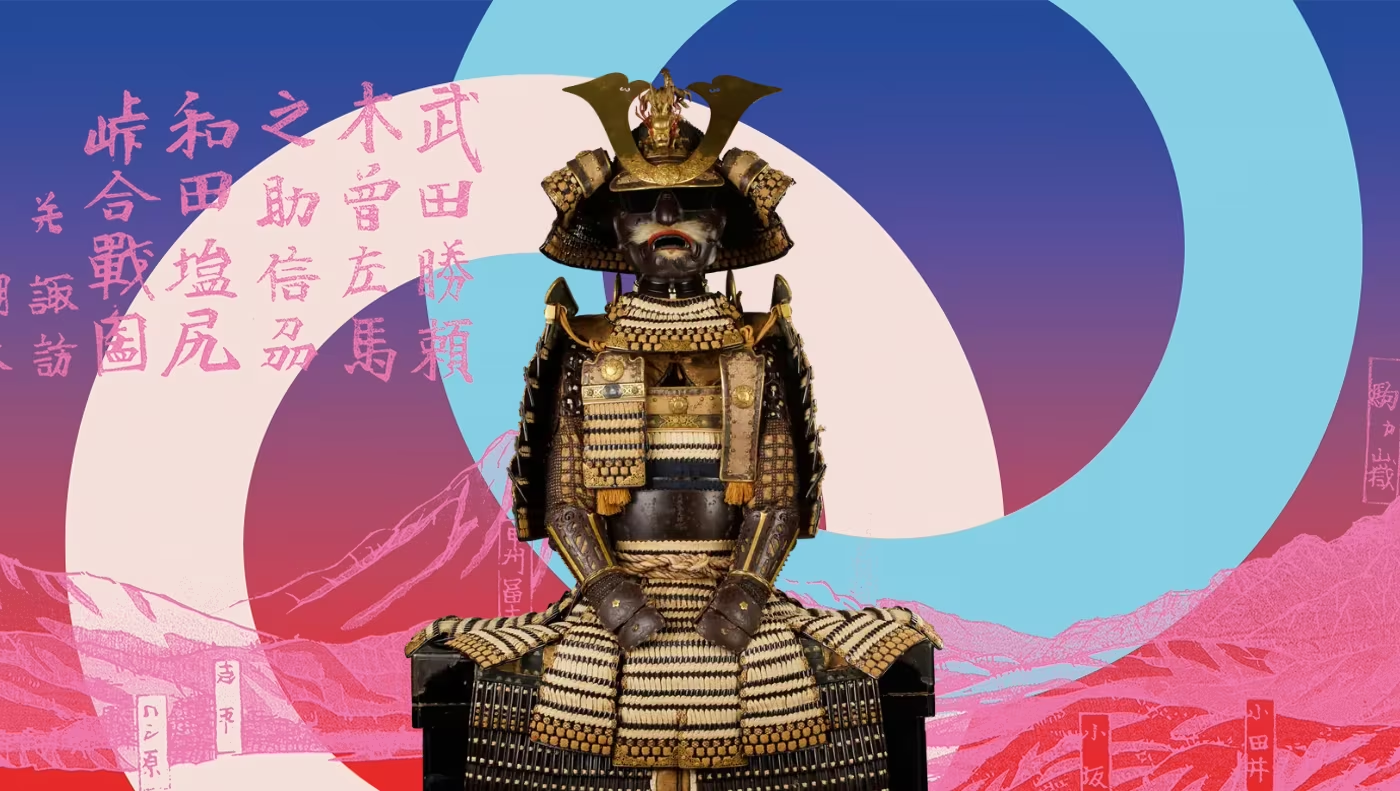
At the Samurai Museum Berlin, around 900 exhibits from the 11th to the 19th century tell of this change.
The Birth of the Warrior Class (794–1185)
792 AD, north-eastern Japan. Sakanoue no Tamuramaro leads 10,000 warriors against the Emishi — the indigenous population resisting subjugation by the imperial court in Kyōto. His archers ride, shoot, evade. Tactics they have adopted from their opponents.
They were frontier warriors, tax collectors and enforcers for local power-holders, securing landholdings, enforcing levies and putting down uprisings. The British Japanologist and non-fiction author Jonathan Clements soberly describes them as “men who learned from their enemies”: culturally Japanese, militarily pragmatic.
The weapon of these early warriors was the bow, not the sword. The tachi, the first curved Japanese sword of this era, was worn hanging — blade downwards, optimised for quick access from horseback. Its role: an emergency weapon for close combat when the bow failed. They were also used to carry out a first attack from horseback.
The Genpei War (1180–1185)
While the imperial court in Kyōto, Japan’s ancient cultural and political heart, remained in ceremonial impotence, two warrior families rose to become the real holders of power: the Taira and the Minamoto. Both descended from deposed imperial lines — princes who had been sent to the provinces to remove them from the line of succession. What began as political banishment became a power base.
25 March 1185, Bay of Dan-no-Ura. The Taira fleet encircles the Minamoto ships. Then the current turns. The Minamoto warriors board, ship by ship. Emperor Antoku, five years old, is thrown into the sea by his grandmother, who then throws herself into the waves too — together with the sacred sword Kusanagi, symbol of imperial legitimacy. Taira rule ends in the water.
The Heike Monogatari (平家物語), written down later, describes this moment with epic tragedy. In the eleventh book it says:
“The widow Nii-no-Ama took the emperor in her arms. ‘At the bottom of the sea is our capital,’ she said to the child. She leapt into the waves, and with her the sun sank.”
Historical reality was more prosaic. The American military historian Karl Friday describes the early samurai not as loyal vassals of an honourable code, but as paid specialists in violence — hired swords — who offered their services to the highest bidder. The Genpei War was not a duel between honour and betrayal. It was a struggle over the distribution of land, taxes and political influence.
Minamoto no Yoritomo (1147–1199), the victor, built his power on networks of vassals, not on swordsmanship. In 1192 the emperor appointed him shōgun — “General for the Subjugation of the Barbarians”, as the title was called in the 7th/8th century. The first shogunate was established in Kamakura, far from the imperial court. The samurai were no longer servants. They were the rulers.
The Kamakura Shogunate and the Mongol Invasion (1185–1333)
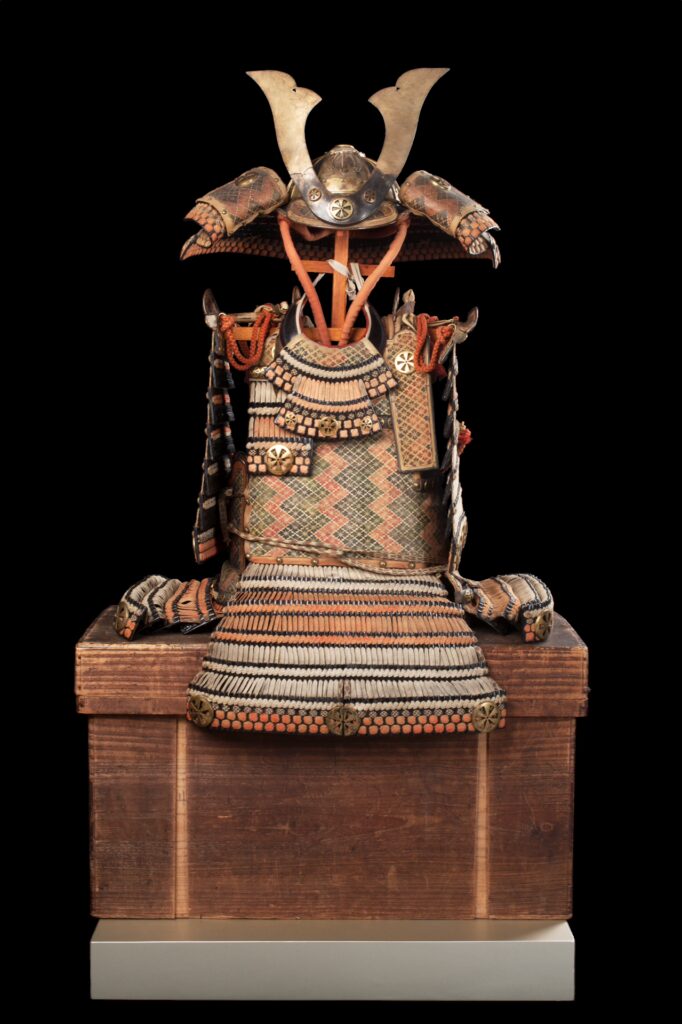
Minamoto no Yoritomo, victor of the Genpei War and Japan’s first shōgun, did not build his apparatus of power in Kyōto — the seat of the imperial court, which as an opponent he never wanted to lose sight of — but in remote Kamakura. The emperor remained on his throne, a figurehead without real power. The new shogunate bureaucracy administered the country, levied taxes, dispensed justice. Samurai now received lands (chigyō, 知行) in return for loyalty — no longer a mercenary contract. From this a feudal system emerged.
This order lasted eighty years. Then came Kublai Khan.
The Wave of Mongol Invasions (1274 & 1281)
In November 1274, 30,000 Mongol-Korean and Chinese warriors landed in Hakata Bay on Kyūshū.
The Mongols attacked in formation, coordinated by drum signals. Explosive incendiary bombs (teppō, 鉄砲) struck between the samurai’s horses. The animals shied, threw their riders and fled. What the samurai had expected to face as individual fighters was a machine.
The samurai Takezaki Suenaga recorded this encounter in an illustrated handscroll — the Mōko Shūrai Ekotoba (蒙古襲来絵詞, 1293). It shows him himself desperately pulling a Mongol soldier from his horse: not an honourable duel, but chaotic close combat. But the scroll was more than a chronicle — it was Suenaga’s personal petition. After the battle he had to travel to Kamakura and personally attest to his heroic deeds, because no one believed that a simple warrior had fought like that. The Ekotoba was his visual proof.
In 1281 the Mongols returned — this time with 140,000 warriors. Stone walls along the coast, guerrilla tactics, night fighting: the samurai had learned. Even so, the decision was not brought about by a sword — a typhoon ended the war. The kamikaze (神風, “divine wind”) destroyed the Mongol fleet.
Zen Buddhism and Kamakura Culture
In 1191 the monk Eisai brought the Chan teaching from China to Japan — and with it a practice that immediately attracted samurai: meditation as a method of taming fear. Zen emphasised direct experience instead of theoretical knowledge, discipline instead of ritual, the present moment instead of promises of the hereafter. For men who fought between life and death, this was a craft — not a luxury.
Friday urges caution: most samurai of the Middle Ages were pragmatic landowners, not philosophical warriors. Zen monasteries were promoted by the elite — as an instrument of power, not out of spiritual conviction. The Hōjō clan, which controlled the Kamakura shogunate after Yoritomo’s death, financed Zen temples in order to create a cultural alternative to the imperial court in Kyōto. Philosophy and politics lay close together.
Sengoku Jidai: The Century of Wars (1467–1615)
1467: Kyōto burned. The Ōnin War, a succession dispute among rival clans, reduced the capital to ashes — and with it the last illusion of central rule. What followed were 130 years in which Japan tore itself apart.
One principle of this era was called gekokujō (下克上, “the low overcome the high”): servants overthrew masters, peasants became generals. Toyotomi Hideyoshi, the later unifier of the realm, began as a foot soldier without.
The Tanegashima Revolution
Until 1543 Japan had kept the world at a distance — the Mongols from the north, the Chinese imperial court through diplomatic distance, the sea as a natural rampart. Then two Portuguese traders landed on the small island of Tanegashima, and with them came something Japan had never seen before: muskets.
The daimyō Tanegashima Tokitaka immediately bought two of them — at a price described in later chronicles as astronomical. He ordered his smiths to take the weapons apart and understand them. What the Portuguese had not reckoned with: Japanese swordsmiths were among the best metalworkers in the world. Within months they were producing working copies. Within fifty years Japanese gunsmiths were making more muskets than any European country.
Why did the Portuguese not simply subjugate Japan with their technological lead? They came as traders — silver, silk and spices interested them more than territory. Japan was, moreover, no passive target: 130 years of civil war had produced a warrior class that would fight foreigners with firearms just as it would fight foreigners without them. And the muskets themselves were anything but invincible — inaccurate beyond thirty metres, slow to reload, useless in the rain. Their real strength lay in the commander who deployed them.
Oda Nobunaga was that commander. 1575, the valley of Nagashino: his 3,000 musketeers fired in three rotating ranks — volley after volley, without pause. The mounted warriors of the Takeda clan charged into the fire. They fell, rank after rank, before they reached the enemy line. Nobunaga had eliminated the weakness of the musket — the long reloading time — through sheer rotation.
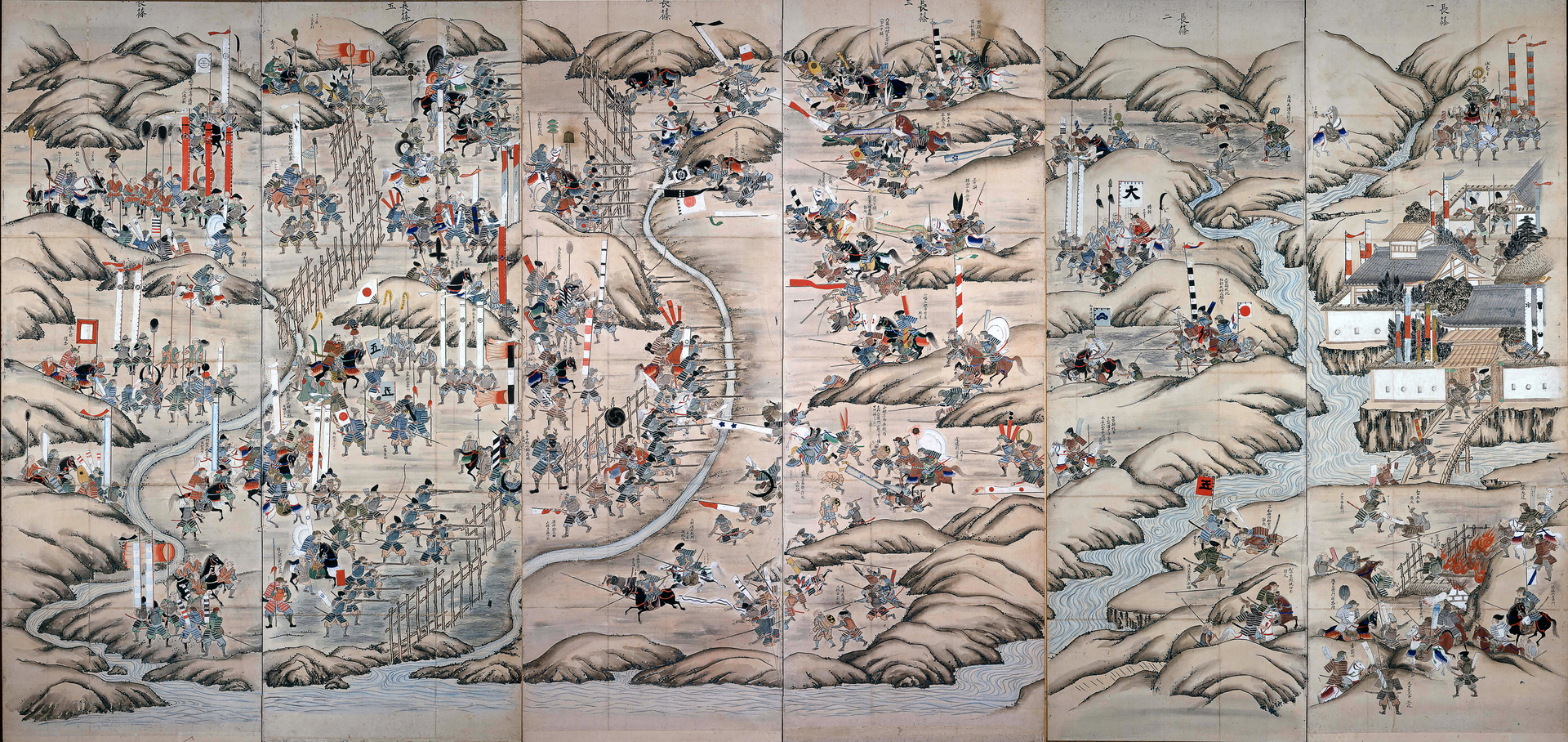
Changed warfare also forced the armourers to respond. The okegawa dō (桶側胴, “barrel cuirass”) came into being as a direct reaction to the new threat posed by firearms.
While armours became more compact, helmets grew to absurd proportions. The kawari kabuto (変わり兜, “unconventional helmets”) bore monumental crests (maedate, 前立): crescent moons, dragon horns, buffalo horns, stylised rabbits.
The helmets also document hierarchies. Simple foot soldiers (ashigaru, 足軽) wore plain straw hats or iron caps. Mid-ranking samurai: standardised suji kabuto with vertical ribs. Only daimyō and their elite warriors: the spectacular kawari kabuto.
Sekigahara (1600) — The Decisive Battle
21 October 1600, the valley of Sekigahara. Tokugawa Ieyasu stood in the morning mist watching 160,000 warriors form up — the largest battle in Japanese history. His opponent: Ishida Mitsunari, loyalist of the late Hideyoshi. They fought for six hours. The decision came not through military brilliance, but through betrayal — Kobayakawa Hideaki, nominally on Mitsunari’s side, changed sides in the middle of the fighting.
40,000 dead. Tokugawa Ieyasu, the patient strategist among Japan’s three unifiers of the realm, had won. In 1603 the emperor appointed him shōgun — thereby founding a dynasty that would last 265 years. The longest period of peace in Japan’s history. And the end of the samurai as warriors.
The Edo Period: From Warrior to Official (1615–1868)
Tokugawa Ieyasu had seen 40,000 dead in six hours — and made peace the only option. The sankin-kōtai system (参勤交代, “alternate residence”) forced every daimyō to spend every other year in Edo — his family stayed behind as hostages. Travel cost a fortune; rebellion was unaffordable. Japan sank into 250 years of enforced peace.
For the samurai this was a catastrophe without a battlefield. A warrior class that no longer had anything to fight. 400,000 armed men whose only function — war — had simply ceased to exist. They became bureaucrats, teachers, administrative officials. The shogunate continued to pay their stipends (fuchi) — an enormous burden that hollowed out the system over generations.
The Sword as a Status Symbol
In this void, the sword took on a new meaning. Since Hideyoshi’s “sword hunt” (1588), the daishō — katana and wakizashi, long sword and short sword together — had been a legally protected privilege of the samurai class. No peasant, no merchant, no craftsman was allowed to carry two swords. The daishō was no longer a fighting tool — it was a visible badge of social belonging. Turnbull describes it as a “soul in the political, not the military sense”: whoever carried the sword belonged. Whoever did not, did not.
The Invention of Bushidō
Why, of all times, did a systematic samurai “code of honour” emerge now — in an era without wars? The Oxford historian Oleg Benesch, in Inventing the Way of the Samurai (2014), has answered this question. His answer is sobering: bushidō was a crisis response, not an ancient code.
The samurai were caught in an identity trap. For centuries, combat and warfare had justified their existence. Now the shogunate was paying 400,000 warriors to do administrative work. Confucian scholars constructed a new answer: moral superiority, not fighting power, justified samurai privileges. Texts such as the Bushidō Shoshinshu (武士道初心集) by Daidōji Yūzan codified this reinterpretation — a code of honour as retrospective legitimation.
Yūzan’s text shows the Edo reality without embellishment:
“The samurai of today carries two swords, yet he has never learned to draw them. He speaks of loyalty, yet he knows no battlefield. When the lord dies, the samurai dies with him — that is the teaching. But when this happens, people say: ‘What a waste!’ The modern samurai is a contradiction.”
Yūzan described not what samurai were — but what they ought to be. Benesch has meticulously documented these contradictions. The samurai scholar Yamamoto Tsunetomo wrote in the Hagakure (1716): “The way of the samurai is death.” His contemporary Yamaga Sokō, a Confucian philosopher and one of the most influential thinkers of the Edo period, preached learning as the highest virtue. Daidōji Yūzan praised thrift. Three men, one era — three irreconcilable answers to the same question. The idea of a coherent bushidō only came into being when no one had to live by it any more.
The 47 Ronin: Loyalty as Theatre
In 1703, 47 masterless samurai (rōnin) demonstrated what bushidō meant in practice — or was supposed to mean. Their lord Asano Naganori had insulted the court official Kira Yoshinaka and had been sentenced to seppuku. For two years the 47 waited, collected money, won public sympathy, found political allies. Then they broke into Kira’s house and beheaded him. Afterwards they gave themselves up to the authorities.
The shogunate faced a dilemma: the rōnin had taken revenge — a samurai ideal. But they had broken the law. The solution: seppuku instead of execution, an honourable death instead of a criminal’s end. They immediately became folk heroes. That same year, kabuki theatres re-enacted the story.
Was it really loyalty? Two years of preparation, carefully calculated public sympathy, perfect timing — this was calculated political theatre. The story of the 47 Ronin says less about samurai honour than about the need of an unemployed warrior class to justify its existence. Bushidō as a stage show — at a time when the stage was the only battlefield left. This is at least one interpretation.
The Meiji Restoration: The End of the Samurai (1868–1876)
In July 1853, four American steamships anchored in Edo Bay. The Japanese called them kurofune — “Black Ships” — because they emitted coal smoke, something Japan had never seen before. Commodore Matthew Perry handed over a letter from US President Fillmore with the implicit demand for trade treaties, open ports and diplomatic relations. Then he sailed away — and gave the shogunate a year to think it over.
The message was clear without being spoken. Japan had observed what had happened to China in 1842: the Qing empire had resisted British trade demands — and had lost to gunboats in the First Opium War. Ports opened, territory ceded, sovereignty damaged. The shogunate knew what refusal meant.
In 1854 Perry returned — this time with seven ships. The Tokugawa shogunate, which had secured peace through isolation for 250 years, signed the Treaty of Kanagawa without resistance. The isolation was broken. Further treaties followed: with Great Britain, France, Russia, Holland — the so-called “Unequal Treaties”, which deprived Japan of control over its own ports and customs duties. Foreigners enjoyed extraterritoriality on Japanese soil. The humiliation was complete.
As a result, unrest began to simmer in the country. The sonnō jōi movement — “Revere the Emperor, expel the barbarians” — gained support among radical samurai clans, above all from Satsuma and Chōshū. In their view the shogunate was too weak to defend Japan and had to be removed. In 1868 the overthrow followed. What was presented as a return to tradition was in truth a coup d’état to wake the country up — and the bitterest irony followed immediately: in order to make Japan strong enough to resist the West, the new rulers copied precisely the West they had promised to drive out.
The scale of the abolition only becomes tangible through figures. In 1868 around 1.9 million people lived in the samurai class — around 6% of the population, including women and children. Within eight years this entire class was legally eliminated: in 1869 the daimyō had to return their fiefs, in 1871 the feudal domains were dissolved, in 1873 universal conscription deprived the samurai of their monopoly on arms, and in 1876 the Haitorei edict banned the public carrying of swords. Lifelong stipends were replaced by one-off government bonds — many samurai invested badly and became impoverished. Others found new roles as officials, officers, entrepreneurs.
Some resisted. Saigō Takamori, former hero of the Meiji Restoration, led the Satsuma Rebellion in 1877 — the last armed uprising of the samurai class. His 30,000 warriors fought with swords against an army of conscripts with modern rifles. It was not a fight. It was a massacre. Saigō committed seppuku on the battlefield.
Yet the Meiji government that had fought him posthumously declared him a national hero. It needed the myth it had just destroyed. Loyalty, willingness to sacrifice, obedience — bushidō became the state ideology for a modern army that no longer knew any samurai.
The Legacy: From Warrior to Global Icon
Militarism and Bushidō (1900–1945)
Inazō Nitobe’s Bushidō: The Soul of Japan (1900), originally written in English for a Western audience, became compulsory reading in Japan itself. Soldiers learned: death in the service of the emperor was the highest honour. The Hagakure quotation “The way of the samurai is death” — written by a man who had never fought, about warriors who had long been dead — now justified kamikaze attacks.
Hollywood and Global Reception
Akira Kurosawa rehabilitated the image in 1954 with Seven Samurai: warriors as protectors of the weak, not as a ruling class. Hollywood copied the narrative — from The Magnificent Seven to Star Wars. In The Last Samurai (2003), an American officer finds “true honour” among Japanese warriors — a projection that Japanese historians criticised as absurd. The modern samurai myth is a Western construct: Zen meditation, katana fetishism, a code of honour without context. It says more about Western longings for discipline and tradition than about historical reality.
The Ambivalence of the Legacy
Japan itself has a divided relationship with the samurai. On the one hand: pride in the aesthetics, the craftsmanship, the discipline. On the other: unease about the violence, the hierarchy, the militarist appropriation in the 20th century. In popular culture an aestheticised, depoliticised samurai dominates — manga, anime and video games show warriors without context, honour without history.
Conclusion: A Mirror of Japanese History
The samurai as the timeless embodiment of a fixed code of honour never existed. In every era he embodied what the balance of power demanded — frontier warrior who learned from his enemies; warlord who deployed firearms; bureaucrat who wore swords as works of art; myth that every generation reinterpreted. Every generation reinvented the samurai — and every generation believed it knew the original version.
Related Articles
- Bushidō: The Samurai Code of Honour
- The Katana: Technology, Symbolism and Myth
- Sengoku Jidai: The Century of Wars
- Seppuku: The Ritual Suicide
Frequently Asked Questions (FAQ)
When were the first samurai?
The samurai emerged in the late Heian period (794–1185). In the 12th century they established their political rule with the Kamakura shogunate (1192).
What does “samurai” literally mean?
The word is derived from the verb saburau (侍う), which means “to serve” or “to attend someone”. Originally it referred to guards and bodyguards of the imperial court.
Were samurai really as honourable as the myth claims?
No. The idea of a uniform “code of honour” (bushidō) is a back-projection from the Edo and Meiji periods. Historical samurai were pragmatic warriors who used betrayal, changing sides and violence as strategic means. Friday describes them as hired swords — specialists in violence who offered their services.
Why are samurai swords so legendary?
The katana only became the symbol of samurai identity in the Edo period (1615–1868) — when samurai were no longer warriors. In the warlike centuries the bow was the main weapon. The “soul of the samurai” romanticism arose when swords became art objects.
How many samurai were there?
At the height of the Edo period, the samurai class comprised around 1.9 million people (approx. 6% of the population), of whom around 400,000 were adult male warriors. Between 1868 and 1876 the entire class was legally abolished.
What is seppuku and why did samurai practise it?
Seppuku (切腹, “cutting the belly”), often also called harakiri, was ritual suicide. Originally a method of preserving honour after defeat, in the Edo period it became a judicial punishment for samurai. The practice had more to do with status than with “honour” — only samurai were permitted to commit seppuku.
What is the difference between samurai and ninja?
Samurai were the official warrior caste with legal status during the Edo period. Ninja (shinobi) were spies, saboteurs and assassins — often recruited from lower social strata. The dramatic distinction “honour vs. deceit” is fiction; many daimyō employed ninja for covert operations.
Why did the samurai era end?
The Meiji Restoration (1868) modernised Japan along Western lines. Universal conscription (1873) made the samurai obsolete as an exclusive warrior caste. The Haitorei edict (1876) banned the public carrying of swords. The last armed rebellion (Satsuma, 1877) was crushed.
How does the samurai myth influence Japan today?
Ambivalently. On the one hand: pride in aesthetics, craftsmanship, discipline. On the other: unease about militarist appropriation in the 20th century. In popular culture an aestheticised, depoliticised samurai dominates — more Zen meditation than violence.
Sources and Further Reading
Primary Sources
- Heike Monogatari (平家物語, c. 1330) – The great war tale of the Genpei War (1180–1185). Quoted: Book 11 (Dan-no-Ura).
- Bushidō Shoshinshu (武士道初心集, Daidōji Yūzan, 1716) – “The Foundations of Bushidō”. Edo-period text on samurai ethics, written in an era without wars.
- Mōko Shūrai Ekotoba (蒙古襲来絵詞, Takezaki Suenaga, 1293) – Illustrated handscroll on the Mongol wars of 1274 and 1281. A visual eyewitness account.
- Hagakure (葉隠, Yamamoto Tsunetomo, recorded c. 1716) – “Hidden Leaves”. A collection of sayings about the “way of the samurai”, written down 100 years after the end of the age of war.
Expert Catalogues (Samurai Museum Berlin)
- Bottomley, Ian (2025). „History of Japanese Arms and Armour”. In: Samurai Museum Berlin: Main Catalogue.
→ Cited for: tachi development, transformation of armour - Bottomley, Ian (2021). „History of Japanese Arms and Armour”. In: Armours of the Samurai: The Janssen Collection.
→ Cited for: ō-yoroi typology, Kamakura armours - Lesniewska, Martyna (2024). „Kawari Kabuto: Unconventional Helmets of the Sengoku Period”. In: Helmets of the Samurai.
→ Cited for: helmet symbolism, psychological warfare
Secondary Literature
- Benesch, Oleg (2014). Inventing the Way of the Samurai. Oxford University Press.
- Clements, Jonathan (2017). A Brief History of Japan. Tuttle Publishing.
- Friday, Karl F. (2004). Samurai, Warfare and the State in Early Medieval Japan. Routledge.
- Hall, John Whitney & McClain, James L. (eds.) (1991). The Cambridge History of Japan, Volume 4: Early Modern Japan. Cambridge University Press.
- Ikegami, Eiko (1995). The Taming of the Samurai. Harvard University Press.
- Jansen, Marius B. (ed.) (1989). The Cambridge History of Japan, Volume 5: The Nineteenth Century. Cambridge University Press.
- Ravina, Mark (2004). The Last Samurai: The Life and Battles of Saigō Takamori. Wiley.
- Shively, Donald H. & McCullough, William H. (eds.) (1999). The Cambridge History of Japan, Volume 2: Heian Japan. Cambridge University Press.
- Turnbull, Stephen (1996). The Samurai: A Military History. Routledge.
- Varley, H. Paul (1994). Warriors of Japan as Portrayed in the War Tales. University of Hawai’i Press.
- Yamamura, Kōzō (ed.) (1990). The Cambridge History of Japan, Volume 3: Medieval Japan. Cambridge University Press.
Further Resources
→ Complete bibliography with 180+ academic sources
→ Tickets & opening hours
© Samurai Museum Berlin – All rights reserved
