 Nominated for the EMYA2026 award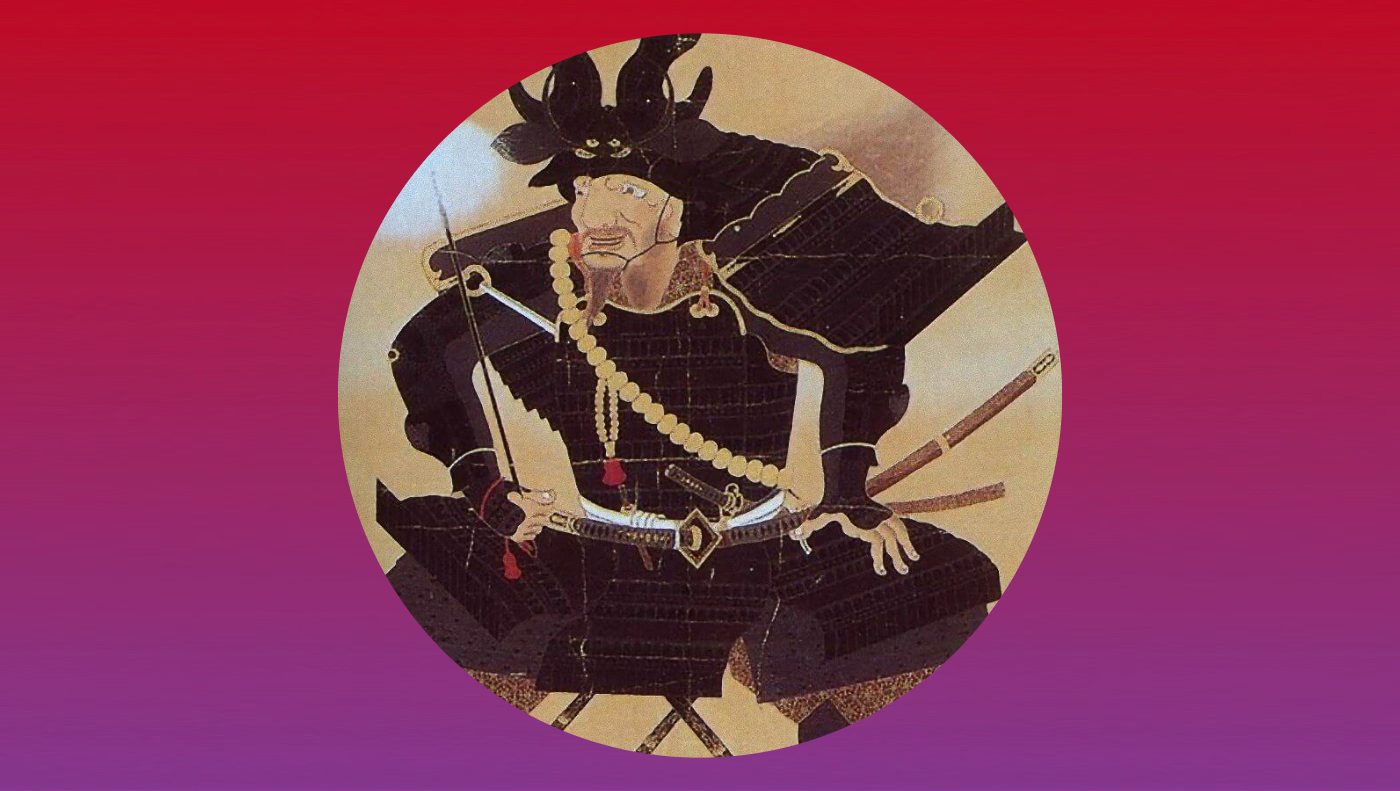
When Honda Tadakatsu died in 1610 at Kuwana Fortress at the age of sixty-two, he left behind a record unparalleled in Japanese military history. According to contemporary accounts, he had taken part in fifty-seven battles — beginning at the age of thirteen under Tokugawa Ieyasu and continuing through the preparations for the Osaka campaigns in the later Keichō years. In none of these fifty-seven battles was he seriously wounded. No sword blade had cut his skin, no arrow had struck him, and no bullet had threatened his life. In an era when the active life of an average samurai warrior often ended after ten to twenty battles through death or permanent injury, this record was so extraordinary that it established an almost supernatural reputation for Honda Tadakatsu during his own lifetime. Toyotomi Hideyoshi himself is said to have called him “the warrior who survived death” (*Shi ga sugita bushi*). Ieyasu, his lord for more than fifty years, simply called him his right arm.[1]
Honda Tadakatsu (1548–1610) belonged to the close circle of four generals known in Japanese tradition as the “Four Heavenly Kings of the Tokugawa” (*Tokugawa Shitennō*) — named after the Buddhist model of the four guardian deities who protect the four directions. The other three were Sakai Tadatsugu (1527–1596), Ii Naomasa (1561–1602), and Sakakibara Yasumasa (1548–1606). All four were closely associated with the rising Tokugawa clan, and all four served it throughout the war years from the Anegawa campaign in 1570 to the Battle of Sekigahara in 1600. Among the four, however, Honda Tadakatsu became the charismatic ideal — the warrior whose courage and skill became so legendary that in Japanese popular culture he remains an embodiment of samurai bravery itself.
This article reconstructs Honda Tadakatsu at the key stages of his life: his early service under the young Ieyasu; the key battles of Tokugawa consolidation (Anegawa, Mikatagahara, Nagashino, Komaki-Nagakute, and Sekigahara); his famous Tonbogiri spear; his iconic antler armor; and his political legacy after 1600 as the daimyō of the newly established Kuwana domain. It presents Honda Tadakatsu not merely as a stereotypical hero, but as a historical figure in an era when the personal courage of an individual could still influence the outcome of battles. The Samurai Museum Berlin preserves, through its extensive collection of dō-maru armor and helmets featuring antler motifs, direct material evidence of precisely the samurai tradition in which Honda Tadakatsu lived and fought.
At the Samurai Museum Berlin, visitors can study authentic armor from the Momoyama period that is directly comparable in form and construction to Honda Tadakatsu’s legendary dō-maru gusoku — offering a visual introduction to the world in which a single warrior could pass through fifty-seven battles without being wounded.
Origins and Youth: The Hondas in Mikawa
The Honda clan was not a great dynasty. Its seat was in the province of Mikawa — the later Tokugawa heartland, today part of Aichi Prefecture east of Nagoya. The Hondas served the Matsudaira lords, from whom the Tokugawa line would later emerge. Honda Tadakatsu was born in 1548 as the son of Honda Tadataka, in the third generation of direct Matsudaira vassals. His father fell in the Battle of Azukizaka in 1549, when Tadakatsu was only one year old. The boy grew up under the Matsudaira — more precisely, under the young Matsudaira Motoyasu, who would later change his name to Tokugawa Ieyasu.[2]
The youth of both men was shaped by political hostage-taking and military preparations. As a child, Motoyasu-Ieyasu spent years in the custody of the Imagawa clan, which at the time dominated the province of Mikawa. Tadakatsu and other young Matsudaira vassals remained in their homeland, awaiting his return. When Ieyasu seized the opportunity to establish his independence in 1560 after the Battle of Okehazama — in which his guardian, Imagawa Yoshimoto, was killed by Oda Nobunaga — Honda Tadakatsu was ready, at the age of thirteen. In his first documented battle in 1560 — the Siege of Tahara — he is said to have taken his first head. In the Sengoku period, this was a significant rite of initiation: a warrior who killed an opponent in his first battle and brought back the enemy’s head as proof had crossed the decisive threshold from boyhood to warriorhood.
From that moment on, Honda Tadakatsu was to fight almost continuously for Ieyasu. In the early 1560s, he became one of his lord’s so-called *Hatamoto* — his closest personal retainers. Ieyasu’s trust in him was remarkable, particularly given the age difference of only five years; the two men developed a relationship that resembled a partnership more than the traditional lord-vassal relationship. Military decisions in the 1560s were often made through direct discussions between Ieyasu and his leading Hatamoto, including Honda Tadakatsu, Sakai Tadatsugu, and later Ii Naomasa. The *Shitennō* structure thus began to take shape during these decades, long before the term was officially coined.
The Tonbogiri: The “Dragonfly Cutter”
One of the most famous weapons in Japanese history — and one inseparably associated with Honda Tadakatsu — was his spear: the *Tonbogiri* (蜻蛉切), the “Dragonfly Cutter.” The name of this weapon refers to a popular Japanese legend: the blade was said to have been so sharp that when a dragonfly landed on it while flying past, it was split in two. Whether this anecdote is historical or a later embellishment can no longer be determined. What is certain is that the Tonbogiri was a real weapon, and Honda Tadakatsu carried it throughout most of his military career.[3]
The Tonbogiri was a *Sanku-no-yari* — a “three-sided spear” with a blade approximately 43 centimeters long, ending in a distinctive triangular shape. The weapon was forged by Masazane Fujiwara, a sword and spear smith from Mikawa Province. Its wooden shaft was unusually long, approximately six meters, giving Honda Tadakatsu the advantage of keeping opponents at a distance and unhorsing mounted warriors before they could engage with their swords. The combination of reach, sharpness, and Honda Tadakatsu’s physical strength — he was regarded as an exceptionally tall warrior for his time, estimated at around 1.80 meters in a culture where the average height was approximately 1.60 meters — made the Tonbogiri a feared weapon.
The Tonbogiri still exists today. It is preserved as an important cultural property (*Jūyō Bunkazai*) at the Tokugawa Art Museum in Nagoya. Its original blade displays the characteristic *ken-form* (double-edged) design and the distinctive *hamon* pattern of the Muromachi/Momoyama swordsmithing tradition. During Honda Tadakatsu’s later years — when he increasingly took on political rather than military responsibilities — he had the shaft shortened to make it more practical to transport. The blade itself remained unchanged. An inscription on the *nakago* (tang) records the smith’s origins and the weapon’s association with the Honda family.
In addition to the Tonbogiri, Honda Tadakatsu used other weapons — swords, bows, and secondary spears — but the Tonbogiri was his signature weapon. It appears in numerous contemporary depictions of his battles, and in later samurai literature it became inseparably linked to his name. Together with his antler helmet crest, which we will discuss shortly, the Tonbogiri formed the visual identity by which Honda Tadakatsu was recognized on the battlefield — an important element in an era when armor largely concealed the body and the identification of friend and foe often depended on visible distinguishing features.
The Antler Armor: A Warrior’s Visual Identity
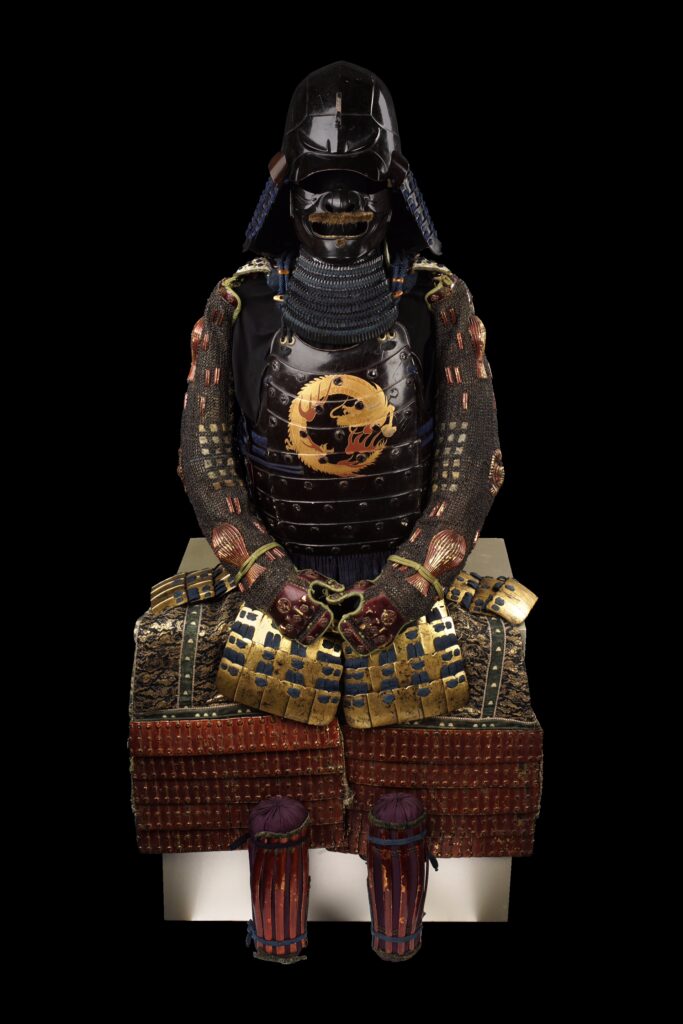
Perhaps the most famous visual association with Honda Tadakatsu is his armor, particularly the helmet with its distinctive antler crest. The original armor has survived and is today catalogued as No. 10 in the Metropolitan Museum of Art’s “Art of the Samurai” collection, where it is regarded as one of the most prominent examples of the *dō-maru gusoku* form from the late Momoyama period.[4]
The *dō-maru* style was a lightweight form of infantry armor that had originally developed during the Muromachi period and experienced a revival during the late Momoyama period. Unlike the heavy *ō-yoroi* armor of the classical Heian and Kamakura periods, the *dō-maru* was optimized for the warfare of the Sengoku era: low weight, high mobility, and sufficient protection against sword strikes and arrows. For the agile cavalry and infantry maneuvers of the 1570s and 1580s, it was an ideal form of armor. Honda Tadakatsu’s armor is lacquered black — a deliberate aesthetic choice that recalls the austere traditions of early Kamakura armor while also making him immediately recognizable on the battlefield.
The most striking feature of the armor is the helmet crest. Mounted on the *kabuto* is a massive pair of antlers made of gilded wood — an extraordinary, almost iconic form. Deer antlers held several meanings in Japanese Shinto tradition: deer were regarded as messengers of the gods, and the Kasuga Shrine in Nara, in particular, was famous for its sacred deer. The antlers also symbolized military power and dignity. Honda Tadakatsu deliberately chose this motif as his personal signature. The *Sakakibara Kōzan* work, a classic nineteenth-century Japanese armor manual, lists Honda Tadakatsu’s antlers as one of the classic examples of the primary function of the *maedate*: identifying the wearer amid the chaos of battle and psychologically intimidating the enemy.[5]
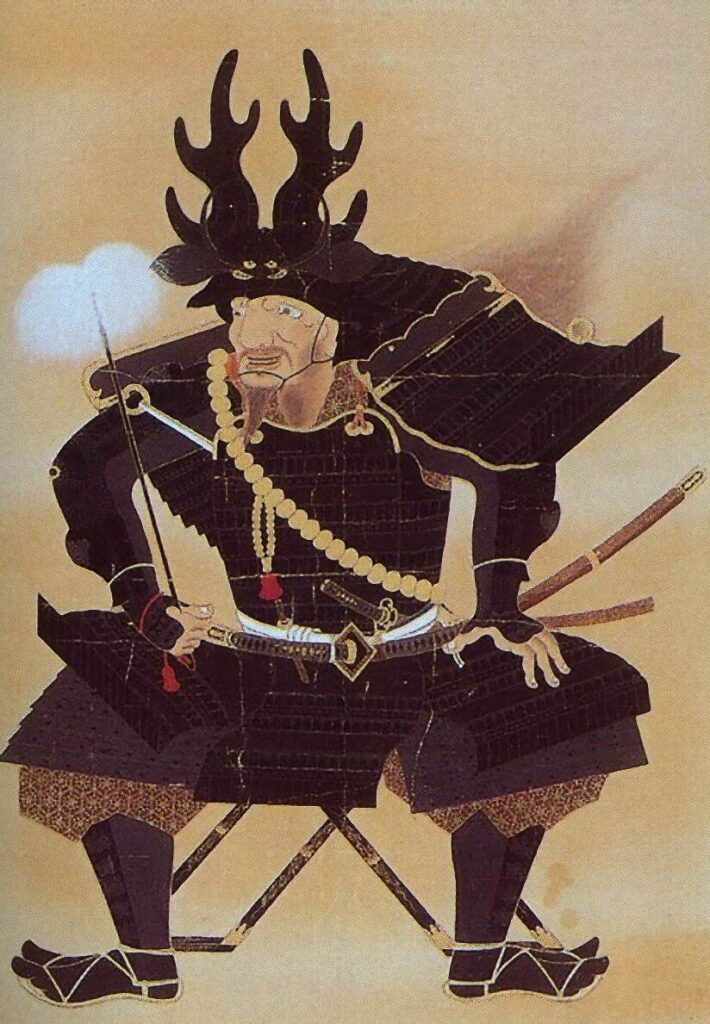
The practical effect of this helmet crest on the battlefield was considerable. A warrior who saw a massive pair of antlers rising above black-lacquered armor from a distance knew: this is Honda Tadakatsu. He knew that this was the warrior who had remained unwounded through fifty-seven battles. This was the warrior whose spear could split dragonflies. This was Ieyasu’s right hand. The psychological dimension of this identification should not be underestimated. For the enemy, it could mean retreat, avoiding direct engagement, or shifting the attack toward less dangerous targets. For his own troops, it meant that their commander was highly visible, providing orientation amid the chaos and strengthening morale.
Anegawa 1570: The Initiation Battle
The battle that marked the beginning of Honda Tadakatsu’s reputation as an exceptional warrior was the Battle of Anegawa in July 1570. The political constellation was complicated: Tokugawa Ieyasu and Oda Nobunaga stood together against the Asakura and Asai clans, which threatened Nobunaga from the north of Kyoto. The battle took place on the banks of the Ane River, in Ōmi Province (present-day Shiga Prefecture). Honda Tadakatsu was twenty-two years old at the time and commanded a small but experienced unit within the Tokugawa contingent.[6]
The decisive moment of the battle for Honda Tadakatsu came when the Asakura forces launched a counterattack that threatened to break through the Tokugawa lines. According to the *Mikawa Gofudoki*, one of the principal sources for early Tokugawa history, Honda Tadakatsu drove his horse into the front line at this critical moment and challenged a single Asakura commander to combat with the Tonbogiri. He killed his opponent, severed his head, tied it to his saddle, and rode back to his own lines — a display of personal bravery that strengthened the morale of his troops and broke the Asakura attack.
For Ieyasu, this achievement was particularly significant because it took place in front of Nobunaga. At the time, Nobunaga was reorganizing the military hierarchy of central Japan and showed particular interest in charismatic warriors. Honda Tadakatsu caught his attention. Nobunaga is said to have remarked to Ieyasu after the battle: “This Honda truly is a hare that flies through the battle lines.”
Mikatagahara 1573: Surviving the Catastrophe
Mikatagahara was perhaps the darkest moment for the Tokugawa during the entire Sengoku period. In December 1572, Takeda Shingen — one of the most powerful daimyō in Japan — marched northward against Ieyasu’s territory with 27,000 men. Ieyasu, who had only 11,000 troops at his disposal (including several thousand sent by Nobunaga), would have been wise to allow his main fortress at Hamamatsu to be besieged and rely on attrition. Instead, on January 6, 1573, he made the decision to confront Takeda in the open field at Mikatagahara, north of Hamamatsu. It was a mistake that nearly cost him his rule.[7]
The battle was decisive. Takeda’s experienced cavalry crushed the Tokugawa lines within a matter of hours. Ieyasu’s troops were routed, and Ieyasu himself was repeatedly placed in mortal danger.
Amid this catastrophe, Honda Tadakatsu was the central figure in the rearguard action. While the main body of the Tokugawa army fled, he formed a small group of experienced warriors to cover the retreat. In several documented encounters with Takeda pursuers — including a clash with the famous Takeda general Baba Nobuharu that ended in a near-draw — Honda Tadakatsu delayed the Takeda advance long enough for Ieyasu to reach Hamamatsu alive. Tokugawa tradition remembers Mikatagahara as the day Honda Tadakatsu saved Ieyasu’s life. Without this rearguard action, Ieyasu would probably have been captured or killed — and the Tokugawa rule that would later shape the whole of Japan might never have come to pass.
Ironically, only a few weeks later, Takeda Shingen died from an old wound. His son, Takeda Katsuyori, was unable to continue the campaign with the same effectiveness. The Tokugawa defeat at Mikatagahara therefore did not become the total catastrophe it had threatened to become in December 1572. Nevertheless, its psychological impact remained. Ieyasu is said to have commissioned a famous portrait of himself after Mikatagahara, depicting him at the moment of his defeat — a lasting reminder of the dangers of arrogance and miscalculation. The portrait still exists today.
Nagashino 1575 and Komaki-Nagakute 1584
The following twelve years were marked by further campaigns at Ieyasu’s side. At the Battle of Nagashino in 1575 — the famous engagement in which Oda Nobunaga and Tokugawa Ieyasu destroyed the Takeda cavalry under Takeda Katsuyori through the systematic use of arquebus volley fire — Honda Tadakatsu commanded a flanking unit. His specific role at Nagashino is less prominent in the sources than his actions at Anegawa or Mikatagahara; the battle was primarily a triumph of Nobunaga’s firearms tactics, in which the achievements of individual warriors were less decisive than the disciplined formation.[8]
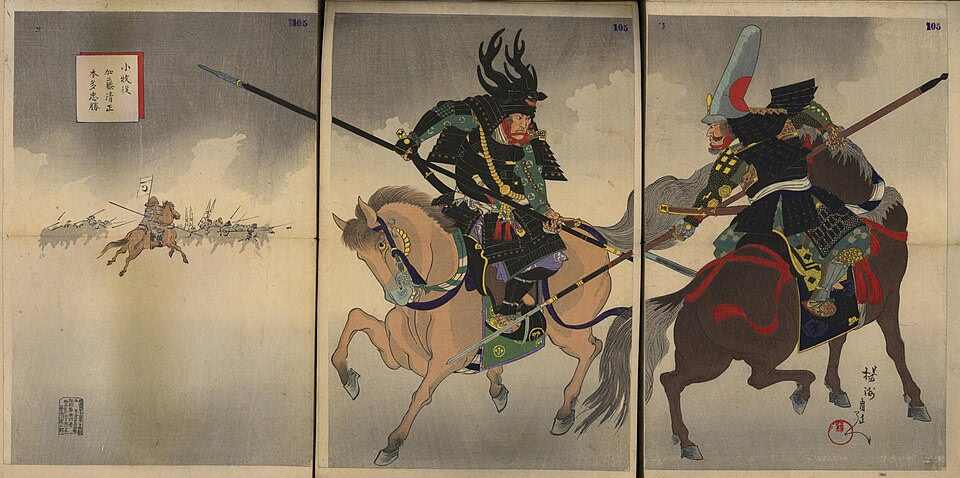
More important for Honda Tadakatsu was the Battle of Komaki-Nagakute in 1584, the first major confrontation between Tokugawa Ieyasu and Toyotomi Hideyoshi. Hideyoshi, who had emerged as Nobunaga’s most important successor following his death in 1582, sought to establish his supremacy over Japan. Ieyasu, increasingly wary of Hideyoshi’s rise, allied himself with Oda Nobukatsu (one of Nobunaga’s sons) and opposed him. The Battle of Komaki-Nagakute was not tactically decisive — it ended in a stalemate — but it was strategically important: Ieyasu demonstrated that he was not militarily inferior, and Hideyoshi recognized that he needed a diplomatic rather than a military solution.
Honda Tadakatsu’s most famous episode from this campaign is the so-called “river bluff.” After a tactical defeat on Ieyasu’s side, a smaller portion of the Tokugawa army withdrew, and Hideyoshi gave chase. Honda Tadakatsu, with only 500 men, positioned himself at the Ryūsen River and deliberately began watering his horse in the river. The gesture was psychological warfare: it suggested that he was unafraid, that reinforcements were within reach, and that an ambush might be imminent. Hideyoshi — an experienced commander — halted, studied the situation, and ultimately decided to call off the direct attack. Through a bluff, Honda Tadakatsu had averted a potential catastrophe. Hideyoshi is said to have remarked to his generals after the episode that Honda Tadakatsu was one of the “most dangerous opponents he had ever encountered” — a statement that established the reputation of the Mikawa warrior beyond Ieyasu’s own circle.
Sekigahara 1600 and the Later Command
The Battle of Sekigahara on October 21, 1600, marked the culmination of Honda Tadakatsu’s military career and, at the age of fifty-two, one of his last major battles.
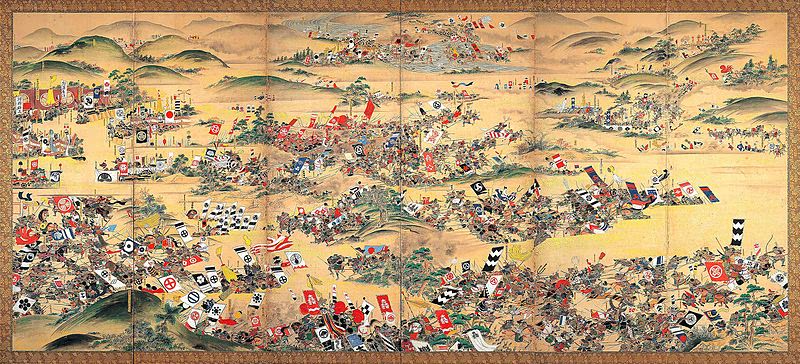
After Sekigahara, Honda Tadakatsu was appointed daimyō of the Kuwana domain in Ise Province (present-day Mie Prefecture), with an income of 150,000 *koku* — a respectable, though not exceptionally large, sum. More important than the territory was the rank: Honda Tadakatsu was now one of the closest confidants of the newly established Tokugawa shogunate, a member of the inner council and an adviser to Ieyasu on all important matters. He contributed to the preparations for the Osaka campaign, although he would not live to see the actual siege of 1614–15.
In his final years, Honda Tadakatsu increasingly withdrew from military affairs and devoted himself to administrative duties. An eye condition — possibly a consequence of the severe physical demands of his decades on campaign — restricted his mobility. In 1610, he died in Kuwana at the age of sixty-two. His son, Honda Tadamasa, succeeded him as lord of the domain. The Honda lineage continued as an important Tokugawa vassal family until the Meiji Restoration in 1868.
Character and Legacy
What distinguished Honda Tadakatsu from other prominent samurai of his time can be reconstructed with relative precision from contemporary sources. He was physically strong and above average in height. Unlike some other Sengoku warriors, he was not particularly well educated; he read little, wrote little, and preferred practical training. He was deeply religious, a follower of Pure Land Buddhism, and is said to have carried a small Amida Buddha talisman inside his helmet. He was a disciplined warrior who performed ritual purification before every battle. And he had a profound loyalty to Ieyasu that went beyond mere service — the two men shared decades of experience, and in Ieyasu’s later years, Honda Tadakatsu was regarded as one of the few men who could openly disagree with his lord.[10]
Honda Tadakatsu’s legacy in Japanese historical memory is extensive. During the Edo period, he was transformed into one of the archetypal ideal samurai figures: the loyal, incorruptible, courageous vassal who followed his lord through battle and crisis. His record of fifty-seven battles became a benchmark of military excellence. His antler armor became one of the most iconic visual motifs of samurai aesthetics. And his Tonbogiri became one of the “Five Great Spears of Japan” — a cultural canon that was established during the late Edo and Meiji periods.
In modern popular culture — from Kabuki plays and Japanese television’s Taiga dramas to video games such as *Samurai Warriors* and *Sengoku Basara* — Honda Tadakatsu is one of the most frequently featured Sengoku figures. His literary portrayal typically emphasizes three elements: superhuman physical strength (often exaggerated to almost caricature-like proportions), the antler armor as his identifying feature, and the Tonbogiri as his weapon. The historical reality behind this figure is more complex, but the basic image — the eternally loyal, victorious, invulnerable warrior — does indeed reflect what contemporary sources report about Honda Tadakatsu.
Five Myths About Honda Tadakatsu
Myth 1: “Honda Tadakatsu really emerged from all fifty-seven battles completely unscathed.”
The figure of fifty-seven battles comes from later tallies and may have been rounded up. What appears historically well established is that Honda Tadakatsu never suffered a serious, incapacitating injury in battle. Minor cuts or bruises are likely, but they are not documented. The “perfect” record is partly a statistical construct; what is certain is his extraordinary survival rate.
Myth 2: “The Tonbogiri could actually cut dragonflies in mid-air.”
The dragonfly anecdote is almost certainly a literary embellishment. It probably originated as a metaphor — “so sharp that it could split a dragonfly in flight” — that was gradually misunderstood as a factual account. The Tonbogiri was exceptionally sharp, but it was not a supernatural blade.
Myth 3: “The antlers were made from real deer antlers.”
No. They were made of gilded wood. Their lifelike appearance can obscure the actual material. Real antler would have been neither sufficiently practical for use on the battlefield nor capable of producing the same iconic visual effect.
Myth 4: “Honda Tadakatsu belonged to the Tokugawa Shitennō from the very beginning.”
The term “Four Heavenly Kings of the Tokugawa” is a later Edo-period summary. There was no formal structure by this name during their lifetimes; the four men — Honda Tadakatsu, Sakai Tadatsugu, Ii Naomasa, and Sakakibara Yasumasa — were closely associated with Ieyasu, but the Shitennō framework emerged only retrospectively.
Myth 5: “Honda Tadakatsu was a simple, straightforward warrior.”
This portrayal is only partly accurate. He was practically oriented and not classically educated, but he was also a sophisticated tactical thinker, as demonstrated by his bluff at the Ryūsen River. The reduction of Honda Tadakatsu to a “pure warrior without ulterior motives” is a literary stylization of the later tradition.
Conclusion: The Warrior Who Survived Death
In Japanese historical memory, Honda Tadakatsu is perhaps the most striking embodiment of a particular samurai ideal: the eternally loyal, physically superior, militarily successful figure who serves his lord throughout every phase of a fifty-year career, succeeding both on the battlefield and in politics. In his case, the image is remarkably well grounded in historical evidence: the fifty-seven battles can be counted, his record of victories is real, the antler armor has survived, and the Tonbogiri is documented. What later legend adds — the dragonfly, the mystical invulnerability, the supposed simplicity — are literary embellishments of a genuinely extraordinary biography.
What makes Honda Tadakatsu particularly interesting, however, is the structural pattern he embodies: the fact that during the Sengoku period, the qualities of individual warriors — their physical strength, tactical skill, and loyalty — could still genuinely influence the course of historical events. Without a Honda Tadakatsu at Mikatagahara, Ieyasu would very likely have died. Without Ieyasu, there would have been no Tokugawa order. Without the Tokugawa order, there would have been no 250-year Edo peace, no cultural consolidation of samurai culture, and no Japanese modernity in its particular historical form. In this sense, Honda Tadakatsu is more than an individual figure: he is a key to understanding how the late Sengoku period functioned, an era in which the difference between triumph and destruction often hinged on individual men and individual acts.
Visitors viewing the *dō-maru* armor of the Momoyama period at the Samurai Museum Berlin should bear this historical dimension in mind. Armor of this kind — black lacquered, fitted with a distinctive *maedate*, and designed for agile cavalry maneuvers — was worn by warriors like Honda Tadakatsu through fifty-seven battles, preserving not only their own lives but also the careers of their lords. Encountering such an object transforms the abstract history of the samurai wars into a tangible world in which individual people, at individual moments, could quite literally shape history.
Frequently Asked Questions
Who was Honda Tadakatsu?
Honda Tadakatsu (1548–1610) was one of the most important generals in the service of Tokugawa Ieyasu and belonged to the “Four Heavenly Kings” (Tokugawa Shitennō) of the Tokugawa clan. He took part in more than 50 battles — according to some tallies, 57 — and is said never to have suffered a serious wound. He is regarded as one of the most legendary samurai figures in Japanese history.
What was the Tonbogiri?
The Tonbogiri (蜻蛉切, “Dragonfly Cutter”) was Honda Tadakatsu’s personal spear, forged by Masazane Fujiwara in Mikawa Province. Its name derives from the legend that the blade was so sharp that a dragonfly landing on it was split in two. The weapon survives to this day as an Important Cultural Property at the Tokugawa Art Museum in Nagoya.
What is an antler helmet crest?
The maedate (helmet crest) on Honda Tadakatsu’s kabuto consisted of a massive pair of deer antlers made of gilded wood. The maedate served two purposes: identifying the wearer amid the chaos of battle and psychologically intimidating the enemy. Honda Tadakatsu’s antlers became one of the most iconic visual motifs of Japanese samurai aesthetics.
Who were the “Four Heavenly Kings of the Tokugawa”?
The Tokugawa Shitennō (徳川四天王) were four particularly distinguished generals of Tokugawa Ieyasu: Honda Tadakatsu (1548–1610), Sakai Tadatsugu (1527–1596), Ii Naomasa (1561–1602), and Sakakibara Yasumasa (1548–1606). The term draws on the Buddhist concept of the four guardian deities and was established as a retrospective category during the Edo period.
Why is Honda Tadakatsu still so highly revered today?
His fame rests on several factors: his extraordinary survival rate across more than 50 battles, his iconic visual identity (antler helmet and Tonbogiri spear), his rescue of Ieyasu at Mikatagahara in 1573, and his later career as daimyō of Kuwana. In popular culture — from Kabuki to video games — he is perhaps the most frequently featured Sengoku warrior after the three great unifiers themselves.
Where can Honda Tadakatsu’s original armor be seen today?
Honda Tadakatsu’s original dō-maru armor with its antler helmet is preserved at the Metropolitan Museum of Art in New York and was featured in the major “Art of the Samurai” exhibition in 2009. The Tonbogiri is housed at the Tokugawa Art Museum in Nagoya. The Samurai Museum Berlin displays comparable dō-maru armor from the Momoyama period.
Visit the Samurai Museum Berlin
The Samurai Museum Berlin displays numerous *dō-maru* armor sets, *kabuto* helmets, and *yari* spears from the Momoyama and Edo periods that can be directly compared with Honda Tadakatsu’s famous equipment. Within the context of the comprehensive collection, visitors can explore the material culture and technological conditions that made it possible for a warrior like Honda Tadakatsu to pass through fifty-seven battles. A visit makes it possible to trace the abstract history of Tokugawa consolidation through tangible historical objects.
Sources and Further Reading
This article is based on academic research, primary sources, and the expert catalogues of the Samurai Museum Berlin. All cited works are documented in the complete bibliography of the Knowledge Hub.
Primary Sources
- [1] Samurai Museum Berlin (2025). SMB Catalogue 2025 — Momoyama and Edo Period Armor. [Used: E04V_63 Dō-maru armor, F07V_56 Yari spear]
Secondary Literature
- [2] Turnbull, Stephen (2022). War in Japan 1467–1615. Osprey Publishing. [Used: Mikawa politics, the rise of the Tokugawa, context of the Honda clan]
- [3] Friday, Karl F. (2004). Samurai, Warfare and the State in Early Medieval Japan. Routledge. [Used: Sengoku warfare, individual combat skills, spear traditions]
- [4] Ogawa, Morihiro (ed.) (2009). Art of the Samurai: Japanese Arms and Armor, 1156–1868. Metropolitan Museum of Art / Yale University Press. [Used: No. 10 Honda Tadakatsu armor, dō-maru gusoku, antler helmet]
- [5] Sakakibara, Kōzan (1800 / English translation 1962). The Manufacture of Armour and Helmets in Sixteenth Century Japan. Translated by H. R. Robinson, Tower of London Armouries. [Used: maedate function, Honda Tadakatsu as an example]
- [6] Turnbull, Stephen (2000). Nagashino 1575: Slaughter at the Barricades. Osprey Publishing. [Used: Battle of Anegawa, Takeda conflict, Tokugawa campaigns]
- [7] Sadler, A. L. (1937). The Maker of Modern Japan: The Life of Shogun Tokugawa Ieyasu. Allen & Unwin. [Used: Battle of Mikatagahara, Ieyasu’s early career, Honda Tadakatsu’s role]
- [8] Turnbull, Stephen (2012). Toyotomi Hideyoshi. Osprey Publishing. [Used: Komaki-Nagakute, Hideyoshi-Ieyasu conflict of 1584]
- [9] Hall, John Whitney (ed.) (1991). The Cambridge History of Japan, Vol. 4: Early Modern Japan. Cambridge University Press. [Used: Sekigahara context, Tokugawa Shitennō, Edo-period daimyō system]
- [10] Ikegami, Eiko (1995). The Taming of the Samurai: Honorific Individualism and the Making of Modern Japan. Harvard University Press. [Used: samurai loyalty, warrior ethos of the Sengoku period, cultural memory]
Museum Catalogues and Expert Assessments
- [11] Samurai Museum Berlin (2025). Exhibit Documentation — Dō-maru Armor and Yari Collection. [Used: Honda tradition, comparable Momoyama-period objects]
© Samurai Museum Berlin – All Rights Reserved
You might also like
Tokugawa Ieyasu: The Last Unifier of Japan
Tokugawa Ieyasu (1543–1616), Japan's last unifier. Sekigahara, Osaka, Pax Tokugawa. 250 years of peace – with original exhibits at the…
Read the article
Toyotomi Hideyoshi: From Peasant’s Son to Ruler of Japan
Toyotomi Hideyoshi (1537–1598): how a nameless foot soldier became the unifier of Japan. History, reforms & exhibits at the Samurai…
Read the article
The 47 Rōnin: Japan’s Legendary Revenge Story
The true story of the 47 Rōnin: how 47 masterless samurai avenged their lord in 1703 – and why not…
Read the article