 Nominated for the EMYA2026 award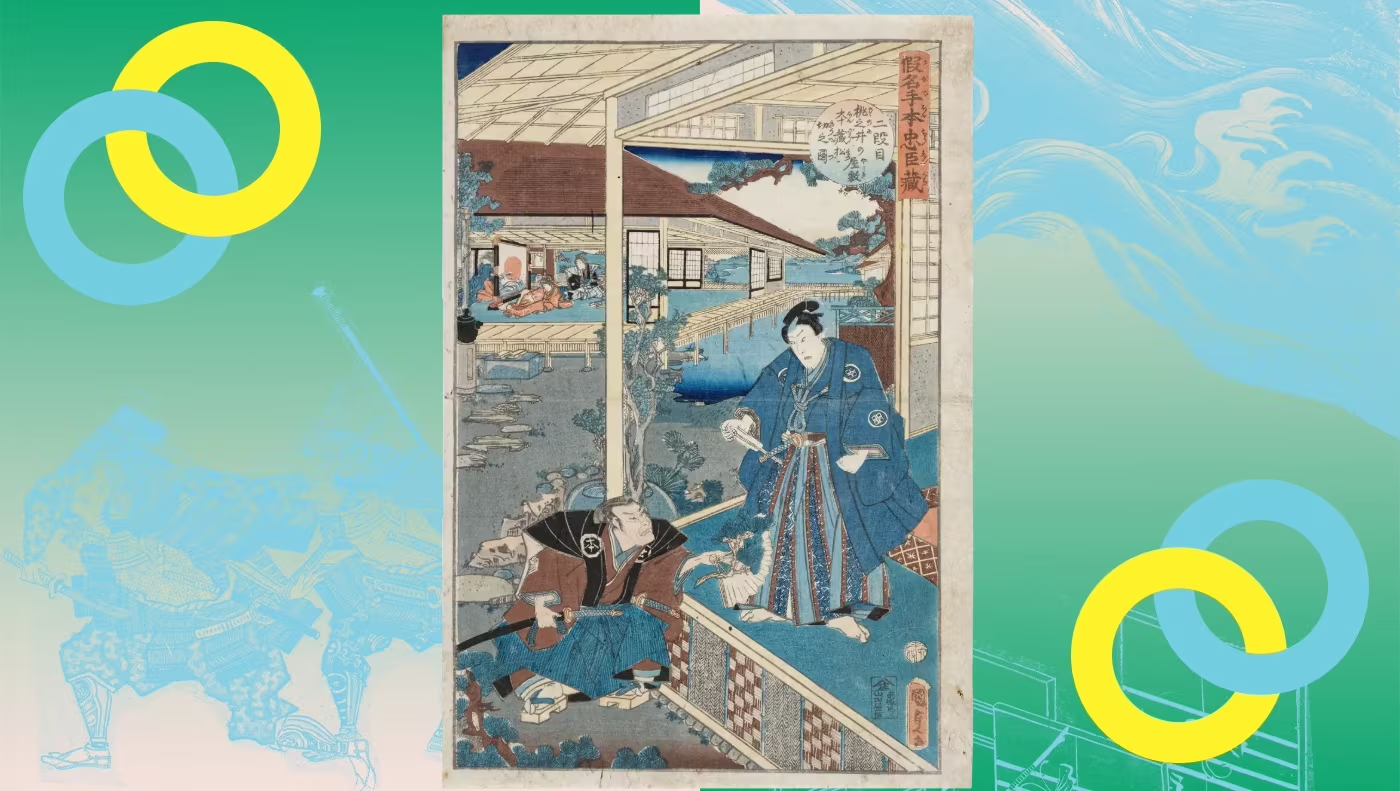
The 47 Rōnin: Japan’s Legendary Revenge Story – Honor unto Seppuku
On a winter’s night in 1703, 47 men break into the residence of a high-ranking official. They are not bandits—they are samurai without a master, known as rōnin. Their goal: revenge for an injustice that took place nearly two years earlier. What unfolds that night becomes one of Japan’s most famous stories and a test of what honor truly means.
What is a Rōnin?
The word Rōnin (浪人) literally means “wave person” — someone who drifts like a wave, without a fixed place to call home. Originally, the term referred to peasants who left their land. During the Edo period (1615–1868), its meaning evolved: a Rōnin was now a samurai without a lord, a warrior who had lost his place in the rigid social hierarchy.
Under the shōgun Tokugawa Iemitsu, there were reportedly as many as 500,000 such masterless samurai at certain times. Their status was precarious. They belonged neither to the commoner class nor to the prestigious warrior class. Without the rice stipend that regular samurai received from their daimyō, they had to make ends meet as bodyguards, swordsmanship instructors, or scribes. Some turned to crime. The stigma of failure followed them — in the eyes of many, a man who had lost his lord had also lost his honor.
The most famous Rōnin in history are the 47 Rōnin of Akō.
Sources: Ikegami (1995), Chapter 11; Harper (2019), pp. 210–250.
The Akō Incident
The Incident in the Pine Corridor (1701)
In April 1701, Edo Castle is bustling with activity. Envoys from the emperor in Kyōto are expected, and protocol demands a flawless reception ceremony. The shōgun Tokugawa Tsunayoshi has assigned two provincial daimyō to organize the event: Kamei Korechika and Asano Naganori, the young lord of the small Akō domain in western Japan.
Neither man is familiar with court etiquette. Their instructor is Kira Yoshinaka, the shogunate’s master of ceremonies—a man who understands the intricacies of protocol better than anyone else. Kira is powerful, and he knows it. He expects the customary “gifts” that accompany such instruction to be generous.
Kamei understands how the game is played and leaves his advisers to handle the matter. They present Kira with a substantial sum, and from then on, the master of ceremonies treats him courteously. Asano, however, a man shaped by Confucian principles and strict moral convictions, refuses to pay a bribe. The consequences are immediate: Kira humiliates him at every opportunity, gives him careless instructions, and mocks him in front of other courtiers. He is said to have called him an “uncouth country bumpkin.”
What exactly happened on April 21, 1701, in the Matsu no Ōrōka, the “Great Pine Corridor” of Edo Castle, can no longer be fully reconstructed. What is certain is that Asano Naganori loses his composure. He draws his dagger and lunges at Kira. The first blow strikes the master of ceremonies in the face. The second misses him and strikes a wooden pillar. Then the guards arrive and separate the two men.
Kira’s wound is not life-threatening. But that makes no difference. Drawing a weapon inside the shōgun’s castle is a capital offense. The verdict comes down that very day: Asano Naganori must commit seppuku, the ritual act of suicide by disembowelment. His lands are confiscated, and his house is dissolved. Kira Yoshinaka, meanwhile—the man who provoked Asano—is completely exonerated.
This is where the real injustice lies, and it is what sets the subsequent events in motion. The law of the Edo period recognized the principle of Kenka Ryōseibai, or “mutual punishment for a quarrel”: in a dispute, both parties were to be punished, regardless of who had started it. Yet the shōgun, concerned with ensuring that the imperial visit proceeded without disruption, overrides this principle. He punishes only one man.
Sources: Harper (2019), pp. 25–110; Encyclopaedia Britannica, “Chūshingura.”
From Samurai to Rōnin
Five days later, news reaches Akō Castle, more than 600 kilometers west of Edo. Ōishi Kuranosuke, the karō—chief adviser and administrator—of the Asano house, immediately assumes leadership. He secures the safety of his late lord’s family and prepares to surrender the castle to officials of the shogunate.
The 308 samurai of the Asano house face an impossible choice. With their lord’s death, they have overnight become rōnin—masterless, without income, and dishonored by their association with a dissolved household. Some want to resist; others demand collective suicide before the castle gates. Ōishi counsels restraint.
On May 26, 1701, Akō Castle is surrendered without a fight. But Ōishi and a core group of loyal retainers have not yet given up. Their plan is initially not a bloody one: they fight with paper rather than swords. For months, Ōishi travels to Edo, bribes intermediaries, and submits petitions. The goal is to have Asano’s younger brother, Daigaku, reinstated as heir. If the Asano house were restored, the rōnin would once again have a lord—and their honor would be restored.
The political effort fails. The shogunate rejects the petition. Only then, after nearly a year of waiting, is the revenge plan set in motion.
Sources: Harper (2019), pp. 150–220; Ikegami (1995), pp. 224–228.
Preparing for Revenge (1702)
Of the original 308 samurai, only about 50 are now willing to risk their lives for revenge. The others have accepted their fate, found new employment, or yielded to pressure from their families. Poverty, one chronicler notes, was loyalty’s greatest enemy. A man who is starving does not think about revenge.
Ōishi Kuranosuke now begins one of the boldest acts of deception in Japanese history. He moves to Kyōto and pretends to be a broken man. He visits brothels, gets drunk in public, and neglects his appearance. He repudiates his devoted wife and takes a young concubine into his household. Kira’s spies, who are watching every former Asano retainer, report back to Edo: this man poses no threat.
One scene from this period has been passed down through the years: Ōishi lies drunk in a gutter on a street in Kyōto. A passing samurai from Satsuma is outraged by this disgraceful sight. He kicks Ōishi in the face, spits on him, and denounces him as a disgrace to the warrior class. Ōishi does not react. He silently endures the humiliation. Years later, after the revenge has been carried out, the man from Satsuma will make a pilgrimage to the rōnin’s graves. He will ask for forgiveness—and then take his own life.
While Ōishi performs his role of degradation in Kyōto, his fellow conspirators work in Edo. They disguise themselves as merchants and craftsmen, rent lodgings near Kira’s residence, and study the guards’ routines. One of them, Okano Kin’emon, goes particularly far: he marries the daughter of the builder who constructed Kira’s house, thereby gaining access to the building plans.
By the autumn of 1702, everything is ready. The conspirators have smuggled weapons and armor into Edo. They know every corner of Kira’s estate. And Kira, lulled into a false sense of security, has reduced his guard force.
Source: Harper (2019), pp. 350–500.
The Attack on Kira’s Residence
On the night of January 30, 1703—according to the Japanese calendar, the 14th day of the 12th month of Genroku 15—the cold in Edo is bitter. Snow falls, and the wind howls through the streets. At four o’clock in the morning, 47 men assemble at a secret meeting place.
Ōishi divides his force into two groups. He leads the assault on the front gate himself. His son, Ōishi Chikara, just sixteen years old, commands the group at the rear entrance. The signals have been agreed upon: a hammer blow means the attack has begun. A whistle signals that Kira is dead.
Before striking, Ōishi sends messengers to the neighboring houses. Their message is clear: We are not robbers. We are retainers avenging the death of our lord. No one but Kira will be harmed. The neighbors, all of whom despise Kira, remain inside their homes.
The attack itself is brief and brutal. The rōnin are seasoned professionals wearing armor they have made themselves. Kira’s guards—some of them servants roused from sleep—stand no chance. Within an hour, sixteen of Kira’s men are dead and twenty-two wounded. The attackers suffer no casualties.
But Kira himself is nowhere to be found.
The rōnin search the house systematically. They find weeping women and children, but not the man they seek. Their desperation grows. Then Ōishi checks Kira’s sleeping quarters—the bedding is still warm. He cannot be far away.
A renewed search leads to a concealed courtyard, hidden behind a heavy wall hanging. There stands a small shed for coal and firewood. When the rōnin force the door open, a man lunges at them with a dagger. He is quickly overpowered. He refuses to give his name. But when Ōishi approaches with a lantern, he sees the scar on the man’s face—the scar Asano Naganori inflicted on him almost two years earlier.
What happens next is among the most frequently retold scenes in Japanese history. Ōishi kneels before the high-ranking official and addresses him respectfully. He explains who they are and why they have come. Then he offers Kira a dagger—the same dagger with which Asano performed seppuku. It is a final opportunity to die an honorable death.
Kira trembles. He begs. He remains silent. Minutes pass. Finally, Ōishi realizes that there is no point in waiting any longer. He signals to his men. They restrain Kira. Ōishi grabs him by the hair, pulls his head back, and cuts his throat with three strokes.
In the early hours of January 31, the 47 rōnin carry their enemy’s head through the streets of Edo to Sengaku-ji Temple, where Asano Naganori is buried. The people they encounter cheer them on and offer them refreshments. At their lord’s grave, they lay down Kira’s head and the dagger that sealed his fate.
Then they surrender themselves to the authorities.
Source: Harper (2019), pp. 530–565.
Honor or Crime? – The Shogunate’s Dilemma
The 46 Rōnin—one man had been sent away as a messenger—are arrested and distributed among the residences of four different daimyō. The shogunate faces an apparently impossible dilemma.
On the one hand, the men have followed bushidō, the samurai code of honor, which places loyalty to one’s lord above all else. They have done what one might expect of faithful retainers. On the other hand, they have broken the law: blood vengeance was strictly prohibited in Edo. If the shogunate pardons them, it undermines its own authority. If it executes them as ordinary murderers, it turns them into martyrs.
The country’s Confucian scholars are divided. The influential philosopher Ogyū Sorai argues in favor of their execution: the law must be upheld, or chaos will prevail. Others emphasize the moral dimension of the deed: the Rōnin have administered justice where the state has failed.
The sociologist Eiko Ikegami has described this conflict as a clash between two systems. On one side stood the old warrior ethic, which placed individual honor above state authority. On the other stood the new Tokugawa bureaucratic system, which demanded stability and obedience. The 47 Rōnin embodied this contradiction, and their story forced Japan to confront it.
The extent to which this dilemma became embedded in Japan’s cultural memory is illustrated by a woodblock print by Toyohara Kunichika from 1862 (catalogue E10V_49, Samurai Museum Berlin). The print depicts Ōishi Kuranosuke—known in Kabuki theatre as Ōboshi Yuranosuke—at the moment he receives news from his son Rikiya. The character’s crossed eyes, a distinctive visual convention in Kabuki theatre, convey his inner turmoil as he struggles between duty and its consequences.
On March 20, 1703, the verdict is delivered. It is a compromise: the Rōnin are sentenced to death, but they are not executed like criminals. Instead, they are permitted to perform seppuku—an honorable death by their own hand. The law is upheld: they die as condemned men. Their honor is preserved: they die as samurai.
Soldiers from the shōgun’s personal guard serve as kaishakunin, or seconds, delivering a swift sword stroke after the ritual abdominal cut to spare the men prolonged suffering. Their bodies are buried at Sengaku-ji Temple, before the grave of Asano Naganori. The 47th Rōnin, Terasaka Kichiemon, is later pardoned—presumably because of his youth or because he had served as a messenger. He dies at the age of 87 and is buried alongside his comrades.
Sources: Ikegami (1995), pp. 228–235; Harper (2019), pp. 600–680.
Contemporary Criticism
Die Geschichte Today, the story of the 47 Rōnin is usually told as an example of unconditional loyalty and samurai heroism. Yet not all of their contemporaries saw it that way.
Yamamoto Tsunetomo, a samurai from the Saga domain and the author of the Hagakure, sharply criticized the Rōnin. Approximately fifteen years after the events, he dictated the following to his student:
“The Rōnin of the Asano clan incurred blame because they did not immediately commit seppuku at Sengaku-ji Temple. Above all, they took far too long to avenge their lord’s death at the hands of his enemy. If you first stop to consider how you might win, you may miss the best opportunity to act.”
For Tsunetomo, waiting for the right moment was not a matter of prudent strategy but of cowardly calculation—“merchant thinking,” which was unworthy of a true warrior. A genuine samurai would have attacked immediately, even without any prospect of success.
This criticism may seem surprising today. However, it demonstrates that the assessment of the Rōnin’s actions was by no means unanimous. The Hagakure represents a radical minority viewpoint, but it reminds us that even within samurai culture, competing conceptions of honor existed.
Source: Yamamoto Tsunetomo, Hagakure (c. 1716), Book 1-55, p. 68.
From Historical Event to Legend
The mythologization began almost immediately. Just two weeks after the Rōnin performed seppuku, the first theatrical play dramatizing the events was staged in Osaka. The authorities banned it after three performances, but this could not stem the flood of adaptations. By 1844, 47 different stage plays on the subject had been recorded.
The story’s rapid rise in popularity was also a product of its historical context. The Genroku era (1688–1704) was a period of cultural flourishing in Japan. In the cities of Kyōto, Osaka, and Edo, an affluent urban merchant class (chōnin) had emerged, consuming theatre, prose, and woodblock prints on a scale unprecedented in earlier generations. Playwrights such as Chikamatsu Monzaemon and novelists such as Ihara Saikaku shaped an urban entertainment culture hungry for precisely this kind of material: a conflict between loyalty and law, honor and pragmatism, involving real deaths and an unresolved moral question.
The most famous adaptation is Kanadehon Chūshingura, a Bunraku puppet play from 1748 that was later also performed as a Kabuki drama. Its authors circumvented censorship by relocating the story to the 14th century and changing all the names: Asano became En’ya Hangan, Kira became Kō no Moronao, and Ōishi became Ōboshi Yuranosuke.
Chūshingura introduced elements that were absent from the historical events: a love story, a traitor within the group, and a conflict between family obligations and warrior honor. It condensed two years of agonizing waiting into a gripping drama about giri (duty) and ninjō (human feeling). The result was so successful that the theatrical version largely displaced historical reality in the public imagination.
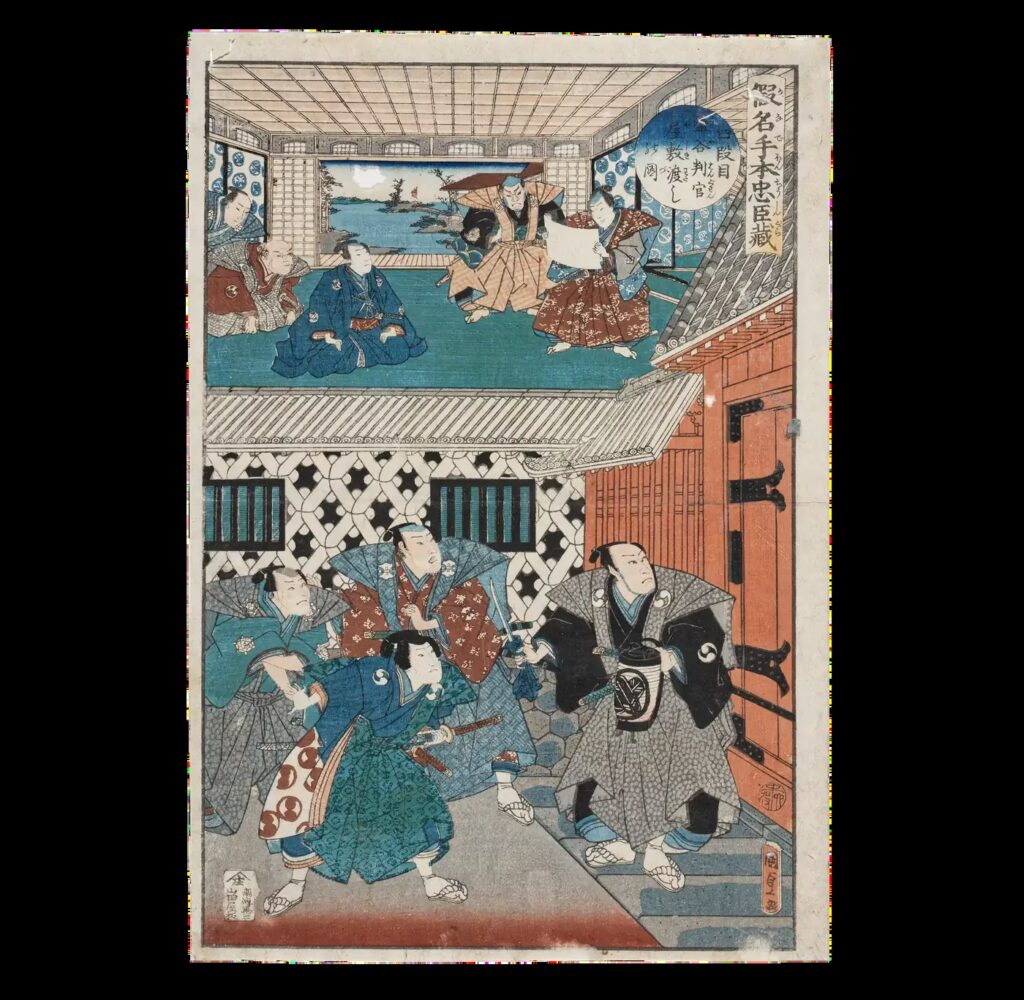
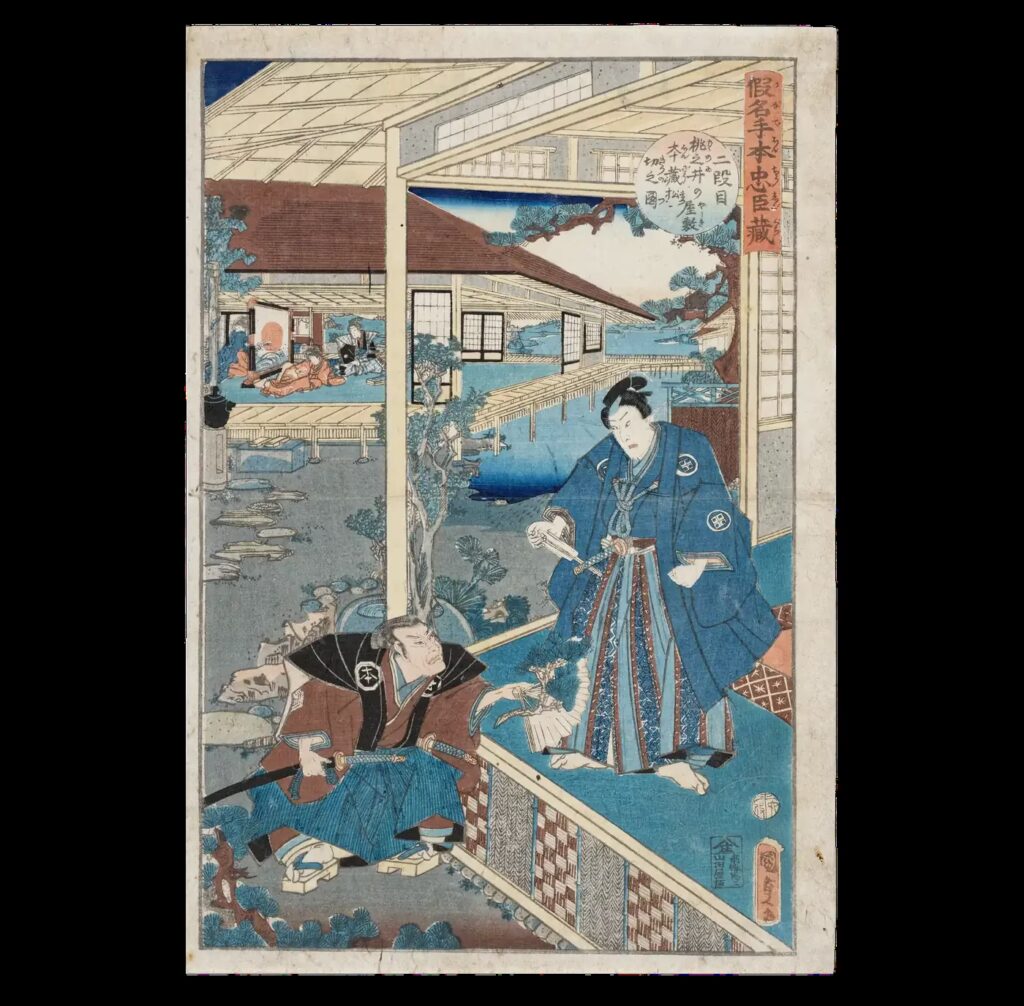
The twelve-part woodblock print series by Utagawa Kunisada in the Samurai Museum Berlin exemplifies this theatrical reinterpretation. The prints illustrate not the historical events themselves, but the Kabuki version, with altered names (En’ya Hangan instead of Asano, Kō no Moronō instead of Kira) and romanticized plotlines. One striking feature is that samurai of various ranks are depicted in civilian clothing rather than armor—a reflection of the Edo-period reality in which the warrior class had long since evolved into a class of civil administrators.
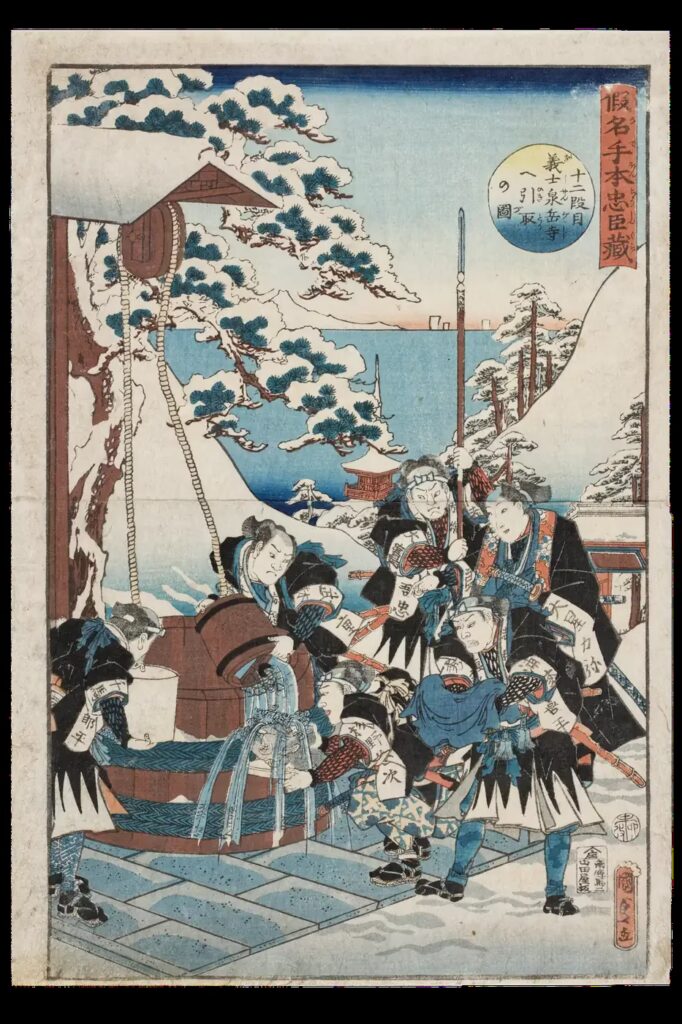
Much of what we associate with the 47 Rōnin today comes from Chūshingura, rather than from history. The iconic black-and-white zigzag patterns on the attackers’ clothing? A theatrical invention. In reality, the Rōnin wore practical fire-resistant garments and chain mail beneath their clothes. Terasaka Kichiemon as a coward who fled before the battle? False. He had been sent away as a messenger and was carrying out an order from Ōishi. Kira Yoshinaka as a one-dimensional villain? An oversimplification. The historical Kira was a meticulous court official, not a monster.
Sources: Van Norden (2013); Harper (2019), p. 815; Hall (1991), Chapter 14 (Genroku Culture); Atkins (2017), Chapter 2.
The 47 Rōnin Today
At Sengaku-ji Temple in Tokyo, the gravestones of the 47 Rōnin still stand in a row before the grave of their lord. Every year on December 14, the anniversary of the attack according to the Japanese calendar, a memorial festival is held there. Visitors from all over Japan come to light incense and pay their respects to the spirits of the Rōnin.
The story has become part of Japan’s national identity—a myth that raises questions that remain relevant today: What do we owe those who place their trust in us? When is obedience a virtue, and when is it cowardice? Can justice justify breaking the law?
At the Samurai Museum Berlin, this world of honor and duty can be explored through authentic historical objects.
Source: Sengaku-ji Temple (official website).
Frequently Asked Questions
How many Rōnin were there really—46 or 47?
47 men took part in the attack on Kira’s residence. Since one of them, Terasaka Kichiemon, was later pardoned and only 46 performed seppuku, both numbers are used. The term “47 Rōnin” refers to the attackers, while “46 Rōnin” refers to those who were sentenced to death.
Why did the Rōnin wait almost two years to take their revenge?
Initially, they pursued a political solution: they hoped to have the Asano house restored through petitions. Only after these efforts failed did they decide to carry out their vendetta. They also needed to lull Kira into a false sense of security—a goal Ōishi achieved through his notorious deception in Kyōto.
What happened to the 47th Rōnin?
Terasaka Kichiemon, an ashigaru (a low-ranking foot soldier), was sent away by Ōishi as a messenger to inform the families of the successful revenge. He was later pardoned, lived to an advanced age, and was eventually buried alongside his comrades at Sengaku-ji Temple.
Did the Rōnin really wear the famous zigzag-patterned uniforms?
No. The black-and-white patterns familiar from films and woodblock prints are an invention of Kabuki theatre. The historical Rōnin wore practical clothing, including fire-resistant garments and chain mail, to disguise and protect themselves.
Where can you visit the graves of the 47 Rōnin?
Their graves are located at Sengaku-ji Temple in Tokyo’s Minato district. The site also contains the grave of Asano Naganori and historical artifacts associated with the Rōnin, including clothing and weapons connected to that fateful night.
Visit the Samurai Museum Berlin
You can experience the woodblock print series and artifacts featured in this article in person in our permanent exhibition: the Kunisada Chūshingura series, the Kunichika print, and the tantō dagger engraved with Fudō Myōō.
Open daily from 10 a.m. to 7 p.m.
Auguststraße 68, Berlin-Mitte.
Related Articles
- Seppuku: The Ritual Suicide of the Samurai
- Bushidō: The Code of Honour
- Tantō: The Secret Weapon of the Samurai
References
This article is based on the following sources:
- Atkins, E. Taylor (2017): A History of Popular Culture in Japan: From the Seventeenth Century to the Present. Bloomsbury Academic.
- Hall, John Whitney (ed.) (1991): The Cambridge History of Japan, Vol. 4: Early Modern Japan. Cambridge University Press.
- Harper, Thomas J. (2019): 47: The True Story of the Vendetta of the 47 Ronin from Akō. Leete’s Island Books.
- Ikegami, Eiko (1995): The Taming of the Samurai: Honorific Individualism and the Making of Modern Japan. Harvard University Press, Chapter 11.
- Van Norden, Bryan W. (2013): “A Reader’s Guide to Chūshingura.” In: Education About Asia 18:2.
- Yamamoto Tsunetomo (c. 1716): Hagakure. Translation based on the 2021 Anaconda edition.
Museum Objects:
- Catalogue C28V_30: Woodblock print series Kanadehon Chūshingura by Utagawa Kunisada (1786–1865). Samurai Museum Berlin.
- Catalogue E10V_49: Kabuki scene The Treasury of Loyal Retainers by Toyohara Kunichika (1835–1900), 1862. Samurai Museum Berlin.
- Catalogue C41V_66: Tantō dagger engraved with Fudō Myōō, blade dating to the Momoyama period, signed Myōju (Umetada Myōju). Samurai Museum Berlin.
© Samurai Museum Berlin – All rights reserved
You might also like
Date Masamune: The One-Eyed Dragon of Oshu (1567–1636)
Date Masamune was 17 years old when he took control of Oshu, and nearly unified Japan. The story of the…
Read the article
Tomoe Gozen: Japan’s Most Famous Female Warrior (ca. 1157–1247)
Tomoe Gozen – warrior, legend, question. What do we really know about Japan's most famous onna-musha? History & fact-check at…
Read the article
Toyotomi Hideyoshi: From Peasant’s Son to Ruler of Japan
Toyotomi Hideyoshi (1537–1598): how a nameless foot soldier became the unifier of Japan. History, reforms & exhibits at the Samurai…
Read the article