 Nominated for the EMYA2026 award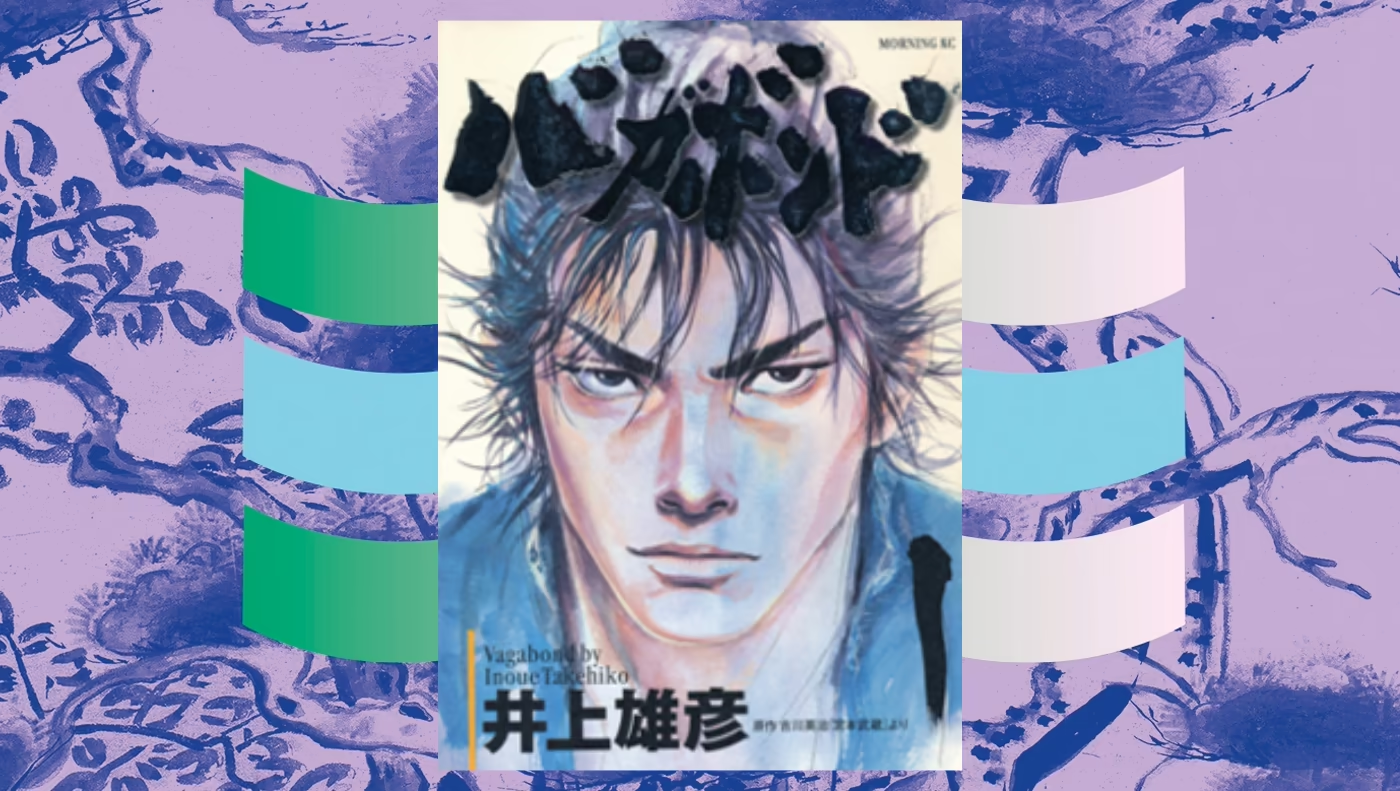
Vagabond: Miyamoto Musashi as a Manga Icon — Art, Philosophy and Historical Truth
A double-page spread without dialogue. Ink on paper, black and white, so detailed that you can make out the clumps of earth under the fingernails. A young man kneels in a pool of blood on the battlefield of Sekigahara. His sword is stuck in the sodden earth. Around him lie the dead — soldiers who only hours ago still had names, families, plans. His gaze is empty. Not the gaze of a hero. The gaze of a survivor who does not yet know whether that is a good thing.
This is how Vagabond begins, Takehiko Inoue’s manga about Miyamoto Musashi. More than 82 million copies sold make the series one of the most successful manga of all time — a work exhibited in galleries and museums, not just in comic shops.
Vagabond tells the story of probably the most famous sword master in Japanese history.
But which story?
For the source material is not a history book. Inoue adapts Eiji Yoshikawa’s novel Musashi from 1935 — a newspaper serial that appeared during Japan’s militarist expansion and stylised Musashi as a national role model. 120 million copies sold turned Yoshikawa’s fiction into supposed truth. The manga thus tells the fictionalisation of a fictionalisation. And the historical Musashi was neither the lone wolf nor the enlightened sage that Yoshikawa and Inoue portray him as.
Vagabond — The Manga at a Glance
Before Takehiko Inoue drew Musashi, he drew basketball. His debut Slam Dunk sold more than 170 million copies and is regarded as one of the most influential manga of the 1990s. That Inoue did not then begin the next sports manga, but a historical epic about a 17th-century sword master, was a conscious decision.
As he explained in interviews, he wanted to explore “more fundamental concepts” — life and death, human nature, the struggle for meaning beyond victory and defeat.
The result appeared from September 1998 in the seinen magazine Morning (Kodansha). 37 tankōbon volumes followed until July 2014, then the series fell silent. Since May 2015, Vagabond has been on indefinite hiatus.
What sets Vagabond apart from other manga is not the story, but the way Inoue tells it. From the Kojirō storyline onwards, he switched from pen to brush and developed a drawing style reminiscent of traditional Japanese ink painting (Suiboku-ga). His declared model: Akira Kurosawa’s films — the “gloomy, dirty feeling” of Seven Samurai and Rashōmon. The awards confirmed the ambition: in 2000 the Kodansha Manga Award, in 2002 the Osamu Tezuka Cultural Prize, Japan’s most prestigious manga honour.
In 2008 Inoue went one step further. For the exhibition *The LAST Manga Exhibition* at the Ueno Royal Museum in Tokyo, he created more than 140 large-format sumi-e paintings — up to three metres high, each an artwork in its own right. The exhibition told an epilogue to Vagabond: the old Musashi in the Reigandō cave, the place of his death. Inoue called the concept “Spatial Manga” — the museum space itself as a narrative format. Tickets sold out within hours. Between 2008 and 2010 the exhibition toured Japan, from Tokyo to Kumamoto and Osaka.
Vagabond is an art project, not a typical manga. And that is precisely why it is worth asking how seriously it takes history.
History → Novel → Manga: The Three Layers of the Musashi Myth
Vagabond does not tell Musashi’s story. It tells Yoshikawa’s version of it — filtered through Inoue’s artistic vision. Anyone who reads the manga without knowing about this layering mistakes fiction for biography.
Layer 1: The Historical Musashi
Measured against his fame, the sources on the real Miyamoto Musashi are surprisingly thin. In his biography *Miyamoto Musashi: His Life and Writings* (2004), the Japanese martial arts researcher Kenji Tokitsu systematically evaluated the available primary sources. What remains once the legends are stripped away?
What is certain: Musashi was born around 1584 in Harima or Mimasaka Province, the son of the sword master Shinmen Munisai. He fought a series of duels, of which the fights against the Yoshioka school in Kyoto and the famous duel against Sasaki Kojirō on the island of Ganryū-jima (1612) are the best documented. He developed the two-sword technique Niten Ichi-ryū, wrote the strategic work Gorin no Sho (The Book of Five Rings) and died in Kumamoto in 1645. There he served the Hosokawa as a guest and adviser — no longer a masterless wanderer, but a recognised master.
Almost everything that makes the story exciting is not certain: whether Musashi fought at Sekigahara (Tokitsu shows that his father was close to the Kuroda clan of the Eastern Army — so Musashi may have stood on the winning side, not the losing side), whether he really fought more than 60 duels, and above all: almost every episode of his youth. The gaps are huge — and it was precisely into these gaps that Yoshikawa wrote his novel.
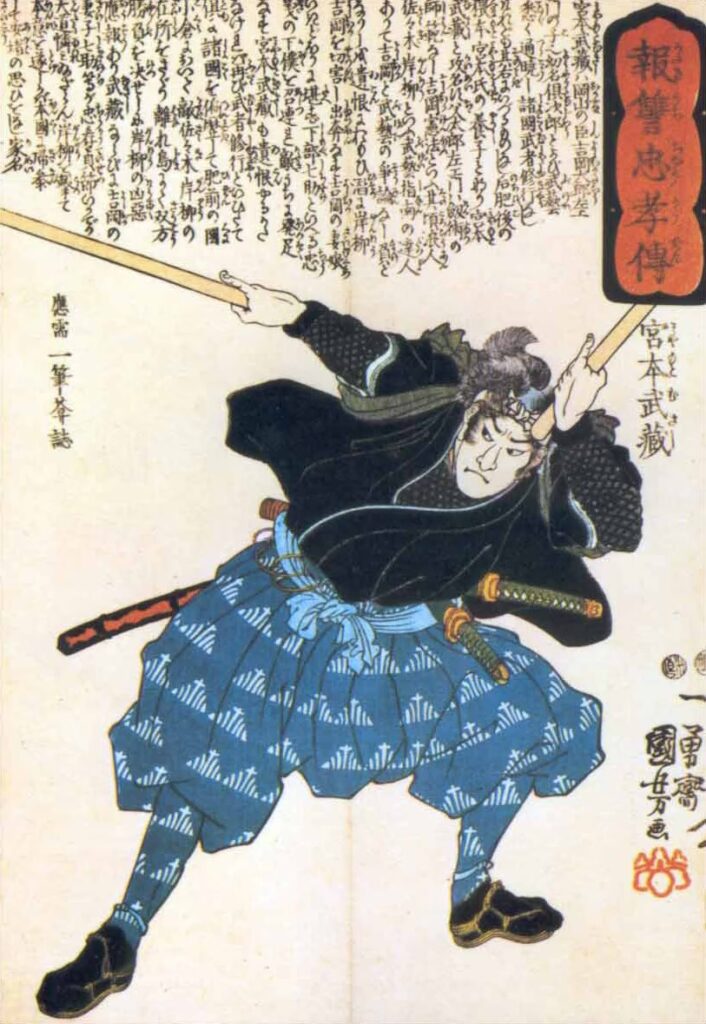
Layer 2: Yoshikawa’s Novel (1935–1939)
Eiji Yoshikawa was not a historian. He was a writer of popular fiction who drew his material from old chronicles and his own imagination. His Musashi appeared between 1935 and 1939 as a daily serial in the Asahi Shimbun, Japan’s highest-circulation newspaper — in the midst of militarist expansion, while Japan was waging war in China.
The timing was no coincidence. Yoshikawa’s Musashi transformed the historical sword master into a national role model: a young savage who is refined through discipline, combat and Zen meditation into an enlightened warrior. The novel supplied the moral blueprint that 1930s Japan needed — personal self-sacrifice as the path to perfection.
Yoshikawa’s most important inventions, which Inoue later adopted: the love story with Otsū — an entirely fictional character who appears in no historical source. The mentorship of the Zen monk Takuan Sōhō, which structures Musashi’s transformation from beast to sage — historically, there is no evidence of any contact between the two (Tokitsu, p. 85). And the dramatic arc from the wild Takezo to the mature Musashi, which follows a Western Bildungsroman structure and is alien to the Japanese original.
After the Second World War, the novel was revised. References to emperor worship disappeared, and the focus shifted from national duty to personal enlightenment. This sanitised post-war version — not the militarist original — became an international bestseller. More than 120 million copies sold worldwide made Yoshikawa’s fiction the standard version of Musashi’s life.
Layer 3: Inoue’s Manga (1998–2015)
Takehiko Inoue follows Yoshikawa’s plot, but he tells a different story. Where the novel describes a moral ascent — from beast to sage —, Inoue draws a psychological study. His Musashi is not a hero on the path to enlightenment. He is a traumatised young man who kills because he can do nothing else, and who only slowly comprehends what this is doing to him.
The strongest departures from Yoshikawa show in the tone, not in the plot. Inoue expands the character of Sasaki Kojirō into a narrative strand of his own and makes him Musashi’s mirror figure — a swordsman who seeks the same thing but takes a completely different path. He gives the supporting characters a psychological depth that Yoshikawa’s popular novel never had. And he lets his Musashi suffer from violence instead of portraying it as a cleansing act.
Inoue himself has stressed in interviews that his Musashi is not a samurai but a rōnin — a masterless man who follows no code but seeks his own path. “Bushido plays no role,” he said. “Musashi’s path is unique.” This is a deliberate correction of Yoshikawa, who still placed his Musashi firmly within the framework of samurai ethics.
What remains is a three-stage filter: history passes through Yoshikawa’s romanticising lens, then through Inoue’s psychological lens. Anyone who reads Vagabond as a biography is reading a novel based on a novel.
Musashi vs. Vagabond — The Great Fact Check
Vagabond is surprisingly close to history — but at crucial points Yoshikawa embellishes, and Inoue adopts the inventions. A systematic comparison shows where art and truth part ways. The following table is based on Kenji Tokitsu’s biographical research and contrasts the manga’s portrayal with the historical sources.
| Manga/Novel | Historical Reality | Assessment |
|---|---|---|
| Musashi fights at Sekigahara on the losing side | Participation disputed. Tokitsu shows that Musashi’s father was close to the Kuroda clan (Eastern Army) – Musashi may have stood on the winning side (Tokitsu, p. 45) | 🟡 Possible but unproven |
| Musashi is an uneducated savage who is refined into a sage | Musashi was the son of the sword master Shinmen Munisai, not illiterate. He later wrote the Gorin no Sho and was a recognised calligrapher | ❌ Yoshikawa invention |
| The Zen monk Takuan Sōhō educates Musashi | No historical contact documented (Tokitsu, p. 85). Takuan was a real figure, but the mentorship is Yoshikawa’s most effective invention | ❌ Yoshikawa invention |
| The love story with Otsū | Entirely fictional. No woman named Otsū appears in the historical sources on Musashi | ❌ Yoshikawa invention |
| The Yoshioka feud and the Ichijōji massacre | The duels against the Yoshioka school are documented in several sources. The details of the “massacre at the tree”, however, are exaggerated into legend (Tokitsu, p. 50) | 🟡 Historical core, details uncertain |
| Ganryū-jima: duel against Kojirō with a wooden sword | One of the best-documented events in Musashi’s life. Confirmed in clan records and the Kokura Hibun memorial stone | ✅ Historically accurate |
| Musashi’s Niten Ichi-ryū two-sword technique as the ultimate martial art | It existed, but had “far less influence on the technical development of kendo than schools such as Ittō-ryū or Shinkage-ryū” (Hurst, p. 180) | ✅ Correct, but overemphasised |
| Musashi as a lone wandering rōnin | Partly. Musashi held positions in the service of the Ogasawara and Hosokawa and was a town planner in Akashi and Himeji – not just a masterless wanderer | 🟡 Simplified |
| Sasaki Kojirō as an equal rival | The figure existed, but details of his origins, technique and personality can hardly be verified (Tokitsu, p. 60) | 🟡 Figure existed, details uncertain |
| Musashi created ink paintings and tsuba designs | Confirmed. Musashi was a recognised sumi-e master and calligrapher. Several of his works are held in Japanese museums | ✅ Historically accurate |
The result: about 40 per cent of the plot is historically accurate, 30 per cent possible but unproven, 30 per cent Yoshikawa’s fiction.
Vagabond is not a history lesson — but it is not pure fantasy either. The manga’s strength lies not in historical fidelity, but in the psychological depth with which Inoue fills the framework of fact and fiction.
Two Swords, One Question: What Was Niten Ichi-ryū Really?
There is hardly a stronger visual motif in Vagabond than Musashi with two swords. Inoue stages Niten Ichi-ryū — literally: the “school of two heavens as one” — as the ultimate expression of martial perfection. When Musashi wields both blades at once, the fighting becomes choreography, the panel becomes a double-page spread, the dynamics visually overwhelming. It is the aesthetic heart of the manga.
Historically, the matter is more complicated. Musashi’s two-sword style existed — that is undisputed. But his influence on Japanese swordsmanship was far smaller than the manga suggests. The historian G. Cameron Hurst III, one of the few academics to study Japanese martial arts as social institutions rather than as mystical paths, classifies Musashi in Armed Martial Arts of Japan (1998) as an “outlier”. Niten Ichi-ryū had “far less influence on the technical development of kendo than schools such as Ittō-ryū or Shinkage-ryū” (Hurst, p. 180).
The schools that truly shaped the style were others. The Ittō-ryū, founded by Itō Ittōsai, laid the technical foundation for modern kendo — the principle of the single, decisive strike (ippon) goes back to it. The Yagyū Shinkage-ryū became the house sword school of the Tokugawa shōguns and thus shaped the entire sword culture of the Edo period from the top down. Musashi’s Niten Ichi-ryū, by contrast, remained a niche school, regionally limited and without institutional power.
Why the fascination, then? The sword master’s reasoning was pragmatic, not mystical. “To die with a weapon left unused in one’s belt would be regrettable,” he wrote in the Gorin no Sho.
That was no philosophical enlightenment — it was the logic of a man who survived in a world in which duels ended in death.
Two swords meant a tactical advantage: the katana for attack, the wakizashi for defence or close combat.
What actually made the sword master timeless was not his technique, but his philosophy. The Gorin no Sho describes strategy as a universal principle — applicable to the sword, architecture, the tea ceremony and trade. Not the two blades, but the idea that mastery in every field follows the same laws, secured his reputation for centuries.
To understand what Niten Ichi-ryū meant, one must also understand what sword schools (Ryūha) were in the Edo period: not romantic dojos, but commercial enterprises. Headmasters sold certificates (Menkyo), guarded secret teachings as intellectual property and were embedded in clan hierarchies (Hurst, p. 175; Friday 1997). The great schools such as Ittō-ryū had hundreds of students and political influence. Musashi, the loner who founded his own school and never permanently subordinated himself to any clan, was a foreign body in this system — brilliant, but institutionally powerless.
Sekigahara — The Historical Background That Vagabond Takes for Granted
Vagabond begins with two words: “After a battle.” For Japanese readers, that is enough. For Western readers, the context remains invisible — and with it the entire political order that defines Musashi’s world.
The battle that Inoue does not explain was the decisive confrontation of early modern Japan. On 21 October 1600, two armies faced each other at Sekigahara, a village in Mino Province: the Eastern Army under Tokugawa Ieyasu and the Western Army under Ishida Mitsunari. Some 90,000 soldiers fought over the succession to Toyotomi Hideyoshi, who had died in 1598 — and thus for control of all of Japan.
Dense fog covered the battlefield in the early morning. Both sides were evenly matched until Kobayakawa Hideaki — a commander of the Western Army — switched sides and attacked his own allies. Other lords followed. What began as an even battle ended in collapse. Tokugawa Ieyasu won, took the title of shōgun and founded a rule that would last more than 260 years.
For the losing side, Sekigahara meant ruin. Clans were dissolved, lands confiscated, tens of thousands of samurai lost their lords. They became Rōnin — masterless warriors in a world that suddenly had no place for them. This is the world into which Inoue casts his Musashi: not romantic freedom, but social downfall. Being a rōnin was not a choice, but a stigma.
It meant the loss of income, of social belonging and — in a society that defined loyalty to one’s lord as the highest value — of one’s own honour.
Whether Musashi actually fought at Sekigahara is one of the great question marks of his biography. Tokitsu shows that Musashi’s father was close to the Kuroda clan — an ally of the Eastern Army. If the young warrior was there at all, he may have fought on the winning side, not on the losing side, as Yoshikawa needed for dramatic purposes. The truth is: we do not know. Musashi himself is silent on the matter in the Gorin no Sho. Contemporary battle reports do not mention his name. Yoshikawa needed the start on the losing side because it provides the perfect narrative low point — from the very bottom to the very top. Here, history serves the drama, not the other way round.
At the Samurai Museum Berlin, one object makes this historical moment tangible. A suit of armour of the Wakisaka clan — one of the rare surviving examples made for clan members before the Battle of Sekigahara. The Wakisaka belonged to the Western Army, but switched sides during the battle and thus contributed to Tokugawa’s victory. Their armour shows the Hakeme lacquer technique: a wave pattern drawn with a comb into the still-wet layer of lacquer.
Even for the Sengoku period, this technique was extremely rare — the Wakisaka armours are the only known examples worldwide. One is literally looking at an artefact that stood on the battlefield of Sekigahara.
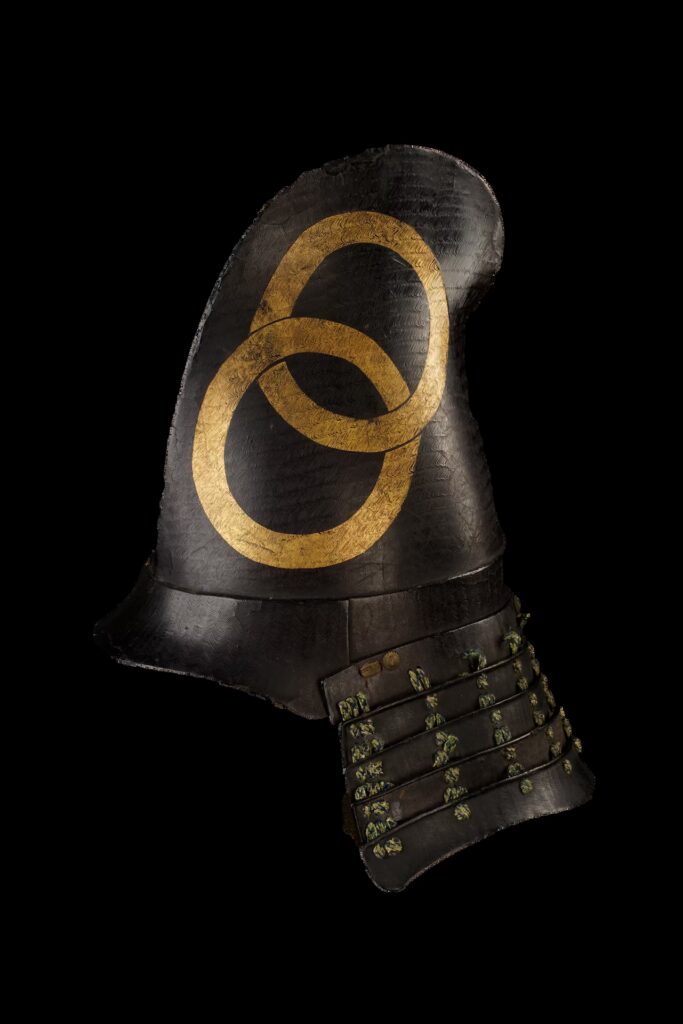
Armour of the Wakisaka clan — made before Sekigahara 1600, with the Hakeme lacquer technique that is unique worldwide
Musashi as an Artist — The Side Inoue Understands Best
Inoue’s greatest achievement in Vagabond is not the fact check, not the fight choreography and not the psychological depth. It is a parallel so obvious that it is easily overlooked: Musashi was himself an artist. A manga artist who works with a brush tells the story of a sword master who painted with a brush. That is no coincidence. It is the real theme.
The historical Musashi was a recognised master of ink painting (Sumi-e). His works — herons in sparing ink, wild horses in dynamic brushstrokes, calligraphy of meditative precision — hang in Japanese museums and are regarded as important works of Edo-period art. He designed Tsuba, the sword guards, with characteristic motifs. And he was a town planner: in Akashi and Himeji he designed gardens and urban development projects.
The sword master whom Yoshikawa portrayed as a one-dimensional fighter and whom popular culture reduces to a duellist was in reality a universalist — a man who made no distinction between blade and brushstroke.
Inoue mirrors this dual talent in his own working process. From the Kojirō storyline onwards, he switched from pen to brush — a deliberate move towards traditional Japanese ink painting, which Musashi himself practised. In an interview he explained that he had wanted to translate the “gloomy, dirty feeling” of Akira Kurosawa’s films *Seven Samurai and Rashōmon* into images. The result is a manga that at its best moments looks like a series of sumi-e paintings — with the dynamism of a film sequence and the stillness of a meditative print.
The connection goes deeper than aesthetics. In the Gorin no Sho, Musashi describes strategy as a universal principle: the laws of swordsmanship apply to the brush, the tea ceremony, architecture, trade. Mastery is not technical skill, but a state — “the Void” (Kū), the fifth and final book, describes a place beyond technique where the difference between sword and brush ceases to exist. Inoue’s Vagabond tells exactly this journey. And his decision to leave the manga unfinished — on indefinite hiatus since 2015 —, read in the context of Musashi’s philosophy, appears not as failure but as consistency. Musashi described the Void as the place where “there is no beginning and no end”. A manga without an ending is perhaps the most honest realisation of this idea.
That the historical protagonist himself designed tsuba connects him with a craft that is shown in impressive depth at the Samurai Museum Berlin. 18th-century tsuba of the Sōten school present battle scenes from the conflict between the Minamoto and Taira (1180–1185) in the Hikone bori technique: fine coloured inlays of gold, copper and silver on an iron ground, the warriors’ faces of shimmering silver, their armour set in fine gold. Each tsuba is a miniature work of art no larger than the palm of a hand — battle scenes condensed onto the surface of a sword guard. Despite its small workshop of only 25 students, the Sōten school competed with the greatest tsuba makers in Japan. Musashi, who designed tsuba himself, would have recognised these works for what they are: the same union of warrior and artist that also defined his life.
Tsuba of the Sōten school — battle scenes in gold, silver and copper on an iron ground, miniature works of art on sword guards
The double-page spread with which everything begins — the young man in the pool of blood at Sekigahara, the sword in the sodden earth, the empty gaze — shows no historical moment. It shows Yoshikawa’s invention, filtered through Inoue’s brush, condensed into an image that 82 million readers take for the truth. That is not a criticism. It is the structure one needs to know in order to read Vagabond properly.
For what defines this manga is not what it shows, but what it sets in motion. Anyone who follows Inoue’s Musashi through 37 volumes will at some point read Yoshikawa’s novel to understand what the artist changed. Anyone who reads the novel comes across the gaps — the questions that Yoshikawa filled with fiction. And anyone who notices the gaps ends up with Tokitsu, with Hurst, with the historical sources. Good fiction does not make us dumber. It makes us curious about the truth behind it. That is the real achievement of Vagabond: not conveying history, but creating a desire for it.
The historical Musashi — the sword master who created ink paintings, designed tsuba, laid out gardens and wrote a book about the Void — disappears behind 120 million copies of Yoshikawa sold and 82 million Inoue volumes. But he does not disappear completely. At the Samurai Museum Berlin lie the artefacts that bear witness to his real world: the armour of a clan that switched sides on the battlefield of Sekigahara.
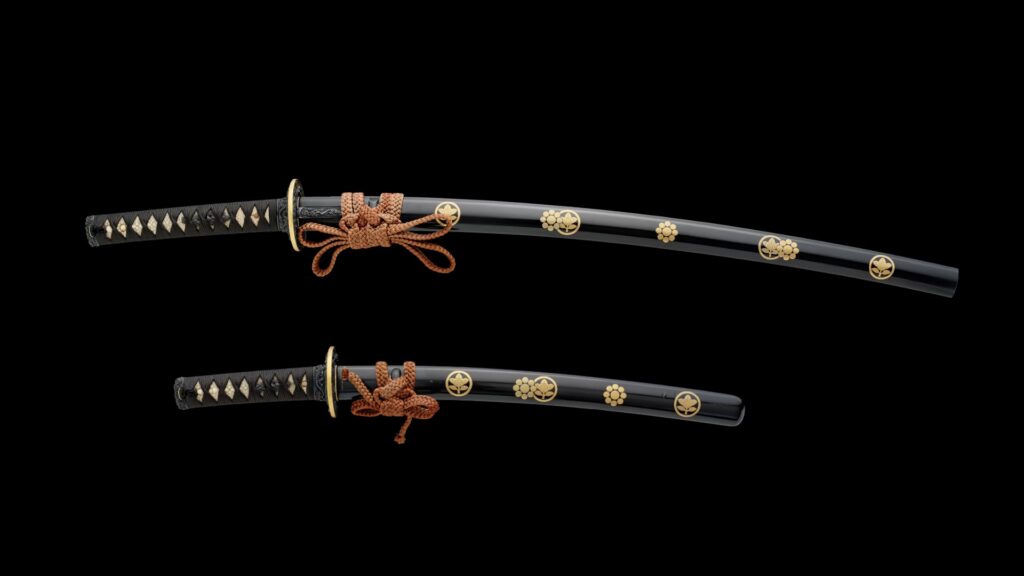
The sword pair of a samurai whose family crests gleam in gold lacquer on the scabbard — marks of rank that the manga’s protagonist repurposed as weapons. The tsuba of a school that engraved battle scenes in gold, silver and copper on an iron ground, miniature works of art that unite warrior and artist in one object — precisely the connection that also defined Musashi’s life.
The manga tells the legend. The museum shows the history. And anyone who knows both understands why the truth is sometimes more interesting than fiction.
More on the world of the sword schools that Musashi challenged — from Niten Ichi-ryū to modern kendo.
Frequently Asked Questions about Vagabond
Is Vagabond historically accurate?
Partly. About 40 per cent of the plot is based on historically established events (Yoshioka duels, Ganryū-jima), 30 per cent on possible but unproven episodes (Sekigahara) and 30 per cent on inventions by the novelist Eiji Yoshikawa (Otsū, Takuan’s mentorship). Vagabond adapts Yoshikawa’s novel, not the historical biography.
Why is Vagabond unfinished?
The series has been on indefinite hiatus since May 2015. Takehiko Inoue has spoken in interviews about creative exhaustion and the strain of serialisation. With 37 volumes and more than 82 million copies sold, the series is one of the best-selling manga of all time.
What is the source material for Vagabond?
Vagabond is based on the novel Musashi by Eiji Yoshikawa, which appeared as a serialised novel in the Asahi Shimbun between 1935 and 1939. With more than 120 million copies sold, the novel is one of the most successful in the history of Japanese literature.
How does Vagabond differ from the novel?
Inoue follows Yoshikawa’s plot, but tells it with greater psychological depth. His Musashi suffers from violence instead of glorifying it. The character of Sasaki Kojirō is greatly expanded, and the novel’s national-moral tone is replaced by existential questions.
List of Sources
This article is based on:
Primary Sources (Tier 1 — Academic)
- TTokitsu, Kenji (2004): *Miyamoto Musashi: His Life and Writings.*Shambhala Publications. ISBN 978-1-59030-045-6
- Hurst III, G. Cameron (1998): *Armed Martial Arts of Japan: Swordsmanship and Archery.* Yale University Press. ISBN 978-0-300-04967-9
- Atkins, E. Taylor (2017): *A History of Popular Culture in Japan: From the Seventeenth Century to the Present.* Bloomsbury Academic. ISBN 978-1-4742-5853-1
- Friday, Karl F. (1997): *Legacies of the Sword: The Kashima-Shinryū and Samurai Martial Culture.* University of Hawaii Press. ISBN 978-0-8248-1847-4
- Turnbull, Stephen (2022): *War in Japan 1467–1615.* Osprey Publishing. ISBN 978-1-4728-4669-8
- Turnbull, Stephen (2010): *Katana: The Samurai Sword.* Osprey Publishing. ISBN 978-1-84908-349-1
- Sesko, Markus (2014): *Encyclopedia of Japanese Swords.* Lulu Publishing. ISBN 978-1-312-37991-8
Visit the Samurai Museum Berlin
Experience the exhibits and topics of this article up close in the permanent exhibition of the Samurai Museum Berlin. More than 900 original objects from feudal Japan — armour, weapons, everyday objects — await you at Auguststraße 68, Berlin-Mitte. Open daily from 10 a.m. to 7 p.m.
Related Articles
- Samurai: History, Culture and Legacy
- Bushido: The Samurai Code of Honour
- The Katana: Myth and Reality
© Samurai Museum Berlin – All rights reserved
You might also like
Ninja Pop Culture: From Turtles to Naruto — Myth & Reality
Ninja pop culture: from Turtles to Naruto – how the black suit belongs to Kabuki theatre, not the battlefield. Myth…
Read the article
The Last Samurai: Film vs. Reality – The Ultimate Fact Check
Last Samurai: Film vs. Realität – großer Faktencheck. Was stimmt über Saigō Takamori, Meiji & den echten letzten Samurai? Antworten…
Read the article
Sekiro: Shadows Die Twice — The True Sengoku History
Sekiro: Shadows Die Twice – What is historical, what is fiction? The real Sengoku history behind the game, explained with…
Read the article