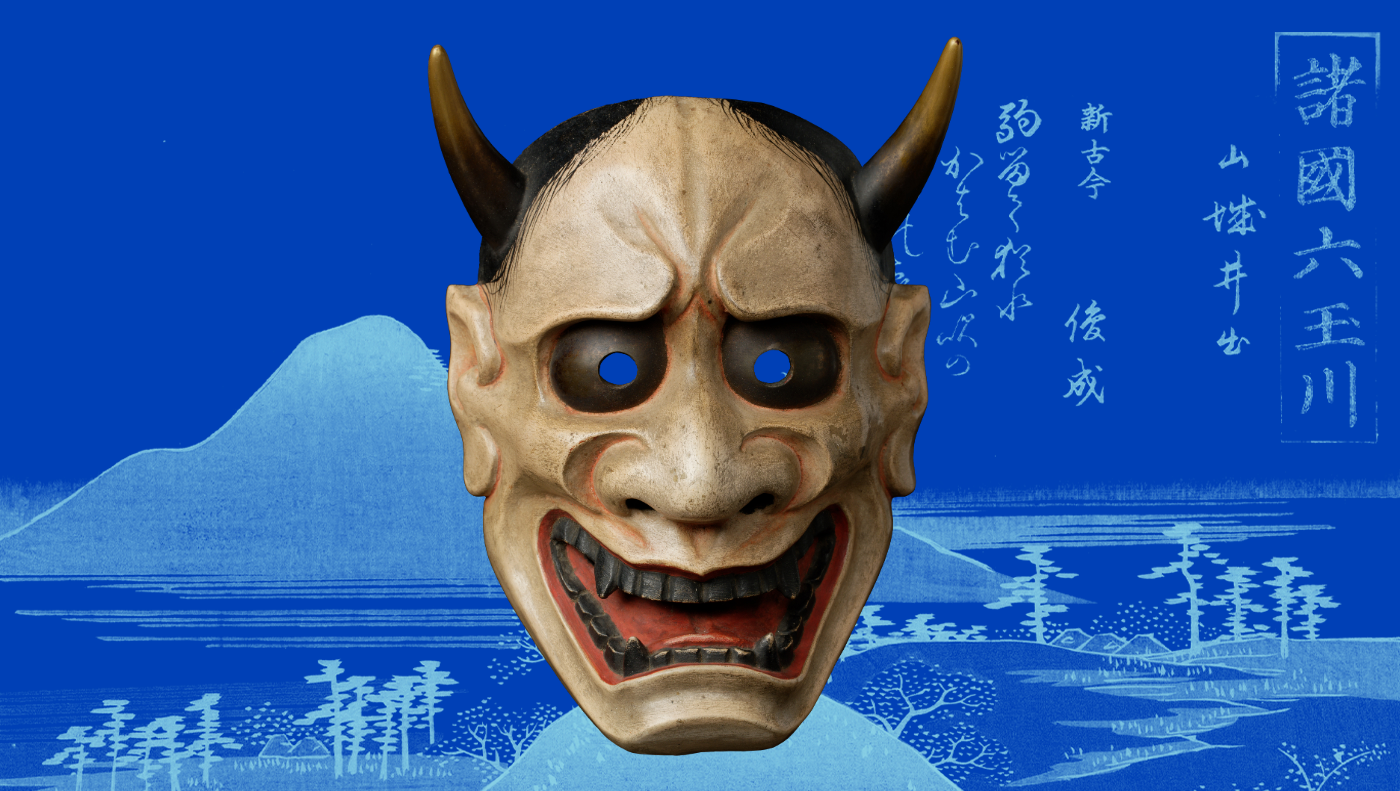
A Nō play lasts between two and eight hours. The masks — carved from wood — show no unambiguous emotions: depending on how the light falls, their expression changes between grief and a smile. Nō is one of Japan’s oldest living forms of stage art.
Zeami and the Shogunal Court
Nō arose from the sarugaku (popular entertainment) of the 14th century. Zeami Motokiyo (1363–1443) transformed it into high art. Keene shows that this transformation took place almost entirely through the patronage of the military nobility — shōgun Ashikaga Yoshimitsu elevated sarugaku to the ceremonial art of the warrior nobility (shikigaku).[1]
Within the schools, Zeami’s theories were treated as military secrets (kuden) — artificial scarcity to secure the monopoly.[2]
The Warrior Plays: Trauma, Not Triumph
The shura-mono (warrior plays) do not glorify battles, but revolve around guilt, remorse and redemption. In the play Atsumori, the ghost of the Taira warrior does not appear for revenge — together with his killer, he seeks Buddhist peace. Kiyotsune chooses death out of despair, not out of duty.[3]
Today the active repertoire comprises around 240–250 canonical plays out of more than a thousand that were written in the course of the Muromachi and Edo periods.[1]
Kyōgen: The Social Safety Valve
The comic kyōgen interludes showed miserly, cowardly samurai lords. The shogunate tolerated these parodies because they relieved psychological pressure on the ruling order.[2]
Frequently Asked Questions
What is Nō theatre?
Nō is one of Japan’s oldest living forms of stage art, developed in the 14th century under Zeami Motokiyo with the patronage of the Ashikaga shogunate. Slow, highly stylised, oriented towards yūgen. UNESCO World Heritage since 2008.
What does yūgen mean?
Yūgen is the central aesthetic principle of Nō — deep, melancholic beauty, inseparably interwoven with Buddhist transience (mujō). The inexpressible in silence and sparing gesture.
What are shura-mono?
Warrior plays of the Nō — dramas about the ghosts of fallen samurai. Contrary to popular belief: not the glorification of heroes, but guilt, remorse and longing for Buddhist redemption. A well-known play is Atsumori.
What is the hashigakari?
The hashigakari is the characteristic bridge of the Nō stage. It symbolises the link between the earthly world of the audience and the metaphysical world of the spirits.
Is Nō still alive?
Yes. The five schools (Kanze, Hōshō, Komparu, Kongō, Kita) perform Nō regularly. The active repertoire: 240–250 canonical plays. UNESCO World Heritage since 2008.
Visit the Samurai Museum Berlin
Nō masks are among the most striking objects of samurai culture. The Samurai Museum Berlin. Daily 10 a.m.–7 p.m., Auguststraße 68.
Related Articles
Bibliography
- [1] Keene, Donald (1990): Nō and Bunraku. Columbia UP.
- [2] Brandon, James R. (1997): Cambridge Guide to Asian Theatre. CUP. pp. 147–165.
- [3] Nippon Gakujutsu Shinkōkai (1955/2012): The Noh Drama: Ten Plays. Tuttle. Atsumori, Kiyotsune, Sanemori.
© Samurai Museum Berlin – All rights reserved
You might also like
Shogun – The Military Rulers of Japan
Shogun – the military rulers of Japan: who they were, how they ruled & why they never abolished the emperor.…
Read the article
Bushidō: The Code of Honour
Bushidō – the samurai code of honor. Nitobe's 7 virtues, historical reality, Hagakure, modern adaptations. Facts instead of myths, with…
Read the article
Tea Ceremony: Why Sen no Rikyū Convinced the Samurai to Drink Tea
In April 1591, Sen no Rikyū, Japan’s most important tea master and personal tea adviser to the most powerful man…
Read the article