History: From the Battlefield to the Dōjō
Kenjutsu – The Roots in War
The prehistory of kendo does not begin with the sword.
On the battlefields of the Kamakura (1185-1333) and Muromachi periods (1336-1573) the katana was a secondary weapon. Combat priorities lay with the bow (yumi), the spear (yari) and, from the mid-16th century, the arquebus (teppō). The sword came into use when the spear broke, the distance became too short or the decisive head cut (kubi-tori) for taking trophies was required. [1] Paradoxically, systematic swordsmanship only developed when war subsided.
From the late 15th century, the first formalised schools (ryū) emerged, which codified their techniques and kept them secret – not primarily as military innovation, but as social distinction, comparable to medieval guilds. [2] Hundreds of schools competed for pupils and patronage, each with its own secret techniques (hiden): The Kashima Shinryū (founded c. 1450) focused on rapid counter-attacks and is regarded as one of the oldest documented sword schools. The Ittō-ryū (founded 1580) propagated the minimalist “one sword” style – the idea that a single, perfect cut is enough. And the Yagyū Shinkage-ryū (founded 1565) rose to become the official sword school of the Tokugawa shogunate. Its founder Yagyū Muneyoshi and his son Munenori taught three generations of shōguns – a position of political power that went far beyond swordsmanship.
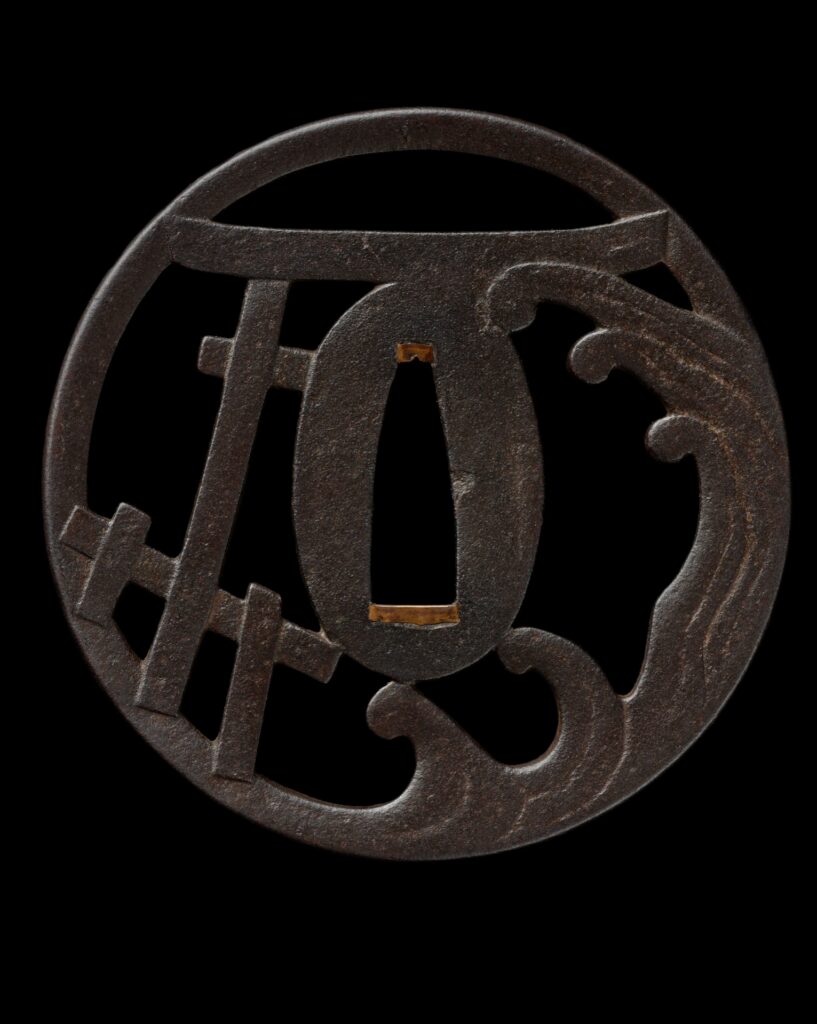
The Yagyū served the Tokugawa shogunate as official sword masters, and the beginnings of tsuba production are attributed to Yagyū Ren’ya (1625–1694). These artfully worked sword guards are not mere protective devices – they are insignia of a dynasty of sword masters whose techniques flowed directly into modern kendo. The Yagyū philosophy of katsujin-ken (“the life-giving sword”) – the idea that true swordsmanship lies not in killing, but in the ability to resolve conflicts without bloodshed – shapes kendo philosophy to this day.
The Edo Revolution: Bamboo Instead of Steel
The decisive transformation took place in the Edo period (1615–1868). More than 250 years of peace under the Tokugawa confronted the samurai with an existential problem: how do you preserve an art of war without war?
The answer came in two waves. At first, kata (型, “forms”) dominated – choreographed practice sequences with wooden swords (bokutō) that preserved techniques without injuring anyone.
But kata alone had a problem: they trained principles, not responsiveness. “Kata training is predictable and symmetrical,” Turnbull analyses. “Real combat is unpredictable, asymmetrical and brutal.”. [3]
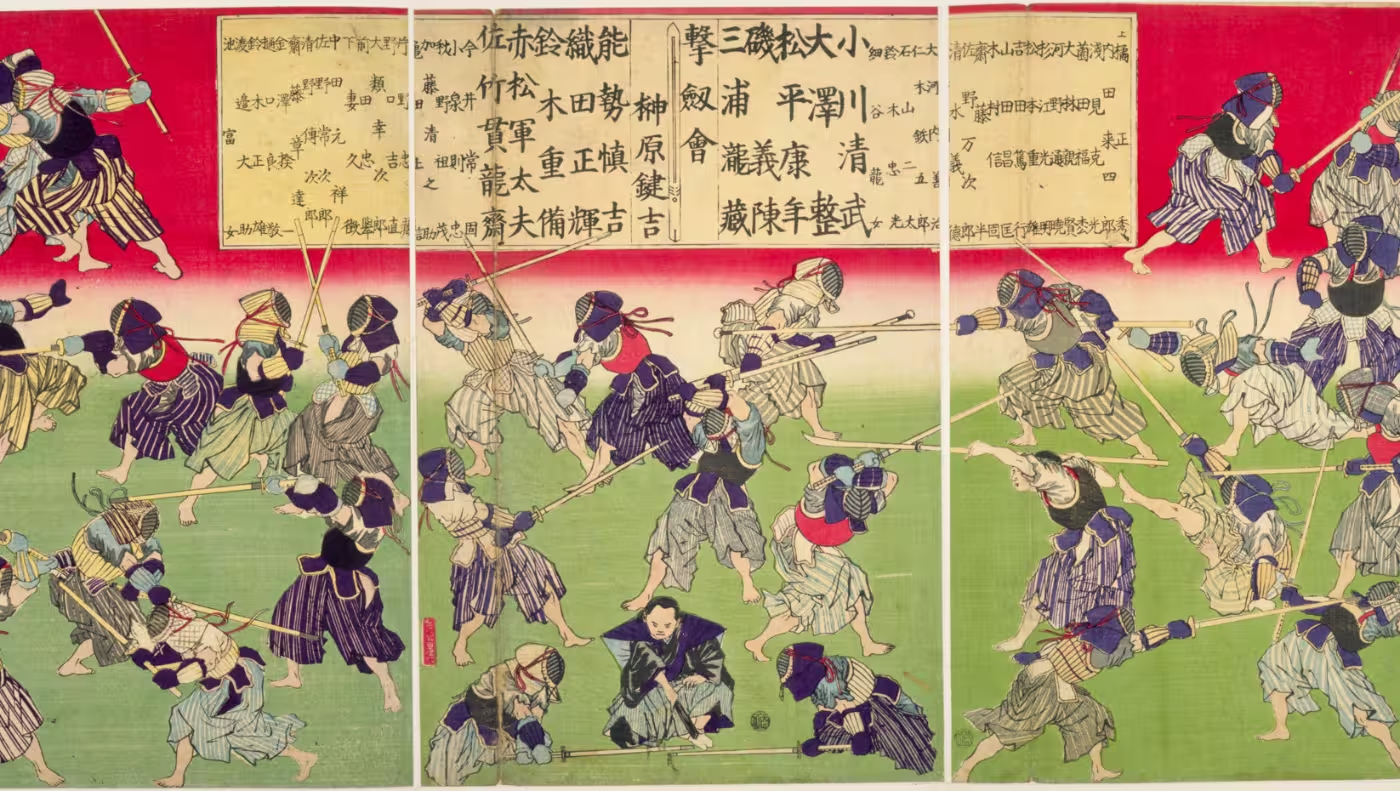
The second wave was the invention of protected free sparring. In the early 18th century, sword masters such as Naganuma Shirōzaemon developed the first protective armour (bōgu) for use with shinai (bamboo swords). Suddenly pupils could fence with full contact without dying. This innovation triggered a debate that Karl Friday documents as the “kata vs. sparring” controversy of the early 18th century. [1] Traditionalists saw free sparring as a decline: the shinai conveyed false distances and false cutting angles and trained reckless aggression instead of calculated precision. Reformers countered that kata without resistance were useless – an argument that has still not been conclusively settled.
The decisive breakthrough came in the late Edo period.
Chiba Shūsaku (1793–1855), founder of the Hokushin Ittō-ryū, systematised shinai free sparring and introduced kirikaeshi training – fast, repetitive sequences of strikes against a partner that still form the basic exercise of every kendo session today. Chiba identified 68 techniques (waza) and classified them by target zone – a system that led directly to the four modern target zones (men, kote, dō, tsuki).
At the same time, inter-school duels (taryū-jiai) arose, which were more marketing events than fights to the death. The cinematic “duels to the death” à la Miyamoto Musashi were extremely rare and illegal; most encounters took place with wooden or bamboo swords. [3] These duels had an important social function: they served to recruit pupils and build the schools’ reputations – an early model of what we know today as competitive kendo.
In the late Tokugawa period, the martial arts expanded beyond the samurai class. Townspeople (chōnin) and even peasants began to attend sword schools. This undermined the exclusivity of the samurai and created a proto-commercial dōjō culture with professional teachers – the forerunners of modern kendo clubs. Sánchez García documents how this diffusion fundamentally changed the character of the martial arts: from exclusive class training to an open market offering, from preparation for war to leisure activity. [2]
Meiji: Death and Rebirth
The Meiji Restoration (1868) overthrew not only the shogunate, but the entire samurai class. In 1876 the Haitōrei edict banned the public wearing of swords. Dōjō closed. Sword masters became merchants or farmers. The art that had shaped generations of warriors faced extinction.
Rescue came from an unexpected quarter: the police. Kawaji Toshiyoshi, first head of the modern Japanese police, recognised the (the police already carried Western-style sabres), but as a method of discipline and mental strengthening. In 1879 kenjutsu was integrated into police training. The Battōtai – sword-armed police units – had already proved in the Satsuma Rebellion of 1877 that traditional swordsmanship could be effective even against modern firearms under certain conditions.
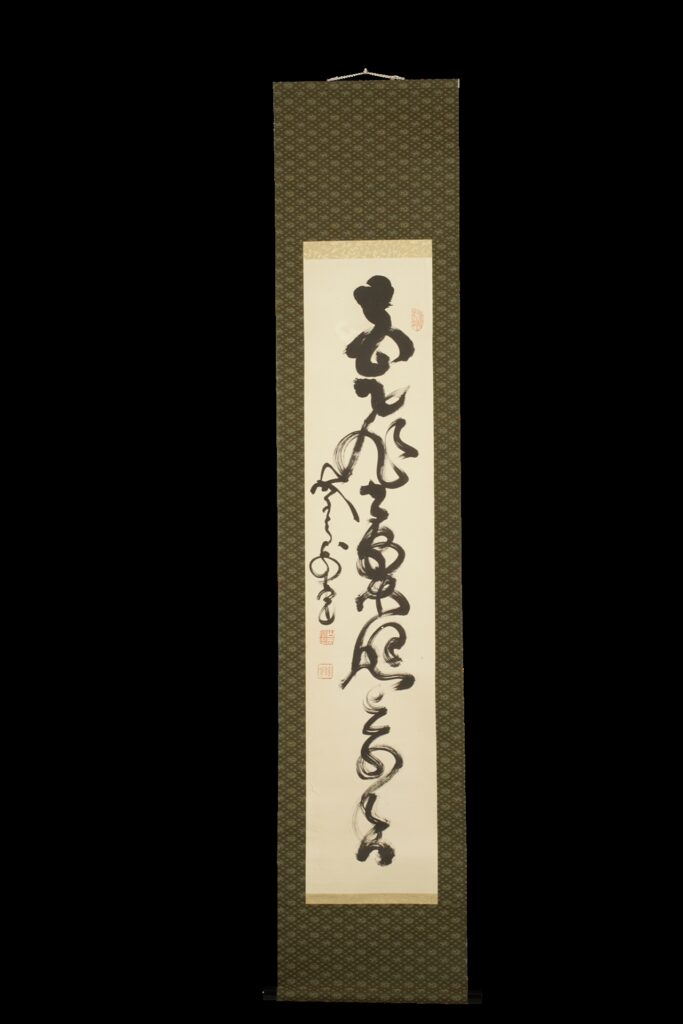
One man embodies the transition like no other: Yamaoka Tesshū (1836–1888). Tesshū was at once an outstanding swordsman, Zen Buddhist and master of calligraphy – a living example of the bunbu ideal. He played a decisive role in the peaceful handover of government from the Tokugawa shogunate to the Meiji emperor and later became his private tutor.
Tesshū founded the Mutō-ryū (“school without a sword”), whose name said it all: overcoming dependence on the physical sword through spiritual maturity. This philosophy, that the sword is ultimately only a tool and that true mastery lies in the mind, paved the way for modern kendo.
The institutional rescue came in 1895 with the founding of the Dai Nippon Butoku Kai (“Greater Japan Martial Virtue Society”). The organisation standardised the rules and transformed kenjutsu into kendō. The change of name was programmatic: from -jutsu (technique) to -dō (way). The model for this came from Kanō Jigorō, who had transformed jūjutsu into jūdō – not primarily technically, but ideologically: from “combat technique” to “educational tool”. His approach – abolition of dangerous techniques, competition rules, moral education – became the model for all modern budō disciplines. [2]
Kendo as a Weapon of the State
The darkest phase began in 1931, when the Japanese government made budō a compulsory subject in schools. Boys trained in kendo and jūdō, girls in kyūdō (archery) and naginata. What was marketed as a “revival” was in truth a reinvention as an instrument of indoctrination. The historian Alexander Bennett coined for this the term budozation of sport: instead of promoting sport, the state suppressed sporting values and misused martial arts for ultranationalist propaganda. [2]
The consequences were serious. Kendo training in schools and universities was dominated by conditioning and drill, not by the philosophical self-cultivation that Tesshū or Kanō Jigorō had propagated. The Dai Nippon Butoku Kai was appropriated by the state and turned into a propaganda machine.
The trend towards fair competition with clear rules was actively pushed back in favour of a warlike rhetoric that preached readiness for sacrifice and national obedience.
After Japan’s defeat in 1945, the US occupation (SCAP) banned all budō as militaristic. Dōjō were closed, equipment confiscated, the Butoku Kai dissolved. The enforced re-legitimation as “peaceful education” forced the kendo community into a fundamental self-examination: what was kendo actually, once the militaristic superstructure was stripped away? The answer – character building, not preparation for war – became the foundation of post-war reform.
The ban accelerated internationalisation: the Japanese had to market martial arts as cultural heritage, not as an art of weapons.
A New Beginning: The All Japan Kendo Federation
In 1952 – the same year in which Japan regained its sovereignty – the All Japan Kendo Federation (AJKF) was founded.
It faced a delicate task: kendo had to distance itself clearly from its militaristic past while at the same time preserving its cultural identity. The solution was a threefold new approach.
First, the AJKF standardised the competition rules on the model of modern sports federations – clear target zones, a refereeing system, time limits. Second, it created the Kendo no Kata (10 formalised forms: seven with the long sword, three with the short sword), which served as a link between historical kenjutsu and modern kendo.
Third, in 1975 it formulated the philosophical foundation: Kendo no Rinen – “The purpose of kendo is to discipline the human character through the application of the principles of the sword.”
This document, only two sentences long, is one of the most important texts of modern kendo. It explicitly defines kendo not as a sport, but as a way of self-cultivation. This wording is not marketing – it is the yardstick against which every dan examination, every tournament and every training session is measured.
1970 saw the founding of the International Kendo Federation (FIK).
Since then the World Kendo Championships (WKC) have taken place every three years – most recently in Milan in 2024, with participants from over 60 nations. The FIK deliberately rejects inclusion in the Olympic Games: kendo is budō, not an Olympic sport. The position is not uncontroversial within the kendo community – some see the refusal of the Olympics as a missed opportunity for global growth – but the AJKF holds to it.
Philosophy: More Than Sport
Bunbu – The Unity of Learning and the Sword
A fundamental ideal underlying modern kendo is far older than the bamboo sword. Bunbu (文武) denotes the unity of civil learning (bun) and military skill (bu).
This concept goes back to classical Chinese texts and was elevated to a samurai ideal from the 13th century onwards.
At the Samurai Museum Berlin this concept becomes, in several places, tangible.
For modern kendo, bunbu means: a good kendoka is not only technically skilled, but also educated, reflective and ethically upright. The AJKF expressly emphasises that kendo examinations from 4th dan onwards assess not only technical ability, but also character, attitude and understanding of kendo philosophy.
Mushin, Fudōshin, Zanshin – The Mental States
Zen philosophy pervades kendo, but not as exclusively as popular accounts suggest. Karl Friday shows that the spirituality of swordsmanship was historically a mix of esoteric Buddhism (mikkyō), Shintō and Confucianism – Zen is disproportionately emphasised in the West (Friday, 1997, p. 153). [1]
Three mental states are central: mushin (無心, “mind without mind”) denotes acting without conscious reflection – analogous to the “flow” state of modern sports psychology. Yagyū Munenori, sword master to the Tokugawa shōguns, formulated the famous paradox: “The sword that kills is the sword that gives life”. What is meant: true mastery lies not in killing, but in freedom from the fear of death. [3]
Fudōshin (不動心, “immovable mind”) is inner calm under pressure – the ability to think clearly even at the moment of attack.
Zanshin (残心, “remaining mind”) describes continued alertness after an action. In kendo, zanshin is so important that a technically perfect strike without zanshin is not counted.
Shu-Ha-Ri: The Path of Learning
Friday documents the traditional learning progression of the Japanese martial arts in three phases: shu (守, protect) – exact imitation of the master. Ha (破, break) – critical variation of the learned forms. Ri (離, separate) – transcendence of form, free application.
The goal is “freedom from form through form”. [1]
This model explains why kendo beginners spend months learning only the basic stance (kamae), the basic stroke (suburi) and the correct bow (rei) before the first technique comes. It is not drill – it is the shu phase: one must master the form perfectly before one may break it.
In practice this means: a typical kendo session begins with mokusō (黙想, meditation), followed by warm-up exercises and suburi (basic strikes in the air). Then comes kirikaeshi – the exercise of fast alternating strikes systematised by Chiba Shūsaku and performed against a partner. Only after that come waza-geiko (technique training), kakari-geiko (attack training) and finally ji-geiko (free practice fighting). The session ends again with mokusō. This ritual framework – meditation, practice, meditation – reflects the underlying philosophical structure: every training session is a microcosm of the budō way.
Technique and Equipment
The Shinai: Bamboo Instead of Steel
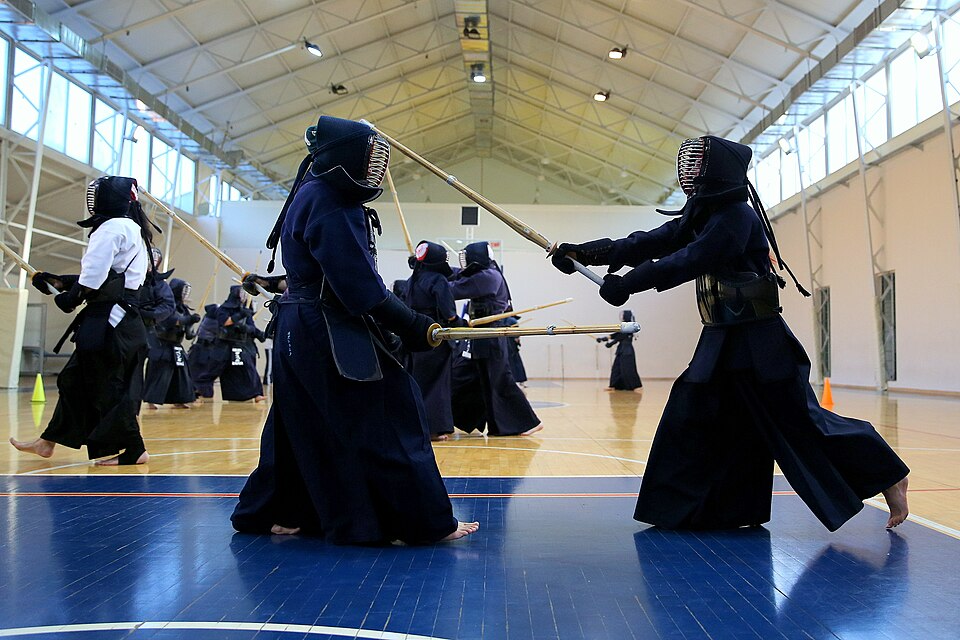
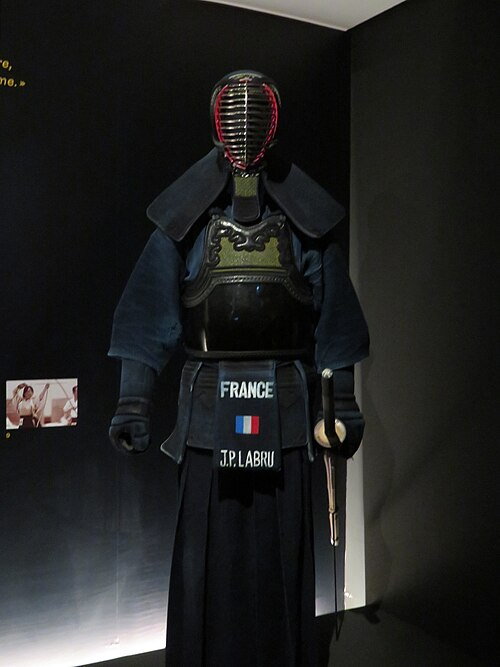
It consists of four bamboo staves, bound with leather and cord, is about 120 cm long and weighs 500-600 grams. It simulates a katana without killing. At the The protective armour (bōgu) consists of four parts: men (face mask with steel grille, protects head and face), dō (breastplate, protects torso and ribs), tare (hip protector of three fabric panels) and kote (padded gloves). A fully equipped kendoka wears 5–7 kg.
The Four Target Zones: Form over Force
Kendo recognises only four valid strikes (yūkō-datotsu): men (head), kote (wrist, upper side only), dō (torso, left or right side) and tsuki (thrust to the throat, for advanced practitioners only).
A strike only counts if the movement is executed correctly (body, sword and mind as one), the strike is made with the datotsu-bu (middle section of the shinai), the kiai accompanies the strike and the fighter then shows zanshin.
Kendo no Kata: The Invisible Legacy
Besides bouts (shiai), kendoka practise Kendo no Kata – ten choreographed forms (seven with the long sword, three with the short sword) performed in pairs with wooden swords (bokken). These kata are technically precise and historically grounded. They preserve techniques that do not exist in modern competition: side cuts (yoko-men), evasion techniques (nuki-waza), counter-attacks (kaeshi-waza).
Many kendoka neglect kata in favour of free sparring. A mistake, warns Friday: kata are not “outdated dances”, but a “hypertext learning system” – each form encodes principles that only reveal themselves through years of practice. [1]
Myths and Corrections
“Kendo is real samurai sword fighting”
No. Kendo is a deliberate abstraction. Historical kenjutsu comprised dozens of techniques – leg cuts, disarms, throws, ground fighting – that were eliminated from modern kendo for safety reasons. The four target zones are a pedagogical simplification, not historical reality.
“Kendo is an ancient tradition”
The roots go back to the 15th century, but kendo as a standardised discipline has only existed since 1912. Turnbull sums up the paradox: “The most formalised sword schools emerged in times of peace, when actual combat experience was rare”. [3]
“Zen is the religion of kendo”
Zen is influential, but historically overemphasised. Friday shows that meditation in the martial arts uses techniques from esoteric Buddhism (mikkyō) and Taoism, not only Zen.
The popular image of the “Zen samurai” is largely a post-war romanticisation. [1]
Kendo in Pop Culture
Kendo is one of the most visible Japanese martial arts in film, anime and video games. In anime, Bamboo Blade (2007) is one of the best-known kendo series, realistically portraying the everyday training of a high-school kendo club.
In gaming, Ghost of Tsushima (2020) has reached millions of players with a stylised but respectful portrayal of swordsmanship. The game incorporates kamae (basic stances) that are borrowed from historical sword schools, and uses concepts such as maai (distance) and seme (pressure) as game mechanics. Many kendo clubs report that anime and games are the most important source of recruitment for young beginners.
Kendo Today: Figures, Facts, Practice
Global Spread
Kendo is practised today in over 60 countries. Japan remains the undisputed centre, with an estimated 1.5 million active kendoka. In Japanese society kendo occupies a special position: alongside jūdō it is the most widespread budō discipline, an established part of school sport at junior and senior high schools and one of the few martial arts actively required in Japanese police and military service.
Outside Japan, development took a different course. South Korea has the second-largest kendo community in the world. In Brazil, the large diaspora of Japanese descent has created a lively kendo scene. And in Europe the federations are growing steadily, with France, Germany and Great Britain the most active nations.
Age Structure: Kendo Has No Expiry Date
Kendo is one of the few martial arts that can be practised throughout life. Many kendoka start at 40+, some at 60+. The focus on technique, timing and mental clarity rather than raw strength makes this possible. The sociologist Sánchez García describes this change as a transformation of habitus: from the warrior (readiness for violence) via the retainer (self-control) to the modern martial artist (self-cultivation and competition). Modern kendoka are “hybrids of all three”. [2]
Frequently Asked Questions (FAQ)
What is Kendō?
Kendo (剣道, “way of the sword”) is a modern Japanese martial art in which two opponents fence with bamboo swords (shinai) and protective armour (bōgu). It is based on historical samurai swordsmanship (kenjutsu), but is geared towards character building and mental training, not combat effectiveness.
How long does it take to learn kendo?
Kendo has no “graduation”. The basic techniques can be learned in 6–12 months, but refinement takes a lifetime. The 8th dan examination – the highest grade regularly awarded – has a pass rate of under 1%.
What does kendo equipment cost?
Getting started: keikogi + hakama approx. €100-150. Protective armour (bōgu): €500-2,000. Shinai: €15-30 (regular wear and tear). Club fees: €20-50 per month. Total costs in the first year: approx. €300-600 (excluding bōgu).
Is kendo dangerous?
Kendo is considered one of the safest full-contact martial arts. The protective armour absorbs blows effectively. Injuries are mostly limited to bruises on the wrist (kote strikes) or to the Achilles tendon.
What is the difference between kendo and iaido?
Kendo is loud – two kendoka fence with bamboo swords and protective armour. Iaido is quiet – an individual performs forms (kata) against imaginary opponents with a real or blunt sword. Kendo focuses on responsiveness and timing, iaido on precision and meditation.
Where can you learn kendo in Berlin?
Berlin has several active kendo dōjō that offer beginners’ courses. For a complete overview, the website of the Deutscher Kendo Bund (DKenB) is recommended: www.dkenb.de.
At what age can you start kendo?
Children can start kendo from about 6-8 years of age. Equally, there is no upper limit – kendo can be practised into old age. The AJKF expressly promotes practice across all age groups.
The Way Without End
At the Samurai Museum Berlin, the Bakumatsu display case holds the calligraphy of a man who mastered both sword and brush. Yamaoka Tesshū would have understood modern kendo – not as a nostalgic repetition of a past that never existed in that form, but as a living practice of self-improvement.
In Tōkyō, businesspeople train after work. In Berlin, students practise at the weekend. In São Paulo, pensioners fight with bamboo swords. What unites them is not a longing for samurai romanticism, but the search for the moment when body, mind and sword become one.
Visit the Samurai Museum Berlin
Experience the culture of the samurai at first hand in the permanent exhibition of the Samurai Museum Berlin. More than 500 original objects from feudal Japan — armour, weapons, everyday objects — await you at Auguststraße 68, Berlin-Mitte. Open daily from 10 a.m. to 7 p.m.
Related Articles
- Samurai: History, Culture and Legacy
- Bushido: The Code of Honour of the Samurai
- The Katana: Myth and Reality
Bibliography
- [1] Friday, Karl F. / Seki, Fumitake (1997): Legacies of the Sword: The Kashima-Shinryū and Samurai Martial Culture. University of Hawai’i Press.
- [2] Sánchez García, Raúl (2019): The Historical Sociology of Japanese Martial Arts. Routledge.
- [3] Turnbull, Stephen (2010): Katana: The Samurai Sword. Osprey Publishing.
→ History of the Samurai – Historical context
→ Katana – The Japanese Sword – Weapon of kenjutsu
→ Bushidō – The Way of the Warrior – Philosophical framework
→ Miyamoto Musashi – Most famous kenjutsu master
→ Tokugawa Ieyasu – Founder of the Edo era of peace
→ Sengoku Jidai – The age of war before kendo
→ Kabuto – Samurai Helmets – Armour tradition
→ Tantō – The Japanese Dagger – Related weapon
→ Seppuku – Ritual context of sword culture
© Samurai Museum Berlin – All rights reserved
You might also like
Bushidō: The Code of Honour
Bushidō – the samurai code of honor. Nitobe's 7 virtues, historical reality, Hagakure, modern adaptations. Facts instead of myths, with…
Read the article
Shogun: The Military Rulers of Japan — History & Significance
Shogun – the military rulers of Japan: who they were, how they ruled & why they never abolished the emperor.…
Read the article
Tea Ceremony: Why Sen no Rikyū Convinced the Samurai to Drink Tea
In April 1591, Sen no Rikyū, Japan’s most important tea master and personal tea adviser to the most powerful man…
Read the article