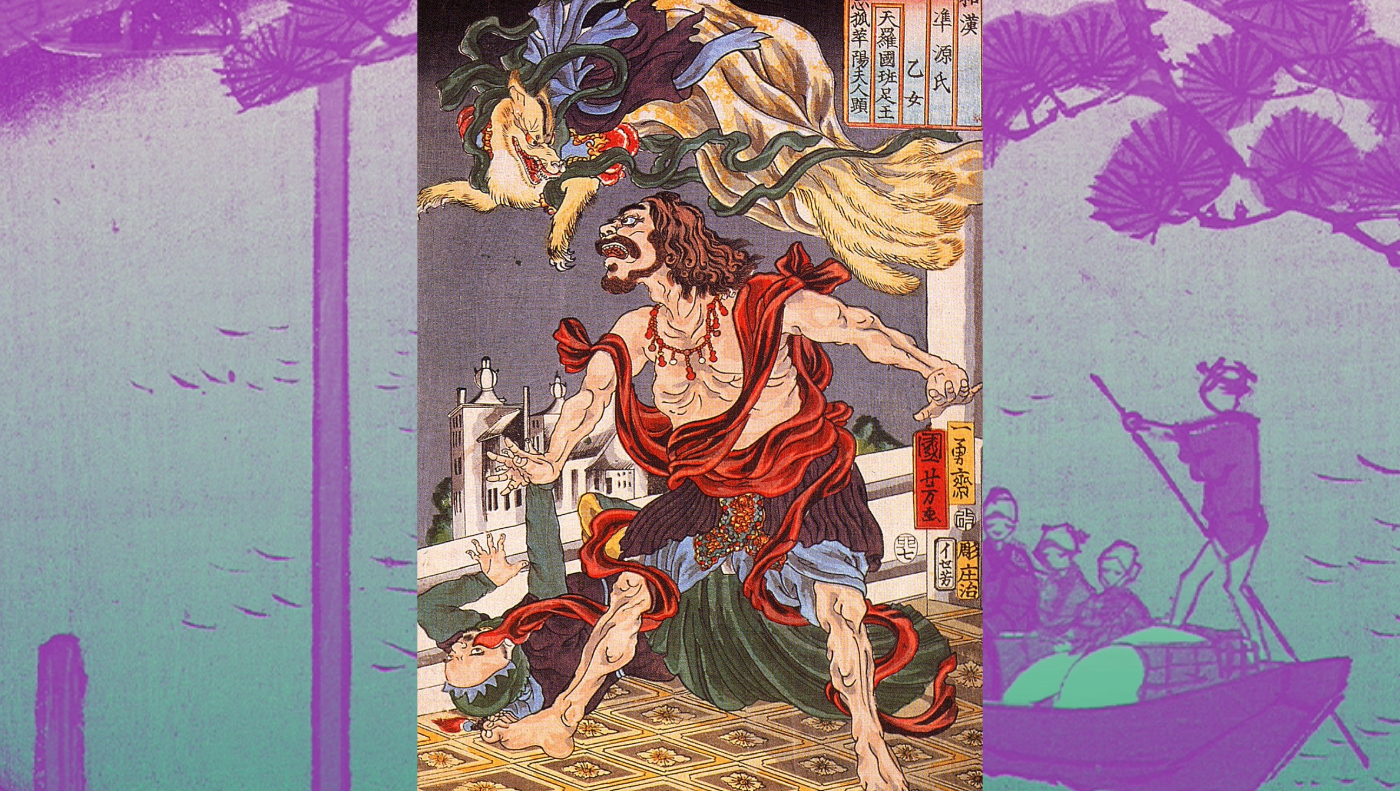
In Japan there are beings of a supernatural nature. They are called yōkai (妖怪) — and they arise exactly where the safe world of the familiar begins to fray at its edges. Michael Dylan Foster defines yōkai as what arises when the unknown needs a name.[1]
Yōkai and Yūrei: The Most Important Distinction
Yōkai are supernatural beings with a body and agency — bound to nature, independent of the death of particular people. Yūrei, by contrast, are spirits of the dead without a fixed body, bound to unresolved emotions such as revenge, grief or love.
History: From Terror to Toy
In the Heian period, uncanny phenomena were formless threats — mononoke — that had to be banished through esoteric rituals. Only through illustrated handscrolls (emaki) did these fears acquire concrete, grotesque forms.[1]
In the Edo period, Toriyama Sekien systematised the creatures in four encyclopaedic catalogues (1776–1784) with over 200 beings. Yōkai went from sacred figures of terror to secular figures of consumption and play.
→ Masks and objects: Samurai Museum Berlin
Yōkai and the Samurai World
The tengu embodies the interface between warrior culture and the supernatural world. Tengu were popular symbols among the samurai, as they were regarded as great swordsmen. Minamoto no Yoshitsune is said to have learned his martial arts from the tengu of the Kurama mountains.[1]
The idea of tsukumogami — that objects acquire a soul after 100 years of faithful service — also applies to swords. If they are thrown away, they become vengeful spirits: Shintō animism as a warning against disrespect for craftsmanship.[1]
Yōkai in Modern Pop Culture
Shigeru Mizuki’s GeGeGe no Kitarō turned yōkai into nostalgic icons. Studio Ghibli’s films are steeped in yōkai iconography: My Neighbour Totoro, Spirited Away, Princess Mononoke. In video games: Nioh, Okami, Yo-kai Watch. In manga and anime: the tailed beasts (bijū) in Naruto, the demons in Demon Slayer.
Frequently Asked Questions
What is the difference between yōkai and yūrei?
Yōkai are supernatural beings with a body and agency, bound to nature. Yūrei are spirits of the dead without a body, bound to unresolved emotions. Taxonomically they are fundamentally different, although they occasionally overlap.
What are tengu?
Tengu are yōkai, often of human shape, with bird-like features. Yoshitsune is said to have learned martial arts from them.
What are oni?
Oni are horned demons, usually red or blue, with iron clubs. In Buddhist belief they guard hell.
When did yōkai become pop culture?
In the Edo period: Toriyama Sekien compiled over 200 beings in encyclopaedic form (1776–1784). In the 20th century, Mizuki’s GeGeGe no Kitarō and Studio Ghibli turned yōkai into cultural icons.
Were yōkai real to historical Japanese people?
Among other things, as real explanatory models for illnesses, natural disasters and exceptional mental states. Inoue Enryō had to found yōkaigaku (yōkai studies) specifically in order to deconstruct the belief rationally.
Visit the Samurai Museum Berlin
The spiritual world of the samurai is present at the Samurai Museum Berlin through masks, armour decoration and cult objects. Daily 10 a.m.–7 p.m., Auguststraße 68.
Related Articles
Bibliography
- [1] Foster, Michael Dylan (2015): The Book of Yōkai. UC Press. Ch. 1–5.
- [2] Keene, Donald (1990): Nō and Bunraku. Columbia UP. Kiri-Nō, Ikiryō.
- [3] Deal, William E. (2006): Handbook to Life in Medieval and Early Modern Japan. Oxford UP.
© Samurai Museum Berlin – All rights reserved
You might also like
Tea Ceremony: Why Sen no Rikyū Convinced the Samurai to Drink Tea
In April 1591, Sen no Rikyū, Japan’s most important tea master and personal tea adviser to the most powerful man…
Read the article
Kabuki: The Colourful Stage Art of the Edo Period
In 1603, on the dry bed of the Kamo River in Kyōto, Izumo no Okuni opened a performance that was…
Read the article
Seppuku: The Ritual Suicide of the Samurai
Seppuku – history, ritual and meaning of the stomach-cutting. From battle tactic to Edo ceremony: what really drove the samurai…
Read the article