
Note on reading: This article deals with ritualised suicide in feudal Japan from a historical and academic perspective. The account serves cultural-historical education and neither romanticises death nor glorifies violence. If you are struggling with suicidal thoughts, you can find help from the Telefonseelsorge (0800 111 0 111) or the Deutsche Gesellschaft für Suizidprävention.
In 1703, 47 masterless samurai cut open their bellies before the gates of the Sengaku-ji temple in Edo. Two centuries later, in 1912, General Nogi Maresuke followed them on the day of the Meiji emperor’s funeral. And in 1970 the writer Yukio Mishima committed seppuku in front of rolling cameras after a failed coup attempt. Three moments, separated by centuries – connected by a practice that shapes the Western image of the samurai to this day: ritual suicide by cutting the belly.
Seppuku (切腹, literally “belly cut”), or in its colloquial form harakiri (腹切り, “cutting open the belly”), was not a romantic gesture of heroic warriors, but a highly regulated social practice in feudal Japan. Between the 12th and 19th centuries it developed from an improvised act of desperate warriors into a formalised ceremony with a legal function. This article traces the historical development, explains the philosophical foundations and distinguishes between the ritualised seppuku of the samurai era and its modern mythologisation.
Understanding seppuku requires a sober look at the historical realities: it was neither always a free decision by noble warriors nor an exotic curiosity, but an instrument of social control in a stratified social system. At the same time, its ritual form reveals how deeply honour, physicality and self-determination were anchored in historical Japan.
The Historical Origins: From Battle to Ritual
Early Mentions in the Heian and Kamakura Periods
The first documented cases of suicide by cutting the belly date from the late 12th century, a period of profound political upheaval. When Minamoto no Yorimasa was defeated by the Taira forces in the battle at the Byōdō-in temple in 1180, he is said – according to some traditions – to have opened his belly before a retainer cut off his head. [1] Whether this account is historically accurate or was stylised by later chroniclers remains disputed. What is certain: the Genpei War (1180-1185) marks the beginning of an era in which warrior suicide appears as the last option in the face of impending capture.
Early cases have little in common with the later ritualised seppuku. They were acts of desperation on the battlefield – improvised, chaotic, without ceremonial form. The belly cut was not a symbolic act, but a practical method of ensuring one’s own death before the enemy could take the head as a trophy.
Why the belly? The explanations range from accessibility (in contrast to the armoured chest) and the symbolic meaning of the belly as the seat of the soul (hara) to the sober fact that a belly cut, though fatal, does not kill instantly – which gave a retainer time to deliver the “merciful” blow to the neck (kaishaku).
Codification under the Kamakura and Muromachi Shogunates
Between the 13th and 15th centuries, seppuku changed from a spontaneous act into a socially accepted practice with implicit rules. The Kamakura shogunate (1185-1333) established a feudal system in which loyalty (chūgi) became the ruling principle. In this context, seppuku developed into a way of taking responsibility for mistakes or atoning for political guilt – though still without the strict formalisation of later centuries.
A key development was the introduction of junshi (殉死, “following into death”): the voluntary suicide of retainers after the death of their lord. This practice, first documented in the 14th century, linked seppuku to the idea of unconditional loyalty. Critics argue that junshi blurred the line between “voluntary” and “socially compelled” – retainers who did not follow were regarded as dishonourable.
The Muromachi period (1336-1573) brought further differentiation: seppuku became a means of resolving conflicts in aristocratic circles. A defeated daimyō could protect his family from retribution through seppuku – the victor accepted the ritual death as satisfaction. This began the transformation from a military act of desperation into a quasi-legal institution.
The Sengoku Period: Pragmatism and First Regulation
The Sengoku period (1467-1603), the era of the “warring states”, brought a pragmatic approach to seppuku. In an age of permanent warfare, ritual suicide was on the one hand commonplace – failed castle defenders, captured commanders, disgraced samurai – and on the other hand still largely unregulated. The form varied greatly: from hasty cuts on the battlefield to elaborate ceremonies in temples.
At the same time, the first written codifications emerged. The military house laws (kakun) of great clans such as the Takeda or Uesugi contained passages on the “dignified death”. These texts did not yet define rigid rituals, but laid down basic principles: death was to be met with composure, pain was not to be shown, and a witness (kaishaku) was to be present.
The introduction of firearms by the Portuguese (1543) and the increasing centralisation under Oda Nobunaga and Toyotomi Hideyoshi changed warfare fundamentally. Paradoxically, this strengthened the importance of seppuku: while mass battles depersonalised the individual warrior, ritual suicide offered a way to assert individuality and status in death.
With the Battle of Sekigahara (1600) and the establishment of the Tokugawa shogunate (1603), the Sengoku era came to an end. The Edo period that followed was to transform seppuku from a martial practice into a civil institution.
The Philosophical Dimension: Honour, Belly and the Soul of the Warrior
The Belly as the Seat of Truth
Why did a samurai cut open his belly, of all things, and not his throat or his wrists? The answer lies deeper than mere anatomy – it leads into the heart of the old Japanese world view. The belly, in Japanese hara (腹), was regarded not as a digestive organ, but as the seat of the soul, the will and true feelings. [2] While the head could deceive and the mouth could lie, the belly revealed a person’s unadulterated truth.
This idea shaped the entire Japanese language: someone who has hara ga aru (“has a belly”) has character. Someone who hara wo kimeru (“decides his belly”) makes a firm decision. And someone who hara wo miseru to another (“shows the belly”) opens up completely. Cutting open the belly was therefore not an arbitrary way of killing oneself, but a symbolic act: the dying man laid bare his soul, demonstrated his sincerity and proved that he had nothing to hide.
When in 1701 the daimyō Asano Naganori drew his blade in Edo Castle and attacked his tormentor Kira Yoshinaka, he knew that only death could wipe out this disgrace. Three hours later he knelt in a white death robe on a tatami mat and opened his belly. Not in order to die – a cup of poison would have done that faster – but to prove that his anger had been just and his honour pure. The belly cut was not an execution, but a statement.
Bushidō and the Paradox of Honour
The term bushidō (武士道, “way of the warrior”) only became a codified system in the late 19th century – and the idea that its roots reach back to the Kamakura period is historically untenable. [3] What existed in the Kamakura and Muromachi periods were military house laws (kakun) that laid down concrete rules of conduct for everyday military life – not an abstract philosophical system. These kakun emphasised pragmatic loyalty within the framework of go’on to hōkō (favour in return for service): the vassal served as long as the lord rewarded him. Unconditional loyalty unto death was the exception, not the rule. [3]
Only in the Edo period, when samurai no longer waged war, did this pragmatic relationship become an idealised construct – and only Nitobe Inazō turned it into an export hit in 1900 with Bushido: The Soul of Japan. At the centre of this retrospective system stood the concept of honour (meiyo), which was not acquired by birth or wealth, but proved through deeds and could be lost for ever through mistakes. A samurai without honour was one of the living dead – socially outcast, a disgrace to his family, unbearable to himself.
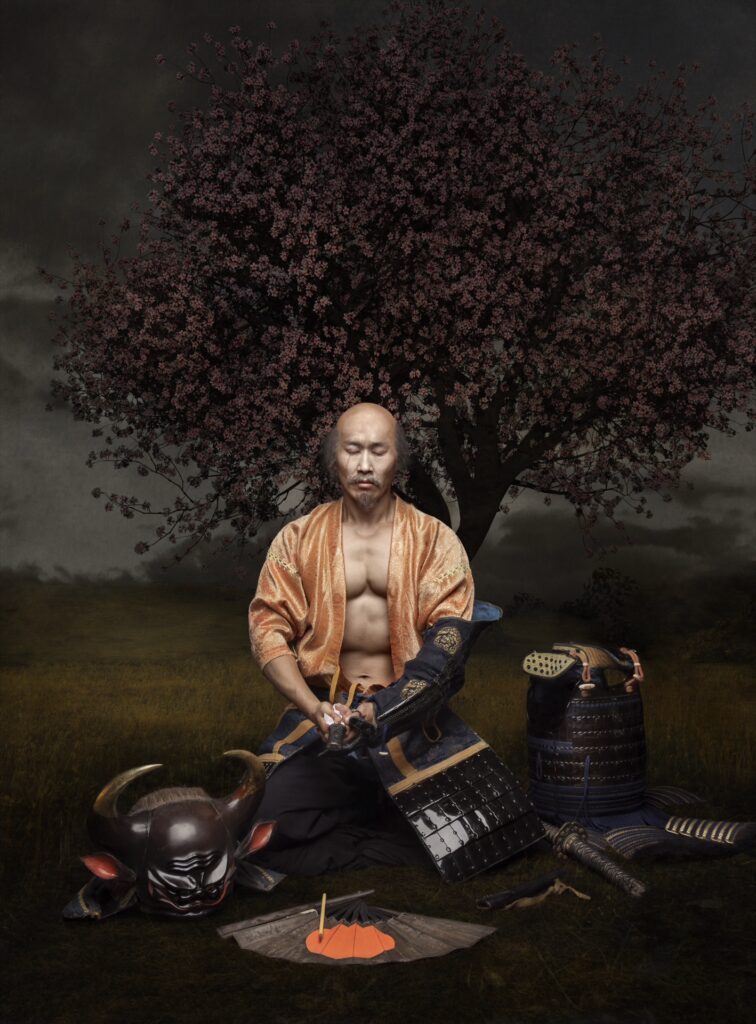
Here lies the central paradox: honour could only be preserved through self-control, yet self-control alone was not enough. A failed samurai who had gone on living would have become living proof of his disgrace. Seppuku offered the only way out: through a controlled, ritual death, the warrior could restore his honour posthumously. He thereby proved that although he had failed, he knew how to bear the consequences – and that, paradoxically, made him honourable again.
Bushidō ethics distinguished strictly between shame (haji) and guilt in the Christian sense. Shame was not an inner transgression before God, but a public loss of status. It was not about sin and forgiveness, but about social position and collective perception. Whoever violated his duty (giri) towards his lord, his family or the clan damaged not only himself, but everyone connected with him. Seppuku was the radical cut that confined the shame to the body of the individual and saved the rest of the community.
The sociologist Toyomasa Fusé places this pattern in Émile Durkheim’s category of “altruistic suicide”: a self-killing in which the individual is so completely integrated into the group that he understands his own death as a service to the community. [4] Japanese itself supplies the conceptual differentiation: jijin (自刃, “death by the sword”) for suicide on the battlefield, inseki-jisatsu (責任自殺, “responsibility suicide”) for death in atonement for a mistake, junshi for following one’s lord into death. [4] Each form had its own social place – but all followed the same logic: the individual sacrifices himself so that the group survives.
Loyalty unto Death: The Concept of Junshi
The most extreme expression of this logic was junshi (殉死), “following into death”. When Emperor Meiji died in 1912, General Nogi Maresuke killed himself together with his wife – not out of despair, but out of loyalty. In 1877, during the Satsuma Rebellion, Nogi had lost a regimental flag, a disgrace he carried with him for 35 years. The death of the emperor he had served offered him the opportunity to wipe out this guilt through a final service: going together into the beyond.
Junshi was already controversial in the Edo period. The Tokugawa shogunate banned the practice in 1663, because entire retinues were taking their own lives when their lord died – a loss the system could not afford. But the ideal remained: the perfect samurai was prepared not only to die for his lord, but with him. This readiness distinguished the true warrior from the mere mercenary.
The Confucian concept of hierarchical loyalty provided the philosophical justification: just as the son had to serve the father and the subject the ruler, the vassal owed his lord unconditional loyalty. This loyalty did not end with the lord’s physical death – it transcended it. Dying together was not an irrational gesture, but the logical completion of a lifelong relationship.
Critics such as the Confucian Ogyū Sorai (1666-1728) argued otherwise: true loyalty, according to Sorai, consisted not in following one’s lord into death, but in living on and serving his successors. Junshi, he held, was ultimately selfishness – the wish to escape one’s own responsibility. This debate was never finally decided, but it shows that even in the Edo period seppuku was not an unquestioned ideal, but a contested concept.
The Ritual Procedure: Anatomy of a Ceremony
Preparation and Setting
The formalisation of seppuku reached its peak in the Edo period (1603-1868). What had once been a chaotic act on the battlefield became a meticulously choreographed ceremony in which every movement, every gesture and every object carried symbolic meaning. The setting itself was already part of the ritual.
For a formal seppuku – whether as a voluntary act or as a death sentence – a special room was prepared. The floor was laid with two white tatami mats, on which a red or white mat of raw linen (mosenjo) was placed. This mat was to absorb the blood and protect the surroundings from pollution. White folding screens (byōbu) were set up on three sides, shielding the dying man from curious eyes while at the same time giving the official witnesses a clear view.
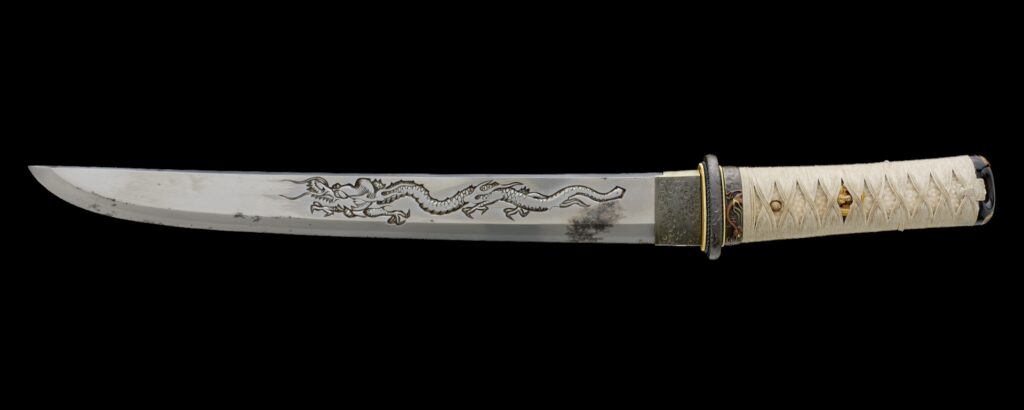
In front of the mat stood a low offering stand of unlacquered wood, the sanbō (三方). On it lay the dagger – usually a tantō with a blade about 20-25 centimetres long. The blade was always wrapped in several layers of white paper, so that only the very tip was left free. This wrapping had a practical reason: it prevented the hands from slipping on the blood and allowed a firmer grip. At the same time, the white paper symbolised purity – death was to be as immaculate as the beginning of life.
The type of dagger itself also followed a convention: formal seppuku tantō were made in the aikuchi style – without a guard (tsuba) and without a hilt wrapping. The absence of the hand guard was not chance but symbolism: whoever sat down to die no longer needed any defence.
The Role of the Kaishakunin: Mercy by the Sword
The central figure alongside the dying man was the kaishakunin (介錯人), literally the “mediator” or “second”. His task carried the highest responsibility: he was to shorten the suffering of the dying man by severing his head with a single, perfect sword stroke – at the very moment when the dying man set the blade to his belly.
The choice of kaishakunin was no formality. He had to be an experienced swordsman whom the dying man trusted. A botched cut – the head only partly severed, the body writhing – would have been the ultimate disgrace for both parties. In some cases, the man condemned to death asked a particular friend to take on this task. The request was rarely refused, for it was an honour: the dying man entrusted his last dignity to his friend’s skill.
The technique of kaishaku was demanding. The kaishakunin stood to the right behind the kneeling man, the long sword (katana) or tachi already half drawn. The cut was to pass through the neck from left to right, exactly between the third and fourth cervical vertebrae. The head was not to be severed completely – a thin strip of skin was to keep head and body connected (daki-kubi, “embraced head”). [2] A completely severed head rolling across the room was considered tasteless and was avoided wherever possible.
The Procedure: From the Bow to the Last Breath
The man condemned to seppuku entered in ceremonial dress – usually a plain white kimono, the death robe. White was the colour of purity, but also of death. He bowed to the witnesses present, often spoke a few last words (yuigon) or recited a death poem (jisei) expressing his state of mind and philosophical attitude.
Then he knelt on the mat in the formal seiza position: knees together, heels under the buttocks, back straight. The upper part of the kimono was slipped off the shoulders and tied together behind the back, so that chest and belly were bared. This too had a practical reason: the dying man was not to fall forward when he died, but to remain sitting upright – the tied kimono acted as a support.
An assistant brought the sanbō with the wrapped dagger and placed it in front of the kneeling man. He took the weapon in both hands, raised it to his forehead (a gesture of respect towards the sword) and set the point to the left side of his abdomen. The traditional cut ran from left to right, horizontally below the navel. In some variants a second cut followed from bottom to top, producing a cross-shaped wound – but this was extremely painful and was practised only by the toughest warriors.
In the Edo period a milder form developed: the dying man merely touched the dagger with his hands or brought it symbolically to his belly without actually cutting. In some cases a wooden fan was used instead of a real dagger. As soon as the dying man performed the ritual gesture, the kaishakunin struck. Death followed almost instantly, before the pain could distort the dying man’s face. This development shows the shift from physical act to symbolic gesture: it was no longer about self-injury, but about the readiness for it.
Formalisation and Legal Function
In the Tokugawa period, seppuku became an officially recognised death penalty for samurai. A man of the warrior class sentenced to death received the “mercy” of seppuku – in contrast to the dishonourable public execution reserved for criminals from the lower estates. This distinction was not leniency, but part of the rigid order of estates: the samurai kept his privilege in death, his family property was not confiscated, and his descendants bore no official disgrace.
The ceremony was strictly regulated. Official representatives of the shogunate or of the clan concerned had to be present. A record was made documenting the date, time, names of the witnesses and the exact procedure. After the deed, the head was sometimes presented to whoever had ordered it – not out of cruelty, but as proof that the sentence had been carried out.
This bureaucratisation of death may seem cynical, but it had a function that stabilised the system: it channelled potential acts of revenge and blood feuds into a controlled, legally binding procedure. A samurai who had committed seppuku could no longer be avenged – the guilt was atoned for, the matter closed.
Special Forms: From Protest to the Cross Cut
The standard form of seppuku – a horizontal cut followed by kaishaku – was the most common, but not the only one. Japanese distinguishes a number of variants, each with its own purpose.
Kanshi (諫死, “remonstration by death”) was the suicide of a vassal who wanted to make his lord change course not through words, but through his own death. A retainer who could not prevent a disastrous decision by his lord made a statement with his seppuku that could not be ignored. Funshi (憤死, “death out of indignation”) worked similarly, but was directed not at a particular person, but against an injustice felt to be intolerable. Both forms were rare, but politically effective – they turned an individual death into a public accusation.
The physically extreme variant was jūmonji giri (十文字切り, the “cross cut”): after the horizontal cut from left to right came a second, vertical cut from bottom to top. The cross-shaped wound considerably prolonged the death struggle and was regarded as proof of the highest self-mastery. Only a few historical cases are documented – most samurai refrained from this demonstration and preferred the quicker death by the kaishakunin.
A conceptual differentiation that is central to understanding the modern after-effects is provided by the sociologist Toyomasa Fusé: inseki-jisatsu (責任自殺), suicide to take responsibility. Unlike protest seppuku (kanshi), it was not about accusation, but about making amends. Whoever had made a mistake – in the military, in the administration, in the lord’s household – could restore the moral order through his death and clear the name of the group. Historical examples range from Satsuma samurai who took their own lives over delays to construction projects to Edo-period officials who atoned for the failings of their subordinates. [4]
Famous Historical Cases: When Seppuku Becomes Legend
The 47 Rōnin: The Akō Incident of 1703
On the morning of 14 December 1702, 47 masterless samurai broke into Kira Yoshinaka’s snow-covered estate in Edo. They had waited, planned and dissembled for almost two years. Their leader Ōishi Kuranosuke had presented himself as a drunken failure, frequented teahouses, squandered money – all to lull Kira into a sense of security. Then, on that winter night, they struck. After a short, bloody fight they found Kira hiding in a charcoal shed. Ōishi offered him the chance to commit seppuku. Kira refused. So they cut off his head and carried it through the streets to the Sengaku-ji temple, where their lord Asano lay buried. There they laid the bloody trophy on his grave.
The story begins 21 months earlier, on 14 March 1701. In Edo Castle, where the shōgun was receiving ceremonial envoys of the emperor, a smouldering conflict escalated. Asano Naganori, daimyō of the domain of Akō, drew his short sword and attacked Kira Yoshinaka, the shogunate’s chief master of ceremonies. The reason remains historically unclear – insult, financial extortion, personal enmity? The sources are silent. All that is certain is that Asano wounded Kira on the head and was immediately overpowered.
The verdict came that same day. Asano had broken the highest taboo: armed violence in the shōgun’s palace. There was no defence, no mitigating circumstances. He was ordered to commit seppuku that very evening. His property was confiscated, his clan dissolved, and his 300 samurai became rōnin – masterless warriors without status, without income, without a future. Kira, on the other hand, the actual target of the attack, was not punished. As far as the shogunate was concerned, the matter was closed.
But 47 of Asano’s former retainers saw it differently. Led by Ōishi Kuranosuke, the former chief retainer, they swore a secret oath: they would avenge their lord. The problem: revenge was illegal. The Tokugawa regime had not banned private vendettas (katakiuchi), but regulated them so strictly that they became practically impossible. Whoever attacked Kira attacked the authority of the shogunate – and that meant not only one’s own death, but the destruction of one’s entire family.
The solution was deception. The rōnin scattered, took menial jobs, pretended to have given up their honour. Ōishi himself moved to Kyoto, where he publicly gave himself over to drink and the pleasure quarters. Kira’s spies reported: the former samurai was broken, no longer a danger. That was exactly the plan. When Kira reduced his guards, the 47 struck.
The shōgun now faced a dilemma. Legally, the rōnin were murderers – they had broken the law. Morally, they were heroes – they had done what every samurai was supposed to do: remain loyal to their lord unto death. Part of the population of Edo celebrated them. Kabuki theatres wrote plays about them (under changed names, to get round the censors). Merchants composed songs. The government could not acquit them without undermining its own authority – but executing them would risk a popular uprising.
The compromise was elegant: the 47 were ordered to commit seppuku. No executioner, no execution – they received the honourable death penalty. On 4 February 1703 they committed seppuku together in four different temples. They died as samurai, not as criminals. Their graves at the Sengaku-ji became places of pilgrimage that are still visited today.
The case remains disputed to this day. Were the 47 loyal servants or self-seeking adventurers? Confucians such as Ogyū Sorai argued that true loyalty would have consisted in serving Asano’s successor – not in dying through a spectacular but ultimately futile assassination. [5] Others saw them as the embodiment of the ideal of bushidō: men who sacrificed everything – life, family, future – for the honour of their lord.
What remains undisputed: the Akō incident shaped the modern image of seppuku more than any other historical event. It showed seppuku not as an individual act of desperation, but as a collective political act – a message to the powerful that there are values that stand higher than laws.
Yukio Mishima (1970): The Anachronistic Death
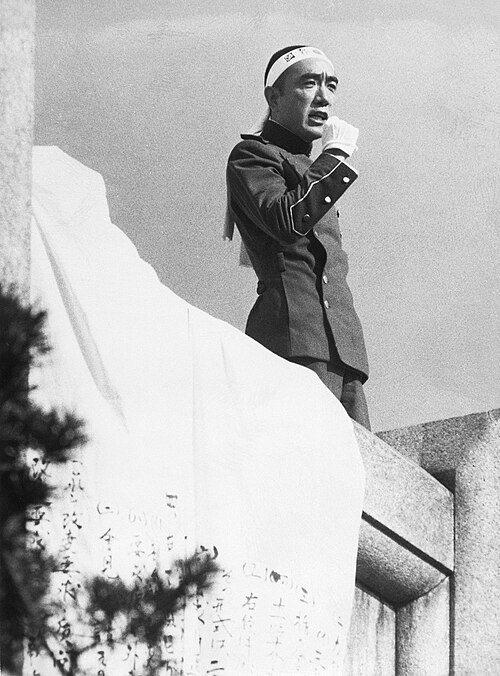
On 25 November 1970, the writer Yukio Mishima and four members of his private militia, the Tatenokai (“Shield Society”), forced their way into the headquarters of the Japan Self-Defense Forces in Tokyo. They took the commandant hostage, stepped out onto the balcony and gave a speech to the assembled soldiers. Mishima demanded the restoration of imperial power, the abolition of the pacifist post-war constitution and a return to traditional values. The soldiers jeered at him. After ten minutes he broke off, went back into the office and committed seppuku. His 25-year-old lover Morita Masakatsu acted as kaishakunin, but botched the stroke – a second man had to sever Mishima’s head. Then Morita committed seppuku himself.
Mishima’s death was perhaps the last “authentic” seppuku in Japanese history – and at the same time an absurd farce. The death of a brilliant writer and multiple Nobel Prize nominee for a hopeless political putsch shocked the world.
Mishima had felt Japan’s decline after 1945 as a personal insult. The militaristic Japan of his youth – with its ideals of readiness for sacrifice, discipline and national greatness – had been replaced by the American occupation, the democratic constitution and capitalist prosperity. The samurai had become the salaryman, the sword the briefcase. For Mishima this was not liberation, but castration. He trained fanatically, built up a private army, posed for photographs as the dying Saint Sebastian. His last novels – the Sea of Fertility tetralogy – circled obsessively around death, rebirth and the impossibility of living authentically in modern Japan.
His seppuku was an act of despair, but also of communication. He knew that no one took his political demands seriously. The coup was doomed to failure from the start. But that was not the point. The point was to send a message through death: that it was possible, in 1970, in a bureaucratic democracy, to live and die by the old code. That values such as honour, sacrifice and national identity were not obsolete. That a person could rebel against modernity – even if only through total self-annihilation.
Reactions were divided. Left-wing intellectuals despised Mishima as a fascist reactionary. Conservatives admired his courage, but kept their distance from his extremist ideas. The general public was simply bewildered. But in one respect Mishima’s plan succeeded: his death made seppuku a topic of conversation again. It forced a nation that believed it had overcome this dark tradition to confront its past.
Mishima’s seppuku marks the break between historical ritual and modern mythology. It was not an act within a functioning system, but a protest against a system that had made such acts superfluous. It was seppuku as a work of art, as a political statement, as existential despair – but it was no longer seppuku in the sense of the Edo period. It was, paradoxically, a modern invention that claimed to revive an old tradition.
Cultural Reception: From Historical Practice to Global Myth
Seppuku in Japanese Art and Literature
Long before Yukio Mishima turned seppuku into a performance, ritual suicide was a central motif of Japanese art. The most famous play, Kanadehon Chūshingura (The Treasury of Loyal Retainers), told the story of the 47 rōnin and has been performed thousands of times since its premiere in 1748. The seppuku scene of Asano (in the play “Enya Hangan”) was the emotional climax: the lord dies honourably while his retainers look on and swear the oath of revenge.
Strict conventions governed the portrayal. The actor wore the white death robe, knelt on the red mat and brought the dagger to his belly in a stylised, slowed movement. No real blood, but theatrical red – often a length of cloth soaked in red dye was pulled out of the kimono when the “cut” was made. The audience knew the procedure, expected it and judged the perfection of its execution. Seppuku was not shock, but ritual – an aesthetic experience that blurred the boundary between death and art.
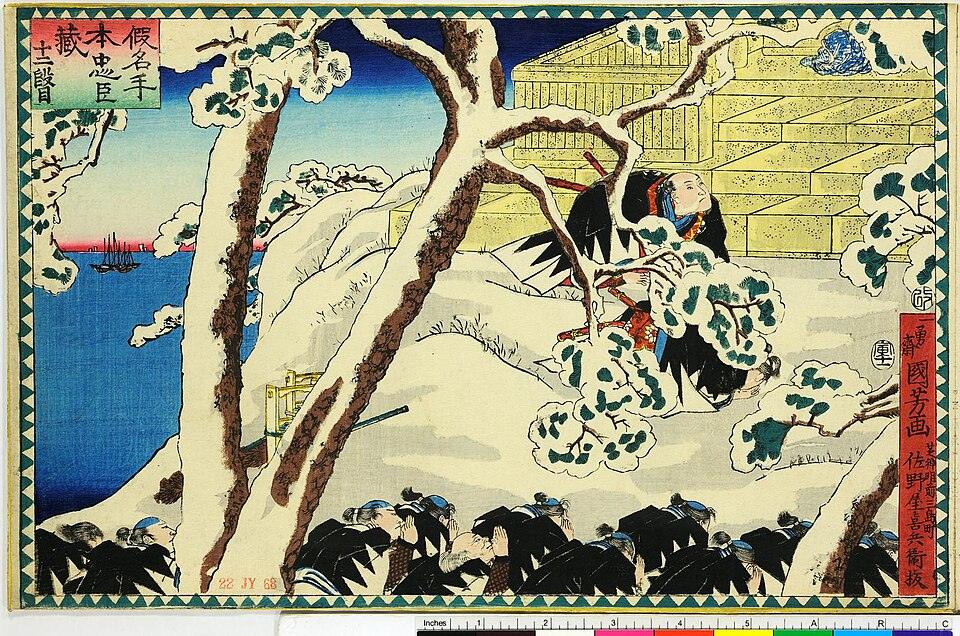
Woodblock printing (ukiyo-e) also took up the motif. Artists such as Utagawa Kuniyoshi created series depicting famous seppuku scenes: warriors in white robes, surrounded by witnesses, the dagger already set in place. These images were not documentary – they were idealised, heroic, beautiful. Death was staged not as tragedy, but as fulfilment.
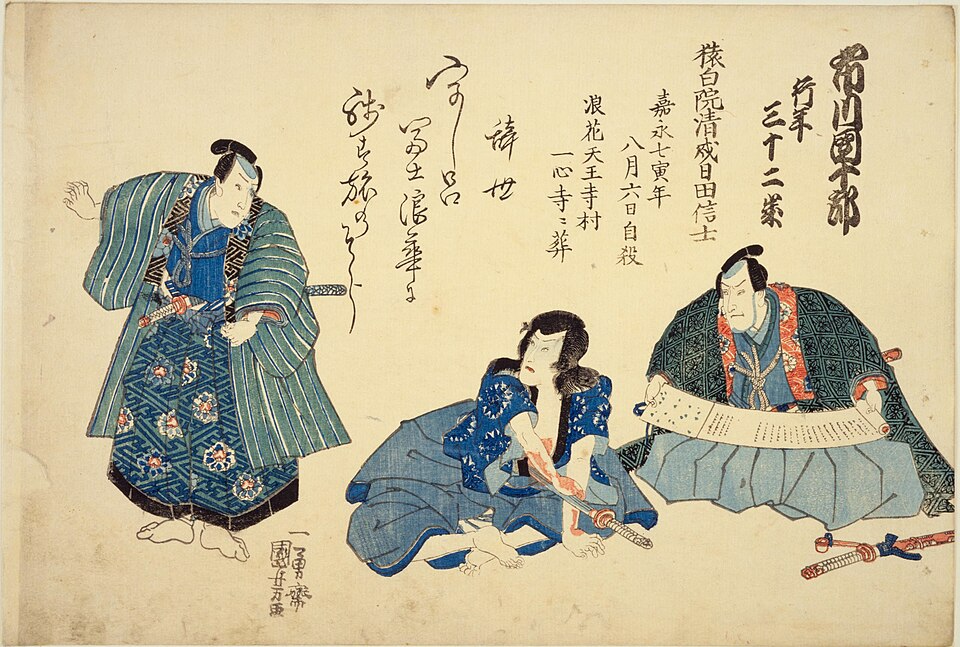
In literature, seppuku became the touchstone of strength of character. The Hagakure (1716), written by the retired samurai Yamamoto Tsunetomo, contains the famous sentence: “The way of the warrior is death.” But the Hagakure was not a representative samurai handbook, but the frustrated outcry of a man who had missed out on heroic death in a peaceful age. During his lifetime the work received scarcely any attention – it was only elevated to the “bible of bushidō” in the 1930s, at the height of Japanese militarism. [3] The modern equation of the Hagakure with samurai ethics is itself a product of the 20th century, not of the 18th. Modern readers often interpret the “way of death” as a longing for death – in fact it was a meditation on transience and sense of duty, written by a man who had never gone to war.
The Western Fascination: Orientalism and Misunderstandings
When Commodore Matthew Perry anchored with his fleet in Edo Bay in 1854 and forced Japan to open up, Western observers began to report on this foreign culture. Seppuku fascinated and shocked them in equal measure. The British diplomat Algernon Mitford observed a seppuku in 1868 in the course of the Meiji Restoration and wrote about it in his book Tales of Old Japan (1871). [6] His account is detailed and respectful – and contains all the elements that shaped the Western image: the white mat, the samurai kneeling motionless, the lightning-fast sword stroke.
But Mitford did not understand why. For him, seppuku was proof of the “strangeness” of the Japanese – people who apparently had no instinct for self-preservation, who did not fear death, who possessed an “oriental” contempt for death. This interpretation became a cliché. In the European popular culture of the late 19th century, the samurai became the noble savage – honourable, but ultimately irrational. Seppuku was the ultimate symbol of this irrationality.
The 20th century reinforced the misunderstanding. In the Second World War, Vice Admiral Ōnishi Takijirō, the inventor of kamikaze tactics, committed seppuku after the Japanese surrender. Western media interpreted this as proof of a national “death cult”. A connection was drawn between seppuku and kamikaze – both were seen as expressions of the same fanatical mentality. That seppuku had historically been an instrument of social control, that it functioned legally rather than religiously, that most Japanese rejected it in the modern era – all this disappeared behind the stereotype.
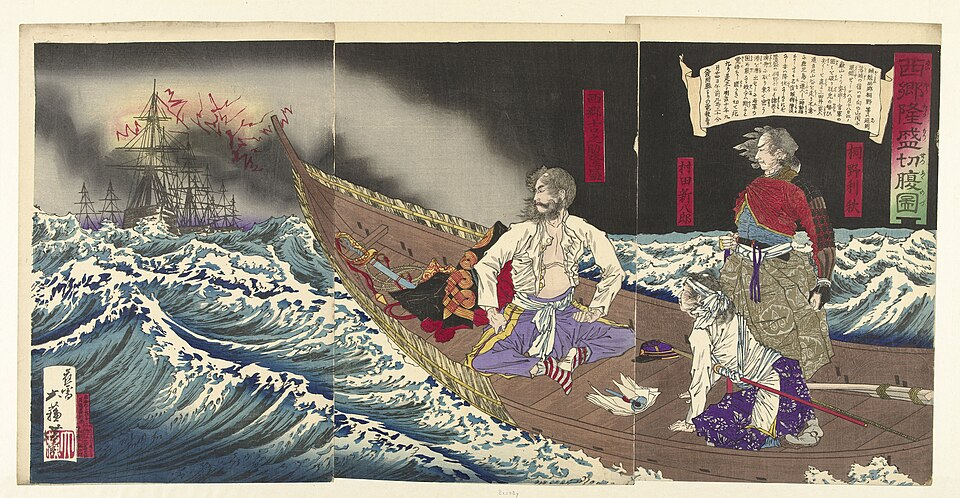
But it was not only the West that distorted the picture. As early as the 19th century, Japanese woodblock masters produced idealised depictions that deliberately contradicted reality. Colour woodblock prints (nishiki-e) showed Saigō Takamori during the Satsuma Rebellion (1877) committing a dignified seppuku in traditional samurai armour – although he actually wore a French uniform, commanded a modern army with artillery and, as research has since shown, did not commit seppuku at all. [7] The woodblock prints were not documentation but propaganda: they sold the romance of the “last samurai” to an audience that wanted to hear exactly this story.
Hollywood did the rest. Films such as The Last Samurai (2003) show seppuku as a mystical, almost spiritual event. The West loves the aesthetics – the white robes, the silent gestures, the controlled violence – but strips them of their historical context. Seppuku becomes an exotic backdrop, a visual thrill, “the Japanese way of dying”, as if there were a genetically encoded cultural essence.
The truth is more complex. Seppuku was not a natural inclination, but a social construct. It was taught, trained, enforced. Many samurai feared it – the historical sources are full of accounts of men who trembled, wept, tried to flee. The perfect, stoic execution was the ideal, not the norm. The West saw only the successful cases and drew conclusions about an entire culture.
Deconstructing the Myths
Myth 1: “Every samurai committed seppuku when he failed.”
Reality: Seppuku was exceptional, not commonplace. Most samurai died in bed, of illness, in old age. Seppuku was ordered only for serious offences, military catastrophes or as a legal sentence. A samurai who made a small mistake was not expected to kill himself – that would have been economically absurd.
Myth 2: “Seppuku was painless and quick.”
Reality: The belly cut was agonising. Even an experienced kaishakunin needed seconds for the fatal blow – enough time for intense pain. The development of symbolic seppuku (a fan instead of a dagger) in the Edo period proves that the physical act was recognised as a problem.
Myth 3: “Women committed seppuku like men.”
Reality: Women from samurai families practised jigai (自害) – cutting the carotid artery, not the belly. They often tied their knees together beforehand so that the body would keep a “modest” posture in death. This shows the gender-specific dimension: even in death, a different standard applied to women.
Myth 4: “Seppuku is a Buddhist ritual.”
Reality: Buddhism forbids suicide. Seppuku is a secular, Confucian phenomenon – rooted in concepts of loyalty, honour and social harmony, not in religious doctrine. Buddhist priests did conduct funeral ceremonies, but the act itself was secular.
Myth 5: “Modern Japanese understand and respect seppuku.”
Reality: Most contemporary Japanese see seppuku as a historical curiosity, not as a living tradition. In 1970, Mishima’s death was perceived by the majority as madness. The romanticisation often comes from outside – from Western Japan enthusiasts, martial arts fans and consumers of pop culture.
Myth 6: “Saigō Takamori honourably committed seppuku on the battlefield.”
Reality: In 2010, the historian Mark Ravina demonstrated forensically that on 24 September 1877 Saigō was seriously wounded by a shot to the hip and could no longer move. His retainer Beppu Shinsuke beheaded him to spare him capture – an act of mercy, but not a ritual seppuku. The popular story of the dignified belly cut only emerged decades later and served the Meiji state in reinterpreting the dangerous rebel as a tragic national hero. [7] It is one of the most successful historical fabrications of modern Japan.
The End of a Tradition: The Meiji Restoration and Its Consequences
The Ban of 1873: Modernisation Through Destruction
On 3 January 1868, the 15-year-old Emperor Meiji proclaimed the restoration of imperial power. The Tokugawa shogunate, which had ruled Japan for 265 years, was overthrown. Within a few decades, Japan transformed itself from a feudal society of estates into an industrialised great power. Railways, telegraph lines, Western clothing, a standing army on the Prussian model – nothing remained as it had been. And with the old order, seppuku disappeared too.
The end did not come immediately. During the turmoil of the Boshin War (1868-1869), which crushed the last shogunate loyalists, numerous samurai committed seppuku – some voluntarily, some on orders. The most famous case concerns Saigō Takamori, the charismatic leader of the Satsuma Rebellion (1877) – but what popular tradition hands down as a heroic seppuku on the battlefield does not stand up to historical scrutiny.
In 2010, in the Journal of Asian Studies, the historian Mark Ravina used contemporary reports, autopsy records and official documents to reconstruct what actually happened on Shiroyama on 24 September 1877: Saigō was seriously wounded by a shot to the hip and could no longer move. His retainer Beppu Shinsuke beheaded him to spare him capture – an act of mercy, but not a ritual seppuku. [7] Saigō wore not samurai armour, but a French uniform; he commanded not sword warriors, but a modern army with artillery.
The legend arose posthumously. Only weeks after the battle, colour woodblock prints (nishiki-e) produced idealised depictions of a dignified seppuku – Saigō in traditional armour, kneeling on the mat, dagger in hand. These images served an audience that wanted to see the “last samurai” as a tragic hero, not as a failed rebel. [7] The Meiji state posthumously pardoned Saigō in 1889 and integrated him into the national canon of heroes – a political decision that cemented the seppuku legend. [7] Hollywood completed the transformation: The Last Samurai (2003) shows Saigō (in the film “Katsumoto”) committing honourable suicide – a scene that is historically pure invention.
But formal abolition came in 1873. The Meiji government issued a decree banning seppuku as a legal punishment. [2] The reasoning was sober: Japan wanted to be perceived as a civilised nation, on an equal footing with the Western powers. Ritual self-killing did not fit this image. At the same time, the entire system of estates was abolished – samurai lost their privileges, their stipends and their right to carry swords. They became citizens like everyone else. Seppuku, which had once defined their status, became obsolete.
Conservative samurai felt the ban to be a dishonour – divided reactions shaped the public debate. They were being robbed of the last symbol of their dignity. More progressive voices welcomed it as an overdue departure from a barbaric tradition. The majority reacted pragmatically: they looked for new professions and became teachers, officials, businessmen. The material basis of samurai culture – the feudal system with its structures of rule and bonds of loyalty – had been destroyed. Without this context, seppuku was meaningless.
Persistence and Transformation in the 20th Century
But, as the saying goes, those declared dead live longest. Although officially banned and socially marginalised, seppuku did not disappear completely. On the contrary: the Meiji era and its successors invented a new variant – patriotic self-sacrifice for nation and emperor. The difference from Edo-period seppuku was subtle but crucial: it was no longer about personal honour or clan loyalty, but about national greatness.
General Nogi Maresuke (1849-1912) was the prime example. His seppuku after the death of Emperor Meiji was celebrated as an act of ultimate loyalty to the imperial house – and at the same time interpreted as a reminder that the old warrior ethic was not entirely lost. The government was ambivalent: on the one hand, Nogi’s act did not fit into modern Japan; on the other, it was useful for propaganda. It showed that Japanese soldiers were prepared to die for their country – a message that was highly welcome in the age of rising militarism.
This instrumentalisation reached its peak in the Second World War. Seppuku became part of military indoctrination – not as a formal ritual, but as a mentality. Soldiers were taught that surrender meant disgrace and that death was more honourable than captivity. The kamikaze pilots who steered their aircraft into enemy ships were placed in the same tradition as the samurai who committed seppuku. Historically this was a falsification – kamikaze was mass killing and suicide, seppuku was a legally regulated procedure – but propaganda exploited the parallel.
After 1945 this ideology collapsed. The American occupation banned militaristic rhetoric and introduced the pacifist constitution. Seppuku became taboo – too closely associated with failed imperialism, with fanaticism, with a dark past. Mishima’s act in 1970 was a shock precisely because it broke this taboo. It showed that the ghosts of the past were not dead – only repressed.
Seppuku in the 21st Century: Between Fiction and Reality
As a cultural point of reference, seppuku remains present even beyond this dark continuity. The 47 rōnin are commemorated every year on 14 December at the Sengaku-ji temple – not as a model, but as a historical event of remembrance. Films, anime and video games take up the motif – mostly aestheticised, decontextualised, as an exotic element of an imagined samurai past. The answer is usually: they can be admired, but not revived.
Interestingly, global pop culture is today the greatest preserver of the seppuku myth. Western and Asian media reproduce the imagery: the white kimono, the tatami mat, the dagger, the reverently kneeling warrior. But these images are decoupled from their original function. They have become iconic – signs for “Japanese tradition”, for “ultimate courage”, for a foreign ethic that fascinates precisely because it remains incomprehensible.
For decades, academic research has tried to historicise seppuku – to understand it as a product of specific social and economic conditions, not as an expression of a timeless “Japanese soul”. This article follows that approach. Seppuku was not a mystical practice, but a historical institution with pragmatic functions: conflict resolution, marking of status, administration of justice, social control. When these functions disappeared – with the end of feudalism, the abolition of the order of estates, Japan’s integration into the capitalist world economy – seppuku disappeared too.
What remains is the memory. And the questions: what does seppuku tell us about the connection between honour and violence? About the power of social norms to drive people to actions that contradict their basic instincts? About the aestheticisation of death as a coping strategy in a world shaped by wars and domination? Seppuku is not the answer – but a window into a society that sought radical solutions to the problem of shame and found them in controlled, ritual death.
Understanding Seppuku, Not Romanticising It
The history of seppuku is not a heroic story. It is the history of a system that forced people to stage their own deaths in order to maintain social order. It is the history of men who wavered between despair and pride, of families ruined by loss of honour, of a society that made suicide a duty.
Anyone who wants to understand seppuku must be prepared to destroy its romance. It was not a noble act of free warriors, but the product of a rigid class society. It was not an expression of courage, but of social compulsion. And it did not end because the Japanese forgot their tradition, but because the material conditions that made it possible disappeared.
What remains is a historical practice that teaches us: culture is not eternal. What was once regarded as self-evident, as natural, as inescapable can become obsolete within a generation. Seppuku reminds us that even extreme forms of human behaviour are rooted not in nature, but in society – and pass away with society.
Further information
At the Samurai Museum Berlin, visitors can view historical tantō daggers, ritual garments and woodblock prints from the Edo period. The permanent exhibition sheds light on the context of samurai culture without glorification and offers space for a nuanced engagement with a complex historical era.
Frequently Asked Questions
What does seppuku mean?
Seppuku (切腹) literally means “belly cut” and refers to the ritualised suicide by cutting open the belly that was practised in the samurai culture of Japan (12th-19th centuries). The term comes from the Sino-Japanese on reading of the kanji characters.
What is the difference between seppuku and harakiri?
Seppuku is the formal, learned term (on reading of the kanji 切腹), while harakiri (腹切り) is the colloquial form (kun reading). Both terms refer to the same act. In historical contexts, “seppuku” was used in official documents, “harakiri” more in everyday language.
When was seppuku banned?
The Meiji government banned seppuku as a legal punishment in 1873, in the course of Japan’s modernisation on the Western model. At the same time, the entire system of estates was abolished and the samurai lost their privileges. Seppuku thus lost its legal and social function.
What was the role of the kaishakunin?
The kaishakunin (介錯人, “mediator” or “second”) was the person who beheaded the dying man with a precise sword stroke in order to shorten his suffering and preserve the dignity of the ritual. The technique required the utmost precision – a botched cut was considered the greatest disgrace for both parties.
Who were the 47 rōnin and why are they famous?
The 47 rōnin were masterless samurai who in 1703 avenged their dead lord Asano Naganori by killing his tormentor Kira Yoshinaka. They then committed seppuku together. Their case is regarded as the most famous example of samurai loyalty and had a lasting influence on the modern image of bushidō.
Why did samurai commit seppuku?
The reasons varied by era. On the battlefield (12th-16th centuries), seppuku served to avoid capture and torture. In the Edo period (1603-1868) it became a regulated punishment that preserved the condemned samurai’s honour of rank – in contrast to the dishonourable public execution. Sociologically, it was “altruistic suicide” in Durkheim’s sense: the individual sacrificed himself to protect the honour of the group – family, clan, feudal lord. [4] In special cases, seppuku could also serve as political protest (kanshi) or as taking responsibility (inseki) for the failure of others.
Did Saigō Takamori really commit seppuku?
No. In 2010, in the Journal of Asian Studies, the historian Mark Ravina demonstrated that on 24 September 1877 Saigō was seriously wounded by a shot and beheaded by his retainer Beppu Shinsuke. The popular story of the ritual seppuku is a later invention of Meiji nationalism, spread by idealised colour woodblock prints (nishiki-e). The legend served to reinterpret the rebel Saigō as a loyal national hero. [7]
Visit the Samurai Museum Berlin
Experience the exhibits and themes of this article at first hand in the permanent exhibition of the Samurai Museum Berlin. More than 500 original objects from feudal Japan — armour, weapons, everyday objects — await you at Auguststraße 68, Berlin-Mitte. Open daily from 10 a.m. to 7 p.m.
→ Tickets & Opening Hours
→ All Exhibitions at a Glance
Related Articles
- Samurai: History, Culture and Legacy
- Bushido: The Code of Honour of the Samurai
- The Katana: Myth and Reality
Bibliography
- [1] Rankin, Andrew (2011). Seppuku: A History of Samurai Suicide. Tokyo: Kodansha USA.
- [2] Pauly, Ulrich (1995). Seppuku: Ritueller Selbstmord in Japan. OAG aktuell Nr. 63. Tokyo: Deutsche Gesellschaft für Natur- und Völkerkunde Ostasiens.
- [3] Hurst, G. Cameron III (1990). “Death, Honor, and Loyalty: The Bushidō Ideal.” Philosophy East and West, 40(4), pp. 511-527.
- [4] Fusé, Toyomasa (1997). Suicide, Individual, and Society. Toronto: Canadian Scholars’ Press.
- [5] Van Norden, Bryan W. (2013). A Guide to Reading Chūshingura: The Play by Izumo, Shōraku, and Senryū. Poughkeepsie: Vassar College.
- [6] Mitford, Algernon Bertram Freeman (1871). Tales of Old Japan. London: Macmillan and Co.
- [7] Ravina, Mark J. (2010). “The Apocryphal Suicide of Saigō Takamori: Samurai, ‘Seppuku’, and the Politics of Legend.” Journal of Asian Studies, 69(3), pp. 691-721.
© Samurai Museum Berlin – All rights reserved
You might also like
Kendo: History, Philosophy & Practice of the Art of the Sword
Kendō – the way of the sword: from Kenjutsu to a modern martial art. History, equipment, philosophy & historical exhibits…
Read the article
Shogun – The Military Rulers of Japan
Shogun – the military rulers of Japan: who they were, how they ruled & why they never abolished the emperor.…
Read the article
Bushidō: The Code of Honour
Bushidō – the samurai code of honor. Nitobe's 7 virtues, historical reality, Hagakure, modern adaptations. Facts instead of myths, with…
Read the article