 Nominated for the EMYA2026 award

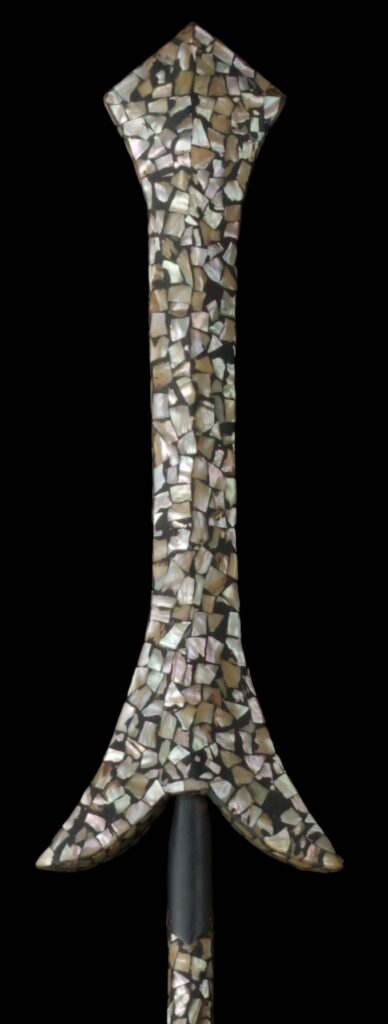
In 1583, the Battle of Shizugatake decided who would inherit Japan after the death of Oda Nobunaga. Toyotomi Hideyoshi charged with a vanguard against the troops of his rival Shibata Katsuie. Seven warriors rode at the head of the attack. Hideyoshi called them Shichi-hon-yari: the Seven Spears of Shizugatake.
Anyone who wants to understand how samurai really fought in the 16th century has to say goodbye to a popular image: the lone swordsman, his katana gleaming in the sunlight. On the battlefields of the Sengoku period, a different weapon decided victory and defeat — a weapon whose blade was forged from the same steel as the famous sword, but which could be up to seven metres long and was carried by the thousand in disciplined formations: the yari.
This article shows why the yari really was a very important weapon of the samurai, what types existed, how it was used on the battlefield, and how it became a parade object in the peaceful Edo period.
What Is a Yari? — Definition and First Classification
The yari (槍) is a straight Japanese thrusting spear with a symmetrical, double-edged blade that is firmly attached to a long wooden shaft by a tang — the nakago. This construction distinguishes it from earlier polearms, whose spearheads were merely fitted onto the shaft, and technically makes it a relative of the samurai sword: both blades were forged from tamahagane steel, and both could bear a hardening pattern (hamon) along the cutting edge.[1]
The yari is not a slashing weapon but primarily a thrusting tool. Its blade allowed cutting movements, but its real effectiveness lay in the coordinated thrust from the formation.[2] It is precisely this property that distinguishes it from the two polearms with which it is often confused:
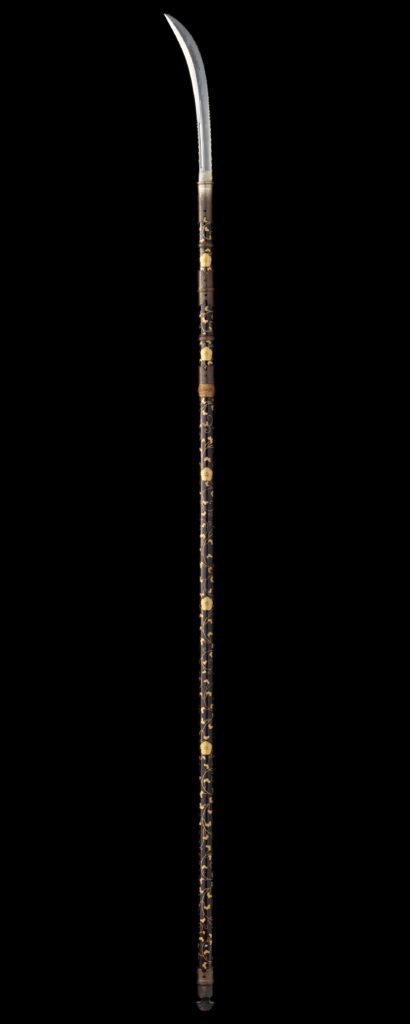
- Naginata — a curved, sword-like blade on a long shaft. Primarily a cutting weapon, effective in open terrain, suited to single combat. Widespread among male warriors of all classes during the Sengoku period, later used in samurai households for self-defence.
- Nagamaki — a long, sword-like object with a comparably long hilt. An intermediate form between long sword and polearm, fashionable in the 14th century and pushed aside thereafter.
By the middle of the Sengoku period, the yari had displaced both as the preferred close-combat weapon.[3] The reason was not aesthetic but tactical: the naginata and nagamaki required sweeping movements and needed space. In a dense formation, their bearers got in each other’s way. The yari, with its straight thrusting profile, worked in a group — and groups decided the Sengoku battles.
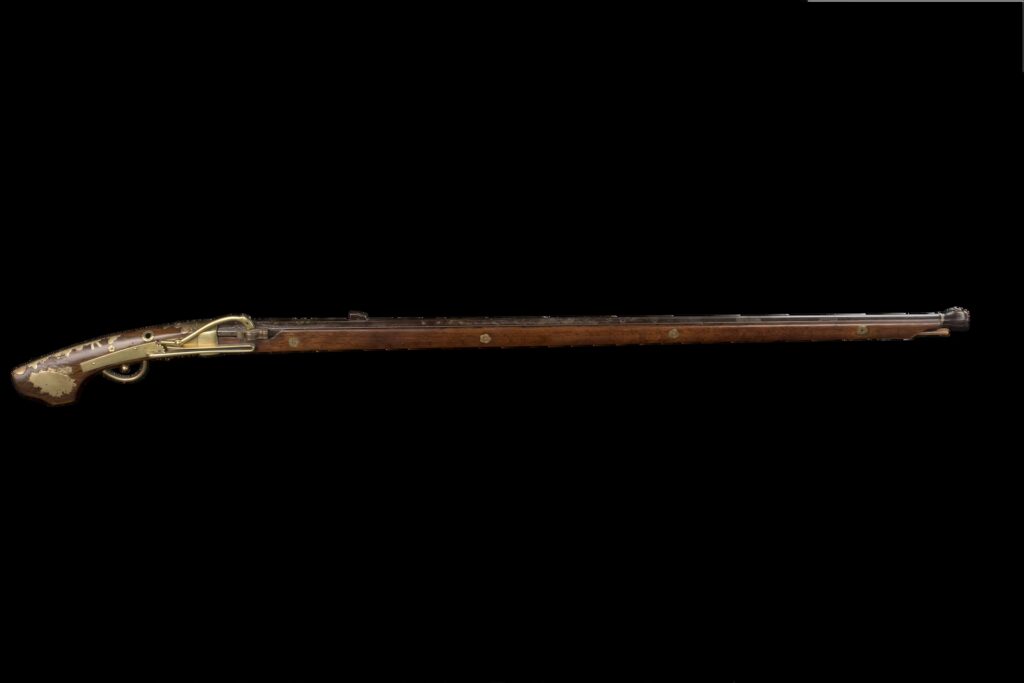
In the Sengoku period, the katana was not the samurai’s primary weapon. It was a secondary weapon for close-combat emergencies, for ritually taking heads after victory and for urban fighting in buildings, where long weapons were impractical.[4] The real work on the battlefield was done by three other weapons in a coordinated sequence: the bow (yumi) at a distance, the matchlock gun (teppō) after 1543, and the yari in close combat.
This reassessment is not a museum curator’s quibble. It explains why Hideyoshi’s inner circle of proven warriors was called the “Seven Spears”. Why Honda Tadakatsu, the legendary Tokugawa general, was depicted with the spear Tonbogiri.
From Hoko to Yari — The History of Its Development
The history of the Japanese spear does not begin with the yari. As early as the Yayoi period (c. 300 BC to AD 300), the inhabitants of the archipelago used an early form of thrusting spear, the hoko (鉾). Its spearhead was socketed: a hollow metal point that was fitted onto the wooden shaft, technically comparable to European spearheads of antiquity. The hoko goes back to Chinese influences and remained in use until the Muromachi period (1336–1573).[5]
The decisive technical change came in the 14th century. The blade was given a continuous tang (nakago), which was set deep into the shaft and fixed with a bamboo peg (mekugi) — the same construction as with the sword. This construction was more resistant to breaking and made it possible to replace the blade when necessary or to store it in a shirasaya (unlacquered storage mounting). At the same time, the quality of the steel improved: yari blades were increasingly forged from tamahagane steel, with the same folding technique and the same hardening pattern as swords.[6]
Why did the new yari displace the older polearms? The answer lies in Japan’s military transformation during the late Muromachi and early Sengoku periods. The Ōnin War (1467–1477) destroyed the old order of the Ashikaga shogunate and ushered in over a century of permanent regional wars. Armies grew from a few hundred mounted archers to tens of thousands of men — and this mass no longer consisted of elite warriors, but of ashigaru: recruited peasants and low-ranking warriors who fought as infantry under the command of a high-ranking samurai.[7]
The naginata was unsuitable for masses of ashigaru. Its swinging use required months of training and open space. The yari, on the other hand, could be mastered sufficiently in a few weeks, and it worked in formation. From around 1500 it became the standard weapon of the foot troops; in the second half of the 16th century, samurai also carried it themselves as soon as they dismounted and joined the close combat.[8]
The historical line is therefore clear: hoko (Yayoi to Muromachi) → naginata and nagamaki (Heian to Muromachi, dominant in the 13th/14th centuries) → yari (from c. 1400, dominant from 1500). Each change followed a change in army size, recruitment base and tactics. The yari was therefore not just a weapon, but an indicator of how warfare itself had changed — from ritualised single duels between mounted archers to the mass infantry of a modern feudal army.
This change accelerated when Portuguese merchants brought the first matchlock guns to Tanegashima in 1543. Within a few decades, Japanese gunsmiths had taken the teppō into mass production. The combination of ashigaru with yari, ashigaru with teppō and a smaller elite of mounted samurai with the yari as a lance produced a new battle formation that was to determine Japan’s fate for a century.
Construction and Anatomy — How a Yari Is Built
A yari consists of three basic elements: the blade, the shaft and the protective cover. But the precision with which they were put together makes the difference between a peasant’s weapon and a prestige weapon owned by a daimyō.[9]
The blade was forged from the same tamahagane steel as a sword. It could be straight or triangular in section, often had a ground fuller to reduce weight, and, on high-quality examples, showed a hardening pattern along the cutting edge.[10] The length varied considerably: the shortest spearheads measured under 20 centimetres, the longest — above all on ceremonial spears of the Edo period — could exceed one metre. Honda Tadakatsu’s Tonbogiri, with a blade about 43 centimetres long, is well known.
Several specialised components follow at the transition between blade and shaft. The tachiuchi, the upper third of the shaft mounting, was the most critical area: this was where the tang sat in the wood, and where the material had to withstand blows and parries. This construction was robust enough to parry enemy blows or to deal heavy blows itself.
Directly below the tachiuchi follows a thick band of cord wrapping, often lacquered scarlet: the kaburamaki, also called chidome (“blood stopper”). Its function was as pragmatic as it was macabre — it was meant to prevent the opponent’s blood from running down the shaft and making the grip slippery. On some examples the kaburamaki is particularly pronounced and forms a visible step on the shaft.[12]
The nagaya — the actual shaft — made up the bulk of the weapon and consisted of selected hardwood, often oak. For particularly long spears, shafts were made of glued strips of bamboo or wood in order to achieve resistance to breaking with lower weight. The nagaya could remain undecorated or be richly decorated with lacquer, gold overlays and family crests (mon) — depending on the rank and wealth of the bearer.
At the end of the shaft, a ring, the so-called mizugaeshi, protected the weapon from water damage. The final element was a pointed metal cap, the ishizuki. This cap had three functions: it served as a counterweight to the blade at the upper end, it protected the end of the shaft from splintering, and in an emergency it could itself be used for thrusting or striking. A samurai whose blade broke off thus still had a usable weapon — albeit with a blunt thrusting end.[13]
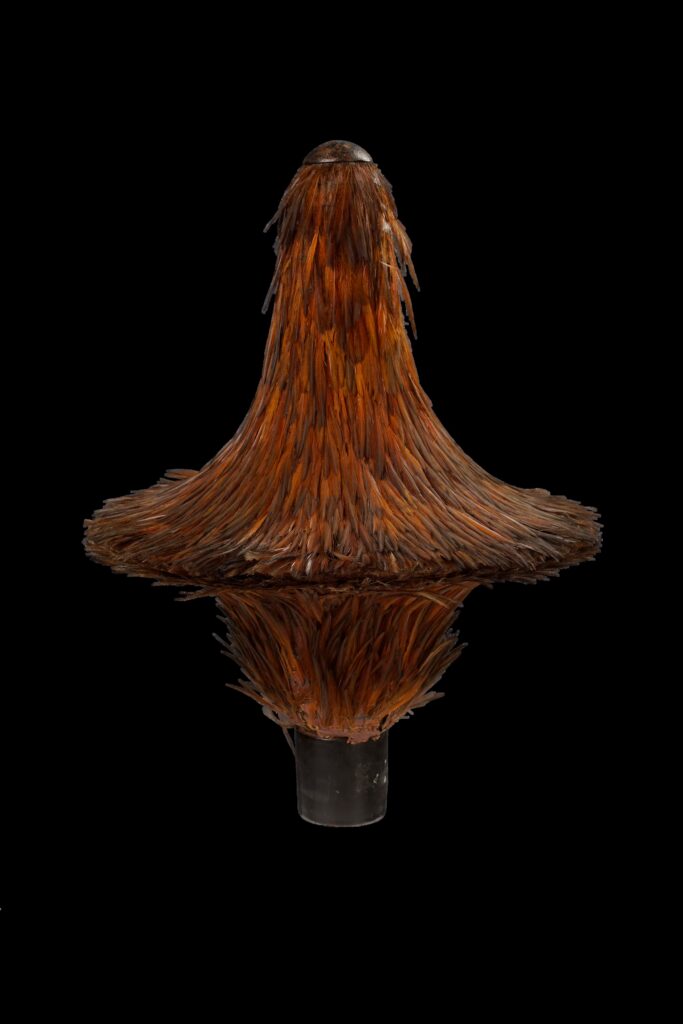
When not in use, the blade itself was kept in a yari saya (spear sheath). These sheaths were fitted exactly to the shape of the blade and could be decorated as eye-catchers with elaborate lacquer techniques, inlays or feathers.
Each component had a precise function: the blade killed, the tachiuchi protected the critical joint, the kaburamaki secured the grip, the nagaya connected everything, and the ishizuki provided balance and a second weapon.
The Most Important Yari Types — from Su Yari to Jūmonji
The yari was not a uniform weapon. During the Sengoku period, numerous variants emerged that differed in shape, length and purpose. Each type had advantages and disadvantages, and clans developed preferences that were reflected in their arsenals.[15]
Su yari — the straight spear. The classic type of yari with a simple, straight blade ground with three edges. Thanks to its uncomplicated design, it was the most widespread yari and the standard weapon of ashigaru formations. The blade had the same properties as that of a sword and could have a hamon along the cutting edge.
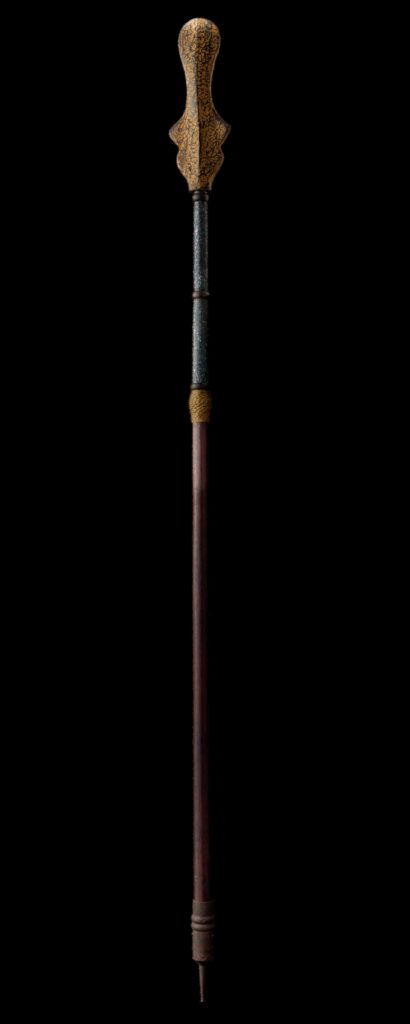
Sankaku yari — the triangular thrusting spear. A subtype of the su yari with a rhombic to triangular cross-section. This blade cut less well than a flat one, but it penetrated armour more efficiently, because the weight concentrated at the tip had an armour-piercing effect. Sankaku variants were popular with cavalry units.[17]
Jūmonji yari — the cross spear. Perhaps the most impressive type of yari: from the central, straight main blade grew two sickle-like side blades, which together formed the shape of the Chinese character 十 (jūmonji, “ten”). This construction allowed not only thrusting, but also hooking, pulling down and cutting to the side. The jūmonji yari is inseparably linked with Hōzōin-ryū sōjutsu, a spear martial art developed in the late 16th century by the monk Hōzōin In’ei at the Kōfuku-ji temple, which is still practised today.[18]
Kama yari — the sickle spear. A variant with only one side hook. Similarly versatile to the jūmonji yari, but lighter. Some subtypes, the kata-kama yari, had the hook pointing diagonally upwards and specialised in pulling mounted opponents down.
Nagae yari — the long spear. The extreme of the genre: a yari with a shaft up to six, in exceptional cases seven, metres long.[19] This spear was the standard weapon of the ashigaru pike formations and worked on the same principle as the European pike blocks of the 16th century. Individual nagae yari were almost unwieldy — but in a disciplined formation of a hundred or a thousand bearers, a moving wall of iron points was created against which even cavalry was powerless.
Also part of the extended yari family is the karakuri jutte (also called yari jutte), a weapon with a straight, spear-like blade and a folding horizontal guard. Developed from the yari, it was already used in the Sengoku period and is a forerunner of the later jutte striking weapon of the Edo police. According to sources, it was used in the Jittetori-ryū, a school said to have been founded by Miyamoto Musashi’s father.[21]
This variety shows that the yari was not a static standard weapon. It was a platform — a forged steel blade on a wooden shaft — from which dozens of specialised forms developed over three centuries. Each answered a tactical question: how do I break through armour? How do I pull riders off their horses? How do I hold a block of pikemen in position?
The Yari on the Battlefield — Tactics of the Sengoku Period
Anyone who wants to understand the Sengoku battles has to abandon three images. The first: the samurai as a chivalrous lone fighter with a sword. The second: the medieval samurai army as a gathering of mounted archers. The third: the ashigaru as an unreliable mass of peasants. All three images describe real conditions — but each from different eras spanning six hundred years.
In the Heian and Kamakura periods (794–1333), samurai identity was indeed closely linked to the bow. The “Way of the Horse and Bow” (kyūba no michi) was the core of the early warrior ideal.[22] Fights often began with ritualised arrow duels, and the sword played a subordinate role. The change came gradually: with the Mongol invasions of 1274 and 1281, which forced Japanese troops to adapt to formation fighting against an enemy without rituals; with the Ōnin War (1467–1477), which shattered the old order; and with the introduction of the ashigaru as professional infantry in the late 15th century.
From around 1500, a Sengoku battlefield looked like this: a daimyō’s army consisted of 60–80 per cent ashigaru infantry, organised into three specialised units.[23]
- Yumi ashigaru — light archers who fired volleys from a distance before close combat began.
- Yari ashigaru — the largest group, armed with nagae yari four to six metres long. They formed the pike blocks that held the front and absorbed cavalry attacks.
- Teppō ashigaru — in growing numbers from the 1550s, equipped with matchlock guns.
These foot troops were complemented by a considerably smaller number of mounted samurai — the traditional elite, but now in a changed role. They were no longer lone fighters, but shock cavalry who used the yari as a lance to break into enemy formations that had already been weakened. Samurai who exchanged their bows for spears thus took on a function that corresponded to that of knights and cuirassiers in Europe.[24]
These units interacted in a fixed sequence. First, the yumi and teppō ashigaru opened the engagement from a distance, causing losses and unrest in the enemy ranks. As soon as the fronts came closer, the ranged fighters withdrew behind the yari ashigaru. The yari pike blocks collided with one another — a brutal, tightly packed shove of bamboo, wood and steel points. Only when the enemy formation began to crumble did the samurai cavalry attack the flanks with lance yari.
Nagashino (1575) is regarded as the battle in which this tactic reached its modern perfection. Oda Nobunaga and Tokugawa Ieyasu faced the Takeda cavalry under Takeda Katsuyori. Nobunaga’s men, armed with matchlock guns, were positioned behind palisades and drawn up in three ranks in order to fire volleys in turn. The Takeda cavalry came under massive fire as it charged, and the battle then turned into close combat — with yari on both sides. Takeda’s army lost about 10,000 of its 15,000 men; Oda-Tokugawa counted around 6,000 dead out of 38,000 deployed.[25]
Modern research has increasingly called into question the classic portrayal of three-rank rotating volley fire. Contemporary sources document the use of muskets, but the specific rotation tactic was reconstructed later and possibly idealised. It is more likely that Nobunaga’s troops won through massive superiority in firepower and the defence provided by the palisades — without the precise choreography described in later accounts.[26] What is undisputed, however, is that the yari played the decisive role in the close combat after the first musket fire. The battle was not decided by the firearm alone, but by the interplay of teppō and yari.
Towards the end of the Sengoku period, the armies of the great daimyō had developed into complex machines. Hideyoshi’s separation edict of 1591 fixed the social order: ashigaru were permanently separated from the peasantry and became a lower warrior caste. The social permeability that had, in theory, allowed any warrior to rise in the Sengoku period was closed off. This also ended the phase in which the yari was purely a battlefield weapon. What followed was its transformation into a work of art.
Legendary Yari Bearers — from Hideyoshi’s Seven Spears to Tonbogiri
The sources of the 16th and early 17th centuries know a remarkable number of samurai whose fame is inseparably linked with a spear. These names refute the image of the sword-fighting samurai on their own — not through academic arguments, but through biographical facts.
The Seven Spears of Shizugatake (Shichi-hon-yari) are regarded as possibly a famous ensemble of yari warriors in Japanese history. In April 1583, Toyotomi Hideyoshi faced his rival Shibata Katsuie on the shore of Lake Yogo in Ōmi Province. Whoever won this battle would take over Nobunaga’s legacy. Hideyoshi sent ahead a vanguard of seven warriors whose attack decided the victory: Katō Kiyomasa, Fukushima Masanori, Kasuya Takenori, Wakisaka Yasuharu, Hirano Nagayasu, Katagiri Katsumoto and Katō Yoshiaki.[27] All seven became powerful daimyō, and all seven entered the official culture of remembrance as “the Seven Spears”. The fact that this designation names the weapon and not the bearer shows the significance the yari had in the military self-image of this generation.
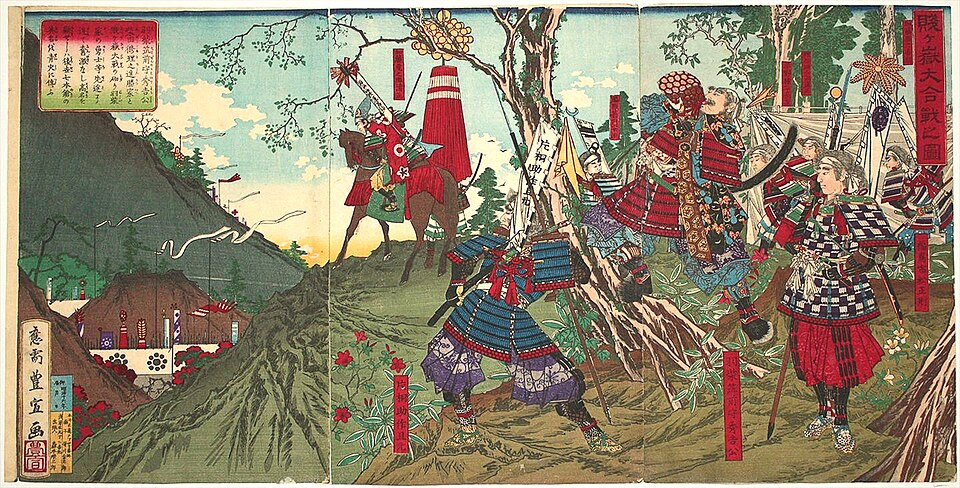
Honda Tadakatsu (1548–1610) is regarded as one of the “Four Heavenly Kings” of the Tokugawa and as perhaps the most famous yari warrior in all of Japan. Tradition credits him with more than fifty battles without a single serious wound. His weapon, the Tonbogiri (“Dragonfly Cutter”), is one of the “Three Great Spears of Japan” (Tenka san meisō) — a category of particularly revered weapons completed by the Otegine of the Yūki clan and the Nihongō from imperial ownership. The name Tonbogiri goes back to a legend according to which a dragonfly landed on the blade and was cut in two by mere contact — a poetic allusion to its sharpness that is not historically documented in this form, but illustrates the legendary status of the weapon.[29] Portraits of Honda Tadakatsu almost without exception show him in full armour with the yari in his hand, not with the sword.
Sanada Yukimura (1567–1615), one of the most famous warriors of the late Sengoku period, led his troops with the yari during the winter siege of Osaka (1614) and the summer siege of Osaka (1615). He broke through the Tokugawa lines and is said to have advanced several times as far as Ieyasu’s command centre before he fell in battle. Contemporary acclaim called him “the foremost warrior in all Japan” (Hinomoto ichi no tsuwamono) — recognition from the opposing side, which underlines its significance.[30] The in-depth main article on Sanada Yukimura is available separately in the knowledge hub; here a reference suffices: the last great figure of Sengoku warriordom was also a spear fighter.
Hōzōin In’ei (1521–1607), finally, represents another dimension of the yari. As a Buddhist monk at the Kōfuku-ji in Nara, he developed a specialised martial art for the jūmonji spear and thereby founded Hōzōin-ryū sōjutsu.[31] This school still exists today and is one of the oldest continuously transmitted spear traditions in Japan. In’ei shows that the yari was not only a mass weapon, but also the subject of highly specialised martial arts — a parallel to swordsmanship that is often overlooked in the discourse on the katana.
The Yari in the Edo Period — From Combat Equipment to Status Symbol
With the Battle of Sekigahara (1600) and the defeat of the Toyotomi supporters at Osaka (1615), the Sengoku wars came to an end. Tokugawa Ieyasu and his successors established the Pax Tokugawa — a period of peace lasting over 250 years that transformed the whole of Japanese society. For the yari, this period meant a paradoxical development: its military usefulness fell to almost zero, but its social and aesthetic significance rose.
In the decades after 1615, the bakufu standardised the samurai way of life with a series of ordinances. The pair of swords, the daishō — katana and wakizashi — became the primary status symbol and the distinguishing feature of the warrior class. The yari, on the other hand, lost its role as a battlefield weapon and took on two new functions: as a ceremonial and parade object and as an object of martial arts in the dojo.[32]
This transformation became particularly visible during the sankin-kōtai processions. From 1635, every daimyō was legally obliged to spend part of each year at the Tokugawa court in Edo and to leave his family there as de facto hostages. The daimyō’s journeys there and back developed into elaborately staged parades in which the ruler’s rank and wealth were demonstrated through the size and splendour of his retinue. Elaborately decorated yari were carried in rows in front of the daimyō’s palanquin — the blades hidden in yari saya, which had themselves become works of art.
At the same time, a second current developed. The martial art of the spear, sōjutsu, was formalised in times of peace and divided into numerous schools (ryū). The Hōzōin-ryū with the jūmonji yari was only one of dozens; others concentrated on the su yari, the short spear or specific techniques such as disarming. In the Edo period, sōjutsu remained largely restricted to male samurai; the parallel naginata tradition, on the other hand, was increasingly codified as a martial art for women — a development that gave rise to the later, historically imprecise association of the naginata with the onna-bugeisha.[34]
The third function of the yari in the Edo period was almost invisible: its military reserve function. Samurai families were obliged to provide a certain number of equipped warriors in the event of war. These obligations were never revoked, and the yari arsenals were looked after and maintained. When the Boshin crisis escalated into armed conflict between Tokugawa loyalists and the modernisers of the Meiji Restoration in 1868, the last samurai units really did still carry yari and naginata into battle — a class of weapon that became definitively obsolete within a few months through the mass use of Western rifles and cannons.
The Edo period was thus not the end of the yari, but its transformation. The battlefield implement became an object with multiple meanings: prestige of the daimyō, craftsmanship of the lacquer masters, object of martial arts, military reserve. This simultaneity explains why the yari preserved in museums almost all date from the Edo period — the Sengoku spears that were actually used were destroyed in combat or later melted down. What survived is the prestige object — and that distorts our image today.
Five Myths about the Yari — and What Is Really True
Hardly any samurai weapon is as systematically underestimated as the yari. Here are five widespread misconceptions that the historical sources clearly contradict.
Myth 1: “The katana was the primary weapon of the samurai.” Historically, the exact opposite is true. In the Heian and Kamakura periods, the primary weapon was the bow (kyūba no michi). In the Sengoku period, the bow, the yari and later the matchlock gun became the decisive battlefield weapons; the sword was a secondary weapon for close-combat emergencies and for kubi-tori (taking heads) after victory.[35] The katana as the “soul of the samurai” is a construct of the Edo period, when the sword had lost its main military function and become a status symbol. The popular image projects a Tokugawa ideology onto previous centuries.
Myth 2: “The yari was only a peasant’s weapon.” The yari was indeed the standard weapon of the ashigaru infantry — and therefore a mass weapon. But it was not only that. Honda Tadakatsu, one of Japan’s most respected generals, carried the Tonbogiri. Sanada Yukimura fought with the spear at Osaka. Prestige yari blades were made by the best swordsmiths of the time and were just as valuable as high-quality swords. Equating the yari with a peasant’s weapon ignores the fact that the same type of weapon was used at different levels of quality and prestige — as with the European spear.
Myth 3: “Yari and naginata are basically the same.” The difference is clear. The naginata has a curved, sword-like blade on a shaft, is a cutting weapon and was handled with open movements. The yari has a straight, symmetrical blade, is primarily a thrusting weapon and works in formation. The naginata was the dominant polearm of the Kamakura and Muromachi periods (13th–14th centuries); from the late 15th century, the yari displaced it as a battlefield weapon because the mass tactics of the Sengoku period favoured straight thrusting spears.[36] In the Edo period, both weapons survived side by side, with different functions.
Myth 4: “Japanese spears were shorter than European pikes.” Wrong. The nagae yari reached lengths of four to six metres, in exceptional cases over seven metres. This equals or exceeds the European pikes of the 16th and 17th centuries, which were typically four to five metres long in Swiss and Landsknecht formations. The tactical logic is identical: a pike block of overlong spears forms a moving wall on which cavalry is shattered.[37] On this point, the Japanese and European military history of the 16th century are structurally related — even though the two cultures arrived at this solution independently of each other.
Myth 5: “Nobunaga invented volley fire at Nagashino.” Here the source situation is more complicated. Contemporary documents confirm Nobunaga’s massive use of matchlock guns at Nagashino in 1575 and their positioning behind palisades. However, the popular story of precisely choreographed three-rank rotating fire is largely a later reconstruction for which there is no clear contemporary evidence.[38] Modern research tends towards the view that the victory resulted above all from superior firepower, tactical preparation and close combat with yari after the musket fire. The yari part of this myth is usually forgotten: after the first wave of fire, spear fighting decided the battle.
These five corrections do not change the fact that the katana was a fascinating and culturally significant weapon. They merely shift the proportions. Anyone who writes samurai history without putting the yari at the centre is writing the history of the Edo period and projecting it backwards. Anyone who wants to understand the battlefields of Kawanakajima, Nagashino, Sekigahara and Osaka has to talk about the yari — as a weapon, as a system, as the symbol of a way of waging war that shaped Japan for a century.
Conclusion: Why the Yari Retells the History of the Samurai
This article began with Hideyoshi at a lake in Ōmi, and his seven vanguard warriors charging against Shibata Katsuie. Anyone who understands this scene understands 16th-century samurai history differently. Not as a sequence of chivalrous duels between sword masters, but as the industrialisation of war. Not as a cultural constant, but as a dynamic process in which weapons, tactics and social roles changed over centuries.
In this narrative, the yari is more than a weapon. It is a symptom of change. Its rise from descendant of the hoko to the dominant polearm of the Sengoku period coincides with the rise of the ashigaru, the introduction of firearms, the development of pike-block tactics and the final turn away from the ritualised single combat of the Heian period. Its decline in the Edo period — more precisely, its transformation into a parade object — coincides with the invention of the samurai as a static bureaucratic class under the Tokugawa. Anyone who follows the yari follows the real social and military history of Japan from the 14th to the 19th century.
The cultural exaltation of the katana has obscured this reality. It arose for understandable reasons — the Edo period needed symbols, and the sword was easier to mythologise than a six-metre-long pike pole. But this mythologisation has distorted the popular image of the samurai. Hollywood films, video games and anime show swordsmen where historical sources describe spear bearers. The “Seven Spears of Shizugatake” are still a fixed term in Japanese; in English they are often called “The Seven Spears” — and hardly any Western viewer of samurai films has ever heard of them.
So what does the reader take away from this article? First, the empirical insight: the yari, not the katana, was the dominant close-combat weapon of the Sengoku battles. Second, the methodological principle: anyone who wants to understand a country’s military history must ask first not about the prestige object, but about the object of everyday use. Third, a concrete incentive to visit: at the Samurai Museum Berlin, these objects can be studied in their material presence — not as illustrations of a text, but as original witnesses to a time when Japan’s fate depended on the coordination of tens of thousands of yari bearers.
The katana remains a cultural symbol of great power. But the real history of samurai battles was written with the yari.
Frequently Asked Questions
What is the difference between a yari and a naginata?
The yari is a straight thrusting spear with a symmetrical blade, designed primarily for thrusting and suited to formation fighting. The naginata has a curved, sword-like blade and is a cutting weapon that is handled with open movements. From the late 15th century, the yari displaced the naginata as the dominant polearm on the battlefield.
How long was a yari?
The length varied greatly by type and period. Standardised su yari measured about two to three metres. The nagae yari, the pike weapon of the ashigaru, reached four to six metres, in exceptional cases seven metres. Ceremonial and prestige yari of the Edo period generally had medium shaft lengths, but elaborately decorated sheaths and mountings.
Was the yari a samurai weapon or a peasant weapon?
Both. The yari was the standard weapon of the ashigaru infantry, which consisted of recruited peasants and low-ranking warriors. At the same time, high-ranking samurai such as Honda Tadakatsu, the Seven Spears of Shizugatake or Sanada Yukimura carried prestigious yari. As with the European spear, it was the quality and decoration of the weapon that determined the bearer’s social rank, not the type of weapon as such.
What is a yari made of?
The blade is forged from tamahagane steel — the same material as a samurai sword — and attached to the wooden shaft by a tang (nakago). The central components are the tachiuchi (reinforced area of the shaft with iron rings), the kaburamaki (cord wrapping as a “blood stopper”), the nagaya (main shaft), the mizugaeshi (protective ring) and the ishizuki (metal cap at the end of the shaft).
Who were the “Seven Spears of Shizugatake”?
The Shichi-hon-yari were seven warriors who fought at the head of Toyotomi Hideyoshi’s vanguard at the Battle of Shizugatake in 1583: Katō Kiyomasa, Fukushima Masanori, Kasuya Takenori, Wakisaka Yasuharu, Hirano Nagayasu, Katagiri Katsumoto and Katō Yoshiaki. All seven rose to become important daimyō after the victory. The fact that the honorific title refers to the weapon shows the importance of the yari in the military self-image of this generation.
What types of yari are there?
The most important forms are: su yari (straight standard spear, widespread), sankaku yari (triangular, armour-piercing), jūmonji yari (cross spear with two side sickle blades, known from the Hōzōin-ryū), kama yari (sickle spear with one hook) and nagae yari (long spear of four to six metres for pike formations). In addition, there are special forms such as the ono no yari (axe-spear combination for ceremonial purposes) and the karakuri jutte.
Visit the Samurai Museum Berlin
The yari collection at the Samurai Museum Berlin makes the history described here physically tangible. From the functional su yari to the prestige sheaths of the daimyō processions and the rare combination weapon ono no yari — the exhibits document three centuries of Japanese military history. Visitors see how the same steel that became the katana myth also forged the spears that really decided the Sengoku battles.
Related Articles
- Katana: History, Forging Technique & 5 Myths Debunked
- Tachi: The Magnificent Long Sword of the Heian Samurai
- Yumi & Ya: The Bow of the Samurai — Primary Weapon and Art
- Tōsei Gusoku: The Bulletproof Armour of the Sengoku Era
- Sanada Yukimura: Japan’s Bravest Warrior (1567–1615)
- Takeda Shingen: The Tiger of Kai — Life & Strategy
- Toyotomi Hideyoshi: From Peasant’s Son to Ruler of Japan
- Japanese Swordsmithing: How a Katana Is Made
Sources and Further Reading
This article is based on academic research, primary sources and the expert catalogues of the Samurai Museum Berlin. All cited works are documented in the complete bibliography of the knowledge hub.
Primary Sources
- [1] Sesko, Markus (2014). Encyclopedia of Japanese Swords. Lulu Publishing. [Used: properties of blade steel in yari and swords, tamahagane construction]
- [2] Samurai Museum Berlin (2025). SMB Catalogue 2025 — Arsenal & Polearms. [Used: exhibit references D02V_38, C35V_33, C011H-C15V_17; definition of yari vs. naginata vs. nagamaki]
- [3] Absolon, Trevor (2017). Samurai Armour Volume I: The Japanese Cuirass. Osprey Publishing. [Used: ashigaru equipment in the Sengoku period, weapon types of the foot troops]
Secondary Literature
- [4] Turnbull, Stephen (2010). Katana: The Samurai Sword. Osprey Publishing. [Used: secondary weapon thesis, kubi-tori, sword myth as an Edo construct]
- [5] Turnbull, Stephen (1977). The Samurai: A Military History. Macmillan/Osprey. [Used: development of the hoko, Mongol invasions, Ōnin War and rise of the ashigaru, account of Nagashino]
- [6] Turnbull, Stephen (2005). Warriors of Medieval Japan. Osprey Publishing. [Used: yari as the dominant ashigaru weapon, Hōzōin-ryū, formation fighting]
- [7] Turnbull, Stephen (2022). War in Japan 1467–1615. Osprey Publishing. [Used: Sengoku tactics, Battle of Nagashino, interplay of weapon types]
- [8] Friday, Karl F. (2004). Samurai, Warfare and the State in Early Medieval Japan. Routledge. [Used: change in samurai warfare, myth of the mounted archer]
- [9] Conlan, Thomas D. (2003). State of War: The Violent Order of Fourteenth-Century Japan. Center for Japanese Studies, University of Michigan. [Used: revision of classic cavalry and formation narratives, critical assessment of Nagashino]
Museum Catalogues and Expert Reports
- [10] Samurai Museum Berlin (2025). Polearms Collection — Exhibition Documentation. [Used: su yari (D02V_38), yari saya (C35V_33), ono no yari (C011H-C15V_17), Wakisaka armour (C07V_13), karakuri jutte (D02V)]
- [11] Bottomley, Ian / Thatcher, Anthony (2013). Samurai Armour: A Concise Glossary. Royal Armouries Leeds. [Used: terminology of the yari mounting, tachiuchi, dōgane, kaburamaki]
© Samurai Museum Berlin – All Rights Reserved
You might also like
Naginata: The Polearm of the Samurai
The naginata: polearm of the samurai, anti-cavalry instrument and woman's weapon. History, types, and three originals at the Samurai Museum…
Read the article
Daishō: The Pair of Swords of the Samurai — Symbol and Meaning
The daishō – two swords, one status badge. History, symbolism & craftsmanship of the samurai pair of swords, with originals…
Read the article
Tantō: The Secret Weapon of the Samurai – Function & Significance
The tantō – Japanese short dagger under 30 cm: history, construction, seppuku function, and masterpieces. With original exhibits at the…
Read the article