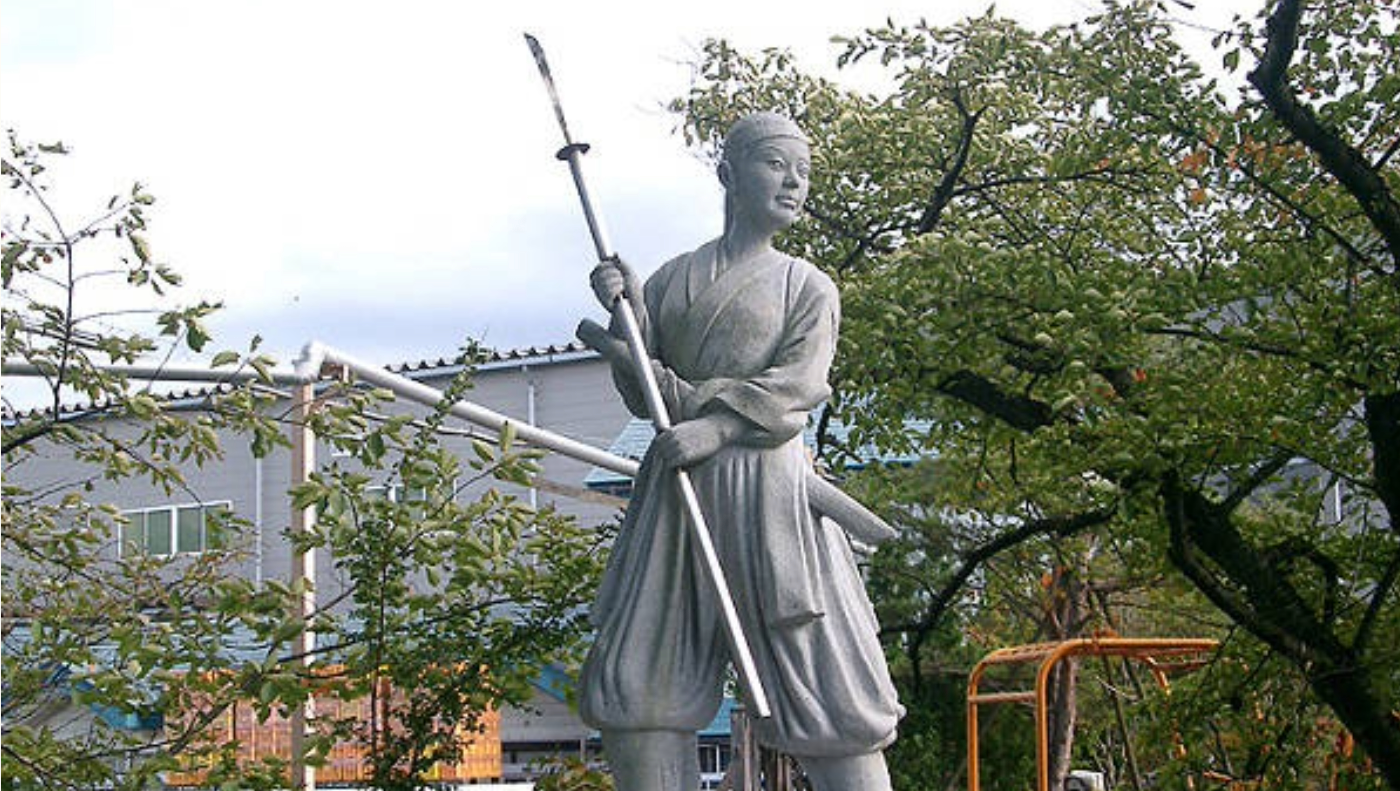
On 23 September 1868, women too stood in the line of battle on the battlefield of Aizu-Wakamatsu. Nakano Takeko, 21 years old, led a group of female warriors against the troops of the Meiji government.
When she was hit by a musket ball, she asked her sister Yukō to cut off her head so that it could not serve as a trophy.
The Onna-Bugeisha: Female Warriors of Samurai Society
The naginata was traditionally the weapon of the female warrior, but was also used by men. The wives of samurai trained with it in order to protect home and family. In the Edo period, naginata training was part of the standard education of girls from samurai families.[1]
Life and Battle
Nakano Takeko was born into a samurai family around 1847. She received an exceptional education: naginata, literature, calligraphy. In the Boshin War she formed the Joshitai, a female fighting corps. She was refused official admission to the army.[2]
On 23 September 1868 she attacked at Bandai and fell, shot in the chest.
The Legacy: Naginatadō and Cultural Memory
Today naginatadō is the martial art with the highest proportion of women in Japan — over 90 per cent of practitioners are female. A memorial ceremony is held every year at the Hōkai-ji temple in Aizu-Wakamatsu.
Frequently Asked Questions
Who was Nakano Takeko?
Nakano Takeko (c. 1847–1868) was a female warrior from the Aizu clan who fought in the Boshin War and fell on 23 September 1868. She is regarded as one of the last onna-bugeisha.
What is an onna-bugeisha?
Onna-bugeisha (female warrior) refers to women of the Japanese warrior nobility who mastered martial arts and fought. Women were not formally recognised as samurai, even when they fought.
Why is the naginata the weapon of the onna-bugeisha?
The naginata uses leverage rather than muscle power and is suitable for fighting in confined spaces. From the Edo period onwards, naginata training was part of the standard education of girls from samurai families.
What was the Boshin War?
The Boshin War (1868–1869) was the civil war between the forces of the Meiji Restoration and the supporters of the Tokugawa shogunate. Aizu was one of the last strongholds of the Tokugawa side.
Is there a memorial to Nakano Takeko?
Yes. A memorial stone has been erected at the Hōkai-ji temple in Aizu-Wakamatsu. Every year a memorial ceremony is held there with women in traditional dress.
Visit the Samurai Museum Berlin
The Samurai Museum Berlin displays historical naginata from the Edo period in display case C28. Daily 10 a.m.–7 p.m., Auguststraße 68.
Related Articles
Bibliography
- [1] Turnbull, Stephen (2008): Samurai Swordsman. Tuttle.
- [2] Stalker, Nancy K. (2018): Japan: History and Culture. UC Press.
- [3] Ravina, Mark (2017): To Stand with the Nations of the World. Oxford UP.
- [4] Samurai Museum Berlin (2025): SMB Catalogue 2025. Display case C28 naginata.
© Samurai Museum Berlin – All Rights Reserved
You might also like
Tomoe Gozen
Tomoe Gozen – warrior, legend, question. What do we really know about Japan's most famous onna-musha? History & fact-check at…
Read the article
Sengoku Jidai: The Age of the Warring States
The Sengoku Jidai (1467–1615) was Japan's 150-year civil war. After the collapse of Ashikaga rule, rival daimyō fought for supremacy…
Read the article
Meiji Restoration: The End of the Samurai (1868–1912)
The Meiji Restoration ended 700 years of warrior rule. How Saigō Takamori, the sword ban and Shiroyama sealed the end…
Read the article