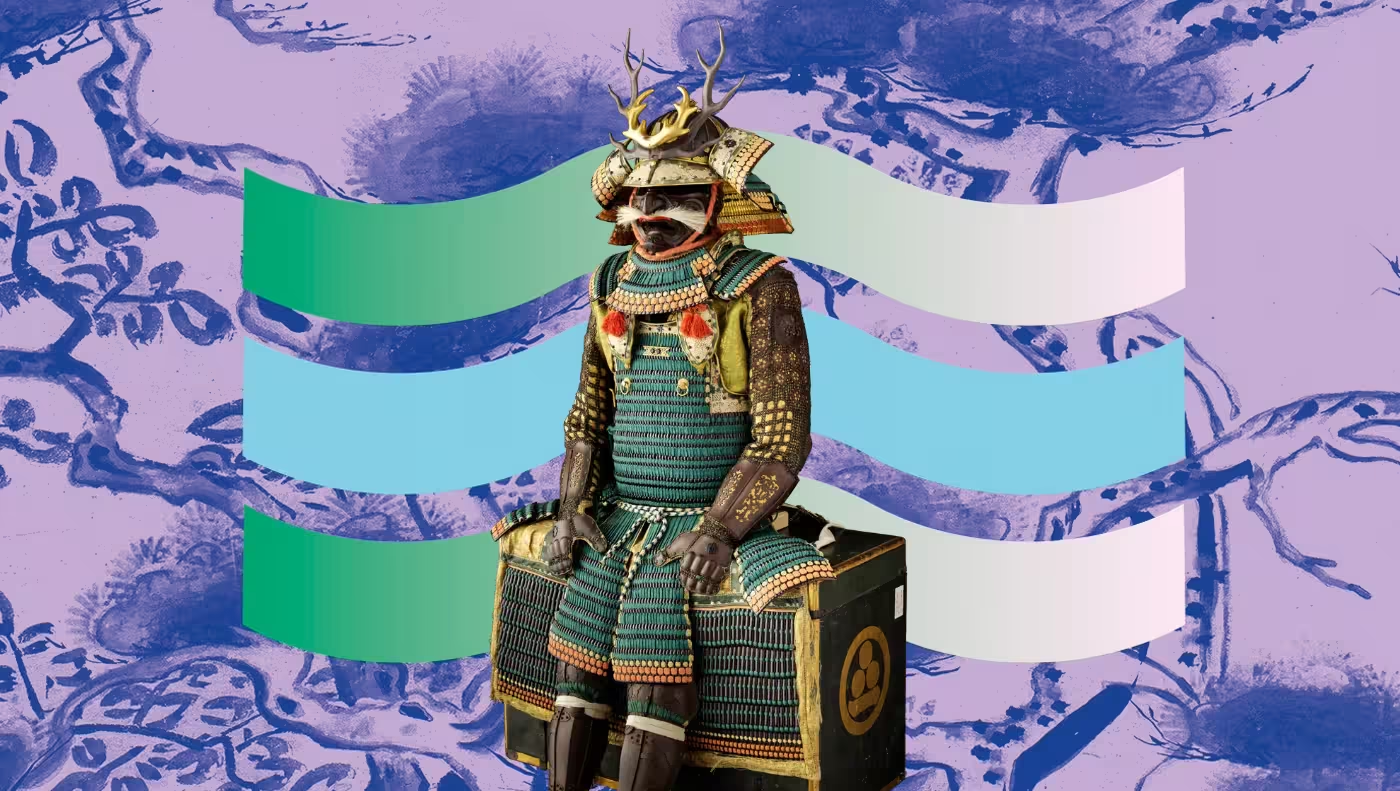
On 9 August 1543, Japanese warfare changed for ever. Portuguese traders landed on the island of Tanegashima and brought two arquebus guns with them. The lord of the island had his smiths observe how they worked and gave the order: build copies. Within months, the first Japanese copies were made. Within decades, Japan had more firearms than any European nation.
What Is Tōsei Gusoku?
Tōsei gusoku (当世具足 — “contemporary complete armour”) is the umbrella term for the modern plate armours of the Sengoku and Edo periods, which replaced the lamellar systems of the ō-yoroi.
The decisive feature: solid iron plates instead of small lamellae. While the ō-yoroi consisted of hundreds of small lamellae connected by cords, the tōsei gusoku used larger, often one-piece plates — horizontally stacked strips (yokohagi okegawa) or vertical half-plates (tatehagi) — which were connected by hinges or flaps.
Absolon describes the engineering progress: the hinges made it possible to connect solid plates firmly to one another without sacrificing mobility. “While small lamellar sections were functional, they represented an excessively complex method of connecting independent armour plates to one another.” (Absolon 2017, p. 401 — paraphrased)[1]
The tōsei gusoku emerged in the second half of the 16th century, when renowned schools such as Myōchin and Saotome introduced new materials and methods. The monopoly of the traditional armourers was broken by the enormous wartime demand of the Sengoku period — new craftsmen entered production.[4]
The Answer to the Arquebus: Tameshi Gusoku
The most important innovation of the tōsei gusoku was the tameshi gusoku — armour tested for bullet resistance.
The tameshi (bullet test) was a testing procedure: the smith fired an arquebus at the finished cuirass and documented the result on the inside. If the dent was small and the plate held, the bullet-test mark was applied: date, place, distance, result. Absolon describes these marks as the most honest certificates of quality that an armour could bear.[1]
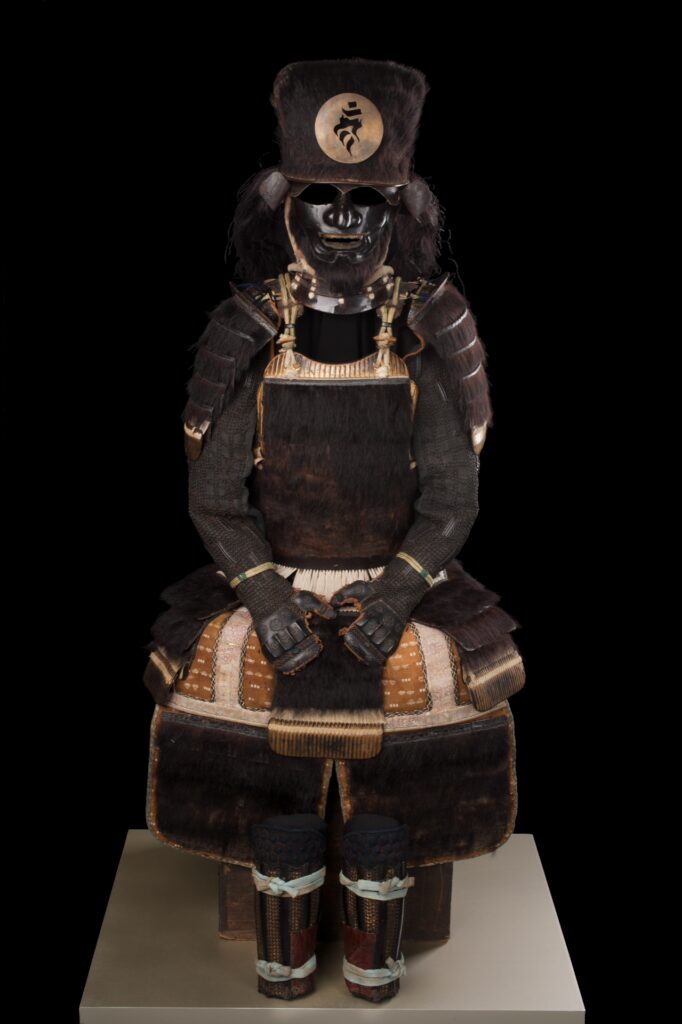
The Bearskin: More Than Decoration
The bearskin on some samurai armours is symbolism with a practical core. In the Sengoku period, when battles increasingly took place in smoke, dust and chaos, being recognisable became a question of survival. A commander who was not recognised by his troops could not lead. Unusual materials — bearskin, deer antlers as helmet ornaments — made leaders unmistakable on the battlefield.
The bearskin also had a second meaning: it signalled strength and rawness. In an aesthetic that favoured dignity and distance, the bearskin was a deliberate provocation — the message: I am the one you should be afraid of.
Absolon describes how the fur added the advantage of being waterproof: metal armour is prone to rust in the humid Japanese climate; a fur covering protects the metal structure underneath from direct rain.[1]
The Myōchin School and the Tōsei Gusoku
The Myōchin school began as helmet specialists (kabuto-shi) in the Heian period and developed over the centuries into generalists for all armour components. In the Sengoku period, Myōchin armours were so well known for their quality that patrons ordered them from all over Japan. Their characteristic trademark: the suji-kabuto (ribbed helmet) with clearly visible ridges between the plates — a construction technique that strengthened the helmet bowl and at the same time served as a distinguishing feature.
In the Edo period, the Myōchin school also produced ō-yoroi reproductions. The ability to master both armour styles — the archaic ō-yoroi and the modern tōsei gusoku — was proof of quality par excellence.
Weight and Mobility: The Comparison with Europe
A common misconception: Japanese armour was much lighter than European armour.
Absolon corrects this with data: a complete tōsei gusoku could weigh 20 to 25 kilograms — comparable to European field armour of the 16th century. The difference lay in the weight distribution: European plate armour concentrated the weight on the shoulders and chest; the Japanese construction with hip armour and hinge technology distributed the weight more onto the hips and allowed better mobility.[1]
This meant that a tōsei gusoku allowed movements that were impossible in heavy European armour. Knee bends, rapid mounting and dismounting, narrow passages in castles — the Japanese construction was optimised for the warfare of the 16th century.
Okashi Gusoku: Armour for the Masses
Alongside the high-quality individual armours for samurai commanders, a system of mass supply emerged in the Sengoku period.
Okashi gusoku — loan armours from the lord’s armoury — were lent to ashigaru (foot soldiers) when they went to war. These armours were more simply constructed and less elaborately decorated, but similar in their essential protective functions. Okashi gusoku was war equipment; the personal armour of a daimyō was a work of art and a statement of status at the same time.[4]
This democratisation of armour protection was one of the profound changes of the Sengoku period. In the Heian period, full armour was the privilege of the upper class. In the 16th century, every foot soldier in a modern army wore at least basic protection.
The Sengoku Period as an Armour Laboratory
The Sengoku period (1467–1615) was the most intensive laboratory of armour development in Japanese history.
150 years of uninterrupted war — in Europe, that corresponds to the period from the Black Death to the Reformation. In this time, more armour was produced than in all previous eras combined. Craftsmen who originally had other specialisms entered armour production and destroyed the monopoly of the traditional armourers.[4] The result was a democratisation of armour quality — and an acceleration of innovation.
While the ō-yoroi is magnificent and complex, with hundreds of individual elements and elaborate lacing systems, the tōsei gusoku is plain, with clear surfaces and practical construction.
Nanban Dō: The European Influence
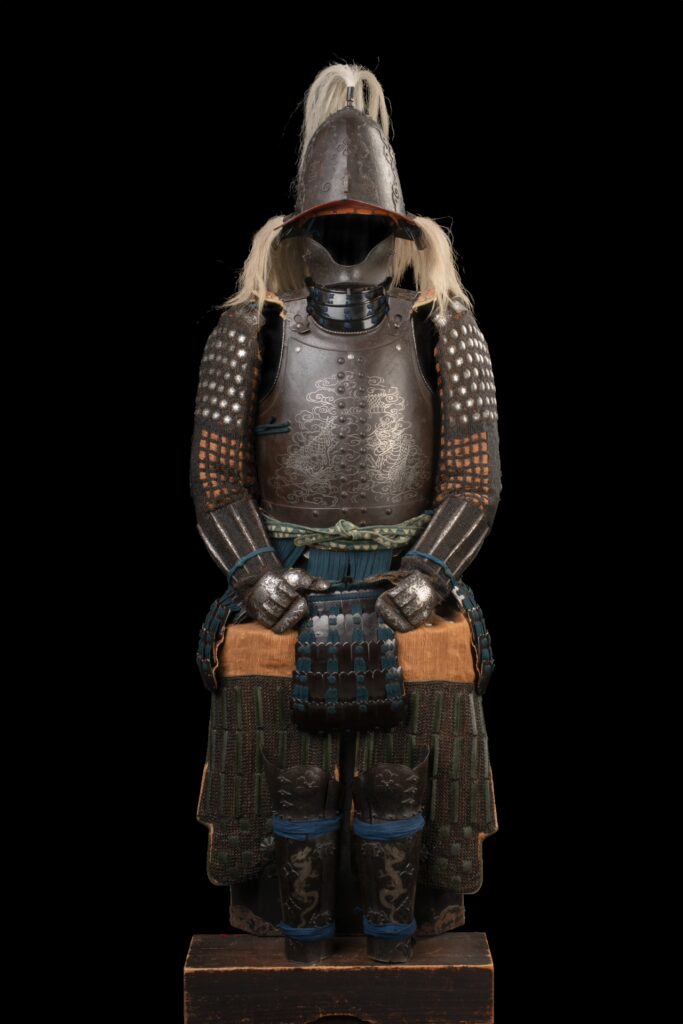
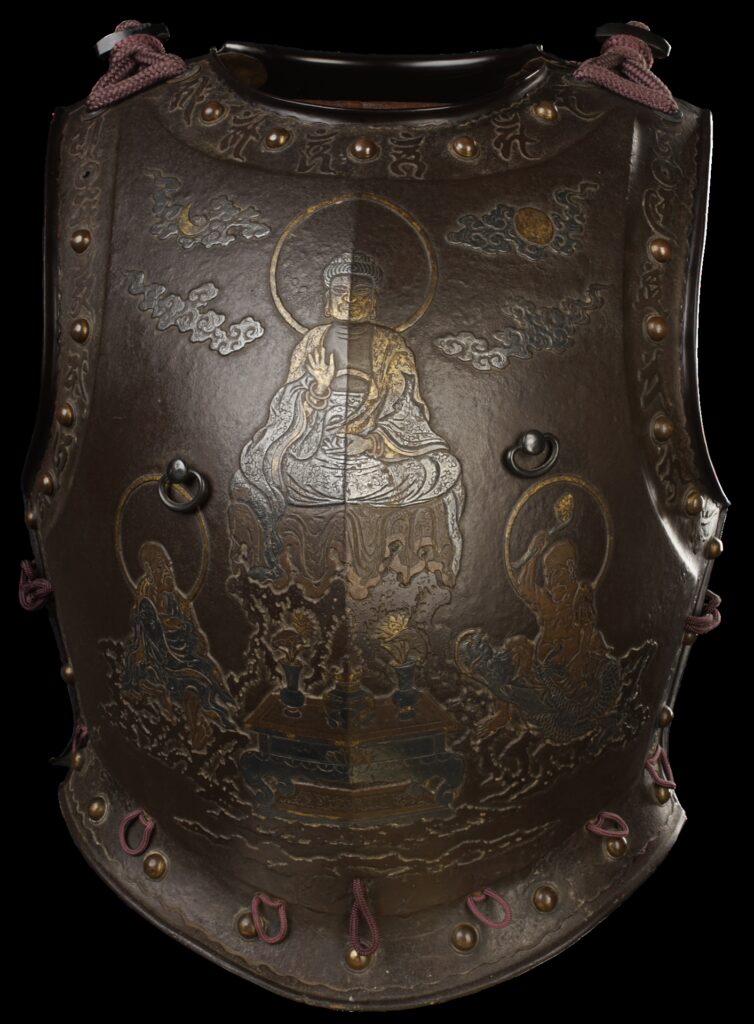
With the trade that brought the arquebus to Japan came another armour design as well: the nanban dō — the “southern barbarian cuirass”.
Portuguese and Spanish traders wore European breastplates with the characteristic central ridge, which deflected projectiles better. Japanese smiths copied this form — and developed the nanban dō from it: a cuirass with a central ridge that combined both the Japanese craft tradition and the European principle of deflection.
Japanese smiths copied the ridge to deflect bullets, proving their adaptability to foreign tech.” (Absolon 2017, p. 685 — paraphrased)[1]
Kawari Kabuto: The Helmet of the Tōsei Gusoku
The tōsei gusoku would be incomplete without its helmet — and the helmet of the Sengoku period is as characteristic as the cuirass.
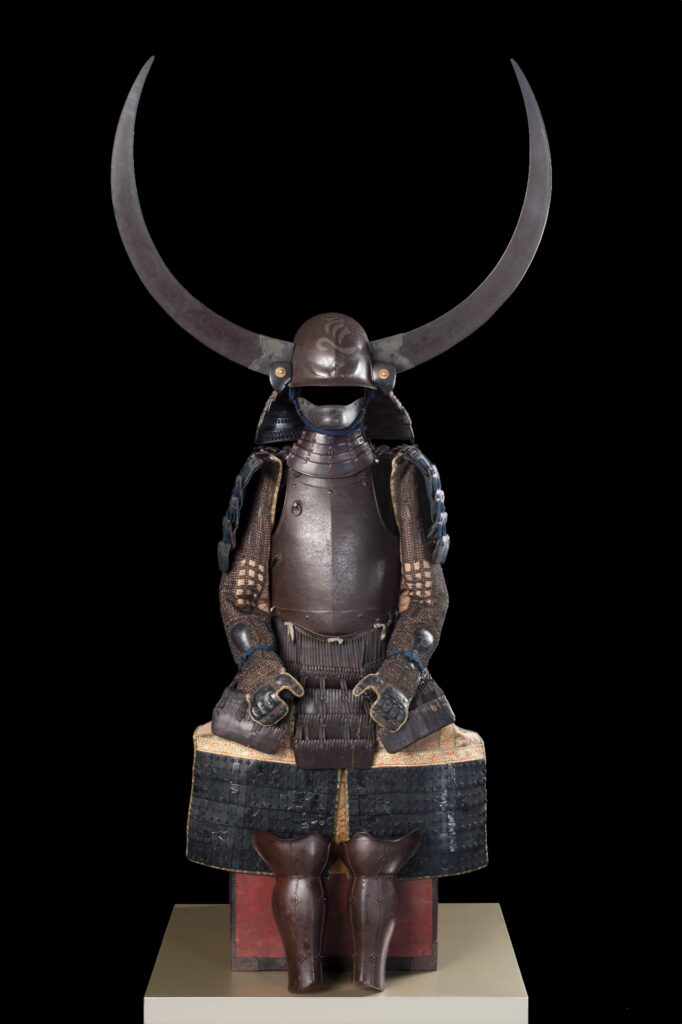
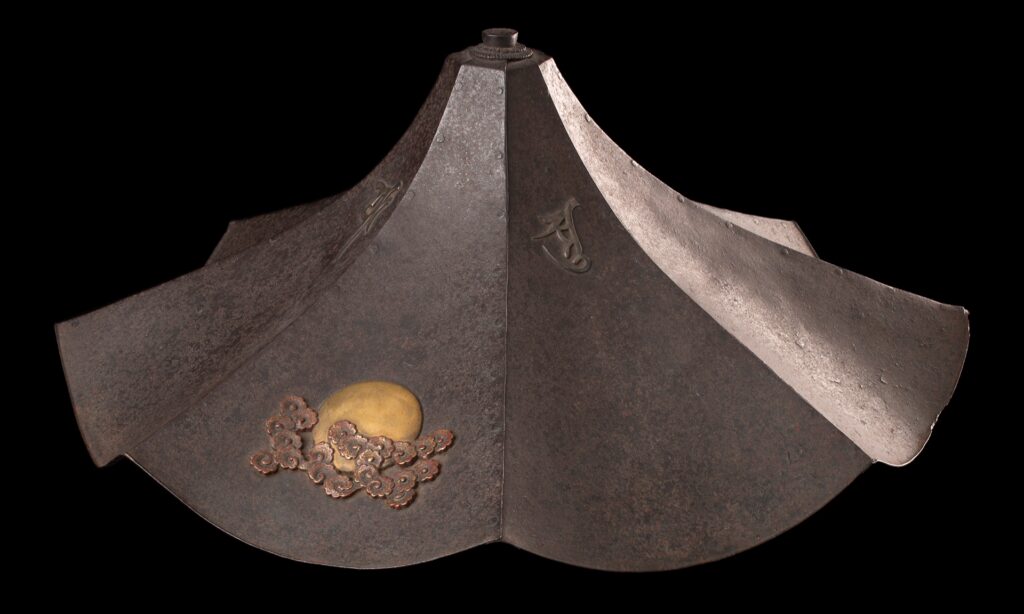
The kawari kabuto — the “extraordinary helmet” — is the most theatrical element of the tōsei gusoku aesthetic. Deer antlers made of leather or wood, gilded shell shapes, huge fan attachments, animal motifs of lacquered paper — the kawari kabuto of the Sengoku period are the most intense expression of the basara aesthetic: deliberate over-staging at a time when old norms no longer applied.
The purpose was pragmatic: recognisability on the battlefield. When thousands of warriors fight in similar armour, the commander becomes invisible. An unmistakable helmet — two-metre-high stylised bull’s horns, a huge golden sun-disc attachment — made the leader instantly identifiable to his troops.
Conclusion: Innovation Born of Necessity
What the Japanese armourers achieved in just a few decades was remarkable: they discarded a system that had worked for seven centuries and developed a new one — with solid iron plates, hinge technology and tameshi test protocols. Technically, the tōsei gusoku of the Sengoku period was on a par with European armour of the same period.
Frequently Asked Questions about the Tōsei Gusoku
What does tōsei gusoku mean?
Literally “contemporary complete armour”. The term refers to the modern plate armours of the 16th and 17th centuries, which replaced the lamellar systems of the ō-yoroi.
Why was the ō-yoroi replaced by the tōsei gusoku?
Primarily because of the introduction of the arquebus (1543): lamellar armour did not offer sufficient protection against lead bullets. At the same time, warfare changed from mounted single combatants to mass infantry — which required a lighter, more mobile construction.
What is tameshi gusoku?
Bullet-tested armour. The smith fired at the finished cuirass and documented the result on the inside. If the plate held, it was considered bulletproof.
How heavy was a tōsei gusoku?
20 to 25 kilograms — comparable to European field armour. The weight distribution, however, was different: instead of being concentrated on the shoulders and chest, the weight was better distributed by the hip armour and hinged construction.
What is okashi gusoku?
Loan armour from a lord’s armoury, lent to ashigaru (foot soldiers). More simply constructed than personal samurai armour, but similar in its protective functions. The mass supply of armour was an innovation of the Sengoku period.
Visit the Samurai Museum Berlin
The Samurai Museum Berlin shows a complete Sengoku-period tōsei gusoku with black bearskin — solid iron plates, hinged construction, an armour concept for the age of firearms. Open daily from 10 a.m. to 7 p.m., Auguststraße 68, Berlin-Mitte.
Related Articles
- Ō-Yoroi: The Great Armour of the Heian Samurai
- Dō: The Cuirass of the Samurai
- Kabuto: The Helmet of the Samurai
- Sengoku Jidai: The Age of Warring Provinces
Sources and Further Reading
- [1] Absolon, Trevor (2017). Samurai Armour, Volume I: The Japanese Cuirass. Osprey Publishing. Used: tameshi gusoku (p. 310), hinge technology (p. 401), weight (p. 200), function of the bearskin, Myōchin school.
- [2] Sakakibara Kōzan (1800/1962). The Manufacture of Armour and Helmets. Translated by Robinson. Used: tōsei gusoku construction, smithing schools.
- [3] Turnbull, Stephen (2022). War in Japan 1467–1615. Osprey Publishing. Used: development of Sengoku armour, the arquebus and the adaptation of armour (pp. 56–60).
- [4] Samurai Museum Berlin (2021). Armours of the Samurai. Display case C16V (tōsei gusoku with bearskin, 16th c.); display case C20V (tameshi gusoku); SMB text on tōsei gusoku (K. Ogorek).
© Samurai Museum Berlin – All rights reserved
You might also like
Kabuto: The Helmet of the Samurai – History & Construction
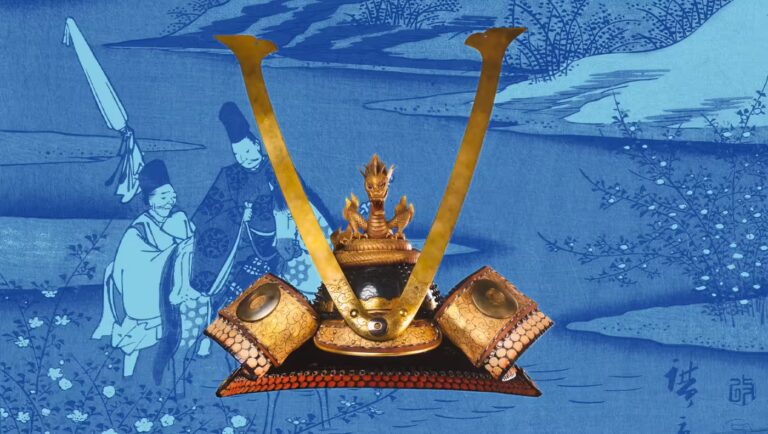
The kabuto – protection, identity, and work of art in one. History, anatomy & smithing traditions of the samurai helmet.…
Read the article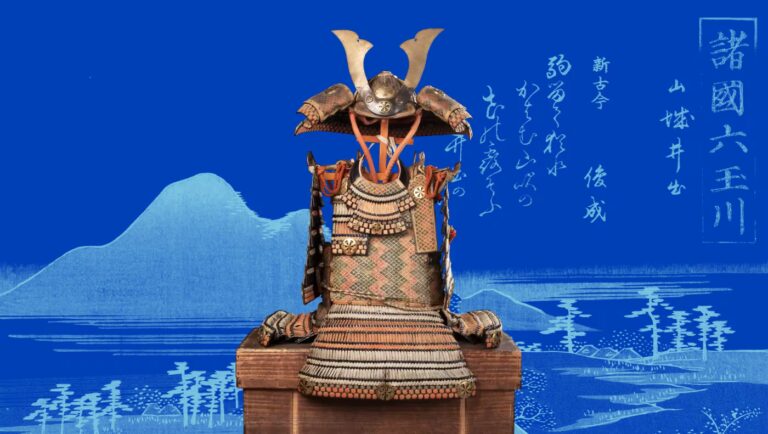
Ō-Yoroi: The Great Armour of the Heian Samurai
Ō-Yoroi – the great armour of the Heian samurai. Not decoration, but a machine for the mounted archer. History &…
Read the article
Tachi: The Magnificent Long Sword of the Heian Samurai
The tachi – the long sword of the Heian samurai. History, manner of wear, gokaden & the path to the…
Read the article