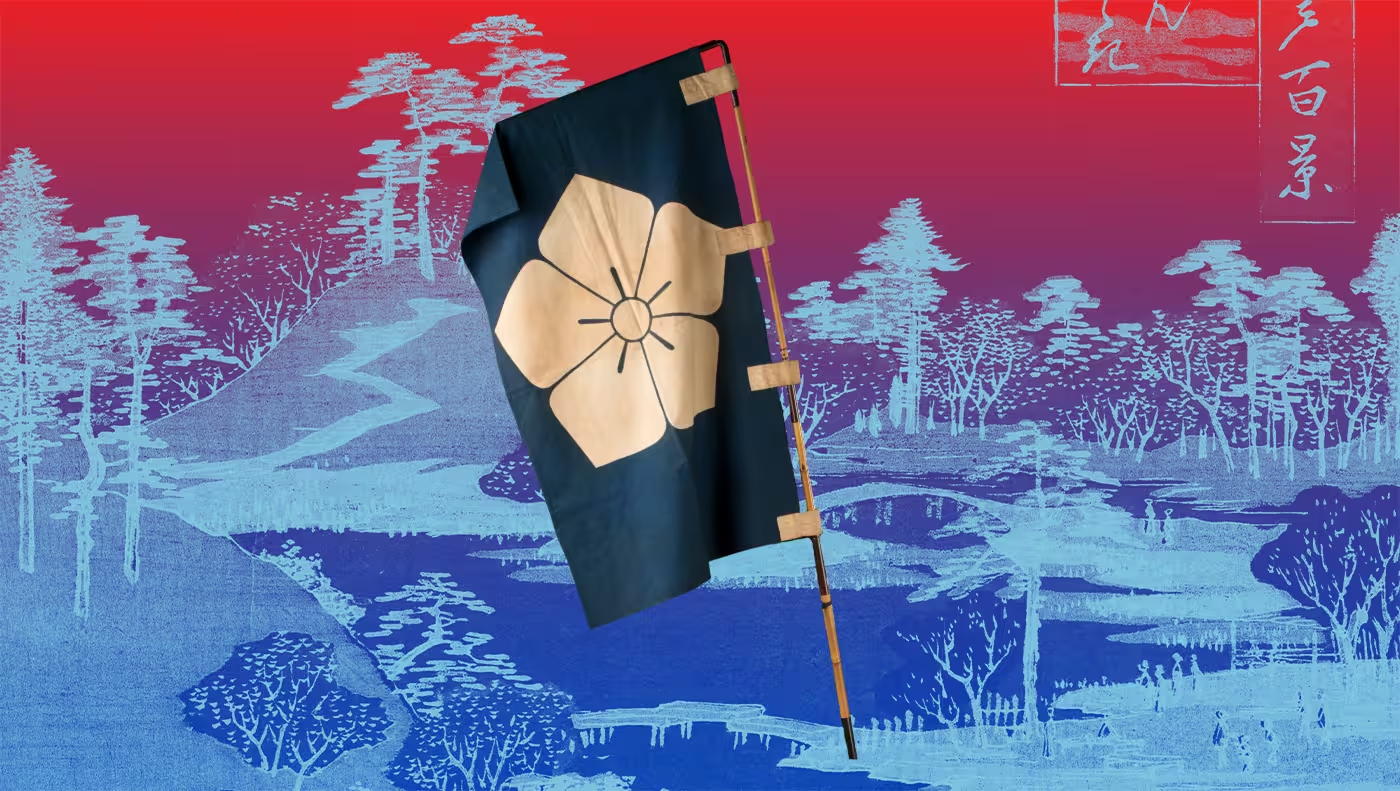
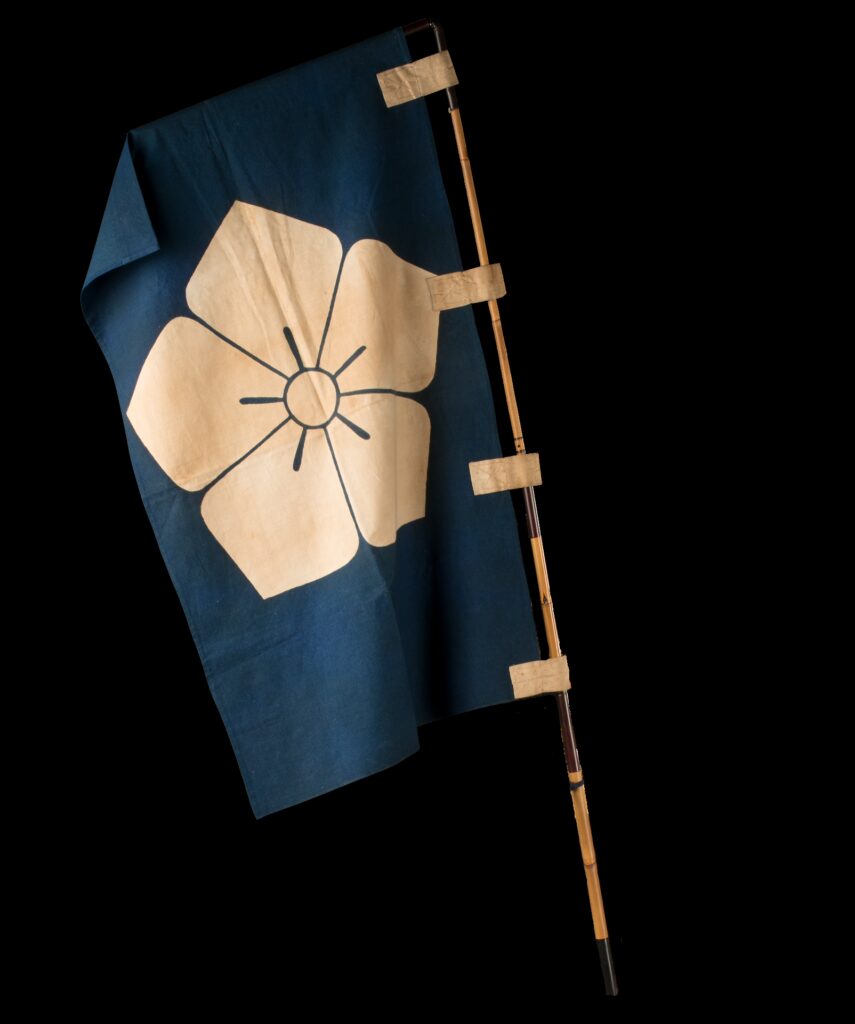
The Battle of Nagashino in 1575 took place on a narrow river plain. Oda Nobunaga had gathered tens of thousands of warriors under his banner; Takeda Katsuyori led one of the most feared cavalry armies in Japan. As the Takeda cavalry raced across the plain, an observer on a command hill saw not individual riders, but a billowing forest. Above every single suit of armour fluttered a narrow banner — red, violet, black, bearing the crests of the respective unit. The Takeda army was not merely a collection of warriors; it was a visibly structured formation in which every warrior was assigned, by his back banner, to a particular unit, a particular commander, a particular clan. This system had a name: sashimono.
Without sashimono, the great battles of the Sengoku period could not have been fought the way they were. The armies of the late Muromachi and Sengoku periods had grown to a size previously unknown in Japan. Ten, twenty, thirty thousand warriors faced each other in the great battles. Among thousands of samurai, ashigaru foot soldiers, spearmen and arquebusiers, how was anyone to recognise who belonged to his own side? How was the commander on his observation hill to follow the movements of his own units? The answer was the back banner. Warriors wore on their backs a narrow, rectangular banner fixed to a bamboo pole in a special holder on the armour. This banner displayed the crest (kamon) of the respective clan or liege lord.
This article reconstructs the sashimono as a technical system, as an instrument of military command and as a visual identifying mark of Japanese warrior culture. It shows how a pragmatic answer to the organisational problem of mass armies became a highly symbolic object — banners that provided orientation on the battlefield and at the same time condensed the entire emotional, religious and political significance of a clan into a single piece of silk. The surviving examples at the Samurai Museum Berlin — from the Hachisuka manji and the Katō Kiyomasa snake’s eye to further examples — document this system in all its variety.
What Is a Sashimono?
The word sashimono (指物) is made up of two elements: sashi (指, “to insert” or “to point”) and mono (物, “thing”). The sashimono is a visual identifying mark intended to make it possible to identify the wearer on the battlefield.[1]
In its standard form, a sashimono was a rectangular banner of silk or linen attached to a bamboo pole. The dimensions varied, but were typically in the range of 50 to 80 centimetres in height and 25 to 40 centimetres in width. The bamboo pole extended beyond the top edge of the banner — often by a further 20 to 40 centimetres — and was inserted into a special holder on the back of the armour.
This holder consisted of two structural elements. The gattari was a metal hook or ring attached to the upper edge of the back plate, which received the upper end of the bamboo pole. The machi uke was a tube or socket at the lower edge of the back plate into which the lower end of the pole was inserted. Together, gattari and machi uke held the pole upright behind the wearer’s back, so that the banner could fly stably above the samurai’s head.[2]
The armours of the late Muromachi period (16th century) were already equipped with these holders as standard. This shows how closely the sashimono tradition was interwoven with the evolution of armour technology. The sashimono is not an arbitrarily attached accessory, but an integral part of the armour system of the Sengoku period. Anyone who imagines an armour of this period without a sashimono holder does not imagine the armour completely.
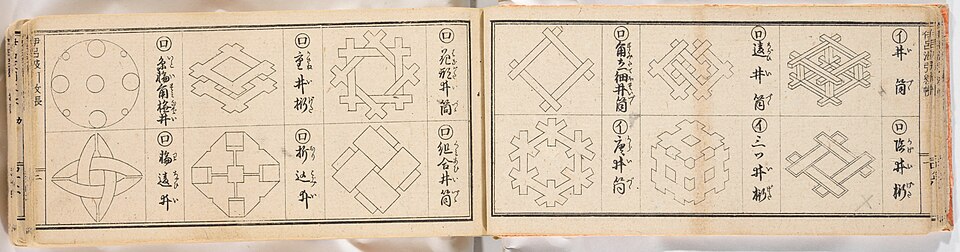
The banner itself bore the insignia of the samurai or his liege lord. Most common was the wearer’s personal family crest (kamon) or the crest of his daimyō. Alongside these, surviving sashimono also bear religious inscriptions, depictions of Buddhist and Shintō deities, bonji (Sanskrit characters), stylised animals and geometric patterns. The design was individual — each clan, sometimes each unit, developed its own banner designs, which were instantly recognisable to the initiated.
An important distinction: the sashimono was the personal back banner of an individual warrior. In parallel, there were larger forms of banner that were carried not on the back but in larger holders by standard bearers. The nobori was an upright long flag carried by a combatant assigned to the task. The uma-jirushi was a large, often three-dimensional standard of the daimyō himself, set up at the command post or carried by an attendant. Sashimono, nobori and uma-jirushi together formed a hierarchically graded system of visual marking on the battlefield — from the individual warrior to the commander-in-chief.
Born of the Organisational Problem of Mass Armies
The Sengoku period (1467–1615) brought with it a transformation of Japanese warfare whose depth is often underestimated. The earlier wars of the Heian and Kamakura periods had primarily been levies of mounted elite warriors. Individual samurai went into battle with their personal retainers, often fought man to man, and identified one another by personal calls and by the individual design of their armour. The armies were small, the combatants knew each other by name, and the organisation could remain informal.
The civil wars of the Sengoku period changed this fundamentally. The daimyō systematically armed their provinces. Ashigaru foot soldiers — peasants and ordinary warriors, recruited en masse and armed with spears or later with arquebuses — formed the backbone of the new armies. Army sizes grew dramatically. Where a Kamakura-period commander might have commanded 500 or 1,000 warriors, a Sengoku daimyō led ten or twenty thousand men into the field. At the Battle of Sekigahara (1600), an estimated 80,000 to 100,000 warriors faced each other on both sides.[3]
Under these conditions, identification on the battlefield became an acute problem. In a crush of thousands of uniformly armoured ashigaru, amid gunpowder smoke, clouds of dust and the chaos of close combat, it was hardly possible any more to tell friend from foe spontaneously. The solution had to be systematic. For this purpose, sashimono were used — banners attached with poles to the back of the armour and showing the crests of the clans. Sashimono were worn both by the foot soldiers (ashigaru) and by higher-ranking samurai.[4]
This universality — from the simple peasant soldier to the high-ranking samurai — was new and characteristic of the sashimono system. Earlier identification practices had mainly distinguished the elite; the mass of ordinary combatants was often barely marked. The sashimono brought visual codification down to the lowest level of the military hierarchy. An ashigaru wearing his daimyō’s sashimono could be clearly assigned by his commander and clearly recognised as “hostile” by the enemy.
The development proceeded in several stages. Earlier forms were still improvised — individual warriors carried banners or pennants, often in different shapes and sizes. In the course of the 16th century, the great daimyō houses increasingly standardised their sashimono systems. The banners were made in a uniform size and shape, the colours and crests were fixed for each clan, and the holders (gattari and machi uke) were built into newly produced armours as standard equipment.
Oda Nobunaga is regarded as one of the commanders who used this system particularly systematically. His troops wore not only uniform sashimono, but also colour-coded armour parts for different units — an early form of the uniformed army, which made command on the battlefield considerably easier. Toyotomi Hideyoshi and Tokugawa Ieyasu continued this systematisation.
The Kamon and Their Bearers — Two Examples
The significance of a sashimono lay not only in its military function, but also in its symbolic content. Every kamon carried a story — family tradition, political alliances, religious references, sometimes the personal biography of a famous commander. Two examples from the collection of the Samurai Museum Berlin illustrate this dimension particularly clearly.
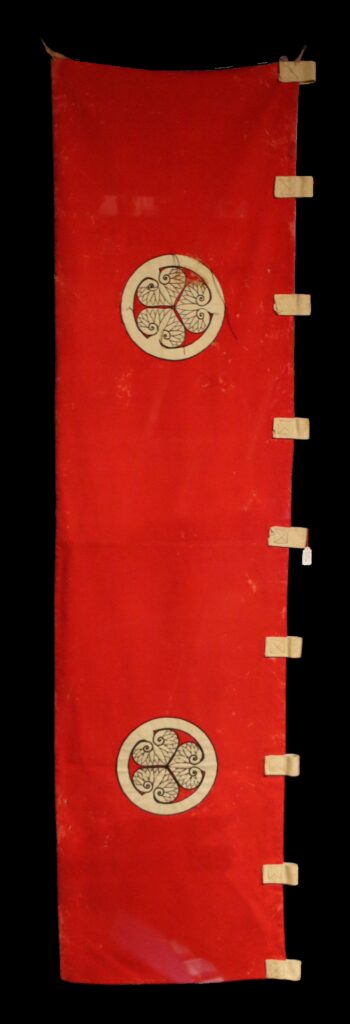
The Hachisuka sashimono shows a black swastika (manji) in a ring on red silk. The banner ends in two black stripes. The manji crest was the kamon of the Hachisuka clan, which resided in Awa Province (today Tokushima Prefecture on the island of Shikoku). The Hachisuka were originally vassals of Toyotomi Hideyoshi; after his death they joined Tokugawa Ieyasu and fought on his side at Sekigahara. For this they were confirmed as tozama daimyō and kept their province. The manji — in Buddhist traditions a symbol of eternal peace — was their identifying mark on the battlefield, in processions, on banners and also on armour parts.[5]
The choice of motif is revealing. The manji is a Buddhist symbol that for centuries in East Asia stood for good fortune, well-being and spiritual perfection. With their kamon, the Hachisuka thus signalled not only their family identity, but also a religious and cultural self-positioning. The manji in the ring was a promise: the warrior who carried this banner fought under the protection of Buddhist principles.
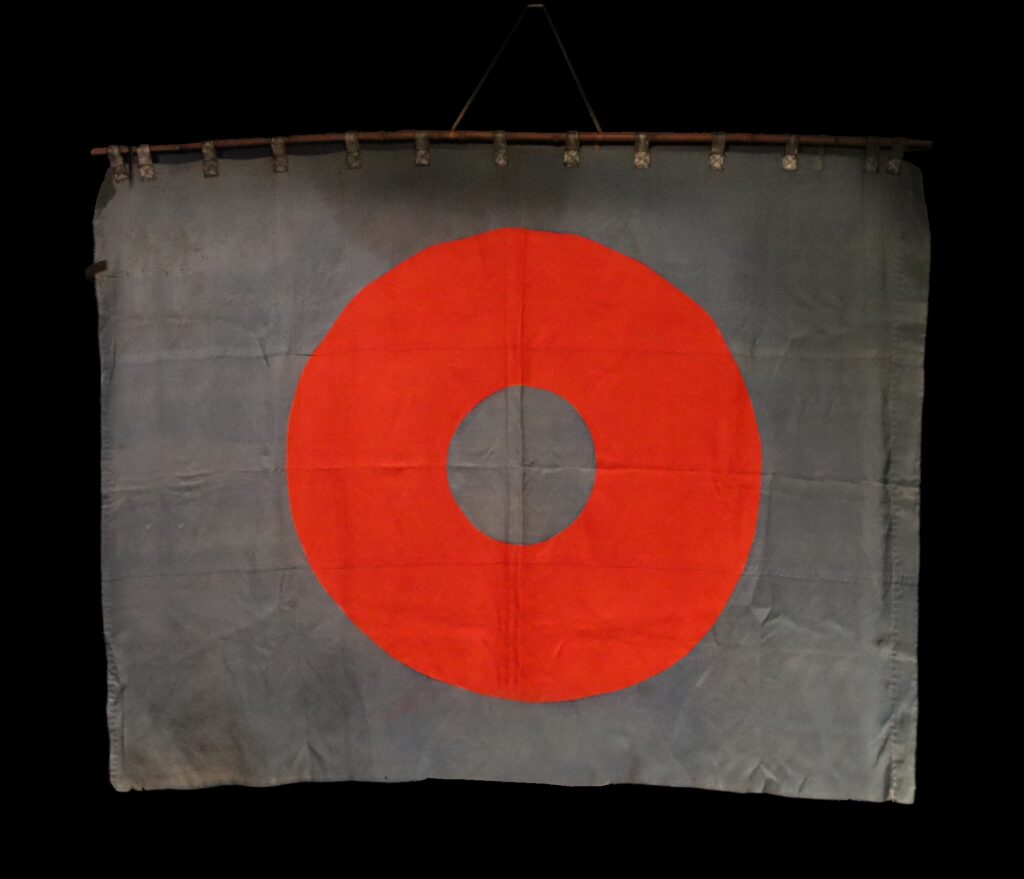
The Katō Kiyomasa sashimono is one of the most historically charged examples in the collection. The silk bears a ring motif — the janome crest, the “snake’s eye” used by the Katō clan. The best-known member of this clan was Katō Kiyomasa (1561–1611), a daimyō who had married into the close family of the second unifier of the realm, Toyotomi Hideyoshi (1536–1598), and was one of the principal military figures of the late Sengoku and early Edo periods.[6]
Kiyomasa became particularly well known for his role in the Korean campaigns of 1594 and 1598. As one of Hideyoshi’s most important commanders in this enormous invasion, he built fortresses on the Korean mainland and coordinated the operations of his troops. He became legendary through his tiger hunts during these campaigns — Japanese tradition tells that Kiyomasa personally killed several tigers, a detail taken up again and again in later depictions. Portraits and ukiyo-e prints frequently show him fighting a tiger. The janome sashimono with the ring on a light background is the visual trademark of this warrior — a banner that signalled the presence of the Katō troops in Korea and in later battles on the battlefields of Japan.
These two examples — Hachisuka and Katō — show the range of the sashimono tradition. One bears a religious, Buddhist motif; the other a geometric sign that may refer to a mythological animal (the snake). One belongs to a tozama daimyō who secured his place in the Tokugawa system; the other to a commander linked to the Toyotomi, whose military career culminated on the Korean mainland. Each sashimono condensed a story — family origins, political loyalty, religious attitude, military tradition — into a single textile object.
Motifs and Their Meaning — The Semiotics of the Back Banners
The motifs on sashimono banners followed conventions that developed over centuries and allowed an experienced observer to draw detailed conclusions about the wearer. This semiotic dimension made the sashimono more than a mere instrument of identification — it was a condensed expression of identity, alliance and ideological position.
Family crests (kamon) formed the core of the repertoire of motifs. The Japanese kamon system was and is highly differentiated; an estimated several thousand different family crests existed in the Edo period. The great clans often had several variants of their main crest — the primary crest for official occasions, secondary crests for different branches of the family, simplified versions for mass use on the sashimono of ashigaru troops. The Tokugawa used the aoi (hollyhock); the Toyotomi the kiri (paulownia leaf); the Oda the mokkō (quince blossom); the Takeda the bishimon (four lozenges); the Mōri three circles — to name just a few of the famous examples.
Religious motifs were widespread. Buddhist bonji — Sanskrit syllables standing for particular deities — were embroidered or painted on sashimono. Namu Amida Butsu (“Homage to Amida Buddha”) was a common inscription, especially on the sashimono of the Ikkō-ikki, the militant Buddhist lay movement that rose up against feudal rule in the Sengoku period. Myōhō Renge Kyō (“Mystic Law of the Lotus Sutra”) was the characteristic inscription of the followers of Nichiren. Kuroda Nagamasa and other Christian daimyō at times bore crosses on their banners — a phenomenon that disappeared again, however, with the persecutions of Christians in the early Edo period.
Mythological and animal motifs are common. Dragons as symbols of imperial power and cosmic order; tigers as signs of strength and protection (particularly widespread after the Korean campaigns, through which the tiger acquired special significance in Japanese samurai iconography); cranes for longevity and good fortune; tiger sharks; mythological creatures such as tengu or shishi. The choice of these motifs was not arbitrary, but followed family traditions or the personal preferences of the wearer.
Geometric patterns were particularly widespread on the sashimono of ordinary troops, because they could be made quickly and in large numbers. Rings, circles, crosses, striped patterns — all of these could serve as clan identification. The janome motif of the Katō clan is an example: a simple ring on a light background, easy to produce, visible from afar, unmistakably identifiable as the Katō crest.
Textual messages — short sayings or inscriptions — are found on some sashimono. These could contain motivating formulas (“victory in a hundred battles”), religious petitions, the abbreviation of the commander’s name or cryptic maxims from the Chinese classics. Particularly prominent was Uesugi Kenshin’s sashimono with the character Bishamon — for the Buddhist war god Bishamonten, whose protection Kenshin claimed for himself.
The legibility of a sashimono could not be taken for granted. For an initiate, a banner with a manji in a ring was instantly recognisable as the Hachisuka sign, a janome as the Katō marking. For a stranger or an enemy warrior from another province, the same banner could remain a mystery. Sashimono semiotics were differentiated by region and clan; full knowledge of them required years of familiarity with the military and political topography of Japan.
Craft and Material — How a Sashimono Was Made
Making a sashimono combined several craft traditions: textile weaving, dyeing, embroidery, bamboo work and metal fittings. A high-quality sashimono was therefore not a simple product, but the joint work of several specialists.
The basis was the fabric. Silk banners were the most expensive and elaborate examples — for high-ranking samurai and for ceremonial occasions. The Hachisuka and Katō sashimono at the Samurai Museum Berlin are both made of silk. Silk had several advantages: it took dyes well and allowed intense, luminous colours; it fluttered in the wind in a characteristic, light way; and it lasted for generations if carefully stored. For ordinary troops and the mass production of ashigaru sashimono, linen or coarse cotton was often used — more robust and cheaper, but less representative.
The dyeing followed the established traditions of Japanese textile dyeing. Red from sappanwood or safflower; blue from indigo; black from cuttlefish ink or iron mordant; gold by applying gold leaf or by gold-thread embroidery. In samurai iconography, the colours were partly tied to meanings — red for courage and life, white for purity and mourning (in the case of mourning sashimono for fallen comrades), black for dignity and steadfastness, gold for majesty.
The crests could be applied to the fabric in various ways. With simple, geometric motifs, the contrast was achieved by resist techniques (shibori) or by direct application — on the Hachisuka sashimono, the black swastika is applied directly to the red silk, probably by a combination of stencil printing and hand-painted retouching. More elaborate designs used embroidery — gold threads (kinran) for high-quality examples, coloured silk yarns for medium qualities, simple cotton threads for mass-produced goods. On the most sophisticated pieces, appliqué was used — separate pieces of fabric were cut out and sewn onto the banner, a technique that made three-dimensional relief effects possible.
The bamboo pole was a craft element in its own right. High-quality battle bamboo had to be long (for sufficient height above the helmet), straight (for stable attachment in the gattari and machi uke) and light (so as not to upset the balance of the armour). The ends were often reinforced with metal ferrules that matched the armour fittings in colour and material.
Attachment to the armour was by the gattari–machi uke system already described. Both holders had to be robust enough to hold the bamboo pole even under the stresses of combat. Losing a sashimono in battle was a catastrophe for the wearer — his commander could no longer identify him, his own unit could no longer recognise him, and he became anonymous in the chaos of the battle crush. Surviving armours therefore often show very carefully made holders that offer several fixing points to prevent accidental loosening.
Some particularly unusual sashimono used three-dimensional elements — carved wooden objects, metal decorations, even living or dried plants. Uma-jirushi (the great standards of the commanders) were often fully three-dimensional; there were experiments at the level of the individual sashimono too. Takeda Shingen had some of his elite soldiers equipped with three-dimensional sashimono that produced complex optical effects in the wind.
From Battlefield to Ceremony — The Edo Transformation
With the end of the great battles after 1615, the sashimono lost its original military function. The Pax Tokugawa brought 265 years of domestic peace — no more large-scale campaigns, no mass armies, no acute need for visual identification in combat. The back banners were not discarded, however. They were transformed — into ceremonial objects of a samurai culture that increasingly stylised itself as a historical phenomenon.
In sankin-kōtai processions — the alternating movements of residence of the daimyō between their provinces and Edo, which shaped all traffic on the Tōkaidō and Nakasendō highways — sashimono were a central visual element. A large procession could consist of several thousand people; at its head and in important positions, the samurai attendants wore their back banners, so that observers could immediately see which clan the passing combatants belonged to. The pomp of these processions was an important political instrument of the Tokugawa — they demonstrated the integration of the daimyō into the centralised system, while at the same time passing the enormous costs of this system on to the provinces.
At military parades, guard duty at castle gates, receptions and ceremonies in the shōgun’s palace, sashimono played a representative role. The Edo-period examples are often even more elaborately made than their Sengoku predecessors; military robustness receded and ceremonial elegance came to the fore. Finer silks, more artful embroidery, more elaborate fittings — all of this shows the transformation from object of use to object of splendour.
At the same time, the sashimono became a collector’s item. Samurai families preserved the banners of their ancestors; the treasuries of the daimyō houses held hundreds, sometimes thousands, of banners from different generations and different branches of the family. These collections documented the history of the clan and were displayed on special occasions — New Year celebrations, commemorative ceremonies, family festivities.
The fire brigades (hikeshi) of the great Edo-period cities adopted elements of the sashimono tradition for their own purposes. The matoi — the often three-dimensional, elaborately designed standards of the hikeshi units — were functionally and aesthetically related to sashimono and uma-jirushi. These matoi served to mark the fire brigade unit so that it was visible from afar to colleagues and citizens, and at the same time to be a proud emblem of the respective district fire brigade. The sashimono idea — a visual sign rising vertically on a pole and signalling the allegiance of its bearer — thus had an effect far beyond samurai warrior culture.
The End and the Afterlife
With the Meiji Restoration in 1868, the world in which sashimono made sense came to an end. The dissolution of the samurai estate, the introduction of Western military uniforms on the Prussian and French models, the modernisation of warfare as a whole — all of this made the back banners obsolete within a few years. The great clan collections of the daimyō houses were incorporated into newly founded museums, sold to private collectors or — especially in the 1870s and 1880s — exported in considerable quantities to Europe and America.
The Japanese sashimono tradition nevertheless lived on in a few niches. The matoi of the urban fire brigades were carried well into the 20th century, and some fire brigade units still carry matoi symbolically in New Year parades and other ceremonies today. The banner tradition of Japanese festivals (matsuri) also preserves elements of the sashimono aesthetic, albeit in an entirely different context. In Japanese popular culture — films, anime, video games, taiga dramas about the Sengoku period — sashimono are ubiquitous; they are part of the basic visual equipment of any depiction of feudal Japan.
Scholarly study of sashimono as historical objects began in the 20th century. Japanese military historians documented the clan-specific kamon systems, assigned surviving banners to particular daimyō houses and reconstructed the typology of the various design forms. Western research came later and benefited particularly from the pieces preserved in European and American museum collections.
The Samurai Museum Berlin takes its place in this international research tradition. Its sashimono — Hachisuka, Katō Kiyomasa and further examples — make it possible to present the range of banner culture in its military, political and symbolic dimensions. Their presentation in the context of complete armours with their gattari–machi uke holders allows visitors to understand the original technical and functional embedding of the sashimono — not as an isolated textile object, but as an integral part of the armour system of the Sengoku and Edo periods.
Five Myths about Sashimono
Myth 1: “Sashimono were only for samurai officers.” In fact, even the simplest ashigaru foot soldiers wore sashimono. That was precisely the innovation of the Sengoku period: the systematic visual codification down to the lowest level of the military hierarchy. The sashimono of the ashigaru were usually plainer — simple kamon on linen or cotton instead of elaborate silk embroidery — but they served the same identification purpose as the officers’ banners.
Myth 2: “Every sashimono was made individually for its wearer.” The banners of high-ranking samurai were individual. Mass production for ashigaru troops, however, followed standardised patterns — the daimyō ordered hundreds or thousands of identical sashimono for his foot soldiers, usually with the uniform clan kamon. Individualisation existed above all at command level.
Myth 3: “Sashimono were a hindrance in close combat.” The banners were designed to interfere as little as possible in combat. The bamboo pole was light, the holder robust, and the banner flew behind the warrior’s back and hardly affected his movement in close-combat techniques. Problems could arise if the banner got caught on branches, walls or the enemy’s weapons — but on the whole the system was well thought out.
Myth 4: “Sashimono always showed the warrior’s own crest.” Often they showed the crest of the daimyō or immediate liege lord, not the warrior’s personal crest. An ashigaru usually had no kamon of his own; he carried his commander’s banner. Even high-ranking samurai displayed the clan crest instead of their personal sign in certain contexts (especially in the Korean campaigns and in formal battles).
Myth 5: “Sashimono disappeared with the Sengoku period.” They lost their military function with the end of the great battles, but as ceremonial and representative objects they continued to exist throughout the Edo period — in sankin-kōtai processions, military parades, fire brigade operations and festivals. Related traditions such as the matoi of the fire brigades or the banners of matsuri festivals live on to this day.
Conclusion: A Banner as Condensed History
The sashimono is more than an identifying mark. It is a compact expression of an entire era — of the Sengoku period with its mass armies and the urgent problem of creating any order at all within those masses; of the Edo period with its transformation from a military to a ceremonial system; of the Meiji period, which hastily shifted everything that remained of this world into museums. Every single banner that lies in a display case today is a material testimony to this threefold historical transformation.
The surviving sashimono make it possible to study this history not only in abstract terms, but in concrete form. The red manji of the Hachisuka clan tells of a tozama daimyō who had to realign and secure his political allegiance. The janome of Katō Kiyomasa recalls the Korean campaigns and a commander who fought on foreign soil and earned the legend of the tiger hunts. Each banner condenses a specific biography, a political constellation, a religious attitude, a military tradition.
Anyone looking at a sashimono should therefore not see only the textile object. They should imagine the battle plains of the late Sengoku period — with thousands of such banners fluttering in the wind, with commanders following the movements of their colour-coded troops from observation hills, with ashigaru advancing in dense formations, their daimyō’s banner on their backs. The samurai world without sashimono is an incomplete samurai world; only with the back banners does it become what it was — a highly organised, visually codified, intricately interwoven system in which every warrior carried his allegiance on his back and thereby became part of something greater.
Frequently Asked Questions
What is a sashimono?
A sashimono (指物) is a Japanese back banner worn by samurai and ashigaru foot soldiers during the Sengoku period (1467–1603) and the Edo period (1603–1868). It consisted of a rectangular fabric banner attached to a bamboo pole and inserted into a special holder (gattari and machi uke) on the back of the armour. The banner displayed the family crest (kamon) of the wearer or his daimyō, sometimes also religious motifs.
What was the function of the sashimono?
Its main function was the visual identification of the wearer on the battlefield. Because of the growing army sizes of the Sengoku period — sometimes over 50,000 warriors per side — without systematic marking it was hardly possible to tell friend from foe or to coordinate one’s own units. Sashimono enabled commanders to follow their troops from observation hills, and individual warriors to signal their allegiance clearly.
What is the difference between sashimono, nobori and uma-jirushi?
All three are Japanese forms of banner, but they differ in size and function. The sashimono is the personal back banner of an individual warrior. The nobori is a larger, upright long flag carried by a dedicated standard bearer. The uma-jirushi is the large, often three-dimensional personal standard of a daimyō, set up at the command post or carried by attendants. Together they formed a hierarchically graded visual system.
What motifs were depicted on sashimono?
Most commonly the family crest (kamon) of the warrior or his liege lord. Also Buddhist and Shintō motifs, Sanskrit characters (bonji), religious inscriptions such as “Namu Amida Butsu”, mythological animals (dragons, tigers, shishi) and geometric patterns. The motifs were semiotically charged — each referred to the family tradition, political alliance or religious position of the wearer.
Were ordinary soldiers allowed to wear sashimono too?
Yes. That was precisely the innovation of the Sengoku period: visual codification reached down to the lowest level of the military hierarchy. Even the ordinary ashigaru foot soldiers wore sashimono — usually in a plainer version of linen or cotton, often with the uniform clan crest of their daimyō rather than individual kamon.
What was the Katō Kiyomasa sashimono?
The sashimono of the Katō clan bore the janome motif — a ring (“snake’s eye”) on a silk ground. Its best-known wearer was Katō Kiyomasa (1561–1611), a daimyō and principal military figure of the late Sengoku period. He was related to Toyotomi Hideyoshi and became particularly well known for his role in the Korean campaigns of 1594 and 1598, where among other things he hunted tigers — a motif often taken up in later portraits.
Visit the Samurai Museum Berlin
The Samurai Museum Berlin shows several original sashimono from the late Muromachi and Edo periods — including the red Hachisuka manji sashimono and the Katō Kiyomasa janome sashimono. Their presentation in the context of complete armours with their gattari–machi uke holders allows visitors to study the back banners in their original technical and functional setting. Together with the kabuto, menpō and jinbaori of the collection, this provides a detailed picture of the complete visual equipment of the warrior in the Sengoku and Edo periods.
Related articles
- Tōsei Gusoku: The Bulletproof Armour of the Sengoku Era
- Kabuto: The Japanese Helmet
- Menpō: The Face Mask of the Samurai
- Jinbaori: The Armour Coat of the Samurai
- Katō Kiyomasa: The Tiger Hunter of Korea
- Battle of Sekigahara 1600
- Ashigaru: The Foot Soldiers of the Sengoku Armies
Sources and Further Reading
This article is based on academic research, primary sources and the expert catalogues of the Samurai Museum Berlin. All cited works are documented in the complete bibliography of the knowledge hub.
- [2] Turnbull, Stephen (2003). Japanese Warrior Monks: 949–1603. Osprey Publishing. [Used: Ikkō-ikki banners, religious motifs on sashimono]
- [3] Turnbull, Stephen (2022). War in Japan 1467–1615. Osprey Publishing. [Used: Sengoku army sizes, Battle of Sekigahara, Oda Nobunaga’s troop systems]
- [4] Conlan, Thomas (2022). Samurai and the Warrior Culture of Japan, 471–1877: A Sourcebook. Hackett Publishing. [Used: military organisation of the Sengoku period, ashigaru recruitment, command structures]
- [5] Hall, John Whitney (ed.) (1991). The Cambridge History of Japan, Vol. 4: Early Modern Japan. Cambridge University Press. [Used: tozama status of the Hachisuka, Tokugawa clan system, sankin-kōtai processions]
- [6] Berry, Mary Elizabeth (1982). Hideyoshi. Harvard University Press. [Used: Korean campaigns, Katō Kiyomasa’s military role, Toyotomi network]
- [7] Friday, Karl F. (2004). Samurai, Warfare and the State in Early Medieval Japan. Routledge. [Used: development of Japanese army organisation, continuity and change from the Middle Ages to the Sengoku period]
- [8] Absolon, Trevor (2017). Samurai Armour Vol. I: The Japanese Cuirass. Osprey Publishing. [Used: gattari and machi uke holders, technical integration of sashimono into armour systems]
Museum Catalogues and Expert Reports
- [9] Samurai Museum Berlin (2025). Exhibit Documentation — Sashimono and Banners. [Used: meaning of the Hachisuka manji, history of the Katō Kiyomasa janome, Edo-period banner transformations]
© Samurai Museum Berlin – All rights reserved
You might also like
Japanese Swordsmithing: How a Katana Is Made
Japanese swordsmithing: how a katana is made from black iron sand. Tamahagane, hamon & master smiths explained – with original…
Read the article
Tōsei Gusoku: The Bulletproof Armour of the Sengoku Era
The Tōsei Gusoku replaced the Ō-Yoroi after 1543. How iron plates and hinges answered the arquebus. With original exhibits at…
Read the article
Ō-Yoroi: The Great Armour of the Heian Samurai
Ō-Yoroi – the great armour of the Heian samurai. Not decoration, but a machine for the mounted archer. History &…
Read the article