 Nominated for the EMYA2026 award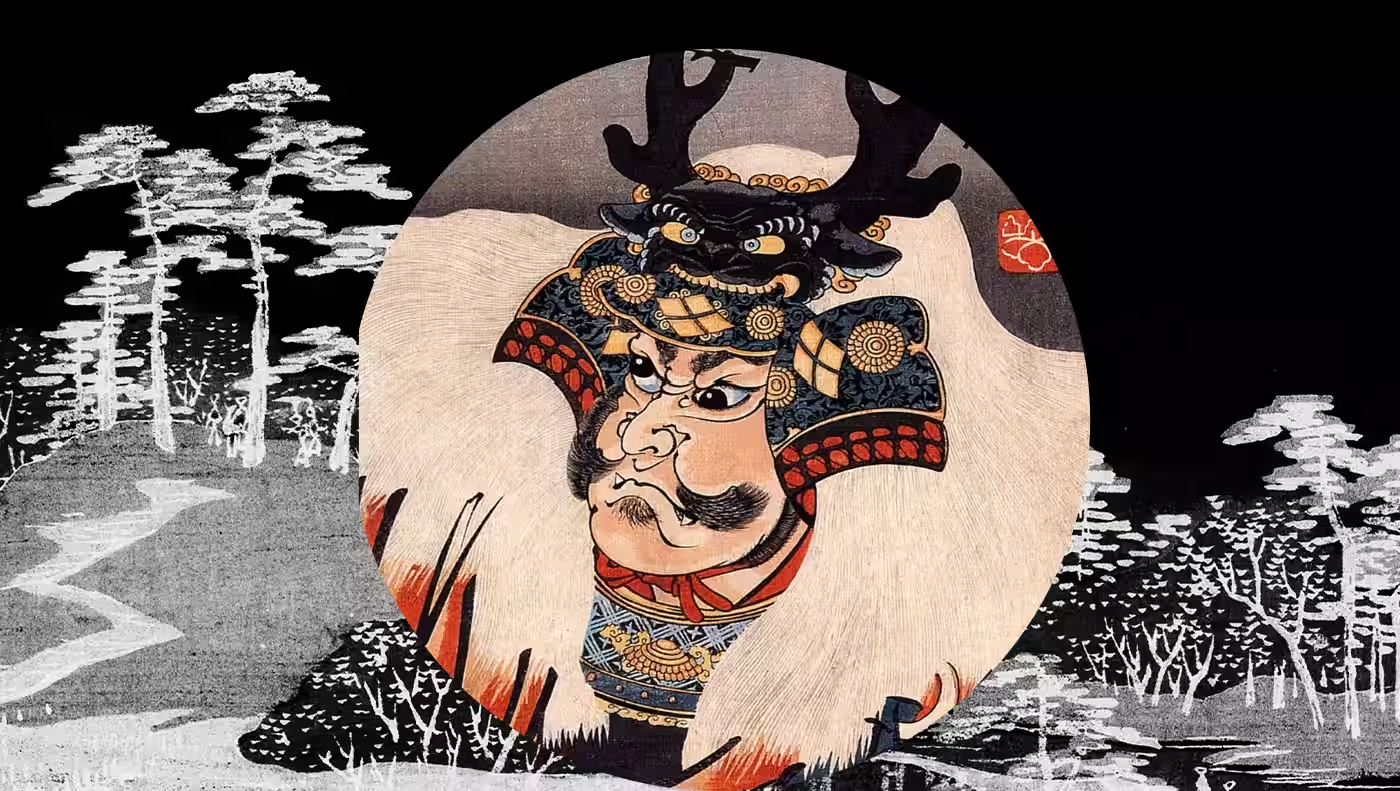
Takeda Shingen (武田信玄, 1521–1573) was one of the most powerful daimyō of the Sengoku period and is regarded as one of Japan’s greatest military geniuses. Under the epithet “Tiger of Kai” (甲斐の虎, Kai no Tora) he controlled the provinces of Kai, Shinano and parts of Kōzuke – despite a lack of access to the sea and barren soils. His legendary rivalry with Uesugi Kenshin, the “Dragon of Echigo”, shaped an entire era. Five times the two strategists faced each other in the battles of Kawanakajima, without either decisively defeating the other. Shingen revolutionized warfare through cavalry tactics, developed innovative administrative systems and left a legacy that deeply influenced even Tokugawa Ieyasu, the founder of the Tokugawa shogunate.
The Duel of Kawanakajima
18 October 1561, the fourth battle of Kawanakajima. Fog lies over the battlefield as Uesugi Kenshin’s vanguard unexpectedly breaks through the Takeda lines. Chaos. Screams. The clash of blades. The Uesugi samurai cut a bloody path straight to Shingen’s headquarters.
Then: a rider charges forward – Uesugi Kenshin himself. He draws his sword and attacks Shingen with three powerful strokes. Shingen does not reach for his sword. Instead he raises his tessen, an iron fan, and parries the blows. Once. Twice. On the third stroke the fan breaks. Kenshin withdraws before Shingen’s bodyguard can intervene.
So the legend tells it.
Historians such as Thomas Conlan doubt this scene – they hold it to be a literary fiction of later chronicles, a dramatized climax for war epics. Stephen Turnbull, by contrast, describes the event with the formulation “believed to have fought” – plausible, but not documented. What is certain: the fourth battle of Kawanakajima was the bloodiest of the five clashes between Shingen and Kenshin. Both sides lost thousands of warriors. Shingen lost two of his most important retainers that day: Yamamoto Kansuke, the brilliant strategist who had developed the famous “woodpecker tactic”, and Takeda Nobushige, Shingen’s younger brother.
In the end both armies withdrew. No victor. No loser. Only the dead.
The Rise of the Tiger
Rebellion Against the Father
Shingen was born on 1 December 1521 as Takeda Katsuchiyo (武田勝千代), the eldest son of the daimyō Takeda Nobutora. Even as a youth he showed talent: at just 15 he helped his father decisively to victory in a battle in 1536. At his coming of age he received the formal name Harunobu (晴信), which bore a character of the Ashikaga shōgun Yoshiharu – an honour that underscored his connection to the highest power in the land.
But the relationship with his father broke down. In 1540 Harunobu rebelled against Nobutora – a bloodless coup, supported by powerful vassals. The trigger: Nobutora had apparently planned to declare not his firstborn but the younger son Nobushige his heir. Harunobu acted quickly. He sent his father into exile in the province of Suruga, where Nobutora spent the rest of his life under the “care” of the Imagawa clan.
The Name “Shingen”
In 1559, at the age of 38, Harunobu entered a Buddhist monastery and received the dharma name Shingen (信玄). Formally his name remained Harunobu; in public, however, he became known from then on as Shingen. With the religious name also came an epithet that is associated with him to this day: “Kai no Tora” – the Tiger of Kai. His rival Uesugi Kenshin received the counterpart: “Dragon of Echigo”. The two epithets symbolized the duality of two powerful rulers who respected and fought one another.
Kai – The Province Without a Coast
Shingen’s homeland, the province of Kai (today Yamanashi Prefecture), was geographically disadvantaged. No coast, no harbours, no maritime trade routes. The land was mountainous, the soils barren. And the mountains yielded gold.
Shingen invested heavily in gold mining and used the revenues to build up his army. He had vast irrigation canals constructed, reformed the tax system, drafted new laws and made Kōfu the administrative centre. Unlike other daimyō, Shingen deliberately refrained from building a great fortress. His motto was: “My men are my fortress.”
The Conquest of Shinano
As soon as Shingen had taken control of the Takeda clan, he began in 1541 the systematic conquest of the neighbouring province of Shinano. The regional power-holders recognized the threat too late. When they suspected Shingen’s troops to be at Fuchu, they marched to the border of Kai – and walked straight into a trap. Shingen had not stationed his army at Fuchu but was waiting on the battlefield of Sezawa. The surprised opponents were crushingly defeated in 1542.
But in 1548 Shingen suffered his first serious setback. At the Battle of Uedahara, Murakami Yoshikiyo drove him back – Shingen lost two of his best generals. He took his revenge. The defeated clan leader fled northward to the province of Echigo, where he sought refuge – with a man who was to become Shingen’s greatest rival: Uesugi Kenshin.
Five Battles, One Rival
Between 1553 and 1564 the armies of Takeda Shingen and Uesugi Kenshin clashed five times at Kawanakajima. Five times both sides withdrew without either decisively defeating the other.
Turnbull describes the battles as “controlled skirmishes” – not total battles of annihilation but strategic positional struggles. Neither Shingen nor Kenshin was willing to stake everything on a single card. A lost battle could have meant the downfall of the entire clan.
The fourth battle (18 October 1561) was the exception. Shingen deployed the “woodpecker tactic”, developed by his strategist Yamamoto Kansuke: a detachment was to attack Kenshin’s troops from behind and drive them into the main force. But Kenshin saw through the trap. He attacked frontally with his entire army, broke through the Takeda lines and stormed straight towards Shingen’s headquarters. Yamamoto Kansuke and Takeda Nobushige died in this battle.
Alliances, Betrayal and Family Drama
After the fourth battle of Kawanakajima, Shingen seemed at the height of his power – yet internally loyalty was crumbling. He uncovered two assassination plots: his cousin Suwa Shigemasa was forced to commit seppuku. Even harder hit him his own son Takeda Yoshinobu, who conspired against him. Yoshinobu was banished to the Tōkō temple, where he died in 1567 – whether from illness or on his father’s orders remains unresolved.
In 1567 Shingen broke with the Imagawa alliance. Together with Tokugawa Ieyasu he marched into the province of Suruga and had conquered it completely within two years. Shingen now controlled Kai, Shinano, western Kōzuke, Musashi and Suruga – an enormous territory. He was 49 years old and at the height of his power.
The March on Kyoto – and the End
In 1572 Shingen joined the “Nobunaga encirclement plan” – a coalition of daimyō who wanted to destroy Oda Nobunaga. At the Battle of Mikatagahara (1573) he met Ieyasu’s army – and shattered it. It was Ieyasu’s worst defeat. Shingen demonstrated what his cavalry tactics could achieve: fast, brutal, unstoppable.
After this victory Shingen led a force of over 30,000 men onward. Kyoto lay within reach.
Then he besieged Noda Castle. And died.
On 13 May 1573, at the age of 51, Takeda Shingen died during the siege of Noda. The exact cause of death is unresolved: some sources report an old war wound, others a sniper, still others pneumonia. He was buried in the Erin-ji temple in Kōshū (today Yamanashi). A legend holds that Shingen ordered on his deathbed: “Keep my death secret for three years.”
Legacy: Ieyasu’s “Spiritual Successor”
After Shingen’s death, Takeda Katsuyori took over the clan. In 1575, at the Battle of Nagashino, he faced a combined army of Oda Nobunaga and Tokugawa Ieyasu. Nobunaga deployed arquebusiers en masse and decimated the famous Takeda cavalry. In 1582 Katsuyori committed seppuku after the Battle of Tenmokuzan. The Takeda clan was destroyed.
Yet Shingen’s influence did not end. Tokugawa Ieyasu, once Shingen’s opponent, became his greatest admirer. After Katsuyori’s death, Ieyasu took over 800 former Takeda samurai into his service. He ordered his generals to study all the military doctrines and strategies of the Takeda, and reorganized his army according to Takeda principles.
When Oda Nobunaga sent Katsuyori’s head to Ieyasu, Ieyasu is said to have declared before the former Takeda retainers: “Although Katsuyori was Shingen’s biological son, I am Shingen’s spiritual successor.”
Takeda Shingen at the Samurai Museum Berlin
The Samurai Museum Berlin preserves an extraordinary exhibit with a direct connection to Takeda Shingen: a gunbai (軍配). The gunbai was not merely a weapon but a command staff with which generals issued orders on the battlefield. This gunbai from the Momoyama period (1573–1615) perhaps belonged to Obata Nobusada (1540–1582), one of Takeda Shingen’s 24 generals. Obata fought under Shingen at the battles of Mimase-tōge (1569) and Mikatagahara (1573).
The collection also includes an armour of the Uesugi clan – a counterpart to Shingen’s legacy. Uesugi Kenshin (1530–1578), Shingen’s arch-rival, was known for the exceptional quality of his armours. The Uesugi clan dedicated their weapons and armours as votive offerings (hōnō) to Shinto shrines and Buddhist temples – a sign of the deepest spirituality.
Frequently Asked Questions
Who was Takeda Shingen?
Takeda Shingen (1521–1573) was one of the most powerful daimyō of the Sengoku period. As the “Tiger of Kai” he controlled the provinces of Kai, Shinano and parts of Kōzuke. He was regarded as a brilliant strategist and was known for his legendary duels with Uesugi Kenshin, the “Dragon of Echigo”.
Why is Takeda Shingen called the “Tiger of Kai”?
The epithet “Kai no Tora” (甲斐の虎) refers to Shingen’s military strength and his domain, the province of Kai. His rival Uesugi Kenshin was called the “Dragon of Echigo”. The two epithets symbolize the duality of two equal rulers whose rivalry shaped an entire era.
How often did Shingen and Kenshin fight each other?
The two daimyō faced each other in five battles of Kawanakajima between 1553 and 1564. The fourth battle (1561) was the bloodiest. Historians describe the battles as “controlled skirmishes” in which neither Shingen nor Kenshin was willing to stake everything on a single card.
How did Takeda Shingen die?
Shingen died on 13 May 1573 at the age of 51 during the siege of Noda Castle. The exact cause of death is unclear: sources report an old war wound, a sniper attack or pneumonia. He was buried in the Erin-ji temple in Kōshū (today Yamanashi).
What influence did Shingen have on Tokugawa Ieyasu?
After Shingen’s death, Tokugawa Ieyasu took over more than 800 former Takeda samurai and integrated their military doctrines into his own army. He reorganized his troops according to Takeda principles and described himself as Shingen’s “spiritual successor”. Historians argue that this integration was a decisive factor in Ieyasu’s later victory and the founding of the Tokugawa shogunate.
Visit the Samurai Museum Berlin
You can experience the exhibits and themes of this article up close in the permanent exhibition of the Samurai Museum Berlin. Over 900 original objects from feudal Japan await you at Auguststraße 68, Berlin-Mitte. Open daily from 10 a.m. to 7 p.m.
Related Articles
- Samurai: History, Culture and Legacy
- Bushidō: The Code of Honour of the Samurai
- The Katana: Myth and Reality
© Samurai Museum Berlin – All rights reserved
You might also like
Nanboku-chō: The War of the Two Imperial Courts (1336–1392)
For 56 years, Japan was ruled by two emperors at once. The Nanboku-chō period: civil war, the collapse of loyalty,…
Read the article
Meiji Restoration: The End of the Samurai (1868–1912)
The Meiji Restoration ended 700 years of warrior rule. How Saigō Takamori, the sword ban and Shiroyama sealed the end…
Read the article
Miyamoto Musashi: Life, Duels & The Book of Five Rings
Miyamoto Musashi – 60 duels, not a single defeat too few. The life, philosophy & Book of Five Rings of…
Read the article