 Nominated for the EMYA2026 award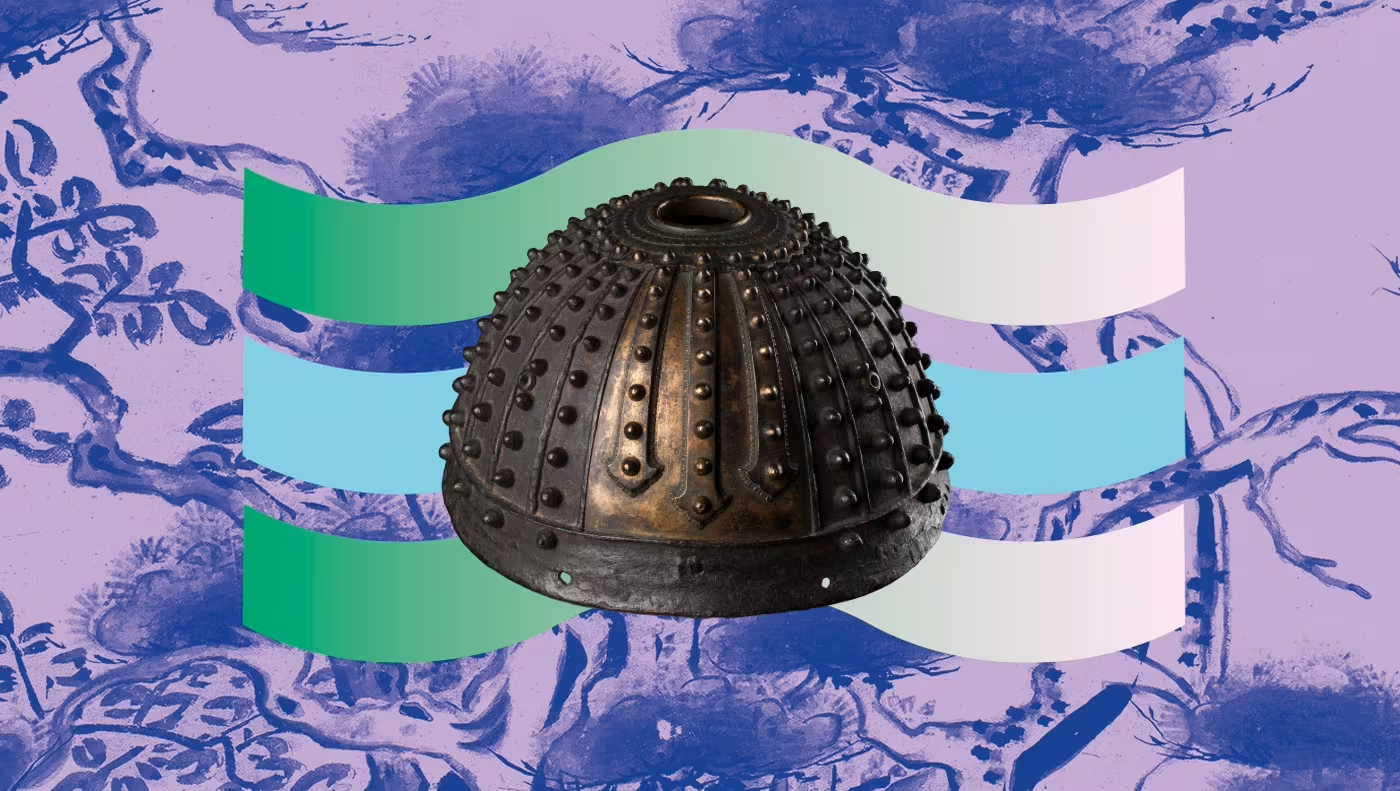
Kublai Khan, grandson of Genghis Khan, wanted to incorporate a great island realm of East Asia into his empire. His troops had overrun Korea, subjugated China, occupied Persia. Japan was the last task.
The Japanese warriors fought for two months in gruelling coastal defences. They had no experience of the massive infantry formations and explosive bombs of the Mongols, no model for war on this scale. Then, on the night of 15 August, a typhoon swept along the coasts of Japan. Hundreds of Mongol ships sank. Tens of thousands of soldiers drowned. The survivors withdrew.
The Buddhist monasteries immediately declared that they had summoned the decisive Kamikaze — the Divine Wind — through their prayers. The warriors demanded land as a reward for their service.
Both sides got what they wanted — and that became the beginning of the end of the first shogunate.
Yoritomo and the First Bakufu: A Military Regime as a Judicial Authority
Minamoto no Yoritomo won the Genpei War — and refused to rule the capital.
No entry into Kyoto, no takeover of the court, no imperial throne. Yoritomo remained in Kamakura, a port town in eastern Japan. In 1192 the emperor formally appointed him Seii Taishōgun — the “Great General for the Subjugation of the Eastern Barbarians”. This title, originally a military field command for campaigns against the Emishi, became the foundation of a new form of state.
The bakufu — literally “tent government”, i.e. field headquarters — marked the first time in Japanese history that warriors ruled openly and institutionally rather than through manipulation of the court.
What Yoritomo established, however, was not a simple military regime. As Mass shows in his analysis of the Kamakura system, the bakufu was in its basic structure above all an arbitration authority: “The bakufu, as we shall see, was a military regime dedicated to keeping warriors away from the battlefield and also to finding judicial answers to the feuds and disputes that were plaguing society.” (Cambridge History of Japan, Vol. 3, p. 46)[1]
Yoritomo’s core promise to the warrior class was: whoever followed him would have their landholdings guaranteed. Not through marriage politics, not through court favour, not through bureaucratic processes in Kyoto — but through the word of a man who could be trusted because he had won. “Yoritomo designed policies to satisfy the most deep-seated desires of the warrior class in general. The Minamoto chieftain promised what had never before been contemplated: a regional security system that bypassed Kyoto and guaranteed the landed holdings of followers.” (p. 53)[1]
This guarantee was the reason why warriors from all over Japan swore loyalty to him. It was also the reason why the system collapsed — when it could no longer keep the promise.
Yoritomo’s own rule lasted only seven years. He died in 1199, possibly after a fall from his horse. His sons succeeded him as nominal shoguns — and were systematically outmanoeuvred by the Hōjō. The Hōjō were the family of Yoritomo’s wife, Masako, a woman whom historians call the “nun shogun” because she effectively controlled the bakufu after Yoritomo’s death. By 1226 the Hōjō had established the title of Shikken (regent) — they ruled as regents for shoguns who were installed from among the imperial princes of Kyoto. Three levels of proxy rule stacked on top of one another.
Masako herself is one of the most remarkable figures in Japanese history — and one of the most underestimated. After Yoritomo’s death in 1199 she formally entered a convent (hence the title “nun shogun”), but retained actual political control. When her son Yoriie was deposed by the Hōjō clan in 1203, she arranged his banishment — and, if necessary, his murder. When her other son Sanetomo was murdered in 1219, she openly took over the leadership. She arranged for imperial princes to be installed as nominal shoguns — a construction that allowed the Hōjō to rule through ever further abstractions.
That was not a weakness of the system. That was the system: power through proxies, legitimacy through distance.
It was Japanese in its elegance — and fragile in its complexity.
The Mongol Invasion: When Japan Survived the Unthinkable
In October 1274, Mongol ships appeared off Hakata in Kyushu.
It was the first time in centuries that Japan was fighting an enemy who knew nothing of its military rules — and did not abide by them either.
The Mongol army used drum-led mass attacks, fire bombs (tetsuhau) and poisoned arrows. The first invasion in 1274 was ended by a rising storm before it turned into a decisive battle — or before the Japanese, in their confusion, could be completely annihilated.
For seven years both sides prepared.
Japan built a protective wall along Hakata Bay — one of the largest military infrastructure projects in Japanese history. The warriors practised defensive manoeuvres. The bakufu mobilised resources on a scale that pushed the centralist basic structure of the country to its limits.
The second invasion in 1281 was the largest: over 140,000 soldiers on around 4,400 ships, made up of two armies that set sail separately and were supposed to meet. The Japanese defence behind the wall was effective enough to hold out for a month. Then the typhoon arrived.
The Japanese called it Kamikaze. The Mongols who had survived and were captured were mostly killed — with the exception of merchants from China and Korea, whose economic value was recognised. The battlefield was a massacre.
The figures for the invasion are still the subject of scholarly debate today. Early Japanese chronicles speak of Kamikaze and divine providence. Conlan’s methodological approach — historical documents rather than war epics as the basis — shows that medieval troop strengths were inflated by a factor of 10 to 100. But even on a conservative estimate, the second invasion of 1281 was an unprecedented event in Japanese history. Never before, and never again until 1945, did foreign troops land on Japanese soil.
The Kamikaze narrative — the wind sent by the gods — became part of national identity, far beyond the military episode. The belief that Japan was protected by divine providence settled into the collective memory and was tragically reactivated in 1945.
What followed was no triumph. It was a fiscal disaster.
The bakufu had mobilised warriors from all over the country, who now demanded rewards. In a system based on the granting of land as the currency of loyalty, there was a fundamental problem: no enemy land had been conquered. Only one’s own had been defended. “There were, in fact, many causes for the warriors’ dissatisfaction, one being the lack of reward land in the aftermath of the Mongol invasions.” (Cambridge Vol. 3, p. 130)[1]
Impoverished Gokenin (vassals), disappointed warriors, overstretched finances. The bakufu could no longer uphold the foundation of the system — the promise to guarantee landholdings. “The presence of a large number of landless gokenin thus posed a major problem to the bakufu.” (p. 130)[1]
The Mongol invasion had saved Japan. And it had hollowed out the foundation of its saviour.
The End of Kamakura: Emperor Go-Daigo and the Nemesis of the Hōjō
Emperor Go-Daigo (1288–1339) was no warrior. He was a scholar, a ritualist, a manipulator. And he recognised that the hour of the Kamakura bakufu had struck.
In 1331 he fled the capital and called for open resistance against the Hōjō. The Hōjō response was militarily convincing — temporarily. Go-Daigo was exiled. But the unrest in the warrior networks could no longer be contained. Too many samurai had waited too long, received too little, risked too much — for a system that broke its own fundamental promises.
Ashikaga Takauji (1305–1358) was a Hōjō vassal who was sent out to fight the rebellious emperor. Instead, he joined him. It was Gekokujō avant la lettre: the one who received orders became the one who made decisions.
In 1333 the Kamakura bakufu fell after 141 years. The Hōjō government was annihilated; reports speak of 870 members of the Hōjō family and their followers who committed collective suicide when defeat was clear.
Emperor Go-Daigo ruled directly for three years — the Kemmu Restoration, for the time being the last attempt by the imperial house to regain real power. It failed because of his own inexperience and the resistance of the warriors, whom he could not satisfy. Ashikaga Takauji, who had installed him, drove him out again in 1336 — and founded the second shogunate. The Muromachi bakufu.
The Muromachi Shogunate: Power without the Ability to Enforce It
The Muromachi bakufu ruled Japan from 1336 to 1573. That is — arithmetically — longer than the Kamakura shogunate. In fact, for long stretches of this time it was a fiction.
Ashikaga Yoshimitsu (1358–1408), the third shogun, was the high point. For the first time since the Heian period, he united civil and military authority in one hand, maintained the China trade monopoly, had the Golden Pavilion built, and patronised Nō theatre and the tea ceremony. “Under the auspices of the third and sixth Ashikaga shoguns (Yoshimitsu and Yoshinori), a military government for the first time gained possession of all aspects of secular authority.” (Cambridge Vol. 3, p. 175)[2]
What this high point concealed was the fundamental weakness of the system: the Ashikaga had no direct administration of the provinces. They ruled through Shugo — provincial governors who were originally the shogun’s representatives and increasingly developed into autonomous dynasties. As Hall shows in his analysis, the Muromachi system lacked the essential: “neither shogun nor shugo acquired the capacity for enforcement needed to fully exercise their legal authority.” (p. 176)[2]
Legal authority without the power to enforce it is decoration.
The shugo became Shugo daimyō — independent territorial lords who controlled the tax revenues of their provinces, raised their own armies and moved their residences to Kyoto in order to cultivate influence at the shogunal court. As a result, they increasingly neglected control over their provinces. In their home territories, local warriors (Kokujin) filled the gaps, which was to escalate in the 15th century.
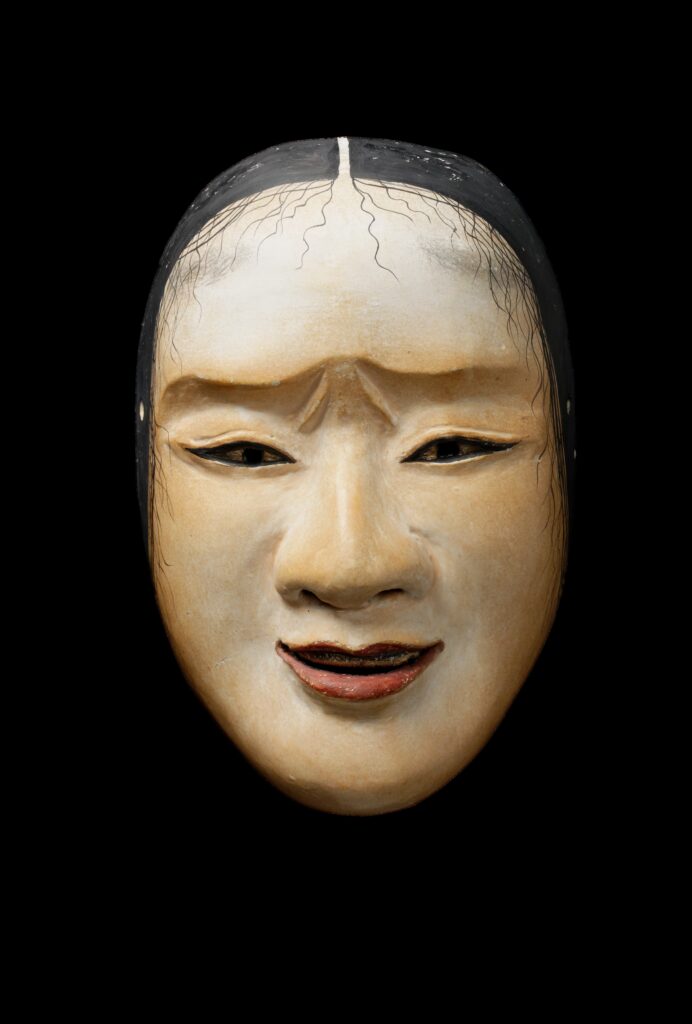
Despite its weakness, the Muromachi bakufu was a cultural golden age. The Kitayama style under Yoshimitsu — a fusion of court culture and warrior culture, visible in the Golden Pavilion — and the Higashiyama style under Yoshimasa — a retreat into radical simplicity, visible in the Silver Pavilion — created aesthetic standards that shape Japanese culture to this day. Nō theatre, the tea ceremony, ikebana, ink painting — all of these owe their classical form to the Muromachi era.
“The aesthetics of the age evolved directly from earlier times. The criteria of Zen… coincided with feelings that were also indigenously Japanese.” (Cambridge Vol. 3, p. 467)[2]
It is a curious historical fact: the weakest shogunal era was one of the most culturally productive.
The Zen monasteries of the Gozan system (the five great Zen temples) played a key role in this that went far beyond religion. As Collcutt shows in his analysis of the Gozan, the Zen monks served as cultural and political advisers to the shoguns, as channels for Chinese knowledge (Neo-Confucianism, literature, painting) and as legitimisers of Ashikaga rule: “Zen monks… served as cultural and political advisers to shoguns and emperors besides being mentors in Zen to the sons and daughters of warrior families.” (Cambridge Vol. 3, p. 598)[2] The connection between warrior rule and Zen aesthetics was no coincidence — it was political strategy in flower arrangements and tea bowls.
The Architecture of Medieval Warfare: What Wounds Reveal
Here is a figure that fundamentally changes our idea of samurai warfare.
Thomas Conlan analysed 1,302 surviving Gunchan — wound reports that samurai submitted in order to receive rewards — from the wars of the 14th century. His finding: 72 per cent of all wounds came from arrows. Swords: about 20 per cent. Spears and other weapons: the rest.[3]
No ritualised single combats. No elegant sword-wielders. Hails of arrows, ambushes, group formations.
“The idea that battles were a series of individual duels conducted according to a strict code of etiquette is a literary construct… Real warfare was messy, chaotic, and pragmatic.” (Friday 2004, p. 155)[4]
What the wound reports also show: sword wounds mainly affected the hands, arms and face — that is, unprotected areas that were left unprotected and in close combat. The sword was the close-combat weapon of last resort, not the warrior’s main weapon. It was drawn when the quivers were empty and the enemy was close enough.
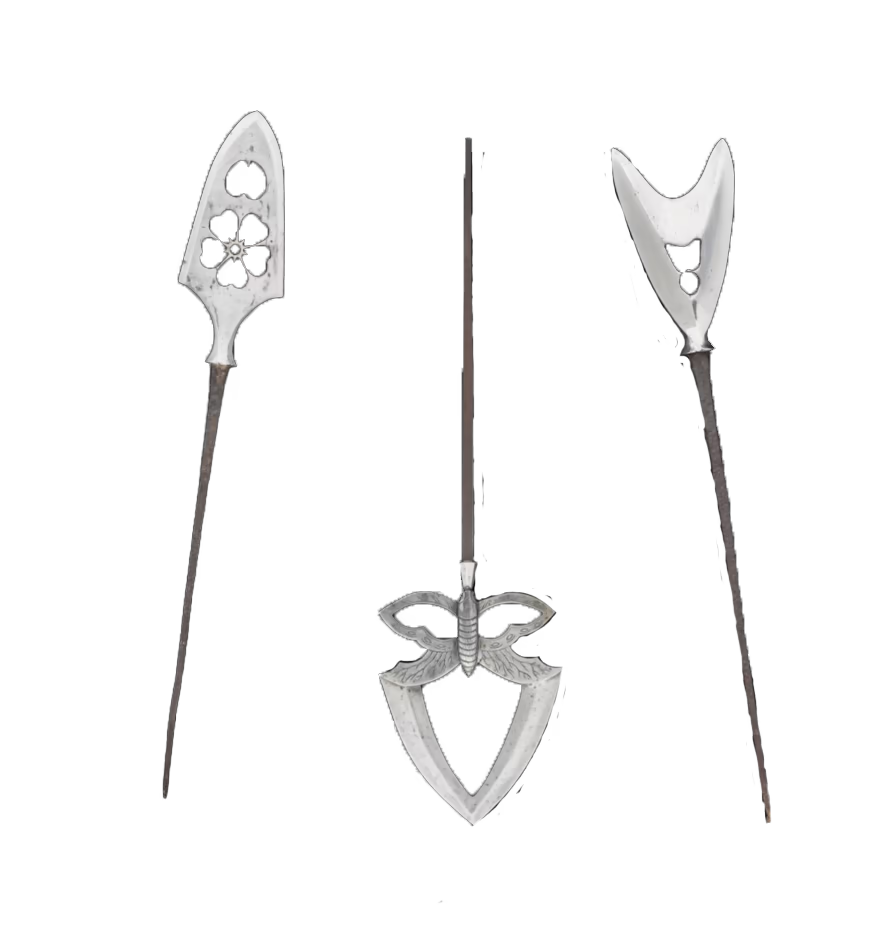
Conlan also describes specialised troops (Tsubute) who threw stones — often more effective than arrows in defending narrow passes. Commanders of the Kamakura and Muromachi periods thought in terms of logistical problems, not duel choreographies.
Another insight from the Gunchan: loyalty was a transaction. A samurai submitted his wound report, received a receipt, and expected land or income in return. “Loyalty was contractual and conditional, not blind. Warriors served for land. If the lord could not pay or guarantee rewards, samurai changed sides.” (Conlan 2003, p. 158)[3]
This is the academic consensus that replaces the romantic image of the vassal loyal unto death: samurai changed sides when it paid off. The political instability of the Muromachi shogunate was not the cause of this behaviour — it was its result.
The Ōnin War: The End of an Era and the Beginning of Chaos
In 1467, two factions of the Ashikaga court began to quarrel over a successor.
What began as a court intrigue turned within months into open war in the streets of Kyoto. Two armies — the Hosokawa faction in the east, the Yamana faction in the west — occupied the imperial city and turned it into a battlefield. The Ōnin War lasted eleven years. When it ended — not through victory, but because both sides had bled themselves dry — large parts of Kyoto lay in ashes. Imperial palace, aristocratic residences, temples: destroyed.
The shogun sat in his residence and drank tea.
Ashikaga Yoshimasa (1436–1490), the eighth shogun, is the tragic figure of these years. Politically weak-willed, torn between rival advisers, he increasingly withdrew into aesthetic projects. He had the Silver Pavilion (Ginkaku-ji) built — the name is a late irony, as it was never clad in silver. The money was lacking. While Kyoto burned, Yoshimasa designed gardens.
It would be easy to condemn him. But Yoshimasa perhaps understood something that escaped his generals: the Ōnin War could not be won because no one knew exactly what was being fought over. The formal cause — the shogunal succession — had long since become an empty shell. Beneath it, clan rivalries, land disputes and personal scores were being fought out. When both main leaders (Hosokawa Katsumoto and Yamana Sōzen) died within a few months of each other in 1473, their successors simply fought on — because stopping would have meant defeat.
That was Gekokujō in its earliest form: the low overcoming the high, not through strategy but through sheer tenacity.
The Ōnin War marks the end of the Muromachi period in its practical significance. The Shugo daimyō, who had led their troops from the provinces to Kyoto during the war, returned to their home territories — or never returned and left local warriors to rule there. The Sengoku period Jidai — the Age of Warring Provinces — had begun.
The bakufu formally existed until 1573, when Oda Nobunaga drove the last Ashikaga shogun, Yoshiaki, out of Kyoto. In practice, it had ceased to govern by the end of the Ōnin War at the latest.
Armour in Transition: From the Ō-yoroi to the Haramaki
The wars of the Kamakura and Muromachi periods left their traces not only in history — they left them in iron.
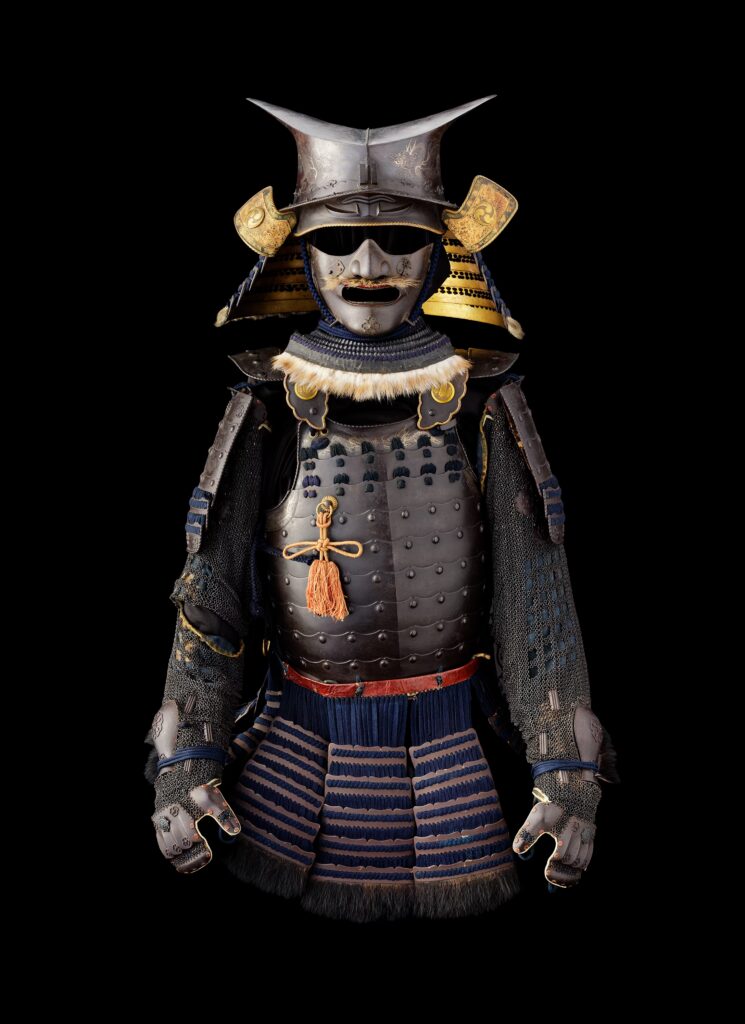
The Ō-yoroi — the box-shaped armour of the Heian warriors — was optimised for the mounted archer. Its successor, the Haramaki (literally: belly wrap), tells the story of the change from cavalry to infantry. Originally the armour of ordinary foot soldiers, improved versions were also adopted by high-ranking samurai from the Nanboku-chō period onwards.
At the Samurai Museum Berlin, a Haramaki armour from the late Muromachi period is on display. This Do-maru style offered complete 360-degree protection and, unlike the heavy Ō-yoroi, was also suitable for longer marches on foot. The lamellar structure was retained, but the construction became slimmer and the joining technique more efficient.
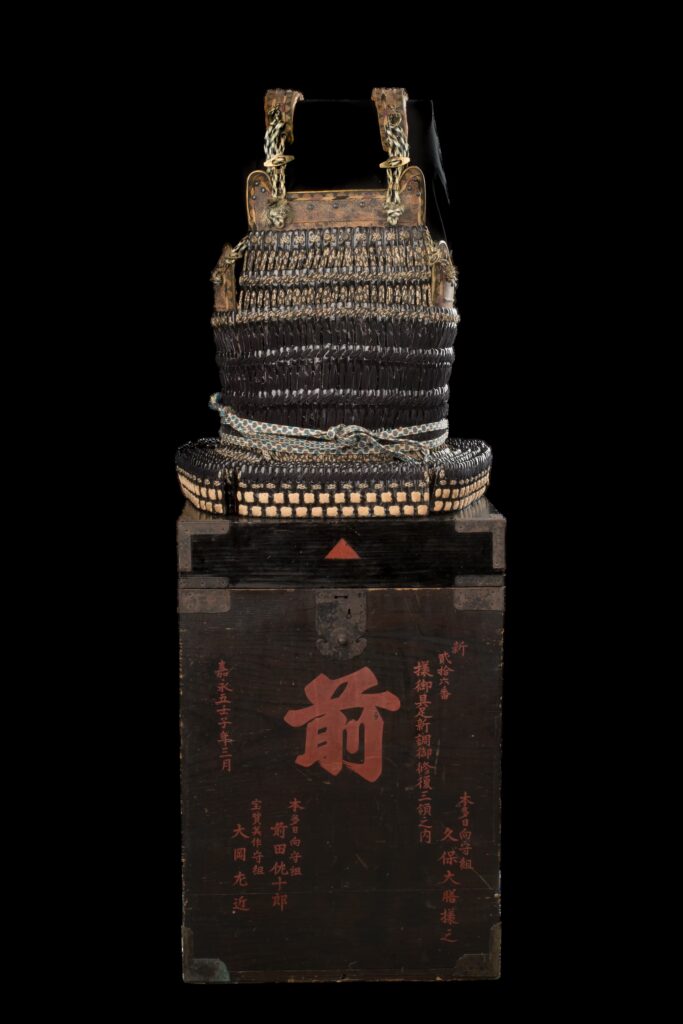
As Absolon shows in his technical analysis of Japanese armour, schools of armourers responded directly to tactical shifts: when the mass infantry battles of the Nanboku-chō period displaced mounted single combat, armour design and lacing patterns adapted accordingly.[6] The Haramaki was not a step backwards from the Ō-yoroi — it was its answer to a changed reality of war.
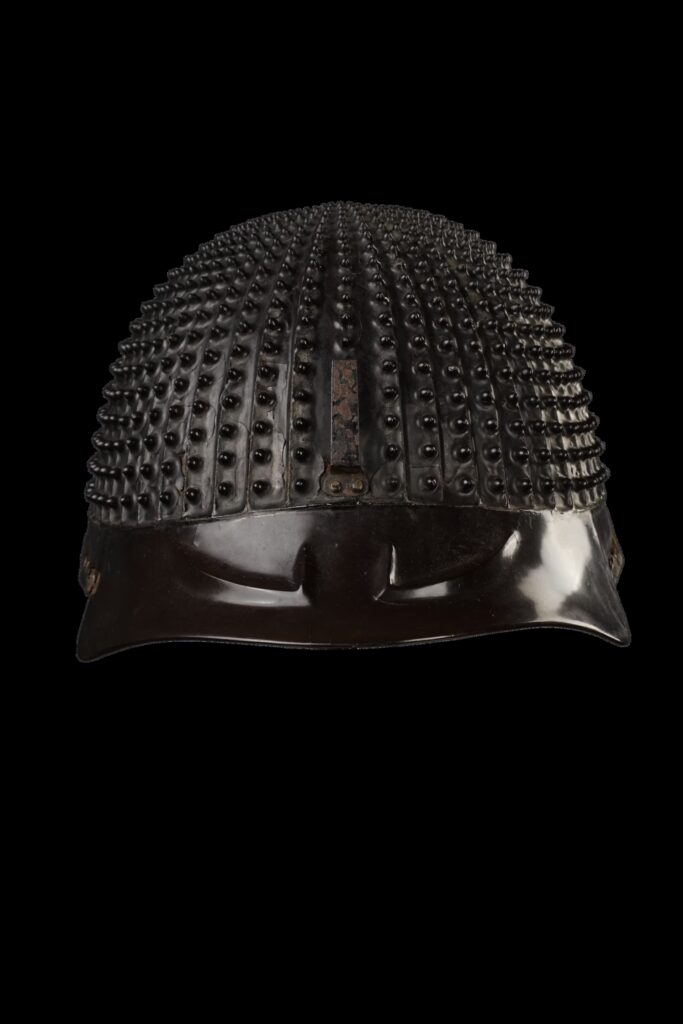
The Kamakura-era helmet technology shows the same change: the Hoshi Kabuto (star helmet) is a riveted helmet construction with prominent rivets (hoshi) that gave the design its name. It was optimised for the mounted archer. When the Mongol invasions forced tactical adjustments and fighting on foot became more relevant, schools of smiths developed lighter variants with countersunk rivets.
The history of armour is military history in metal.
Conclusion: Two Shoguns, One Promise, Two Failures
The Kamakura and Muromachi periods are not a story of rise and decline. They are a story of two different promises that both failed in similar ways.
Yoritomo promised the warriors guarantees of land — and the system held until there were no more spoils to distribute. The Mongols delivered the external blow; the bakufu’s structural inability to compensate impoverished vassals was the internal one. Kamakura did not collapse because of external enemies. It collapsed because it could not pay its own followers.
The Ashikaga promised cultural flowering and political stability — and delivered both, for a brief moment under Yoshimitsu. Then the structural weakness broke through: The authority of the shogun remained without the power of enforcement a shadow rule. No system that is based on the goodwill of provincial governors without being able to control them survives for generations.
Today it can be said: The weakest political era in samurai history was its culturally richest. Nō theatre, the tea ceremony, Zen gardens, calligraphy — all of this bears the stamp of the Muromachi period, an era of instability, war and power vacuum. Perhaps that is no coincidence. In times when political power frays, energy withdraws into culture.
Frequently Asked Questions about the Kamakura and Muromachi Periods
What is a bakufu and how does it differ from the imperial court?
Bakufu literally means “tent government” — the field headquarters of a military commander. As a term for the shogunal government, it denotes a parallel centre of power alongside the imperial court in Kyoto. The bakufu effectively ruled Japan through control of warrior networks and landholdings, while the emperor retained formal authority. For the first time, warriors ruled openly rather than through manipulation of the court.
Why did the Kamakura bakufu fail after the Mongol wars?
The bakufu system was based on the granting of land as the currency of reward. In repelling the Mongol invasions, no enemy land was conquered — only one’s own was defended. Warriors who had been mobilised for years could not be compensated. The resulting discontent of the landless Gokenin (vassals) undermined the system’s basis of loyalty. Cambridge confirms: “The presence of a large number of landless gokenin thus posed a major problem to the bakufu.” (p. 130)
What really was the Kamikaze?
The “Divine Wind” (Kamikaze) refers to two typhoons that struck and destroyed Mongol invasion fleets off Japan in 1274 and 1281. The Buddhist interpretation of them as divine intervention summoned by the prayers of monks served political purposes. In fact, Japanese coastal defence — especially the stone wall at Hakata after 1274 — was a significant factor in the resistance. The term Kamikaze was reactivated in the Second World War for Japanese suicide pilot attacks.
What was the Kemmu Restoration?
The Kemmu Restoration (1333–1336) was Emperor Go-Daigo’s attempt, after the fall of the Kamakura bakufu, to restore direct imperial rule — the first and last time in centuries. It failed because of Go-Daigo’s political inexperience and the resistance of the warriors, who did not receive sufficient rewards. Ashikaga Takauji, Go-Daigo’s own general, drove him out and founded the Muromachi shogunate.
Why did the samurai actually fight?
Academic research (Conlan 2003, Friday 2004) shows: primarily for land and economic rewards, not for abstract honour. After battles, samurai submitted Gunchan (wound reports) to document their bravery and claim compensation. Loyalty was contractual — warriors changed sides when rewards failed to materialise. The idea of the blindly loyal samurai is a later literary construct.
What is the difference between the Kamakura and Muromachi shogunates?
The Kamakura shogunate (1185–1333) had more direct control through a network of personal Gokenin vassals. The Muromachi shogunate (1336–1573) ruled through Shugo governors, who increasingly formed autonomous dynasties. Kamakura failed because of its inability to provide compensation. Muromachi failed because it lacked the power to enforce its will over autonomous provincial lords.
What was the cultural legacy of the Muromachi period?
The Muromachi period is regarded as the golden age of classical Japanese aesthetics: Nō theatre, the tea ceremony, ikebana (flower arranging), ink painting, Zen gardens and karesansui gardens. Shogun Yoshimitsu had the Golden Pavilion built; Yoshimasa the Silver Pavilion. The aesthetic concepts of Wabi (simplicity), Sabi (patina) and Yūgen (mysterious depth) originated in this period of paradoxical synthesis of political decline and cultural flowering.
Visit the Samurai Museum Berlin
The exhibits from the Kamakura and Muromachi periods are among the oldest and rarest in the exhibition. The Samurai Museum Berlin shows objects from the Kamakura era, including a Hoshi Kabuto and a Haramaki armour from the late Muromachi period. Open daily from 10 a.m. to 7 p.m., Auguststraße 68, Berlin-Mitte.
Related Articles
- The Heian Period: The Rise of the Warrior Class
- Nanboku-chō: The War of the Two Imperial Courts
- Kabuto: The Helmet of the Samurai
- Sengoku Jidai: The Age of Warring Provinces
- Samurai: History, Culture and Legacy
Sources and Further Reading
This article is based on academic research and the expert catalogues of the Samurai Museum Berlin. All cited works are documented in the complete bibliography of the knowledge hub.
Primary Sources
- [1] Yamamura, Kōzō (ed.) (1990). The Cambridge History of Japan, Vol. 3: Medieval Japan. Cambridge University Press. Used: ch. 1 (Kamakura bakufu), ch. 3 (decline of Kamakura, Mongols), ch. 4 (Muromachi bakufu), ch. 10 (aesthetics/Zen).
- [2] Hall, John Whitney (1990). Chapter “The Muromachi Bakufu” in: Yamamura (ed.), Cambridge History of Japan, Vol. 3. pp. 175–230.
- [3] Conlan, Thomas D. (2003). State of War: The Violent Order of Fourteenth-Century Japan. University of Michigan Center for Japanese Studies. Used: ch. 2 (wound analysis, weapon statistics), ch. 5 (loyalty, Gunchan).
Secondary Literature
- [4] Friday, Karl F. (2004). Samurai, Warfare and the State in Early Medieval Japan. Routledge. Used: ch. 6 (myth of the duel; real warfare as chaotic and pragmatic).
- [5] Turnbull, Stephen (1977/1996). The Samurai: A Military History. Routledge. Used: ch. 3 (Mongol wars, narrative reconstruction); with corrections by Conlan.
Museum Catalogues and Expert Reports
- [6] Samurai Museum Berlin (2021). Armours of the Samurai. Display case C02V (Ō-yoroi, Kamakura era); display case C03V (Hoshi Kabuto, Kamakura period); display case C04V (Haramaki armour, Muromachi period).
© Samurai Museum Berlin – All rights reserved
You might also like
Nanboku-chō: The War of the Two Imperial Courts (1336–1392)
For 56 years, Japan was ruled by two emperors at once. The Nanboku-chō period: civil war, the collapse of loyalty,…
Read the article
Sanada Yukimura: Japan’s Bravest Warrior (1567–1615)
Sanada Yukimura defended Ōsaka against Tokugawa Ieyasu's army – and became an icon of the honourable last stand. History, myth…
Read the article
Yasuke: The First African Samurai – History & Facts
Yasuke served Oda Nobunaga 1581–1582. What is historically documented? Facts vs. myths about Japan's first Black samurai. Samurai Museum Berlin.
Read the article