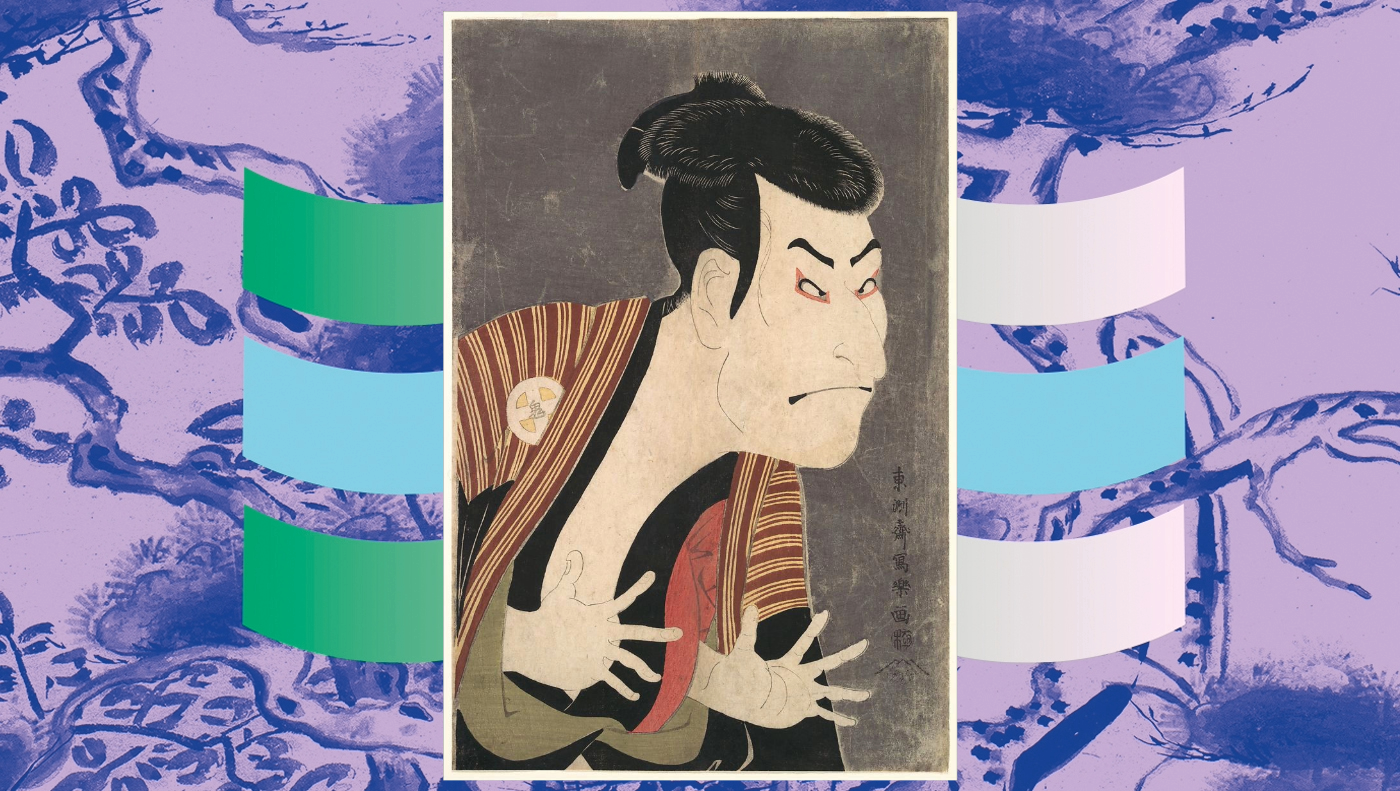
In 1603, on the dry bed of the Kamo River in Kyōto, Izumo no Okuni opened a performance that was to make history. She danced in men’s clothing, parodied priests and played love scenes. This street theatre became kabuki — the dominant popular entertainment of the Edo period.
Origins and Bans
In 1629 the shogunate banned women from the stage. That did not solve the problem: young men took over the female roles — until they too were banned in 1652. From then on, adult men played all the roles. Brandon shows that kabuki actors were classified as kawaramono (riverbed dwellers) — legal outcasts, culturally powerful.[1]
The theatre districts (akasuji) were subversive spaces in which impoverished samurai and wealthy merchants mingled — a permanent threat to the social order.[1]
Aragoto, Kumadori and Hanamichi
The Ichikawa Danjoūrō actors developed the aragoto style: physical exaggeration, bombastic displays of armour and mask-like kumadori make-up in red-and-black patterns. Warrior energy for a peaceful bourgeois audience.[1]
The hanamichi — a walkway running through the audience — broke down the separation between spectator and actor. Mie are frozen expressive poses at the climax of a scene.
→ Edo-period objects: Samurai Museum Berlin
The Sekai System: Censorship as a Catalyst
The shogunate banned contemporary samurai events from the stage. Writers developed the sekai system: current incidents were moved to the Muromachi or Kamakura era. Brandon shows that censorship increased literary creativity instead of paralysing it.[1]
Kanadehon Chūshingura (1748) — the story of the 47 rōnin as a medieval drama — became the most frequently performed kabuki play in history.
Frequently Asked Questions
What is kabuki?
Kabuki is a Japanese form of theatre that emerged in 1603 and was the popular entertainment of the Edo period. Expressive, colourful, accessible to everyone. All roles were played by men. UNESCO World Heritage since 2008.
What is the sekai system?
The sekai system was the response to shogunate censorship: contemporary samurai scandals were moved, under changed names, to distant eras. The audience understood the allusion immediately.
What are mie and aragoto?
Mie are frozen expressive poses at the climax of a scene. Aragoto (rough style) was developed by the Ichikawa line: explosive acting with oversized costumes and red kumadori make-up.
Why were women excluded from kabuki?
In 1629 the shogunate banned women from the stage because of the close connection with prostitution. This gave rise to the onnagata — male specialists in female roles, today a highly developed art form in its own right.
What is Chūshingura?
Kanadehon Chūshingura (1748) is the most frequently performed kabuki play — the story of the 47 rōnin moved to the 14th century to circumvent shogunate censorship. It anchored the ideal of absolute vassal loyalty in collective memory.
Visit the Samurai Museum Berlin
The Edo period — kabuki’s heyday — is documented at the Samurai Museum Berlin through armour and daishō pairs. Daily 10 a.m.–7 p.m., Auguststraße 68.
Related Articles
Bibliography
- [1] Brandon, James R. (1997): Cambridge Guide to Asian Theatre. CUP. pp. 153–165, 182–212.
- [2] Keene, Donald (1990): Nō and Bunraku. Columbia UP. Part II.
- [3] Atkins, E. Taylor (2017): A History of Popular Culture in Japan. Bloomsbury.
© Samurai Museum Berlin – All rights reserved
You might also like
Shogun – The Military Rulers of Japan
Shogun – the military rulers of Japan: who they were, how they ruled & why they never abolished the emperor.…
Read the article
Yōkai: Spirits and Creatures of Japanese Mythology
In Japan there are beings of a supernatural nature. They are called yōkai (妖怪) — and they arise exactly where…
Read the article
Nō Theatre: The Stage Art of the Samurai Elite
A Nō play lasts between two and eight hours. The masks — carved from wood — show no unambiguous emotions:…
Read the article