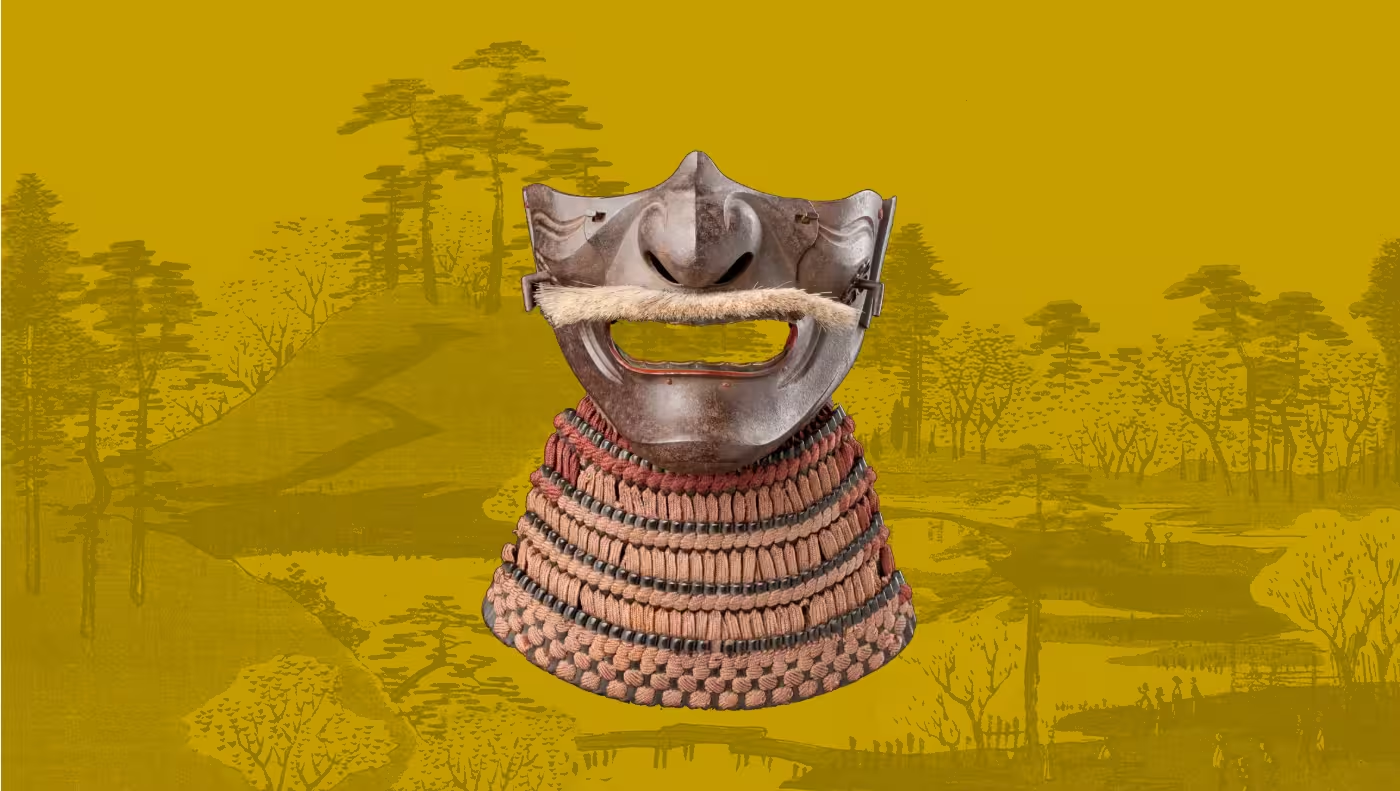
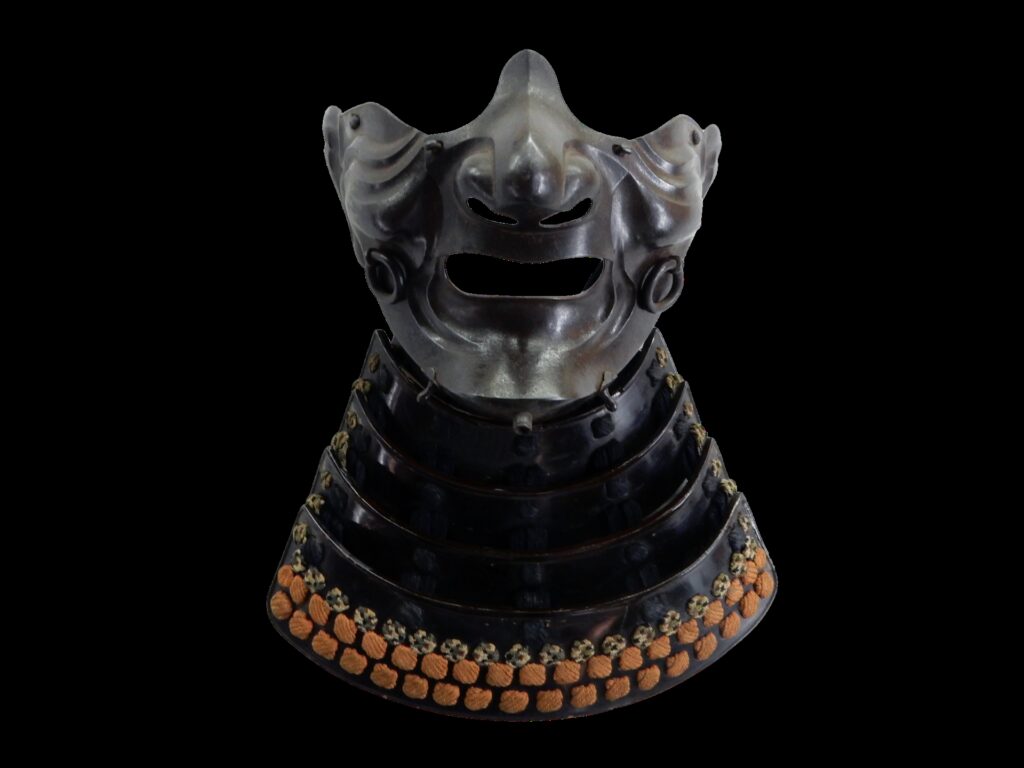
A samurai in full armour no longer looked like a human being. Above the lamellar cuirass sat the kabuto helmet with its curved arches and ornaments. Beneath it, an iron half-mask covered the face from the chin to the bridge of the nose — the menpō. Together, helmet and mask created a strange, almost demonic figure: angry creases around the mouth, bared teeth, a bushy moustache, a gaze that threatened through the narrow gap between mask and helmet. The human being behind the armour disappeared. In his place stood a figure that, seen from one side of the battlefield, inspired fear and horror and, from the other side, radiated courage and self-confidence.
The menpō is more than just a functional piece of armour. It is perhaps the most psychologically dense object in the entire samurai equipment. It concealed the warrior’s individual face and replaced it with a codified physiognomy — a mask that communicated character, rank and intent before the first word was spoken or the first blow struck. The various mask types of the Japanese armour tradition form a small compendium of expressive iconography: the fierce warrior (ressei), the noble hero (ryūbu), the old sage (okina), the half-monstrous tengu, and occasionally even demons and Buddhist deities.
This article reconstructs the menpō in its technical construction, its various types, its function in combat and its cultural significance. It shows how a face guard that was originally purely defensive became a highly developed art object with a psychological effect — and why the surviving examples are among the most impressive testimonies to the Japanese art of armour.
What Is a Menpō?
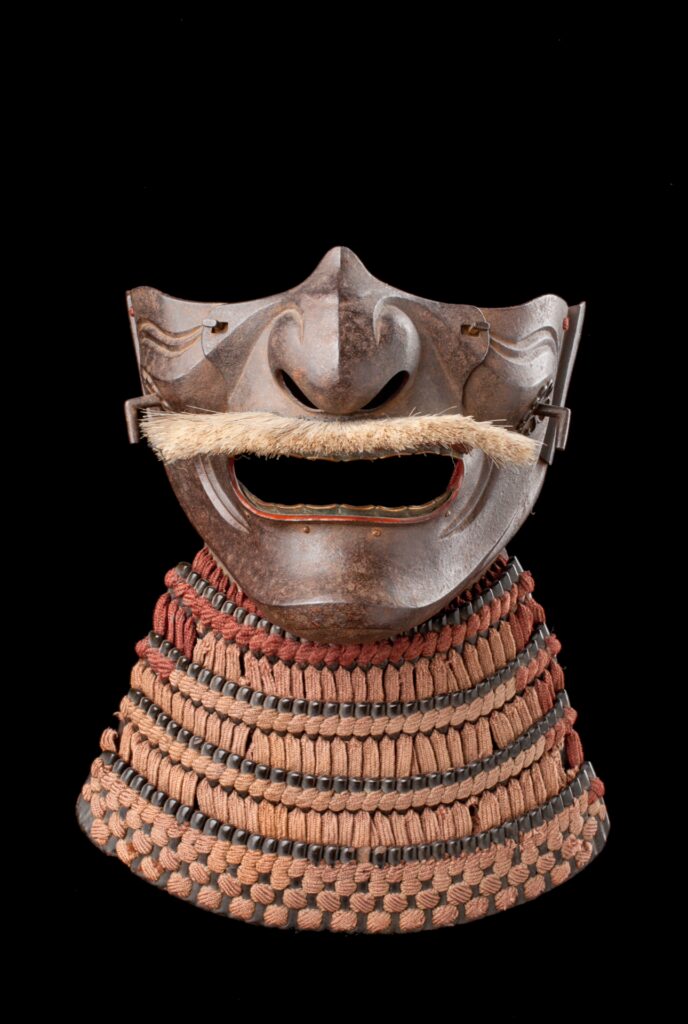
The menpō (面頬) — literally “face and cheeks” — is an iron half-mask that was worn as part of the complete samurai armour. It covers the face from the chin to roughly the bridge of the nose and leaves the eye area free. On its lower edge it typically carries a throat guard (tare) of several lamellar rows, which covers the area between the mask and the upper edge of the cuirass.[1]
The terminology is more precise than popular usage might suggest. The term “menpō” is often used in Western usage as a blanket term for all Japanese combat masks, but Japanese armour studies make much finer distinctions. The Bottomley/Thatcher glossary distinguishes three basic types:
Menpō refers to the classic half-mask — the nose and mouth are covered, the eyes are free. This is by far the most common type and what is usually meant by “samurai mask” today.
Sōmen (総面) is the full mask, which covers the entire face including the eye area. It was less commonly used — the restricted vision was a major disadvantage — and is found mainly among high-ranking wearers in ceremonial contexts.
Hanbō (半頬) is a small mask that covers only the chin and, where applicable, the lower cheeks, without enclosing the nose. It was lighter and less restrictive, but also offered considerably less protection.[2]
There is also a fourth category: the happuri (八幡) — a narrow forehead and cheek guard which, unlike the other types of mask, covers neither the chin nor the mouth. It is primarily a protection against arrows and was used above all in the earlier samurai era.
All these types of mask shared common technical features. They were made of iron, often forged in several pieces and then joined together. The inside was lacquered. The outside could be bare metal, lacquered or, rarely, gilded. Hooks on the sides below the cheeks served to attach the helmet cords with which helmet and mask were fastened together. On the underside of the chin there was often a small opening (“sweat drain hole”) for liquid — an inconspicuous but practically crucial construction detail for hours of strain in combat or on the march.
The Mask Types — An Iconography of Expression
The differentiation of menpō by type of expression is one of the most fascinating topics in Japanese armour. Armourers developed a whole typology of facial expressions, each communicating particular qualities of character and symbolism. A samurai who had a particular menpō chosen for himself was thus making a statement about his own self-perception and the impression he wanted to make on the enemy.
Ressei-men (烈勢面) — literally “fierce, grim face” — is one of the most widespread and best-known types. The mask shows an aggressive physiognomy: pronounced creases around the nose and mouth, an open or snarling mouth with visible teeth, bushy eyebrows, often a moustache made of real hair or formed from metal. With its aggressive facial expression, this ressei mask has several finely forged creases around the cheeks, nose and mouth. The artfully shaped ears are riveted and decorated with ornamental holes in the shape of a six-pointed star (mutsu boshi).[3] The ressei mask was meant to instil fear in the enemy and at the same time fill the wearer with martial self-confidence.
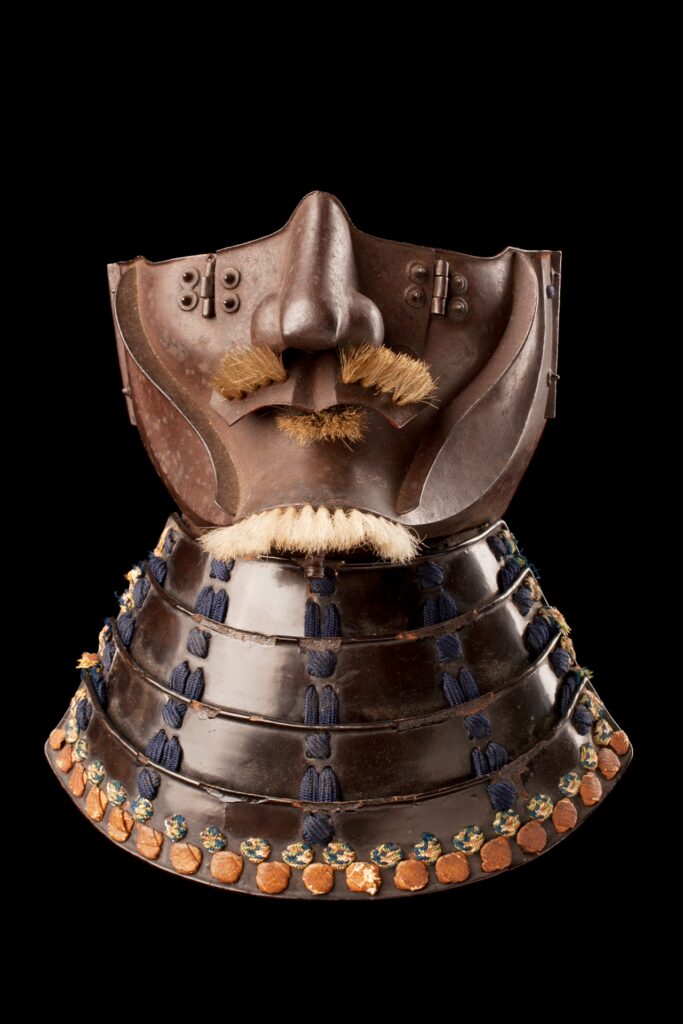
Ryūbu-men (柳武面) — literally “mask with a noble expression” — is the counterpart to the ressei. The ryūbu-men is a mask with a gentle and noble facial expression without creases. Its calm features, chubby cheeks and soft skin are in sharp contrast to the aggressive expressions of the ressei-type masks. For the wearer, ryūbu masks evoke the idea of the noble warrior spirit.[4] A ryūbu menpō communicated dignity, self-control and Confucian virtue — the warrior not as destroyer, but as a cultivated gentleman. This type was particularly popular in the Edo period, when the samurai increasingly saw themselves as a class of officials and purely martial self-presentation gave way to scholarly dignity.
Okina-men (翁面) — the mask of the old man. This type shows the deeply lined face of an old man with long eyebrows, sunken cheeks and often a white beard. The association is that of the experienced teacher, the man who has survived countless battles. Wearing an okina mask was a signal of self-image: “I am the experienced veteran, not the hot-headed youth.” These masks are found more frequently among older samurai and officers.
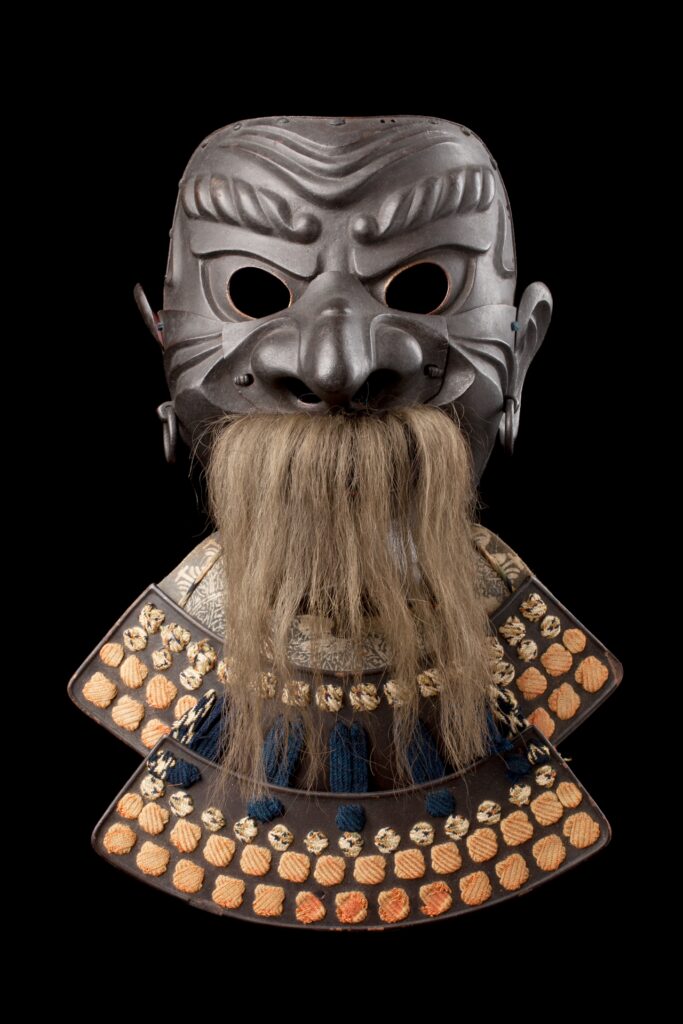
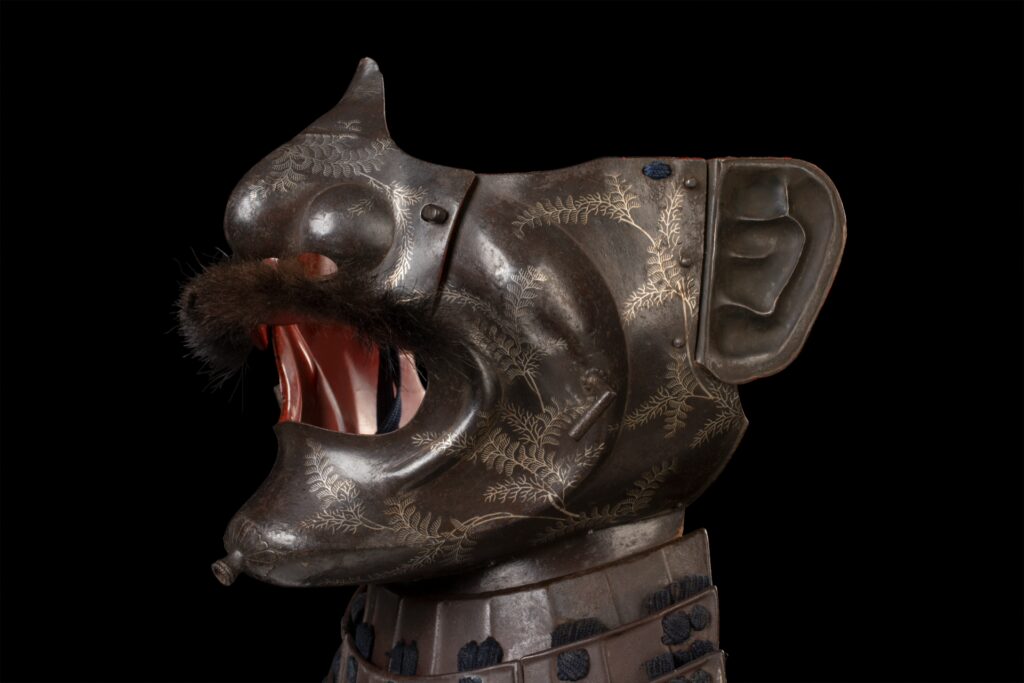
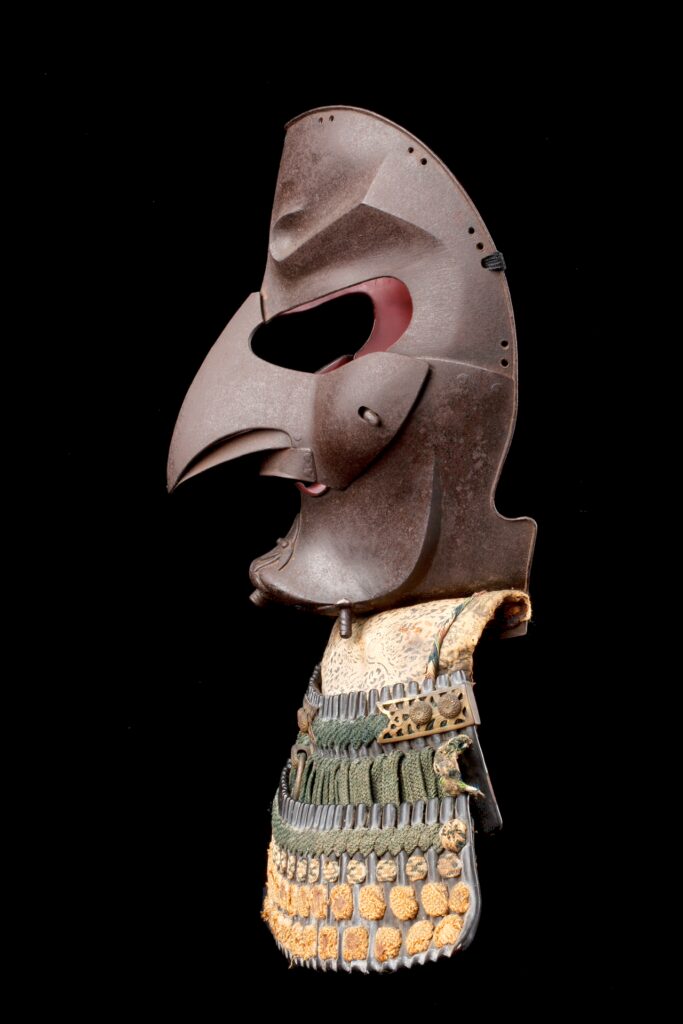
Tengu-men — the mask in the form of the tengu, a legendary creature of Japanese folk religion. Of the legendary creatures, the tengu is the most frequently represented figure. In Japanese folk religion, tengu were originally associated with mountain ascetics and were said to possess outstanding martial skills. They were depicted either as a tall Buddhist monk with an extraordinarily long nose or as a small bird-like creature with wings and a beak-like nose.[5]
Other, rarer types of mask represent other figures from the Japanese religious and mythological pantheon: demons (oni), deities of Buddhism and Shintō, mythological warriors, Buddhist guardian deities. This iconography was not arbitrary. Each figure carried a particular symbolic charge; a samurai chose his mask on the basis of personal affinity, clan affiliation and strategic effect.
Craft and Technique — How a Menpō Was Made
Making a high-quality menpō was a specialised craft that developed in the context of the armour as a whole. The great armour schools — in particular the Myōchin lines, the Iwai and the Haruta — produced masks both as individual commissions and as standard elements of their complete armours. There were also regions with specialised mask producers; Nara was an important centre, where menpō were made in large numbers and then integrated into their armours by other schools.
The basic material was iron. The smith began with a flat iron plate, which was hammered into shape and gradually bent to the geometry of the face. High-quality masks were assembled from several parts — nose, cheeks and chin could be separate elements riveted or screwed together. In the adjustable Munehiro mask mentioned above, four parts were even connected by hinges to allow individual adaptation to the shape of the wearer’s face.[7]
The characteristic expressive features — creases, teeth, contours of the nose, shape of the ears — were worked into the surface by hammering and embossing. Fine detail work was done with punches and chisels. The tengu example shown above shows the peak of this technique: as the last step, the front of the metal was modified with punches and chisels to refine the forms and bring out the details.[8]
After the basic shaping, the inside was coated with lacquer — an important protection against corrosion in the humid Japanese climate, but also a measure for wearing comfort, as the lacquer smoothed the rough metal surface. The sweat drain opening mentioned above was worked in under the chin. On the sides, the ore kugi hooks for the helmet cords were attached — these hooks were often themselves decorated with craftsmanship, and on some Kaga works, for example, were set on washers with engraved radiating lines.
The throat guard (tare) was an integral part of the menpō. It consisted of several rows of lames (kozane or later combined forms), held together with dyed cord in the sugake odoshi or kebiki odoshi lacing style. The colour of the lacing usually matched the lacing of the rest of the armour. Marks of quality of a high-quality tare were finely turned-over edges (hinerigaeshi), even lacing intervals and clean lacquering of the lames. On some Kaga menpō, leather coated with gold leaf was even used for the tare — a conspicuous status signal.
Smith’s signatures (mei) are recorded on menpō, but they are not the rule. Many masks remained unsigned. Others were signed only with a character name (kuni, mune) or with the full master’s title. Documented signatures today make it possible to attribute pieces to particular schools and workshops.
Regional craft traditions each left their own characteristics, from which the origin of a piece can be read today. The Kaga smiths (Kaga Province, today Ishikawa Prefecture) developed the washers with incised radiating lines mentioned above, as well as tare of textured leather with gold-leaf coating (kinpaku). The Iwai school produced particularly massive examples with strongly pronounced creases. The main Myōchin line in Kyōto was known for high technical precision and often subtle, restrained types of expression; Nara production, on the other hand, was characterised by distinctively bushy moustaches, broadly toothed mouths and a certain standardisation, which can be studied well in the bamen type — a russet half-mask whose aggressive basic form is typical of the mass production of Nara Province and which was also integrated into the armours of other schools.[7]
Function in Combat — Protection, Signalling, Psychological Effect
The practical function of the menpō on the battlefield combined three levels: direct physical protection, technical auxiliary functions and psychological effect.
Physical protection: The menpō protected the wearer against several threats. Sword blows coming from the side or diagonally from above struck the iron mask first and could thus be deflected or absorbed. Arrows aimed at the face were deflected by the hard surface. The protection against spear thrusts was lower — a well-aimed thrust through the gap between mask and helmet could still hit the wearer — but here too the mask reduced the vulnerable area. Protection against the blows of close combat was particularly important, in which even the sword guard itself was used as a weapon against the opponent’s face.
Technical auxiliary functions: The side hooks (ore kugi) of the menpō not only served to attach the helmet cord, but secured the entire head protection to the wearer. A kabuto without a menpō could slip during fast movements or when struck; with the menpō and its cord attachment, the ensemble stayed firmly in place. The throat guard (tare) also protected the vulnerable throat — a region that was particularly critical for samurai warriors, as a fatal blow was possible here with comparatively little force.
Psychological effect: This is perhaps where the real significance of the menpō lies. The masked appearance of a fully armoured samurai was meant to intimidate the enemy. The distorted, demonic faces of the ressei masks, the tengu beaks, the deeply lined okina features — all of them communicated to the enemy: “You are no longer facing a human being.” At the same time, the mask had an effect on the wearer himself. In his Historical Sociology of samurai culture (2019), the sociologist Sanchez-Garcia pointed to this mechanism: the masked identity allowed the warrior to distance himself from his individual self and attune himself to his collective role as a warrior of a particular clan. The menpō was thus at the same time protection outwards and transformation inwards.
The significance of the ressei masks on the battlefield can be read from contemporary sources. In his translation of the Natori-ryū manuscript The Book of Samurai, Antony Cummins showed that Japanese military theory explicitly described the menpō as part of the “cosmology of armour” — that is, as an element that acted on wearer and opponent not only physically but also spiritually. Armour was highly codified both spiritually (yin-yang, the five elements) and socially. Wrong lacing colours were considered unlucky (cycle of destruction); the choice of mask form was accordingly part of this elaborate semiotics of war.[9]
Menpō in the Edo Period — From Combat Object to Work of Art
With the end of the great battles after 1615, menpō production also changed fundamentally. The Pax Tokugawa brought 265 years of domestic peace; samurai no longer went to war, but increasingly performed administrative and ceremonial duties. In this context, armour increasingly became a status symbol and an art object rather than combat equipment.
This change is reflected in the development of the menpō. The Edo-period master workshops — especially the Myōchin line under Myōchin Munesada and later Myōchin Munekuni — produced masks of extraordinary craftsmanship and virtuosity. The detailing of the expressive features became ever finer; the carving around the cheeks and mouth became small sculptures; the lacquering became more complex and nuanced. The masks were increasingly intended for display — in the treasuries of the daimyō, in the ceremonial rooms of the Tokugawa rulers, in the armouries of great clan houses.
At the same time, regional traditions with characteristic features developed. The smiths of Kaga Province (today Ishikawa Prefecture) were known for their use of textured leather on the throat guard, often with applied gold leaf. The smiths of Nara concentrated on a certain mass production of standardised mask types, which were incorporated into the armours of various other schools — the bamen type mentioned above is an example of this. The Kyōto masters of the Fujiwara-Myōchin line (Munehiro, Munesada) produced pieces of the highest precision for the most elite clientele.
Some menpō of the late Edo period leave pure combat iconography behind and move towards being pure art objects. Masks with gilded details, with ivory teeth, with beards made of real animal hair, with complex lacquer decoration in several layers — none of this speaks the language of the battlefield any longer, but that of the courtly and museum space. The transition from military to ceremonial use is perhaps more clearly legible in the menpō than in any other part of the armour.
With the Meiji Restoration in 1868, this line of development also came to an end. The dissolution of the samurai class, the sword ban of 1876, the introduction of Western military uniforms — all this made the menpō obsolete. The surviving examples found their way into clan treasuries, museum collections and the international trade in Japanese works of art. Today the Samurai Museum Berlin holds a broad range of these later masterpieces, making accessible a tradition that, even in Japan, is often represented in such density only in specialised museums.
Five Myths about the Menpō
Myth 1: “All samurai masks are called menpō.” The terminology is more precise than popular usage suggests. Menpō is the classic half-mask with the eye area free. Sōmen is the full mask (entire face), hanbō covers only the chin, happuri is the narrow forehead and cheek guard.
Myth 2: “Menpō were only worn in combat.” The menpō was indeed primarily a combat object, but in the Edo period it was increasingly also worn in ceremonial contexts — at parade line-ups, in sankin-kōtai processions, at formal presentations at the shōgun’s court. The late Edo masks are often no longer designed for practical combat at all, but for the display case or the exhibition hall.
Myth 3: “The grim face of the menpō was pure intimidation.” The effect of the ressei masks was not only the external intimidation of the enemy, but also the internal transformation of the wearer. The Japanese military theory of the time described the mask as an instrument for attuning oneself to the role of warrior. The masked identity made it easier for the samurai to distance himself from his individual self and attune himself to the collective warrior habitus.
Myth 4: “Menpō were uniform standard objects.” On the contrary: the range of expressive types (ressei, ryūbu, okina, tengu, demons, deities) made the menpō a highly individualised piece of equipment. The choice of type was a personal statement about self-image, clan affiliation and strategic intent.
Myth 5: “Menpō were omnipresent in Japan.” In fact, high-quality signed menpō were luxury objects that mainly wealthy daimyō and high-ranking samurai could afford. Many simpler ashigaru infantrymen wore no masks at all or only plain, unsigned examples. The surviving museum pieces are almost all from the top of the production pyramid — not everyday life, but the elite.
Conclusion: The Mask as a Second Skin
The samurai had two faces. His own, in the intimacy of his household, his family, his closest confidants. And the second, which he put on when donning the complete armour — the menpō. In this double sense, the mask was more than just a protective object. It was the instrument of a transformation of role: whoever let his individual face disappear behind the iron mask became something else. The warrior of his clan, a member of the samurai caste, a figure in the theatre of battle.
That the Japanese armour tradition did not merely implement this function implicitly but differentiated it explicitly — with ressei masks for the martial habitus, ryūbu masks for noble dignity, okina masks for the wisdom of the veteran, tengu masks for the supernatural connection — shows the high degree of reflexivity of this culture. The menpō was not a mere protective object that happened to have a particular face. It was a well-thought-out instrument of psychological formation, with its own typology and its own iconography.
In the surviving menpō of the great museums more than just craftsmanship is therefore condensed. Each piece is a document of a specific way of being human — a face that a warrior put on for the duration of a battle or a ceremony in order to become something other than just himself. Anyone looking at a menpō should therefore never see only the mask. They should imagine the samurai behind it who put it on — and the transformation that took place in that one moment, when his own face disappeared and the iron physiognomy replaced it.
Frequently Asked Questions
What is a menpō?
The menpō (面頬) is an iron half-mask that was worn by samurai as part of the complete armour. It covers the face from the chin to roughly the bridge of the nose and leaves the eye area free. On its lower edge it carries a throat guard (tare) of several rows of lames.
What is the difference between menpō, sōmen and hanbō?
The three terms refer to different types of Japanese combat mask. Menpō is the classic half-mask (nose and mouth covered, eye area free). Sōmen is the full mask, which covers the entire face including the eyes — it was less commonly used because of the restricted vision. Hanbō is a small mask that covers only the chin; it offered less protection but was lighter to wear.
What do ressei and ryūbu mean?
Ressei-men (“fierce, grim face”) and ryūbu-men (“mask with a noble expression”) refer to the two most important types of expression of Japanese menpō. Ressei masks show aggressive physiognomies with creases, snarling teeth and often moustaches — they were meant to intimidate the enemy. Ryūbu masks show calm, noble features without creases and embody the dignified warrior spirit, especially in the Edo period.
What function did the menpō have in combat?
Three main functions: first, protection against sword blows and arrows. Second, securing the helmet — the side hooks of the menpō served to anchor the helmet cords and secured the entire head ensemble. Third, psychological effect — intimidating the enemy and transforming the wearer into his warrior role.
What is a tengu mask?
Tengu masks are among the fantastical mask types of the menpō tradition. They depict the tengu — a figure of Japanese folk religion who was regarded as a mountain ascetic with extraordinary martial skills. Tengu are depicted either as a long-nosed monk or as a bird-like creature with a beak. With a tengu mask by Fukushima Denbei Kunitaka, the Samurai Museum Berlin holds a rare example of this type.
Who made menpō?
Famous menpō smiths belonged to the great armour schools: the Myōchin line (with masters such as Munehiro and Munesada), the Iwai school and the Haruta school. Nara was an important production centre for standard masks, which were integrated into the armours of other schools. Kaga Province (Ishikawa) developed its own tradition with characteristic features such as textured leather coated with gold leaf on the throat guard.
Visit the Samurai Museum Berlin
The Samurai Museum Berlin shows an exceptional collection of Japanese menpō documenting various types of expression and craft traditions: from signed ressei masks of the Fujiwara-Myōchin line and dignified ryūbu examples to rare tengu masks by signed masters such as Fukushima Denbei Kunitaka. Several masks are displayed in the context of their complete armour ensembles, allowing visitors to study the menpō in its original setting — as part of a total work of craftsmanship that united protection, craft and psychological effect in a single object.
Related Articles
- Kabuto: The Japanese Helmet
- Tōsei Gusoku: The Bulletproof Armour of the Sengoku Era
- Dō: The Cuirass of Samurai Armour
- Jinbaori: The Armour Coat of the Samurai
- Japanese Swordsmithing: From Tamahagane to the Finished Sword
- Battle of Sekigahara 1600
Sources and Further Reading
This article is based on academic research, primary sources and the expert catalogues of the Samurai Museum Berlin. All cited works are documented in the complete bibliography of the knowledge hub.
Primary Sources
- [1] Samurai Museum Berlin (2025). SMB Catalogue 2025 — Masks and Helmets. [Used: E02V_42 Munehiro ressei menpō, E03V_43 ryūbu menpō, F05V_54 Kunitaka tengu mask, F07V_56 bamen mask, C26V_28 Myōchin Munesada ensemble]
Secondary Literature
- [2] Bottomley, Ian; Thatcher, K. (2013). The Samurai Armour Glossary. Royal Armouries. [Used: typology of masks (menpō/sōmen/hanbō/happuri), Myōchin school, technical terminology]
- [3] Absolon, Trevor (2017). Samurai Armour Vol. I: The Japanese Cuirass. Osprey Publishing. [Used: overall context of the development of armour, urushi lacquer as corrosion protection]
- [4] Bottomley, Ian; Hopson, A.P. (1988). Arms and Armor of the Samurai. Crescent Books. [Used: schools and regional traditions, development in the Edo period]
- [5] SMB Helmets of the Samurai (2024). Catalogue of the kabuto and menpō collection. Samurai Museum Berlin. [Used: typology of helmet-mask combinations, series of Myōchin masters]
- [6] Cummins, Antony; Minami, Yoshie (2015). The Book of Samurai: Fundamental Teachings. Watkins Publishing. [Used: cosmology of armour, spiritual significance of masks, yin-yang symbolism]
- [7] Sánchez-García, Raúl (2019). The Historical Sociology of Japanese Martial Arts. Routledge. [Used: masking as transformation of role, psychological effect of warrior insignia]
- [8] Turnbull, Stephen (2005). Warriors of Medieval Japan. Osprey Publishing. [Used: combat function, historical context]
Museum Catalogues and Expert Reports
- [9] Samurai Museum Berlin (2025). Exhibit Documentation — Menpō and Face Masks. [Used: comparison of Munehiro with Meikō zukan, comparison of Kunitaka with Dokka kessaku, regional characteristics of Kaga]
© Samurai Museum Berlin – All rights reserved
You might also like
Sashimono: The Back Banners That Brought Order to Samurai Armies
Sashimono — the back banners of the samurai. History, function, motifs, clans. Authentic examples at the Samurai Museum Berlin.
Read the article
Gokaden: Japan’s Five Great Swordsmithing Traditions
Gokaden – the five great swordsmithing traditions of Japan. Yamashiro, Yamato, Bizen, Sōshū & Mino: history, characteristics & original blades…
Read the article
Kabuto: The Helmet of the Samurai – History & Construction
The kabuto – protection, identity, and work of art in one. History, anatomy & smithing traditions of the samurai helmet.…
Read the article